







































Description
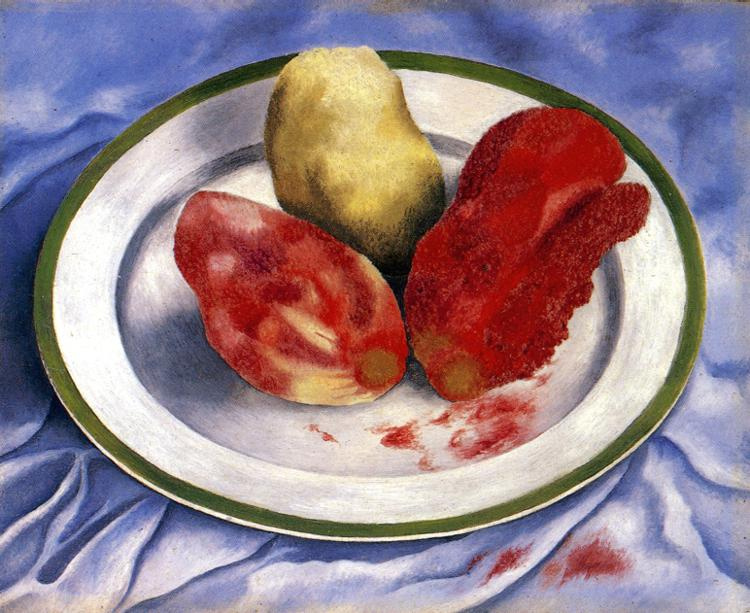
Cactus Fruits is a small still life that Frida Kahlo painted in 1937: three prickly pears, two red and one yellow-green, lie on a white plate with a green rim, and the plate rests on a creased blue cloth. The original, oil on metal, measures only 20 x 24 cm (height x width) and belongs to the Robert Holmes Collection in Perth, Australia. Our painter recreates it by hand in oil colours on canvas, in three landscape sizes from 50 x 40 to 62 x 54 cm or in a size agreed with you; each of these sizes is larger than the original, and before the parcel leaves we show you a photograph of the finished work.
| Title: | Cactus Fruits |
| Other titles: | Tunas · Kaktusfrüchte |
| Painter: | Frida Kahlo (1907–1954) |
| Year painted: | 1937 |
| Original size: | 20 cm x 24 cm (height x width) |
| Original technique: | Oil on metal |
| Painting style: | Mexican modernism |
| Located at: | Robert Holmes Collection, Perth, Australia |
| Our reproduction: | Hand-painted oil on canvas, 3 sizes or made to measure |
Cactus Fruits – Frida Kahlo
What does Cactus Fruits show?
We look down, from slightly to one side, at a round white plate edged with a dark green band. The plate fills almost the whole surface; there is no table, no wall and no other object around it, only blue fabric that rises at the edges in soft folds.
On the plate lie three fruits of the prickly pear cactus, called tunas in Spanish, which is also the original title. At the top in the middle stands a whole yellow-green fruit with a speckled, slightly rough skin. On the left lies a pinkish-red fruit with paler, almost cream streaks; on the right a deep red fruit, opened up, its grainy flesh looking juicy and soft.
Both red fruits show a round, greenish-brown spot at one end. Red stains of juice are scattered across the white surface of the plate and, lower right, on the blue cloth.
Soft greyish shadows lie on the plate, and the folds of the fabric shimmer in white and violet.
What was happening in Frida Kahlo’s life in 1937?
According to the English Wikipedia, 1937 and 1938 were exceptionally productive years for Frida Kahlo: she painted more than in all eight previous years of her marriage to Diego Rivera.
She and Rivera were then living in a house in the San Ángel district, while from January 1937 her family home, La Casa Azul in Coyoacán, housed Leon Trotsky and his wife Natalia Sedova, who had been granted asylum in Mexico.
From 1932 Kahlo painted mostly on small metal sheets, of the kind folk painters used for votive pictures called retablos. She moved to large canvases only after her divorce from Rivera in 1939, so this still life, too, is painted on metal.
Why do people enjoy looking at this still life?
Kahlo is best known for her self-portraits, so many people are surprised by how plain this work is: no face, no symbol to decode, just three fruits on a plate. That directness is its strength; the fruit is painted so solidly that you can almost feel the rough skin and the sweet flesh.
Wikipedia notes that she drew on the nature and artifacts of Mexico and took more and more from Mexican folk art.
In her last years, the same source says, she painted mostly still lifes of fruit and flowers.
Her life and work are covered in the Frida Kahlo article on the English Wikipedia; it is about the painter, with no separate article on this painting.
Where is the original, and what is it painted on?
The original is in the Robert Holmes Collection in Perth, Australia, as the English Wikipedia list of her works records.
It is painted in oil on a metal plate, 20 cm high and 24 cm wide.
Your hand-painted copy is made on canvas rather than metal: the painter works in oil colours on artist’s canvas.
Cactus Fruits or another work by Kahlo?
For a kitchen, dining area or hallway this still life is a rewarding choice: the blue, white and red are lively without being loud, and they sit well with wood, white walls or ceramics.
A year later, in 1938, she painted Pitahayas, also oil on metal, with red fruits on volcanic rock under a stormy sky. Another still life of fruit is Fruits of the Earth.
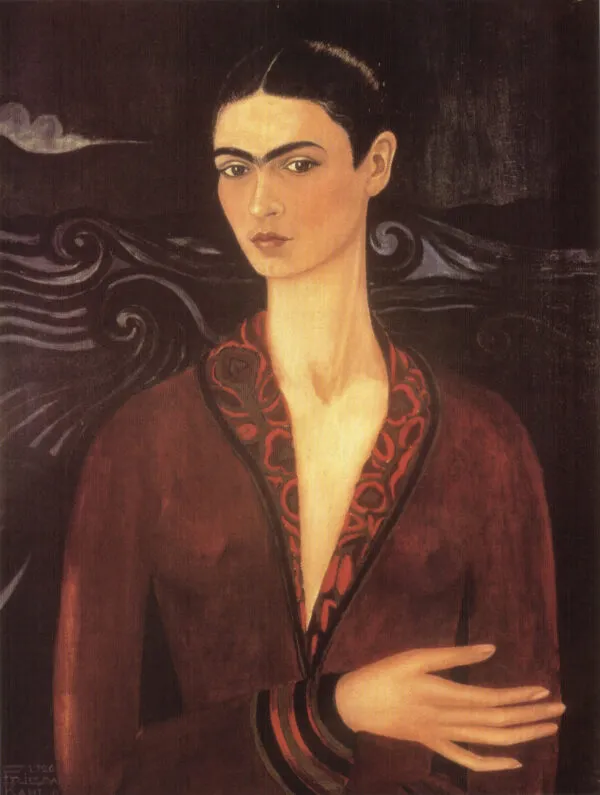
From the same year as these prickly pears comes Self-Portrait Dedicated to Leon Trotsky, in which Kahlo holds a letter bearing an inscription. Among her last works is the still life Viva la Vida (Watermelons) of 1954. Every one of the famous Frida Kahlo paintings we paint to order is gathered on the Frida Kahlo page.
How does our painter capture the juice, the plate and the folds of cloth?
The metal plate of the original is perfectly smooth, and the paint lies on it with no trace of weave. So our painter first levels the canvas with several thin ground layers.
The painter starts with the oval of the plate and its green rim, because the ellipse has to be right or the plate would look tilted. Then the blue cloth is built up in thin layers: the dark hollows of the folds, the pale ridges and the violet passages between them.
The fruits come last. The yellow-green one gets a skin speckled with tiny darker dots, the red one on the left its cream streaks, the one on the right its grainy, almost velvety flesh made of countless red points.
The result is a Frida Kahlo reproduction with real layers of oil paint that you can even feel under your fingertips; the painter starts every order from scratch, for you alone.
Which size suits which wall?
In short: 50 x 40 cm for a kitchen or a narrow wall by a window, 55 x 46 cm above a chest of drawers or in a breakfast corner, 62 x 54 cm above a dining table or a small sofa.
For this work we offer only three landscape sizes (width x height): 50 x 40, 55 x 46 and 62 x 54 cm. The original measures just 24 x 20 cm, so each of them is larger; even the smallest is 26 cm wider and 20 cm taller.
The 55 x 46 cm size has almost the same proportions as the original, about 6 : 5, so the plate sits in it most nearly as it does on the metal sheet.
As a painting for the living room, 62 x 54 cm works best, hung at eye level above a low sideboard or beside a reading chair, where you can step up close.
Is another size possible, and which frame suits it?
If none of the three sizes fits your wall, send us the width and height you need; we will check whether it can be done and reply with a price and a timescale.
You can order the painting rolled in a tube, stretched on a wooden stretcher bar or ready framed. Stretching and framing are done by our workshop in Slovenia, which looks after each canvas painting that leaves our hands.
You pick the frame in the 3D app, which serves only that purpose. Showing the painting on a photo of your own wall is a different, separate service and has nothing to do with the app.
How long does it take, and how does the painting reach you?
From your confirmation to dispatch takes 15 to 45 working days.
When the painting is finished, we send you a photograph of it; if you would like a shade to be different, the painter corrects it before we pack.
Parcels within Slovenia and to other EU countries travel without customs formalities, and every order is covered by our returns policy.
A small fruit still life makes a warm present for someone who loves cooking or loves Mexico. If you do not know the right size, give a wall art voucher instead of the painting and let them choose.
Questions and answers
Where can I see the original?
It belongs to the Robert Holmes Collection in Perth, Australia.
Which fruits are on the plate?
Three prickly pears, tunas in Spanish: two red and one yellow-green.
Am I buying a print?
No. Every stroke comes from the painter’s hand, so you receive an oil painting reproduction on canvas, not a print.
What size is the original?
It is 20 cm high and 24 cm wide; all three of our sizes are larger.
Could it be painted in a fourth size?
Yes, give us the width and height and we reply with a price and painting time.
When will the painting arrive?
Painting takes 15 to 45 working days, and there is no customs duty within the EU.
Does it suit a kitchen or dining room?
Yes, fruit on a plate is a natural choice for rooms where people cook and eat.
Do the fruits have a special meaning?
Our sources give no reading of this still life; we describe only what can be seen in it.
- Subject: three prickly pears, two red and one yellow-green, on a white plate with a green rim, on a creased blue cloth.
- Original: 1937, oil on metal, 20 x 24 cm, Robert Holmes Collection, Perth, Australia.
- Ours: oil on canvas, hand-painted to your order, in three landscape sizes from 50 x 40 to 62 x 54 cm or to an agreed size.
- Worth knowing: The original is smaller than a sheet of A4 paper, so every size we offer is larger.