







































Description
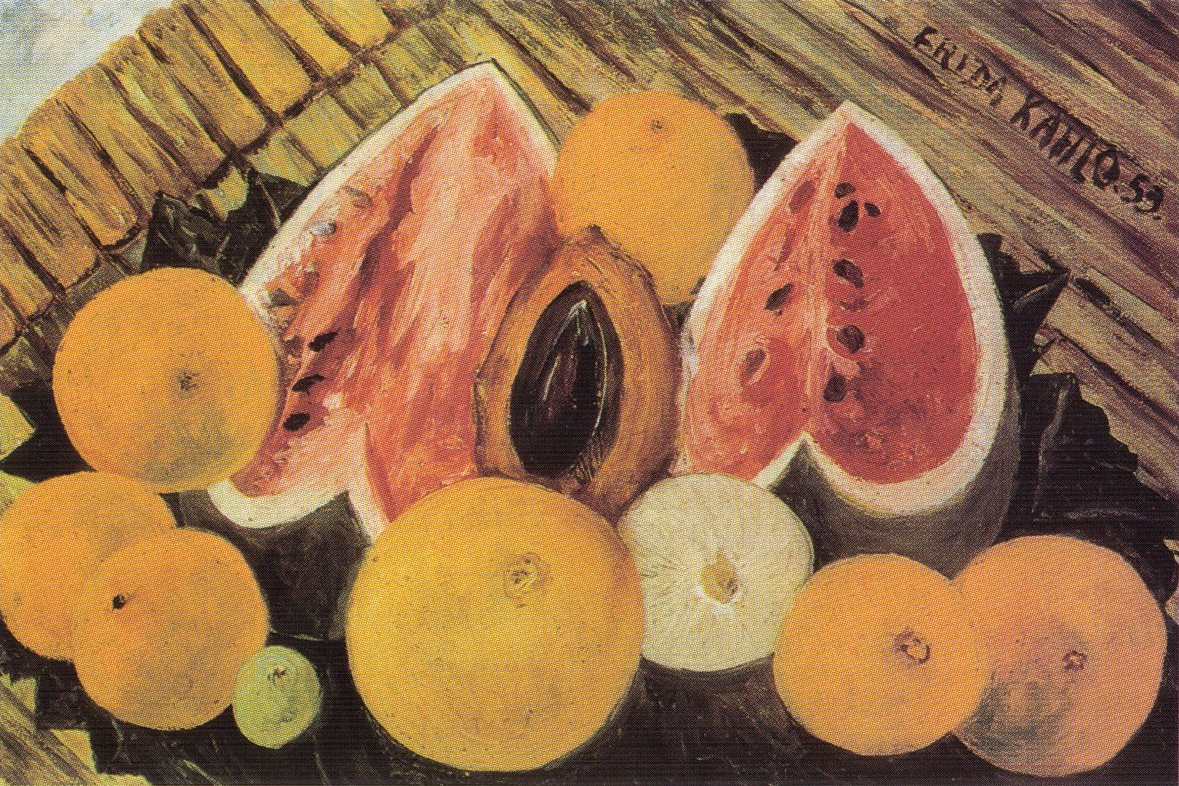
Still Life with Watermelons is a painting Frida Kahlo made in 1953, the year before her death: two upright wedges of watermelon, a halved fruit with a dark stone and a ring of oranges lie on dark leaves beside a woven straw basket. The original, oil on compressed wood (fibreboard), is 40 cm high and 60 cm wide and belongs to the Museo de Arte Moderno in Mexico City. Our painter recreates it for you in oil colours on canvas, in one of only 4 landscape sizes, from 60 x 38 to 90 x 57 cm, or in a size you ask us about; when it is finished, we show it to you in a photograph before it leaves.
| Title: | Still Life with Watermelons |
| Other titles: | Naturaleza muerta con sandías · Stillleben mit Wassermelonen |
| Painter: | Frida Kahlo (1907–1954) |
| Year painted: | 1953 |
| Original size: | 40 cm x 60 cm (height x width) |
| Original technique: | Oil on compressed wood (fibreboard) |
| Painting style: | Mexican modernism |
| Located at: | Museo de Arte Moderno, Mexico City |
| Our reproduction: | Hand-painted oil on canvas, 4 sizes or made to measure |
Still Life with Watermelons – Frida Kahlo
What does Still Life with Watermelons show?
We look slightly down onto a heap of fruit that fills the whole width of the panel. Across the top runs a woven straw basket, and in the upper left corner a small patch of pale blue peeps out behind it.
Two wedges of watermelon stand upright at the centre, spread like open fans. Their flesh shades from pink to deep red and is scattered with black seeds, and each wedge is edged with a white band and a dark green rind.
Between the wedges lies a halved fruit with orange-brown flesh wrapped around one large, glossy dark stone. Below it sits a pale cut fruit whose white face has a small yellow centre.
Round oranges and a larger yellow fruit close the group at the front and the sides, and a small green fruit peeks out at the lower left. Beneath it all spread dark, almost black-green leaves that make the warm colours glow.
How was Frida Kahlo living in 1953?
Kahlo made this still life in 1953, a year before she died. After a long hospital stay and several operations on her spine in 1950, she spent most of her time at the Blue House (La Casa Azul), the family home in Coyoacán.
In April 1953 Lola Álvarez Bravo organised Kahlo’s first solo exhibition in Mexico, at the Galería Arte Contemporáneo. Her doctors had prescribed bed rest, so she had her four-poster bed moved to the gallery, arrived by ambulance and spent the opening in it.
In August 1953 gangrene meant that her right leg had to be amputated at the knee, and the months that followed were very hard for her. Wikipedia does not say in which month the still life was painted.
Why do collectors seek out her late still lifes?
Most famous Frida Kahlo paintings are self-portraits, so a table of fruit without her face surprises many people. Yet Wikipedia records that in her last years she painted mostly still lifes of fruit and flowers, which makes this panel typical of the end of her career rather than an exception.
The same article describes how her hand changed in that period: brushwork that had been careful and delicate grew quicker, the colour bolder and the whole more intense. You can see it here in the loose strokes across the melon flesh and in the heavy orange of the fruit at the front.
Some of those late still lifes carry political signs such as flags or doves; this one has none. To learn more about her, read the Frida Kahlo article on the English Wikipedia, which covers the painter; no article there is devoted to this still life.
Which museum owns the original?
The original belongs to the Museo de Arte Moderno in Mexico City. It is painted in oil on compressed wood, a fibreboard panel, and measures 40 cm high by 60 cm wide, exactly three to two.
The museum has long ties with Kahlo: according to Wikipedia it bought The Two Fridas in 1947, a purchase that eased her finances.
Your hand-painted copy is not made on fibreboard. The painter works on artist’s canvas, which can travel rolled and takes whatever frame you choose.
Still Life with Watermelons or another Kahlo still life?
As a canvas painting in landscape format, this still life is at ease in a kitchen, a dining room or above a sideboard.
The watermelon came back a year later in Viva la Vida (Watermelons), which Wikipedia counts among her last works. Two years earlier she painted Still Life Dedicated to Samuel Fastlicht, where a cut watermelon and citrus fruit gather around a small dark clay dog.
An older, quieter still life of produce is Fruits of the Earth. Everything of hers that we paint to order is collected on our Frida Kahlo page.
How does our painter paint the fruit and the basket?
First the painter draws the arrangement on primed canvas and blocks in the large shapes: the black-green bed of leaves, the red wedges, the circles of the oranges and the band of the basket.
Then he works layer by layer. The melon flesh is built from pink, vermilion and a deeper red in short, directed strokes, so that the wedges keep the lively, rough surface of the original; the seeds and the white rind edges go in once the red has dried.
The oranges get their roundness from a warm shadow on one side and a few light dabs on the other, and the dark stone of the halved fruit a single bright gleam. The basket comes last, plaited stroke by stroke in ochre and brown. What you receive is an oil painting reproduction built from real layers of paint, made separately for each order.
Which size suits which wall?
The short answer: 60 x 38 or 70 x 45 cm for a kitchen or a narrow wall, 78 x 51 or 90 x 57 cm above a dining table, a sideboard or a small sofa.
We offer this work in just 4 landscape sizes (width x height): 60 x 38, 70 x 45, 78 x 51 and 90 x 57 cm. Closest to the original is 60 x 38 cm, the same 60 cm wide but 2 cm lower. The other three are all larger than the panel in the museum.
As a painting for the living room, choose 90 x 57 cm: above a two-seater sofa or a low bookcase, the long strip of fruit reads well from across the room.
Can it be painted to another size, and which frame suits it?
The original is exactly half as wide again as it is tall. If you want that proportion, or a size that is not listed, ask us for a custom size with the width and height you need, and we will reply with a price and a timeframe.
You can have the painting rolled, stretched on a stretcher bar or ready framed; our workshop in Slovenia does the stretching and framing for everything we ship on canvas. You pick the frame in our 3D app, which is there for choosing frames and nothing else; seeing the painting on your own wall is a separate service.
How long will it take, and how is it sent?
Painting starts as soon as you confirm the order and takes 15 to 45 working days. We then send you a photograph of the finished work, and if anything should be adjusted, the painter changes it before packing.
Parcels to addresses in Slovenia and elsewhere in the EU cross no customs border, and our returns policy covers the purchase.
Fruit and summer colours make this Frida Kahlo reproduction a cheerful present for a new kitchen, a housewarming or anyone who loves to cook. If the size is hard to guess, a wall art voucher lets the recipient decide.
Frequently asked questions
Can I see the original in a museum?
Yes, it is in the collection of the Museo de Arte Moderno in Mexico City.
Which fruits are in the painting?
Two wedges of watermelon, a halved fruit with a dark stone, a white cut fruit, oranges and a small green fruit.
Will I receive a print?
No. Every layer is laid on with a brush in oil paint on canvas, and nothing is printed.
What size is the original panel?
40 cm high and 60 cm wide; our 60 x 38 cm is the same width and 2 cm lower.
Is a size outside the list possible?
Send us the measurements you have in mind and we will tell you whether we can paint them and at what price.
How soon will it arrive?
Allow 15 to 45 working days of painting, then transport; within the EU there are no customs.
Is it a good choice for a kitchen or as a gift?
Yes, the fruit and the warm colours suit a kitchen or dining room, and it makes a cheerful present.
What is the painting meant to say?
Wikipedia offers no reading of this particular still life, so we leave the interpretation to you.
- Subject: two upright watermelon wedges, a halved fruit with a dark stone, oranges and a pale cut fruit on dark leaves beside a straw basket.
- Original: 1953, oil on compressed wood (fibreboard), 40 x 60 cm, Museo de Arte Moderno, Mexico City.
- Ours: hand-painted in oil on canvas, made to your order, in 4 landscape sizes from 60 x 38 to 90 x 57 cm, or another size on request.
- Worth knowing: Our 60 x 38 cm is as wide as the original and only 2 cm lower.