







































Description
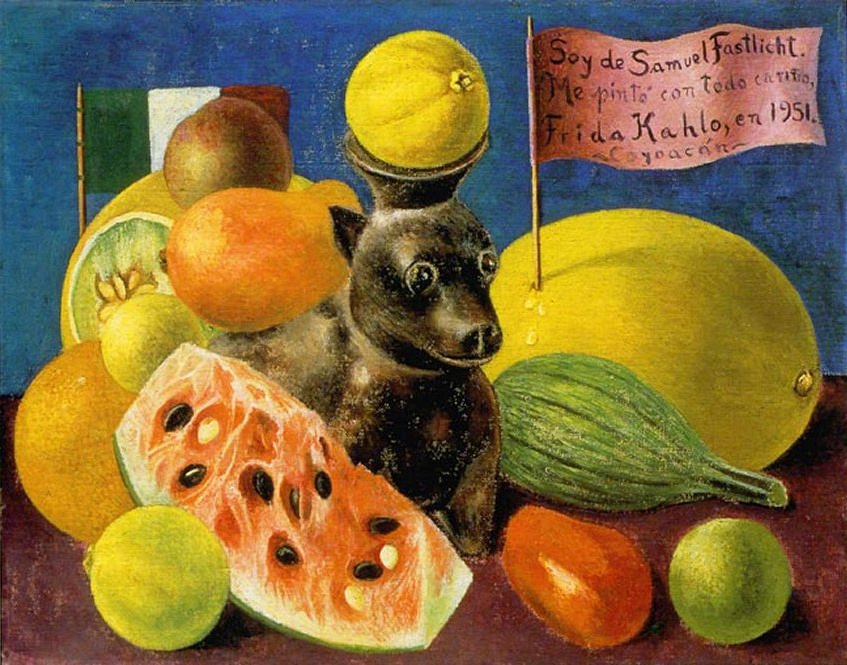
Still Life Dedicated to Samuel Fastlicht is a painting Frida Kahlo made in 1951: a heap of Mexican fruit – melons, a watermelon, oranges and limes – crowds around a small dark clay dog, while a pink pennant bearing a written dedication rises from a yellow melon. The original, oil on canvas, is only 28.2 cm high and 36 cm wide and belongs to the collection of Dr. Samuel Fastlicht in Mexico City. Our painter recreates it by hand in oils on canvas in one of 4 landscape sizes, from 50 x 39 to 70 x 57 cm; each is larger than the original, and before dispatch we send you a photograph of the finished painting.
| Title: | Still Life Dedicated to Samuel Fastlicht |
| Other titles: | Naturaleza muerta dedicada a Samuel Fastlicht · Stillleben, Samuel Fastlicht gewidmet |
| Painter: | Frida Kahlo (1907–1954) |
| Year painted: | 1951 |
| Original size: | 28.2 cm x 36 cm (height x width) |
| Original technique: | Oil on canvas |
| Painting style: | Mexican modernism |
| Located at: | Collection of Dr. Samuel Fastlicht, Mexico City |
| Our reproduction: | Hand-painted oil on canvas, 4 sizes or made to measure |
Still Life Dedicated to Samuel Fastlicht – Frida Kahlo
What does Still Life Dedicated to Samuel Fastlicht show?
The scene is set on a table with a dark, wine-red top, in front of a smooth blue wall.
In the middle sits a small dog of dark clay, with large round eyes and pricked ears. A narrow neck like that of a clay vessel rises from its back, and on it, as if on a pedestal, rests a round yellow fruit.
At front left lies a large slice of watermelon with orange-pink flesh and black and pale seeds. Around it are oranges, green limes, a halved yellow fruit with pale seeds, a reddish round fruit at upper left and a long, striped green fruit at lower right.
On the right a big yellow melon fills nearly a third of the surface. Stuck into it is a thin stick with a pink pennant, where fine lettering carries a dedication to Samuel Fastlicht, together with the year 1951 and the word Coyoacán. On the opposite side, at upper left behind the fruit, stands a small Mexican flag in green, white and red.
How did this still life come about in 1951?
According to Wikipedia, Frida Kahlo spent most of 1950 in Hospital ABC in Mexico City, where she had new bone graft surgery on her spine. A difficult infection and several follow-up operations came after it. Once discharged, she was mostly confined to La Casa Azul, her home in Coyoacán, and got about with a wheelchair and crutches.
In these last years she painted mostly still lifes of fruit and flowers, often adding political symbols such as flags. The Mexican flag at upper left fits that description exactly.
The dedication on the pink pennant tells us who the painting was meant for: the collector Dr. Samuel Fastlicht. The inscription also names Coyoacán, the place where the family home, the Blue House, stood.
Why do buyers warm to this still life?
Wikipedia describes Frida Kahlo as a painter inspired by the nature and the artefacts of Mexico. Both meet here: Mexican fruit and a little clay dog on the same table.
The colour draws people in too: yellow, orange and green glow against the blue wall and the dark red table, so even a small size brings warmth into a room.
For her life story, read the Frida Kahlo article on the English Wikipedia, which is about the painter; this still life has no article of its own.
Where is the original, and who owns it?
According to the English Wikipedia list of her works, the original is in the collection of Dr. Samuel Fastlicht in Mexico City, that is, with the collector to whom she dedicated it. It is oil on canvas, 28.2 cm high and 36 cm wide.
Year, technique, size and owner come from that list; where the sources are silent, so are we. Our hand-painted copy is oil on canvas as well, only in a larger format.
Still Life Dedicated to Samuel Fastlicht or another Kahlo?
This canvas painting is at home in a kitchen, a dining room or on the wall beside the table, where the painted fruit answers the fruit in the bowl. Its blue and yellow sit well with white walls, pale wood and rustic furniture.
As Dr. Fastlicht also owned Self-Portrait (1948), the two works can hang together as a pair from one collection. Two years later came Still Life with Watermelons, in which cut watermelons and melons lie with oranges in a woven basket.
Among her last works is Viva la Vida (Watermelons) of 1954, while Pitahayas of 1938 gives an earlier look at Mexican fruit, red on volcanic rock. Browse the rest of the famous Frida Kahlo paintings we offer, each painted only once you order, on the Frida Kahlo page.
How does our painter handle the fruit and the clay dog?
Wikipedia notes that in her late years her brushstrokes grew hastier, her colour more brash and her style more intense. You can see it here: the melon rinds are laid in with short, visible strokes, and the blue wall is not quite even but flickers slightly.
So our painter does not polish everything to a mirror finish. The blue wall and the dark red table go down first, then the rounded fruit is built up layer by layer, from deeper shadows to the pale highlights on limes and oranges.
The dog and the watermelon take the most care. The clay must stay matt and dark, the eyes bright and round; on the watermelon each black seed and each pale one is set down separately. The lettering on the pennant is traced with a fine brush so that it stays legible.
What reaches you is a Frida Kahlo reproduction in the full sense: the paint sits in layers and, in raking light, rises slightly from the canvas.
Which size suits which wall?
In short: 50 x 39 or 56 x 44 cm for a kitchen or hallway, 65 x 49 or 70 x 57 cm above a sideboard or the dining table.
For this work we offer only 4 landscape sizes (width x height): 50 x 39, 56 x 44, 65 x 49 and 70 x 57 cm. The original is small, so every one of them is larger; the smallest, 50 x 39 cm, is 14 cm wider and 10.8 cm taller.
The largest, 70 x 57 cm, is almost twice the width of the original and suits a smaller dining-room wall or the space above a narrow sofa. As a painting for the living room above a big sofa it would look modest; there it is better hung as a pair with a second painting.
Can I ask for another size, and which frame suits it?
Sizes off the list are possible only by arrangement: ask us about another width and height and we will tell you whether we can paint it, what it costs and when it will be ready. The original’s proportions are roughly 9 : 7.
It leaves us rolled, stretched on a stretcher bar or already framed, as you prefer. Our workshop in Slovenia does the stretching and framing for every painting we deliver.
In our 3D app you look at frames and pick one, and that is its only job; seeing the painting on your own wall is a separate service. A gold or warm wooden frame suits the blue wall and yellow melons, while a dark mahogany moulding brings out the red table.
How long does it take, and how does it reach me?
From your order confirmation to dispatch takes 15 to 45 working days.
When the painting is finished, we send you a photograph of it; if you would like a change, the painter makes it, and we pack only once you are happy.
Parcels to Slovenia and the rest of the EU travel without customs clearance, and every order is covered by our returns policy.
As a gift, this still life suits someone who loves cooking, having friends to dinner or Mexico itself. If you do not know the right size, give a wall art voucher and let the recipient choose.
Frequently asked questions
Where is the original kept today?
In the collection of Dr. Samuel Fastlicht in Mexico City.
What lies on the table around the dog?
A watermelon, yellow melons, oranges, limes and other fruit, with a Mexican flag behind.
Am I buying a print?
No. You get an oil painting reproduction made with brushes and oil colours; no printing machine is involved.
How big is the 1951 original?
It measures 28.2 x 36 cm (height x width), smaller than any of our sizes.
Is it right for a dining room, or as a gift?
Yes: 65 x 49 or 70 x 57 cm above the table, and the smaller sizes are easy to give.
Will you paint a size other than these four?
Ask us; we will say whether it can be done and what it costs.
How long will I wait for the painting?
15 to 45 working days until dispatch, then delivery; no customs inside the EU.
What does the writing on the pennant mean?
It is the painter’s dedication to the collector Samuel Fastlicht, with the year 1951 and the name Coyoacán.
- Subject: Mexican fruit around a small dark clay dog, with a pink dedication pennant and a Mexican flag.
- Original: 1951, oil on canvas, 28.2 x 36 cm, collection of Dr. Samuel Fastlicht, Mexico City.
- Ours: hand-painted in oil on canvas to your order, in 4 landscape sizes from 50 x 39 to 70 x 57 cm.
- Worth knowing: every size we offer is larger than the original; even the smallest is 14 cm wider.