







































Description

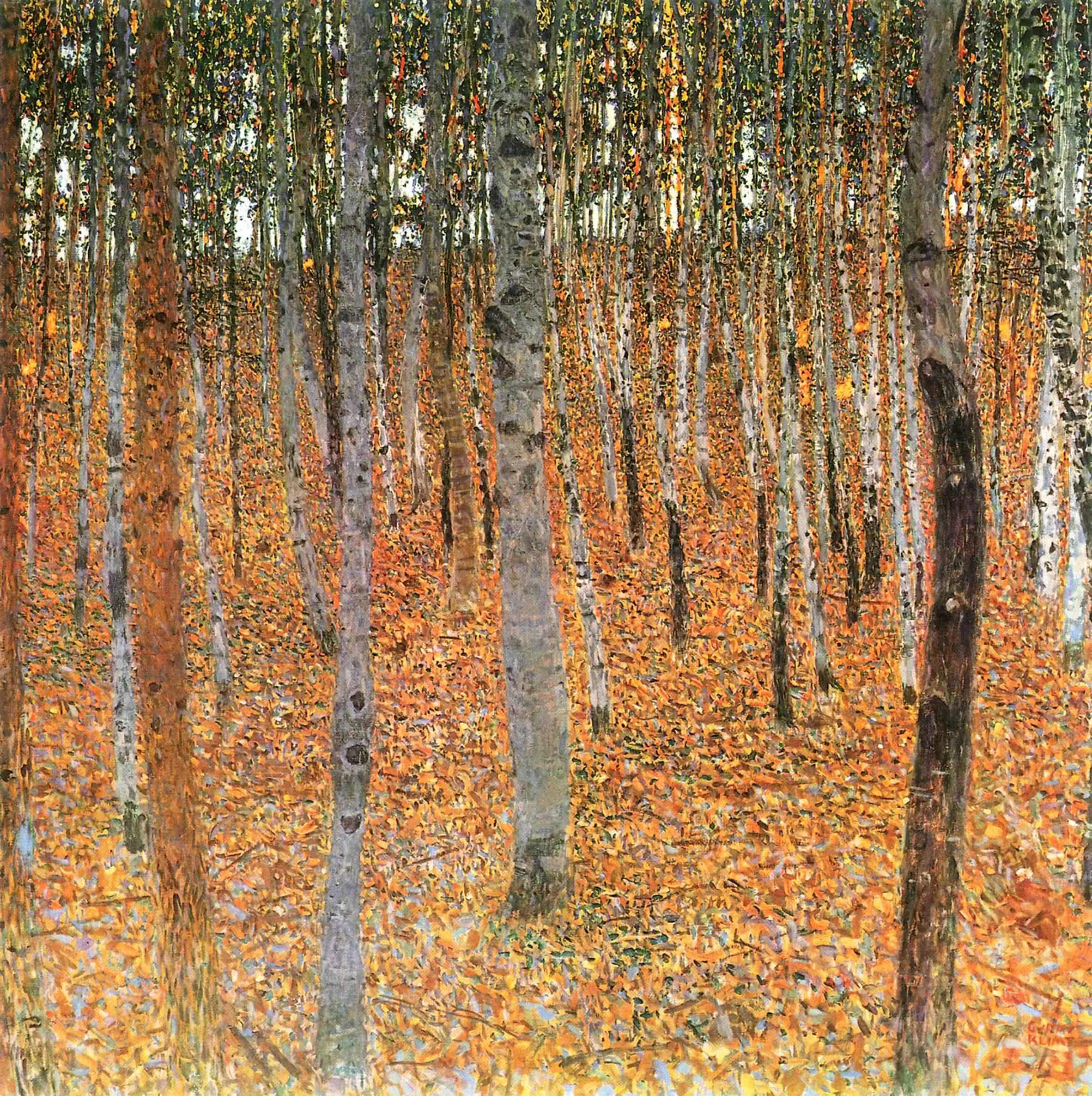
Forest of Beech Trees is Klimt’s square landscape of 1902: a dense stand of slim beech trunks, white-grey and reddish-brown, rises to the top edge of the canvas with no treetops and no sky, and the forest floor is a carpet of orange, rust and yellow fallen leaves. The original, 100 x 100 cm, belongs to the Galerie Neue Meister in Dresden. We paint it for you by hand in oil on canvas, in eight square sizes from 50 x 50 to 150 x 150 cm or made to measure, and before dispatch you receive a photograph of the finished work to approve.
| Title: | Forest of Beech Trees |
| Other titles: | Beech Grove I · Buchenwald I · Beech Forest I |
| Painter: | Gustav Klimt (1862–1918) |
| Year painted: | 1902 |
| Original size: | 100 cm x 100 cm |
| Original technique: | Oil on canvas |
| Painting style: | Vienna Secession, landscape painting |
| Located at: | Galerie Neue Meister, Albertinum, Dresden |
| Our reproduction: | Hand-painted oil on canvas, eight square sizes from 50 x 50 to 150 x 150 cm or made to measure |
Forest of Beech Trees – Gustav Klimt
What does the painting show?
We are inside the forest, as if standing among the trees. Slim beech trunks stand close together, some white-grey, others reddish-brown, and every one of them rises to the top edge of the canvas. There are no treetops, no sky and no horizon – only the trunks and the ground between them.
The ground is covered by a thick carpet of fallen leaves in orange, rust and yellow, with a few touches of green showing through here and there. The trunks give the painting a rhythm of vertical lines repeated across the whole canvas, and the leaves give it a warm horizontal band at the bottom. That warm carpet is what makes it feel autumnal and homely on a wall, although there is not a single figure in it.
Why are there no treetops and no sky?
Klimt cuts the trunks off with the top edge of the canvas, so we look straight into the forest and never see where the trees end. With no sky and no horizon the eye has nowhere to escape: it slides up the trunks and comes back down to the leaves. The landscape becomes almost a pattern, a beat of light and dark verticals on a warm ground.
The square format strengthens this. Forest of Beech Trees is one of the square landscapes Klimt painted on his summer stays, and a square favours neither height nor width. The trunks therefore stand like columns in an evenly divided space. That order is exactly what many people love about it: the painting is calm and tidy, and at the same time full of warm colour.
What does the painting mean?
Forest of Beech Trees tells no story and holds no symbols to decode. Its meaning lies in the experience: the quiet of the forest, the warmth of the autumn leaves and the rhythm of the trunks, repeating like a beat in music. In Klimt, whom most people know for his portraits of women and for The Kiss, this is the other side – the painter who spent his summers painting nature.
That makes it a good choice for a room where you want calm: a bedroom, a study or a city flat with little nature outside the window. On the wall it works like a window into the woods – not a distant view, but a close one, as if you were standing between the trunks.
Where does the painting come from and where is it now?
Klimt painted Forest of Beech Trees in 1902, in oil on canvas, at 100 x 100 cm. It is one of his square landscapes from the summer stays. It is also known as Beech Grove I or Buchenwald I; the Roman numeral sets it apart from Klimt’s other beech forests.
Today the original belongs to the Galerie Neue Meister of the Staatliche Kunstsammlungen Dresden and is on view in the Albertinum in Dresden. The collection record is linked in the table above, and there is more on the painter and his work on Wikipedia.
Forest of Beech Trees among Klimt’s works
If you like Klimt’s nature, you can follow his landscapes with us from the forest to the orchard. A meadow full of red flowers is Poppy Field, while trees with a dense green mass of foliage above thin trunks fill The Park. Fruit trees laden with fruit are in Apple Tree I and Apple Tree II.
Choose Forest of Beech Trees if you want warmer colours and more rhythm than in those paintings: there are no flowers and no fruit here, only trunks and leaves. Among our Klimt landscapes it is one of the most graphic, so it also suits a modern room with straight lines and few patterns.
How is our hand-painted Forest of Beech Trees made?
The painter starts by drawing the trunks, because the beat of the verticals carries the whole painting: the gaps between the trunks have to follow the original, or the forest loses its calm. Then come thin layers of the darker ground between the trunks, and then the trunks themselves, the light white-grey ones and the darker reddish-brown ones, each with its own shades of bark. The leaves on the ground come last, in short, dense brushstrokes of orange, rust and yellow, with a few touches of green.
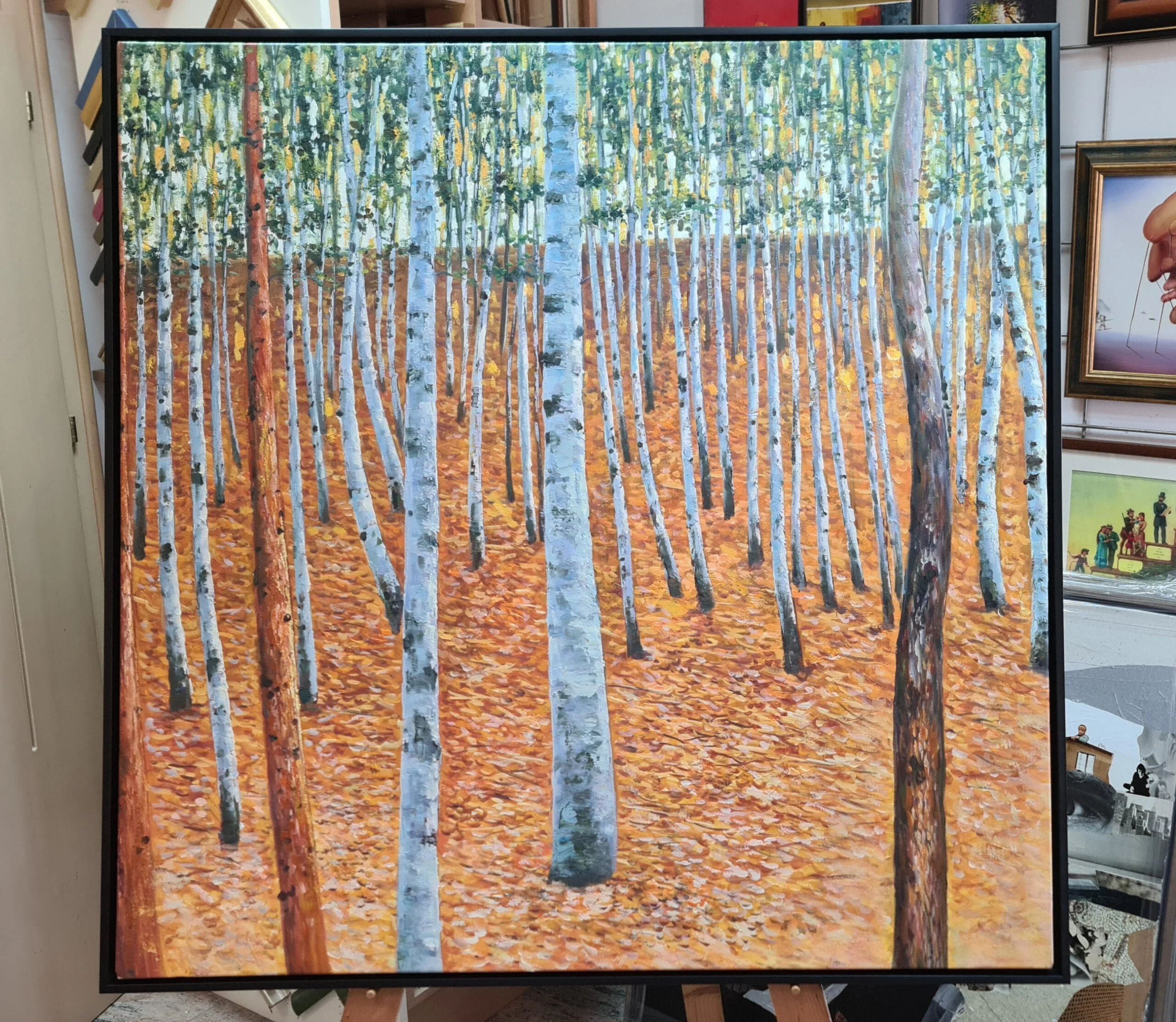
The first photograph shows our copy in a dark floater frame on an easel in the studio, taken from the front. The second photograph shows the canvas up close: the white and brown trunks, the orange carpet of fallen leaves and the thick brushstrokes that give the foliage its relief. The video at the top of the page shows our copy, painted by hand, in full.
Every painting is a hand-painted copy made for your order, so no two are ever quite the same. A printed oil painting reproduction cannot show those strokes in the leaves or the way light catches in the thicker layers of paint.
Which size for which wall?
Short answer: 90 x 90 or 100 x 100 cm above a sofa or bed, 70 x 70 cm above a chest of drawers or in a smaller room, and 120 x 120 or 150 x 150 cm for a large wall. The 100 x 100 cm size is exactly the size of the original in Dresden.
There are eight square sizes: 70 x 70, 80 x 80, 90 x 90, 100 x 100, 120 x 120 and 150 x 150 cm, plus two small ones with sides of 50 and 60 cm. The two smallest suit a hallway or the wall above a desk, the middle ones go above furniture, and the two largest belong on a big empty wall that the forest fills from edge to edge. Because the verticals repeat across the whole canvas, even a smaller size keeps the rhythm of the trunks. A painting for the living room should take up about two thirds of the width of the furniture below it; above a sofa 150 cm wide, that is 100 x 100 cm.
Hang it with the centre of the canvas about 150 cm above the floor, and 20 to 30 cm above a sofa or a headboard.
Custom size, stretcher and frame
If none of the eight sizes fits your wall, we paint it to measure; it works best kept square, like the original. Send us the width and height you want and we will quote a price and a lead time. Every painting we make is stretched over a wooden stretcher and ready to hang.
For the moulding, use our 3D application: it shows every one of our frame profiles on this subject, so you can compare gold, silver, black, white and natural wood before deciding – the application is for choosing the frame only. If you would like to see how the painting will look on your own wall, that is our separate room placement service. Because the trunks run to the edge of the canvas, a slim dark floater frame suits it best, framing the canvas without covering its edges; natural wood also works well and brings out the warmth of the leaves.
Delivery and guarantee
Every painting is made to order in our studio in Slovenia, so allow 15 to 45 days depending on the size you choose. We ship it stretched and protected for transport, framed if you chose a frame, across the EU with no customs. Before dispatch you receive a photograph of the finished work to approve; if anything is not right, we correct it while the canvas is still in our workshop. Our returns policy applies to every order.
If it is a present and you do not know the right size, there is a wall art voucher. Every other Klimt work we paint is in the Gustav Klimt gallery, and there is more on the painter in our article ten interesting facts about Gustav Klimt.
Frequently asked questions
Where is the original Forest of Beech Trees by Klimt?
The original is in Dresden, in the collection of the Galerie Neue Meister of the Staatliche Kunstsammlungen Dresden, and it is on view in the Albertinum. The canvas measures 100 x 100 cm and is painted in oil. If you have seen it in Dresden and want it at home, our 100 x 100 cm size is exactly as large as the original.
What does Klimt’s Forest of Beech Trees show?
It shows the inside of a beech wood: a dense stand of slim trunks, white-grey and reddish-brown, rising to the top edge with no treetops and no sky. The ground is covered by a carpet of orange, rust and yellow leaves with a few green touches. There are no people and no animals, only the rhythm of upright trunks above a warm autumn floor.
When did Gustav Klimt paint Forest of Beech Trees?
Klimt painted it in 1902. It belongs to his square landscapes, made on his summer stays. The canvas is square, 100 x 100 cm. Because he painted several beech forests, this one is also known as Beech Grove I or Buchenwald I, with a Roman numeral that sets it apart from the others.
Is your Forest of Beech Trees really painted by hand?
Yes. Every Forest of Beech Trees we send is a canvas painting made by hand in oil, from the first drawing of the trunks to the last strokes in the leaves. That is why the strokes on the ground can be seen and felt, as the second photograph shows. Before dispatch we send you a photograph of the finished painting so you can approve it or ask for a correction.
Which size of Forest of Beech Trees matches the original?
The 100 x 100 cm size matches the original, because Klimt painted the forest on a square canvas of exactly those dimensions. If you have less space, there are smaller sizes down to 50 x 50 cm, and for a large wall 120 x 120 and 150 x 150 cm. Every size is square, so the balance between trunks and leaves never changes.
Which frame suits Forest of Beech Trees?
A slim dark floater frame suits it best, framing the canvas without hiding the trunks at the edge. That is the frame you see in the first photograph, where our copy stands on an easel in the studio. Natural wood also works and brings out the warmth of the leaves. You can compare every profile in our 3D application, and without a frame the canvas arrives stretched and ready to hang.
Which room suits Forest of Beech Trees?
Forest of Beech Trees looks best where you want calm and warmth: in the living room above the sofa, in the bedroom above the bed, in a study or in a dining room. Its orange and brown tones sit well with wood, leather and green plants. With no figures in it, it never dominates a room, and you can look at it every day without tiring of it.
Is Forest of Beech Trees a good gift?
Yes, Forest of Beech Trees makes a welcome gift because it is calm, warm and free of personal subjects, so it suits almost any home. If you do not know the size of the wall, a voucher is the better present, since the person receiving it chooses the size and frame. We paint to order, so order in good time: making one takes two to six weeks.
How do I care for Forest of Beech Trees in oil?
Oil paint is durable, so care is simple. Hang the painting away from direct sun and radiators, and dust it now and then with a soft, dry cloth or brush, without water or cleaning products. The canvas is stretched over a wooden stretcher, so do not lean it against sharp edges. That way the colours of the leaves and trunks stay alive for many years.
- Subject: the inside of a beech wood, white-grey and brown trunks with no sky above an orange carpet of autumn leaves.
- Original: 1902, oil on canvas, 100 x 100 cm, Galerie Neue Meister, Dresden.
- Ours: a Klimt reproduction painted by hand in oil on canvas, in eight square sizes or made to measure.
- Worth knowing: the 100 x 100 cm size is the size of the original, and you approve a photograph before dispatch.