







































Description
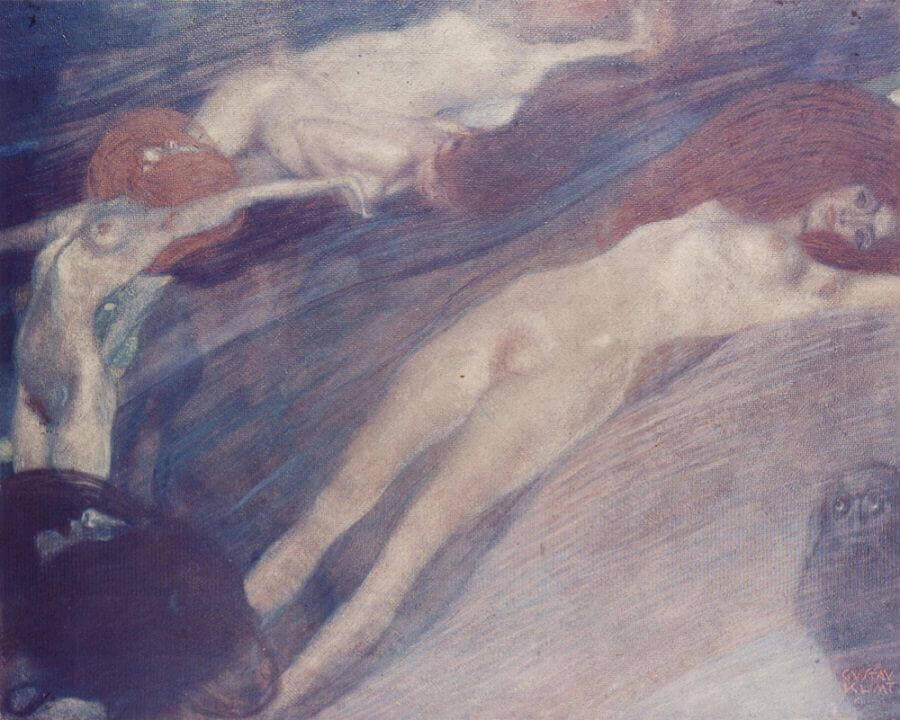
Moving Water is an early painting by Gustav Klimt from 1898: pale young women with long red-gold hair drift diagonally through dark blue-violet water, their bodies stretched out as if a current were carrying them along. The original, 52 cm high and 65 cm wide, is in a private collection. We paint it by hand in oil on canvas, in eight landscape sizes from 40 x 30 to 120 x 100 cm or to your own measurement, and send you a photograph of the finished work for approval before dispatch.
| Title: | Moving Water |
| Other titles: | Bewegtes Wasser · Acqua in movimento |
| Painter: | Gustav Klimt (1862–1918) |
| Year painted: | 1898 |
| Original size: | 52 cm x 65 cm |
| Original technique: | Oil on canvas |
| Painting style: | Vienna Secession, symbolism |
| Located at: | Private collection |
| Our reproduction: | Hand-painted oil on canvas, eight landscape sizes or made to measure |
Moving Water – Gustav Klimt
What does the painting show?
The whole canvas is water. It is deep and dark, blue-violet with lighter streaks that run across it like currents. Through this water drift several young women, pale and nude, their bodies stretched out and turned in the same diagonal direction, as if the water were carrying them along. Their long red-gold hair streams out behind them and glows against the dark.
There is no shore, no horizon and no sky – only water and the floating figures. Klimt does not tell a story here; he paints a movement. Your eye follows the pale bodies and the flowing hair from one corner of the canvas to the other, and that is exactly what the title promises: water that never stands still, and figures that let themselves be carried by it.
Why did Klimt paint women in water?
Women in water are one of the themes Klimt came back to again and again, and Moving Water, painted in 1898, is one of the first. A few years later followed Goldfish and the two versions of Water Serpents, in which slender female figures float among waves, long hair and ornament.
Water allowed him to paint bodies without weight and hair without gravity. The figures do not stand or sit; they hover and glide, and their hair becomes a flowing line that joins them to the current around them. This is the charm of the painting: it is sensual but calm, closer to a dream than to a scene from everyday life.
What does Moving Water mean?
Klimt left no explanation, so the meaning stays open. Many viewers read the drifting women as an image of time and change: everything moves, nothing stays where it is, and we are carried along like the figures in the current. Others simply see the pleasure of floating, the feeling of being weightless in water on a warm summer day.
The dark colours give the scene a slightly mysterious mood, while the warm red-gold hair keeps it alive and luminous. It is an intimate painting rather than a dramatic one. It changes with the light in the room – deep and quiet in the evening, brighter and more open in the morning – and you keep discovering new details when you walk past it.
Where is the original?
The original Moving Water is painted in oil on canvas and measures 52 cm high by 65 cm wide. It is in a private collection, so it is not on permanent public display in a museum. The list of Klimt’s paintings on English Wikipedia records it as privately owned, together with its date and size.
Klimt painted it in 1898, early in his career, in the years when he and other young artists founded the Vienna Secession to renew art in their city. Because the original hangs in a private home, a hand-painted version is for most people the only way to live with this painting every day. Ours is not a print: we paint it for you, by hand, in the size you choose.
Moving Water among Klimt’s water paintings
If you love this theme, our gallery holds its later companions. In Water Serpents I two slender women float upright among golden seaweed and sea creatures, and Water Serpents II spreads several figures across a wide format. Goldfish shows water nymphs and a large golden fish on a tall, narrow canvas, while Danae turns the same soft, flowing line into a single figure curled up in sleep. The closest relative is Will-o’-the-Wisp of 1903, with pale floating women and small glowing lights: choose Moving Water for its dark, calm blue, Will-o’-the-Wisp for violet tones and sparks of light.
Moving Water is the earliest and the darkest of them, and it has no gold at all. Choose it if you like deep blues and a calm, mysterious mood; if you prefer the shine of gold, Goldfish or one of the Water Serpents may suit you better. More about Klimt’s life is on Wikipedia’s Klimt page.
How do we paint Moving Water by hand?
The painter first draws the composition on the canvas: the diagonal line of the floating bodies, the position of each head and the sweep of the hair. Then the water goes on in thin layers of blue, violet and near-black, with lighter streaks that give it movement. The pale bodies are built up slowly, layer by layer, so that the skin keeps a soft, luminous tone against the dark.
The last layers are the hair – long, flowing strokes of red, copper and warm ochre – and the fine reflections of light in the water. A printed oil painting reproduction flattens all of this into one smooth surface; painted by hand, every stroke keeps its texture and catches the light in your room. Each painting is a hand-painted copy made for your order, so no two are exactly alike.
There is no gold in the original and none in our version: we use oil colours only, as Klimt did.
Which size for which wall?
In short: 40 x 30 or 50 x 40 cm for a small wall, a hallway or beside a bed; 65 x 52 or 70 x 60 cm above a chest of drawers or a desk; 80 x 65 or 90 x 70 cm above a bed or a small sofa; 100 x 80 or 120 x 100 cm above a large sofa or on a big wall. The 65 x 52 cm size is the size of the original.
All eight sizes are landscape, wider than they are tall. 50 x 40, 65 x 52 and 100 x 80 cm keep exactly the proportion of Klimt’s canvas; the others are very slightly squarer or wider, which changes nothing in the scene. As a painting for the living room, 100 x 80 or 120 x 100 cm gives the floating figures room to breathe; in a bedroom the deep blue water creates a calm, restful atmosphere.
Hang it with the centre of the canvas about 150 to 160 cm above the floor; over furniture, leave 20 to 30 cm between the top of the furniture and the lower edge of the canvas. As a rule of thumb, a painting above a sofa looks best at about two thirds of the sofa’s width.
Custom size, stretcher and frame
If none of the eight sizes fits your wall, we paint it to measure; keep it a landscape format close to the original, so the figures are not stretched. Send us the width and height you want and we will quote the price and delivery time. Every painting we make is stretched on a wooden stretcher frame and ready to hang.
For the moulding, use our 3D application: it shows every one of our frame profiles on this subject, so you can compare gold, silver, black, white and natural wood before deciding – the application is for choosing the frame only. If you would like to see how the painting will look on your own wall, that is our separate room placement service. A thin black or dark wood frame deepens the blue water; a warm gold or copper-toned frame picks up the colour of the hair.
Delivery and guarantee
Every painting is made to order in our studio in Slovenia, so allow 15 to 45 days depending on the size you choose. We ship it stretched and protected for transport, framed if you chose a frame, across the EU with no customs. Before dispatch you receive a photograph of the finished work to approve; if anything is not right, we correct it while the canvas is still in our workshop. Our returns policy applies to every order.
If it is a gift and you are not sure of the size, there is our gift voucher. More of Klimt’s work is in our Gustav Klimt gallery, and more about the painter in our article 10 interesting facts about Gustav Klimt.
Frequently asked questions
Where is the original Moving Water by Klimt?
The original Moving Water is in a private collection and is not on permanent display in a public museum. Klimt painted it in 1898 in oil on canvas, 52 cm high and 65 cm wide. Our 65 x 52 cm size reproduces it at the size of the original, and every one of our sizes is painted by hand.
When did Klimt paint Moving Water?
Klimt painted Moving Water in 1898, early in his career and in the first years of the Vienna Secession, which he helped to found. It is one of his first paintings of women floating in water, a theme he returned to a few years later in Goldfish and in the two versions of Water Serpents.
What does Klimt’s Moving Water show?
It shows several pale, nude young women drifting diagonally through dark blue-violet water. Their bodies are stretched out as if a current were carrying them, and their long red-gold hair streams behind them. There is no shore and no sky, only water and floating figures, which gives the painting its dreamlike, weightless mood.
What is the meaning of Moving Water by Klimt?
Klimt left no explanation, so the meaning stays open. Many viewers see the drifting women as an image of time and change, carried along like everything in life; others simply feel the calm of floating in water. The dark water and the glowing hair make it a quiet, sensual and slightly mysterious painting.
Is Moving Water suitable for a bedroom?
Yes, Moving Water suits a bedroom very well. The deep blue water and the slow, floating movement create a restful mood, and the figures are shown calmly, without drama. As a canvas painting above a bed, 80 x 65 or 90 x 70 cm works well; for a smaller wall choose 65 x 52 cm, the size of the original.
Which size of Moving Water should I choose?
For a small wall or a hallway choose 40 x 30 or 50 x 40 cm. Above a chest of drawers or a desk, 65 x 52 or 70 x 60 cm works well, above a bed 80 x 65 or 90 x 70 cm, and above a large sofa 100 x 80 or 120 x 100 cm. The 65 x 52 cm size equals the original.
Is there gold in Moving Water?
No, Moving Water has no gold. It belongs to Klimt’s early work, before his famous golden period, and its glow comes from the pale skin and the warm red-gold hair against the dark water. We therefore paint our version in oil colours only, without gold paint, just as the original looks.
How is Moving Water different from Water Serpents?
Moving Water is earlier, darker and has no gold: pale women drift diagonally through deep blue water. Water Serpents I and II, painted a few years later, show slender figures among golden ornament, seaweed and sea creatures. Choose Moving Water for a calm, mysterious mood, and one of the Water Serpents if you want shine and decoration.
Is Moving Water a good gift?
Yes, especially for someone who loves Klimt but already knows The Kiss, or for someone who loves swimming, lakes or the sea. The landscape format fits above a bed, a desk or a sofa, and the mood is calm. If you are not sure of the size, 65 x 52 cm, the original size, fits most homes, or give a voucher.
- Subject: pale young women with long red-gold hair drifting diagonally through dark blue-violet water.
- Original: 1898, oil on canvas, 52 x 65 cm, private collection.
- Our version: a Klimt reproduction painted by hand in oil on canvas, in eight landscape sizes or made to measure.
- Good to know: before dispatch you receive a photograph of the finished work for approval.