







































Description
Will-o’-the-Wisp is Gustav Klimt’s painting of 1903: in a swirl of violet, blue and pink, pale female figures with long red and golden hair float through the dark, and small points of light glow around them like sparks. The original, oil on board laid down on canvas, about 52 x 59.5 cm, is in a private collection. We paint it by hand in oil on canvas, in four landscape sizes from 60 x 55 to 100 x 90 cm or to your own measurement, and you approve a photograph of the finished work before we send it.
| Title: | Will-o’-the-Wisp |
| Other titles: | Irrlichter · Will-o’-the-Wisps |
| Painter: | Gustav Klimt (1862–1918) |
| Year painted: | 1903 |
| Original size: | 52 cm x 59.5 cm |
| Original technique: | Oil on board, laid down on canvas |
| Painting style: | Vienna Secession, symbolism |
| Located at: | Private collection |
| Our reproduction: | Hand-painted oil on canvas, four landscape sizes or made to measure |
Will-o’-the-Wisp – Gustav Klimt
What does the painting show?
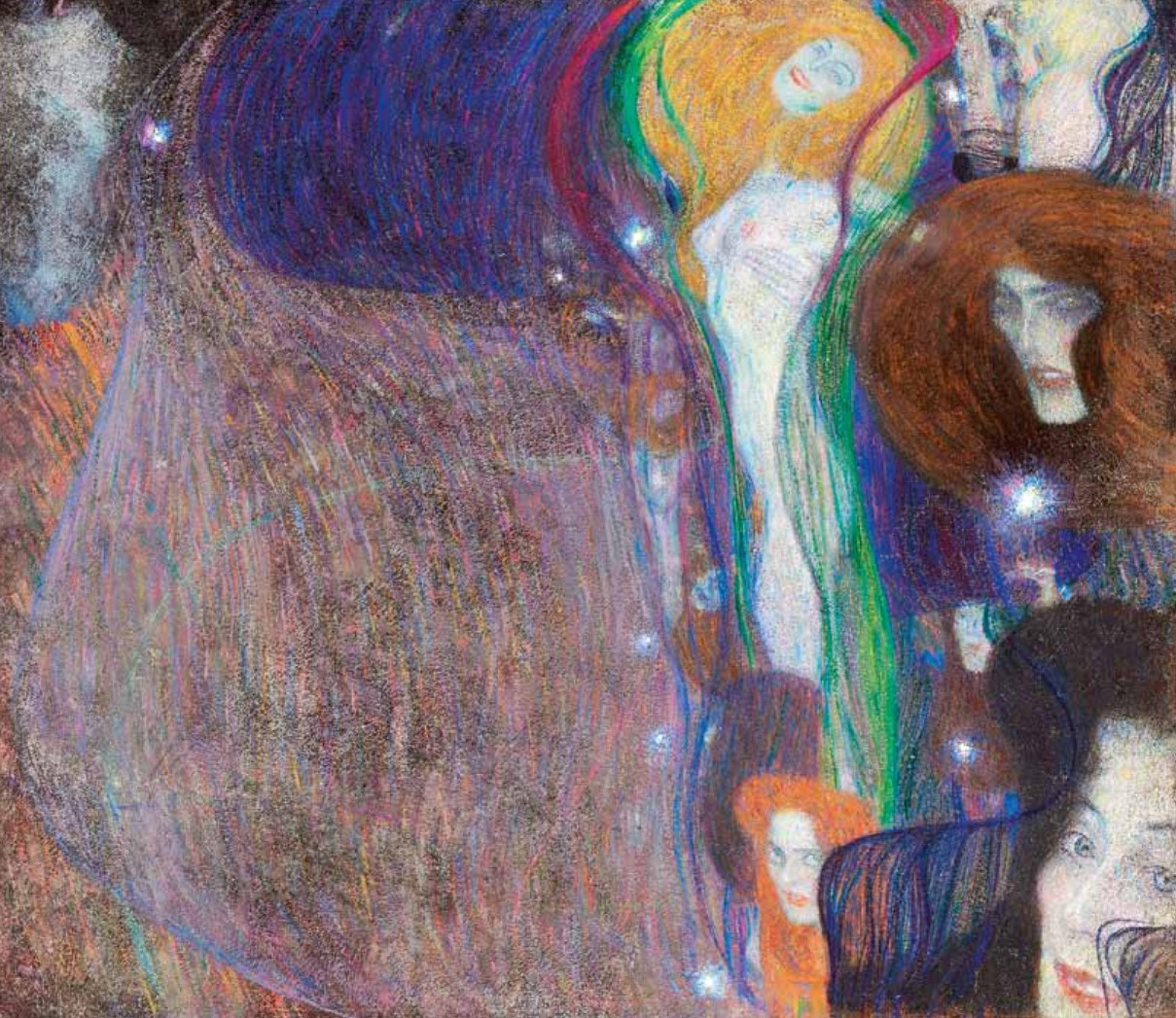
At first you see colour more than figures: a swirling mass of violet, deep blue and soft pink strokes, crossed by streaks of green and turquoise. Then the women appear. Pale, with long red and golden hair, they float through this darkness, their bodies drifting as if they weighed nothing, their hair trailing behind them like flames.
At the lower right a group of women’s faces crowds together, and one of them looks straight out at you. Everywhere between them small, bright points of light glow like sparks in the night. It is a restless, dreamlike scene – part night sky, part water, part vision – and it rewards a long look, because new faces and new lights keep appearing the longer you stand in front of it.
What is a will-o’-the-wisp?
A will-o’-the-wisp is the ghostly light that people once saw flickering over swamps and marshes at night. Old stories tell that these lights lure foolish travellers away from the safe path and lead them astray, deeper into the bog.
Klimt turned the legend into women: the lights become pale, floating figures who glow in the dark and drift wherever they please, and the tiny sparks scattered across the surface can be read as the lights themselves. You can see the painting as a story about temptation and illusion – beautiful, but not to be trusted – or simply enjoy it as a mysterious night scene full of movement.
The painting that was lost and found
For most of the twentieth century Will-o’-the-Wisp was missing. Klimt showed it at the Vienna Secession exhibition of 1903, and afterwards, for decades, it was known only from a photograph of that exhibition and from mentions in publications of the time. Many assumed it had been destroyed, like so many of Klimt’s works in 1945.
Then, in 1978, the painting emerged from a private collection. Since then it has been counted again among Klimt’s surviving works, and it is still privately owned today. The story adds something: you hang on your wall a painting that was long thought lost.
Where is the original?
The original is in a private collection and is not on permanent public display. It is painted in oil on board that was later laid down on canvas, and it measures about 52 cm high and 59.5 cm wide – a small, intimate format. The list of Klimt’s paintings on English Wikipedia gives its date, technique and size and notes its reappearance in 1978.
Our version is painted in oil directly on canvas. Because Klimt’s board is itself fixed to canvas, the look is very close: the same oil colours, the same layered strokes, simply on a canvas that is stretched on a wooden frame and ready to hang.
Will-o’-the-Wisp among Klimt’s water women
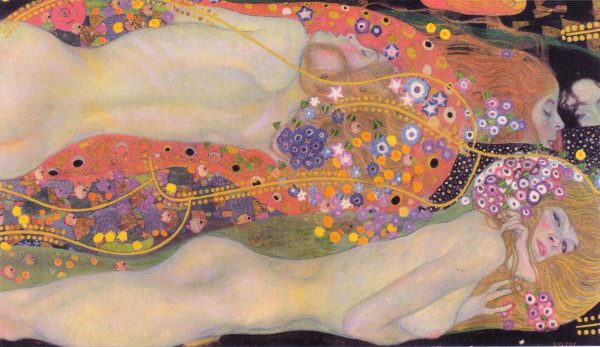
Klimt painted floating, weightless women again and again, and several of them hang in our gallery. The earliest is Moving Water of 1898, with pale women drifting through dark blue water. In Water Serpents I slender figures float upright among gold and sea creatures, Water Serpents II lays them across a wide format, and Goldfish stacks water nymphs and a golden fish on a tall, narrow canvas.
Will-o’-the-Wisp is the most colourful and the most restless of them: violet and pink instead of deep blue, sparks of light instead of gold. Choose it if you want a compact, striking painting with a touch of mystery; for a calmer mood, Moving Water is its quiet older sister. You can read more about the painter on Wikipedia.
How do we paint Will-o’-the-Wisp by hand?
Klimt painted on board; we paint in oil on canvas, which keeps the same colours and brushwork and is lighter and easier to hang. The painter starts with the large movement – the swirl of violet, blue and pink that fills the surface – laid on in thin, overlapping strokes. Then come the floating figures, their pale skin built up slowly, and the long red and golden hair, painted in flowing lines.
The last step is the light: the streaks of green and turquoise, the faces at the lower right and the many small bright points that glow like sparks. These tiny highlights are what a printed oil painting reproduction loses first; painted by hand, each one sits slightly raised on the surface and catches the light. Every painting is a hand-painted copy made only for your order, so each one is unique.
There is no gold in the original, and we use no gold paint: only oil colours.
Which size for which wall?
In short: 60 x 55 cm for a small wall, a bedside or a reading corner; 80 x 70 cm above a chest of drawers or a desk; 90 x 80 cm above a bed; 100 x 90 cm above a sofa or as the centre of a wall. The 60 x 55 cm size is close to the original, which is about 59.5 cm wide and 52 cm high.
All four sizes are landscape and almost as tall as they are wide, like Klimt’s board; 80 x 70 cm has practically its proportion. If you need another size, ask us for one made to measure. As a painting for the living room, 90 x 80 or 100 x 90 cm lets the colours and the little lights work from across the room; in a bedroom or a study, 60 x 55 cm keeps the mood intimate.
Hang the painting so that its centre is about 150 to 160 cm from the floor, and leave 20 to 30 cm between any furniture below and the lower edge of the canvas.
Custom size, stretcher and frame
For a different wall we paint it to measure; a format close to eight by seven keeps the figures in proportion. Tell us the width and height and we will send you a price and a delivery date. Each canvas arrives stretched on a wooden stretcher frame, ready to hang.
Our 3D application lets you try all our frame profiles on this painting – gold, silver, black, white or natural wood – before you order; it is meant only for choosing a frame. To see the painting on your own wall, use our separate room placement service. A slim black frame makes the violet and blue look deeper, while a silver frame echoes the cool sparks of light.
Delivery and guarantee
We paint every order in our studio in Slovenia; depending on the size, it takes 15 to 45 days. The canvas travels stretched and well protected, framed if you ordered a frame, and within the EU there is no customs duty. You approve a photograph of the finished painting before we ship it, and if something needs changing we correct it in the workshop first. Every order is covered by our returns policy.
Buying a gift without knowing the right size? Our gift voucher lets the recipient choose. You will find more of the painter’s work in our Gustav Klimt gallery and his story in 10 interesting facts about Gustav Klimt.
Frequently asked questions
Where is the original Will-o’-the-Wisp by Klimt?
The original Will-o’-the-Wisp is in a private collection and is not on permanent public display. It is a small painting, about 52 cm high and 59.5 cm wide, in oil on board laid down on canvas. Our 60 x 55 cm size comes closest to the original, and we paint every size by hand in oil on canvas.
When did Klimt paint Will-o’-the-Wisp?
Klimt painted it in 1903 and showed it at the Vienna Secession exhibition that year. It belongs to the same years as his best-known golden works, but this painting uses colour and small points of light instead of gold. For decades afterwards it was known only from a photograph of that exhibition.
What does Klimt’s Will-o’-the-Wisp show?
It shows pale female figures with long red and golden hair floating through a swirl of violet, blue and pink. Streaks of green and turquoise cross the scene, a group of women’s faces gathers at the lower right, one of them looking out at us, and small bright lights glow everywhere like sparks.
What does the title Will-o’-the-Wisp mean?
A will-o’-the-wisp is a ghostly light seen over swamps and marshes at night, which old stories say leads foolish travellers astray. Klimt painted these lights as floating women surrounded by sparks. You can read the painting as an image of temptation and illusion, or simply enjoy it as a mysterious night scene.
Was Klimt’s Will-o’-the-Wisp really lost?
Yes. For decades it was known only from a photograph of the 1903 Secession exhibition and from mentions in publications of the time, and it was presumed destroyed like many of Klimt’s works in 1945. In 1978 it emerged from a private collection, and it is still privately owned today.
Is your Will-o’-the-Wisp painted on board like the original?
No, we paint it in oil on canvas. Klimt’s original is oil on board that was later laid down on canvas, so the surface you see is very similar: the same oil colours and layered strokes. A canvas stretched on a wooden frame is lighter, ready to hang and easy to frame in any profile you like.
Which size of Will-o’-the-Wisp should I choose?
Choose 60 x 55 cm, close to the original size, for a small wall or a bedside. The 80 x 70 cm size suits a chest of drawers or a desk, 90 x 80 cm a bed, and 100 x 90 cm a sofa or the main wall of a room. Other sizes can be painted to measure on request.
Which room suits Will-o’-the-Wisp?
It suits a bedroom, a study, a reading corner or a living room used mostly in the evening – anywhere a little mystery is welcome. As a canvas painting it looks best on a calm wall without much around it, so the violet colours and the small lights can glow. It is a fine choice for lovers of legends and dreamlike art.
Is Will-o’-the-Wisp a good gift?
Yes, especially for someone who loves Klimt’s women but would like something less familiar than The Kiss, or who enjoys legends and fairy tales. The format is compact and fits most walls. If you are unsure of the size, 80 x 70 cm suits most homes, or give a voucher so the recipient can choose.
- Subject: pale floating women with long red and golden hair in a swirl of violet, blue and pink, with small sparks of light.
- Original: 1903, oil on board laid down on canvas, about 52 x 59.5 cm, private collection.
- Our version: a Klimt reproduction painted by hand in oil on canvas, in four landscape sizes or made to measure.
- Good to know: you approve a photograph of the finished painting before it is shipped.