







































Description
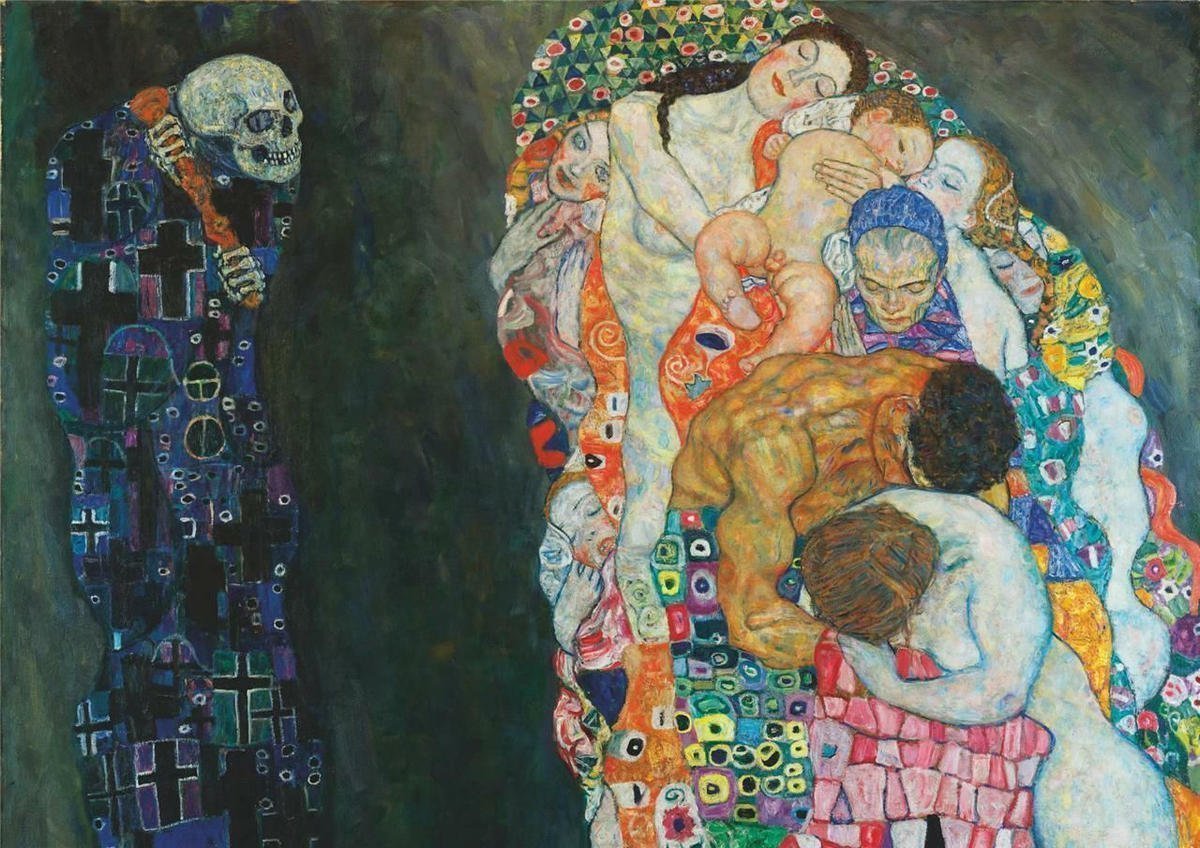
Death and Life is Klimt’s great allegory of the human life cycle: on the left Death in a dark robe patterned with crosses, on the right a stream of sleeping people, from a baby to an old woman, wrapped in colourful blankets and flowers. The original, oil on canvas, belongs to the Leopold Museum in Vienna. We paint it by hand in oil on canvas, in ten sizes or to your own measurement, and send you a photograph of the finished work for approval before dispatch.
| Title: | Death and Life |
| Other titles: | Tod und Leben · Morte e vita · Life and Death |
| Painter: | Gustav Klimt (1862–1918) |
| Year painted: | 1910/11, reworked 1915/16 |
| Original size: | 180.8 cm x 200.6 cm |
| Original technique: | Oil on canvas |
| Painting style: | Vienna Secession, late work |
| Located at: | Leopold Museum, Vienna |
| Our reproduction: | Hand-painted oil on canvas, ten sizes or made to measure |
Death and Life – Gustav Klimt
What does the painting show?
On the left stands Death, alone against a dark, greenish-grey ground. A grinning skull looks out of a long dark-blue robe covered with crosses and circles. In the final version Klimt put a small red club in his hand, which he raises as if waiting for the right moment. Between him and the people lies an empty, dark gap.
On the right is a heap of human bodies, most of them asleep or dreaming: a baby, young women, a mother with her child, an old woman with grey hair, a man holding a woman. They are wrapped in blankets of colourful patterns, circles, squares and flowers, in red, pink, blue, yellow and green. Almost all of them have their eyes closed, and nobody looks towards Death. It is this silence between the two halves that makes the painting so strong.
Why is there no gold in Death and Life?
It once had a gold background. Klimt began the painting in oil in 1910, after first sketches in 1908. When it was first shown, at the International Art Exhibition in Rome in 1911, it won him the gold medal. He then went back to the canvas twice, in 1912/13 and in 1915/16.
In 1915, as the Leopold Museum describes it, he reworked it fundamentally: he painted the gold ground over in grey and turned Death into a vigorous figure in a blue ornamental coat, raising a small red club. Life on the right now glows in bright colours, figures and ornament. That makes it one of the few large Klimt paintings in which the gold we connect with his name is no longer visible at all.
What does the painting mean?
The Leopold Museum counts it among Klimt’s central works and among his greatest allegories of the human life cycle. On one side are all its stages: birth, motherhood, love and old age. On the other is death, which nobody escapes. Most readings point out that the people do not see Death: they sleep, dream and embrace while he stands right beside them.
So the painting is not as dark as its title suggests. The left side is dark and almost single-coloured, the right side full of colour, flowers and warm bodies. Klimt shows no struggle between life and death, only their being side by side. Many find comfort in that: life goes on from one generation to the next, from the baby to the grandmother, whoever stands at the edge.
How did Death and Life come about?
The first sketches date from 1908, and Klimt started painting in oil in 1910. At the International Art Exhibition in Rome in 1911 the painting was shown in public for the first time, and Klimt received the gold medal for it. That did not stop him: he went back to the canvas in 1912/13 and once more in 1915/16, when he changed the background and the figure of Death.
The painting we see today is therefore Klimt’s late version, finished only a few years before his death in 1918. It belongs to the Leopold Museum in Vienna. Older descriptions, including an earlier version of this page, named a private collector as the owner; the correct information is that the painting is held by the museum.
Which other Klimt works are about life and death?
Klimt returned to the cycle of life again and again. In 1905 he painted The Three Ages of Woman, where a child, a mother and an old woman stand side by side. In Hope I dark figures that recall death stand behind a pregnant woman. Death and Life brings these themes together on one large canvas.
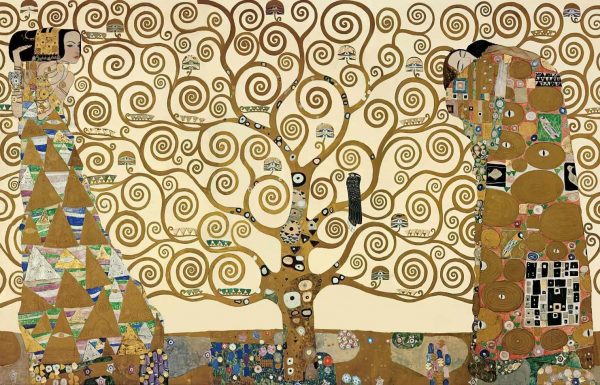
If you are looking for a lighter Klimt subject about love and life, we also paint The Kiss and Tree of Life. Choose Death and Life if you want a painting with a story, one that makes guests stop and look.
How is our hand-painted version made?
The painter first draws both groups in thin lines: the lonely figure of Death on the left and the heap of bodies on the right, with the right gap between them. Then he lays in the dark ground and Death’s robe, and only after that paints the bodies, softly and in several layers so the skin gains warmth. The patterns come last: the crosses and circles on the robe, and the colourful squares, rings and flowers on the blankets.
The patterns take the most time, because there are hundreds of them on the right half and each is painted separately with a brush. There is no gold in the original, so there is none in ours either: the colours follow Klimt’s late version.
Every painting is a hand-painted copy made for your order, so no two are ever quite the same. A printed oil painting reproduction cannot show the relief of the brushstrokes and the depth of colour that you can see and feel on the canvas.
Which size for which wall?
Short answer: 120 x 110 cm for most living-room walls, 160 x 140 or 180 x 160 cm for a large empty wall, and 80 x 70 or 90 x 80 cm for a smaller wall, a bedroom or a study. There are ten sizes: 60 x 55, 80 x 70, 90 x 80, 100 x 90, 120 x 110, 140 x 130, 160 x 140, 180 x 160, 198 x 178 and 250 x 225 cm.
All of them are a little wider than tall, just like the original. The 198 x 178 cm size is almost exactly the size of the original, and 250 x 225 cm is for really large walls. At the smallest size the patterns become very fine, so we recommend it only for a small corner. A painting for the living room should take up about two thirds of the width of the furniture below it.
Hang it with the centre of the canvas about 150 cm above the floor, and 20 to 30 cm above a chest of drawers or a sofa.
Custom size, stretcher and frame
If you need a different size, for example for one particular wall, we paint it to measure. Send us the width and height you want and we will quote a price and a lead time. Every painting we make is stretched over a wooden stretcher and ready to hang.
For the moulding, use our 3D application: it shows every one of our frame profiles on this subject, so you can compare gold, silver, black, white and natural wood before deciding – the application is for choosing the frame only. If you would like to see how the painting will look on your own wall, that is our separate room placement service. A dark wooden or black frame suits the dark ground well.
Delivery and guarantee
Every painting is made to order in our studio in Slovenia, so allow 15 to 45 days depending on the size you choose. We ship it stretched and protected for transport, framed if you chose a frame, across the EU with no customs. Before dispatch you receive a photograph of the finished work to approve, and our returns policy applies to every order.
Every other Klimt work we paint is in the Gustav Klimt gallery, and there is more about the painter in our ten facts about Klimt. If the painting is a gift and you are unsure of the size, there is a wall art voucher: the recipient chooses the size and the subject.
Frequently asked questions
Where is Death and Life by Klimt today?
Death and Life is in the Leopold Museum in Vienna, in the MuseumsQuartier. The museum counts it among Klimt’s central works. Older descriptions named a private collector as the owner, but the correct information is that the Leopold Museum holds it. If you visit Vienna you can see it in person, together with other works of Viennese modernism.
What does Death and Life by Klimt mean?
Death and Life is an allegory of the cycle of life. On the right are all its stages, from a baby and a mother to lovers and an old woman; on the left stands Death, waiting. Most readings stress that the people do not see him: they sleep and dream, and life goes on. More about the painting on Wikipedia.
Why did Klimt paint over the gold in Death and Life?
Klimt painted over the gold ground in 1915, when he reworked the painting fundamentally. The Leopold Museum writes that the background changed from gold to grey, and Death became a vigorous figure in a blue ornamental coat with a small red club. The effect is clear: the colours of life on the right glow more strongly now that no gold competes with them.
When was Death and Life painted?
Death and Life took several years. The first sketches date from 1908, Klimt began the oil painting in 1910, and he reworked it in 1912/13 and again in 1915/16. That is why it is dated 1910/11 and 1915/16. The version we see today is Klimt’s late one, finished only a few years before his death in 1918.
Did Death and Life win a prize?
Yes, Death and Life won Klimt a gold medal. He received it at the International Art Exhibition in Rome in 1911, where the painting was shown for the first time. At that point it still had its gold background. The prize did not stop him: after the exhibition he returned to the canvas twice and reworked it fundamentally in 1915.
Who are the people in Death and Life?
The people in Death and Life are not particular persons but stages of life. The Leopold Museum lists a mother and child, an elderly woman and a loving couple, and among them there are also a baby and young women. Most of them are asleep or dreaming. On the left stands Death with a skull, in a dark-blue robe with crosses, painted as a lonely figure.
In which sizes can I order Death and Life?
You can order Death and Life in ten sizes, from 60 x 55 to 250 x 225 cm, all a little wider than tall, like the original. The 198 x 178 cm size comes closest to the size of the original. If you need a size for one particular wall, we paint it to measure and quote the price and the lead time in advance.
Is Death and Life a good painting for a home?
Yes. Despite its serious title, Death and Life is full of colour, flowers and warm bodies on its right half. As a canvas painting it works best in a living room, a study or a large hallway, where it can be seen from a little distance. The dark left side needs good light, so do not hang it in the darkest corner of the room.
Death and Life or The Three Ages of Woman – which should I choose?
Choose Death and Life if you want the whole cycle of life and a dramatic contrast between dark Death and colourful life. The Three Ages of Woman is calmer: a child, a mother and an old woman stand side by side, with golden ornament. We paint both by hand in oil on canvas, though Death and Life needs more space on the wall.
- Subject: Death in a dark robe with crosses and a colourful group of sleeping people, from a baby to an old woman.
- Original: 1910/11, reworked 1915/16, 180.8 x 200.6 cm, Leopold Museum, Vienna.
- Ours: a Klimt reproduction painted by hand in oil on canvas, in ten sizes or made to measure.
- Worth knowing: you receive a photograph of the finished work for approval before dispatch.