Description
The Bride is the large painting Klimt left unfinished on his easel when he died unexpectedly in February 1918. At its centre a young woman in blue tilts her head dreamily towards a man, to the left bodies intertwine, to the right stands a large nude figure in a colourful ornamental skirt, and part of the canvas is still only a drawing. The original hangs in the Belvedere in Vienna. We paint it by hand in oil on canvas, as it is, unfinished parts included.
| Title: | The Bride |
| Other titles: | Die Braut · La sposa · Nevesta |
| Painter: | Gustav Klimt (1862–1918) |
| Year painted: | 1917/1918, unfinished |
| Original size: | 165 cm x 191 cm |
| Original technique: | Oil, pencil and black charcoal on canvas |
| Painting style: | Vienna Secession, late period |
| Located at: | Belvedere, Vienna – on loan from the Klimt-Foundation |
| Our reproduction: | Hand-painted oil on canvas, unfinished parts as in the original, eight sizes or made to measure |
The Bride – Gustav Klimt
What is shown?
At the centre of the canvas is a young woman in blue. She tilts her head dreamily towards the man on the left. He is surrounded by sensual, intertwined bodies, yet he looks only at her. The left half of the painting is a dense web of faces, arms and bodies in warm colours, with patterned fabrics and flowers.
On the right stands a large nude female figure. Her lower body is covered by a skirt of brightly coloured ornaments: yellow, red, blue and green fields, spirals and triangles. Part of that skirt and part of the body are still only drawn in pencil and charcoal on the bare canvas, with no paint at all. That unfinished part is exactly why the painting means so much to Klimt’s admirers.
Why is The Bride unfinished?
Because Klimt died before he could finish it. When he died unexpectedly in February 1918, the painting stood unfinished on the easel in his studio. So we see several stages of his work at once: in some places the surfaces are fully painted, elsewhere only the drawing remains.
For the viewer this is a rare chance. The Bride shows how Klimt worked: first he drew the figures, then he painted them, and only then did he add the ornament. In most of his paintings the early stages are hidden beneath the final layer; here they have stayed in plain sight.
What does The Bride mean?
Klimt did not name the painting himself. The title The Bride was given only after his death, so any reading of its meaning should be cautious. The name comes from the scene at the centre: a young woman in blue tilting her head dreamily, and a man who looks at no one but her.
The intertwined bodies around them are a theme that returns in Klimt’s last years: love, sleep, waking, the human body set in the rhythm of ornament. The painting does not tell a story with a clear beginning and end; it works like a dream that each viewer reads in their own way.
Who received The Bride after Klimt’s death?
In 1918 the painting passed from Klimt’s estate to Emilie Flöge, his lifelong confidante and companion. It later came into the possession of the Klimt-Foundation in Vienna.
Today The Bride is on loan to the Belvedere in Vienna, where you can see it alongside other works by Klimt. Older descriptions that place it in a private collection are therefore out of date.
Where does The Bride stand among Klimt’s late paintings?
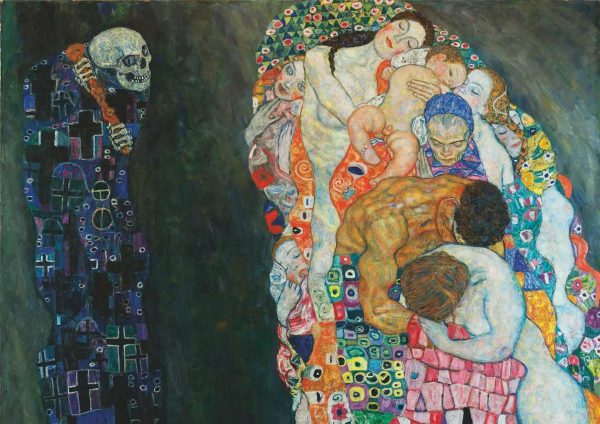
The Bride belongs to Klimt’s very last works, when he had left gold behind and painted in strong colours. The Dancer also remained unfinished, its lower third still a sketch. You know the intertwined bodies from The Virgin of 1913, and the stream of nude bodies on one side with a solitary figure on the other from Death and Life.
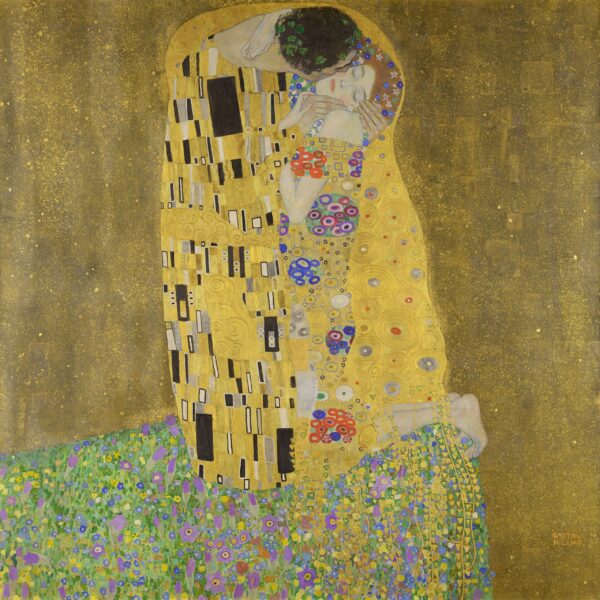
If you are looking for Klimt’s couple from the Golden Period, that is The Kiss, which we paint in several sizes. Choose The Bride if the late, colourful Klimt appeals to you, together with a look into the way he worked.
How is our hand-painted version made?
The painter first transfers all the figures and the layout of the composition to the canvas with a fine drawing, including the part that remained only a drawing in the original. The faces and bodies are then painted in several layers, followed by the blue dress, the intertwined fabrics and the colourful skirt of the figure on the right. The unfinished parts we leave as they are in the original: light canvas and visible lines.
There is no gold on our painting, because there is none on the original either: the late Klimt painted with colour. Every colour is applied by hand with a brush.
Every painting is a hand-painted copy made for your order, so no two are ever quite the same. A printed oil painting reproduction cannot show the relief of the brushstrokes and the difference between the painted and the merely drawn parts that you see on the canvas up close.
Which size for which wall?
Short answer: 130 x 150 or 150 x 170 cm above a sofa or a bed, 166 x 190 cm for a large wall, 80 x 90 or 90 x 100 cm for a smaller room. The sizes are 70 x 80, 80 x 90, 90 x 100, 100 x 110, 110 x 130, 130 x 150, 150 x 170 and 166 x 190 cm.
Worth knowing: the shop lists these sizes as width x height, while the original is wider than it is tall. If you want The Bride in the proportion of the original, choose made to measure in the next section. With its nude figures the painting suits a bedroom or a more private room best, though it can also be a painting for the living room if the subject suits you.
Hang it with the centre of the canvas about 150 cm above the floor, and 20 to 30 cm above a chest of drawers or a sofa.
Custom size, stretcher and frame
The original is 191 cm wide and 165 cm high. If you want the painting in that proportion, we paint it to measure, for example 120 x 104 or 160 x 138 cm. Send us the width and height you want and we will quote a price and a lead time. Every painting we make is stretched over a wooden stretcher and ready to hang.
For the moulding, use our 3D application: it shows every one of our frame profiles on this subject, so you can compare gold, silver, black, white and natural wood before deciding – the application is for choosing the frame only. If you would like to see how the painting will look on your own wall, that is our separate room placement service. A simple dark or white frame suits the bright colours well.
Delivery and guarantee
Every painting is made to order in our studio in Slovenia, so allow 15 to 45 days depending on the size you choose. We ship it stretched and protected for transport, framed if you chose a frame, across the EU with no customs. Before dispatch you receive a photograph of the finished work to approve, and our returns policy applies to every order.
Every other Klimt work we paint is in the Gustav Klimt gallery, and there is more about the painter in our ten facts about Klimt. If the painting is a gift and you are unsure of the size, there is a wall art voucher: the recipient chooses the size and the subject.
Frequently asked questions
Where is Klimt’s The Bride today?
The original is in the Belvedere in Vienna, on loan from the Klimt-Foundation in Vienna. After Klimt’s death in 1918 it was inherited by Emilie Flöge, his lifelong confidante. Older descriptions that place it in a private collection are out of date. At the Belvedere you can also see other works by Klimt, The Kiss among them.
Why did The Bride remain unfinished?
Because Klimt died unexpectedly in February 1918 while the painting still stood on the easel in his studio. So it has parts that are fully painted and parts that remained only a drawing in pencil and charcoal. For his admirers that is exactly the appeal: it shows how he worked, first the drawing, then the colour, and the ornament last.
What does The Bride show?
The Bride shows a young woman in blue at the centre, tilting her head dreamily towards the man on the left. He is surrounded by intertwined bodies, yet looks only at her. On the right stands a large nude figure in a skirt of colourful ornaments, partly still only drawn. Read more about the painter on Wikipedia.
Why is the painting called The Bride?
Klimt did not choose the title The Bride himself: the painting received it only after his death. The name comes from the scene at the centre, where a young woman in blue tilts her head dreamily towards a man who looks at no one else. As the artist left no explanation, every interpretation is a reading of the scene, not his own.
Who inherited The Bride?
In 1918 The Bride passed from Klimt’s estate to Emilie Flöge, his lifelong confidante and companion. Today the painting belongs to the Klimt-Foundation in Vienna, which has lent it to the Belvedere. There it is on view together with other paintings by Klimt, so you can see it on a visit to Vienna.
Is your copy of The Bride unfinished like the original?
Yes, we paint our copy of The Bride as the original is, including the parts that remained only a drawing on Klimt’s canvas. We leave those parts light, with the lines visible. So the whole canvas painting is painted by hand and tells the same story as the original: a work interrupted by death in the middle of its making.
In which sizes can I order The Bride?
There are eight sizes: 70 x 80, 80 x 90, 90 x 100, 100 x 110, 110 x 130, 130 x 150, 150 x 170 and 166 x 190 cm, listed as width x height. The original is wider than it is tall, 191 x 165 cm. If you want its proportion, we paint it to measure and tell you the price and the lead time in advance.
Which room suits The Bride?
Because of its nude figures, The Bride suits a bedroom, a more private living room or a study best, where adults see it. The large sizes fill the wall above a bed or a sofa. The bright colours and dark areas need good light; the painting works well on a calm, light wall without other paintings around it.
Is there gold in The Bride?
No, there is no gold in The Bride, neither in the original nor on our painting. It dates from Klimt’s last years, when he had left gold behind and painted with strong colours: blue, red, yellow and green. Choose it if the late, colourful Klimt appeals to you more than the golden glow of The Kiss.
- Subject: a young woman in blue among intertwined bodies and a large nude figure in a colourful skirt, partly still a drawing.
- Original: 1917/1918, unfinished, 165 x 191 cm, Belvedere, Vienna.
- Ours: a Klimt reproduction painted by hand in oil on canvas, unfinished parts included, in eight sizes or made to measure.
- Worth knowing: you receive a photograph of the finished work for approval before dispatch.