



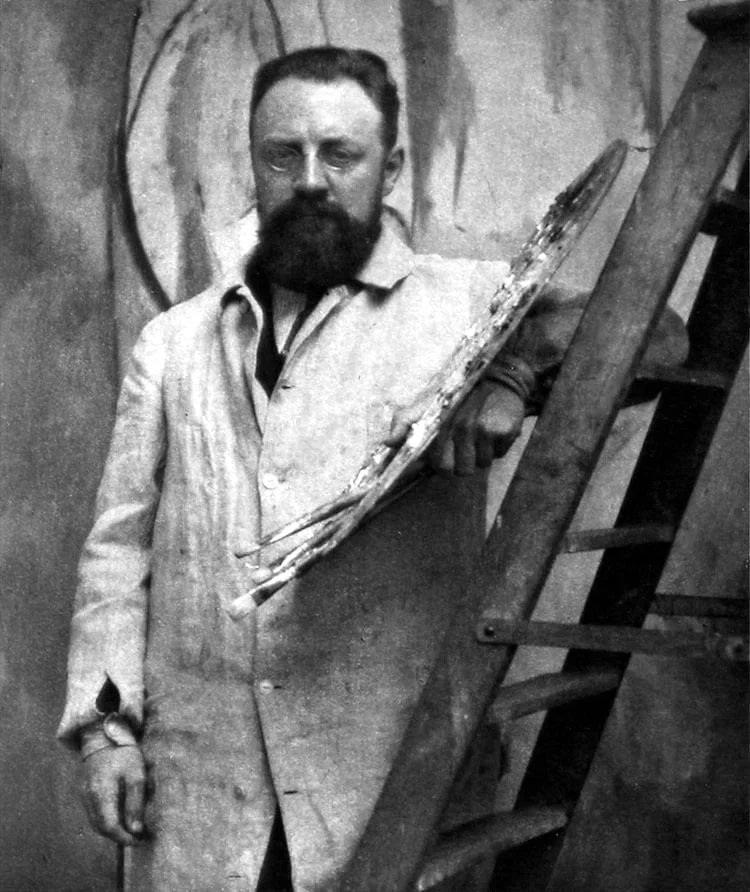
Henri Matisse was a French painter, sculptor, and graphic artist, one of the prominent representatives of Fauvism and modern art of the 20th century. He was known for his use of bold colors and dynamic compositions, often incorporating flattened and simplified forms. His works are recognizable for their striking visual effects and the ability to express a sense of movement and emotions.
Matisse was born in 1869 in Le Cateau-Cambrésis, France, and began his artistic journey with studies at the École des Arts Décoratifs in Paris. Initially influenced by the works of the Impressionists, he later developed his unique style characterized by bright, daring colors and simplified forms.
Among Matisse’s most famous works are the paintings Dance and The Joy of Life. Both pieces were created during the Fauvism movement, known for its use of vibrant colors and bold brushstrokes. He was also renowned for his paper cut-outs, which he started creating in the 1940s by cutting shapes out of painted paper and arranging them into compositions.
Matisse’s work had a significant influence on the development of modern art, and his impact can be seen in the works of many other artists. He was also a teacher and mentor to numerous young artists, and his influence is still felt in the art world today.
Matisse’s works are exhibited in major museums and galleries worldwide, including the Metropolitan Museum of Art in New York, the Musée d’Orsay in Paris, and the Tate Gallery in London. Throughout his career, he received numerous awards and recognitions, including the French Legion of Honour.
Henri Matisse was a French painter, sculptor, and graphic artist who was one of the prominent figures of Fauvism and modern art of the 20th century. He was known for his use of bold colors and dynamic compositions, often incorporating flattened and simplified forms. His works are recognizable for their striking visual effects and the ability to express a sense of movement and emotions. Matisse’s work had a significant influence on the development of modern art, and his impact can be seen in the works of many other artists. His works can be found in major museums and galleries worldwide, and they are still celebrated today.
Henri Matisse – 10 Interesting Facts
- Henri Matisse was one of the leading representatives of Fauvism, known for the use of vibrant colors and strong brushwork.
- Among Matisse’s most famous works are the paintings Dance and The Joy of Life.
- Matisse was also known for his paper cut-outs, which he started creating in the 1940s by cutting shapes out of painted paper and arranging them into compositions.
- Matisse’s work had a significant influence on the development of modern art, and his impact can be seen in the works of many other artists.
- Matisse was also a teacher and mentor to numerous young artists, and his influence is still felt in the art world today.
- Matisse received numerous awards and recognitions throughout his career, including the French Legion of Honour.
- Matisse was also an art collector, and he had an extensive collection of artworks from various cultures, periods, and styles.
- Matisse’s works are exhibited in major museums and galleries worldwide, including the Metropolitan Museum of Art in New York, the Musée d’Orsay in Paris, and the Tate Gallery in London.
- In his later life, Matisse suffered from poor health and was confined to a wheelchair in his last years, but he continued to work and create art.
- Matisse’s art is still celebrated, studied, and regarded as an important part of the Fauvism movement and 20th-century art in general.