



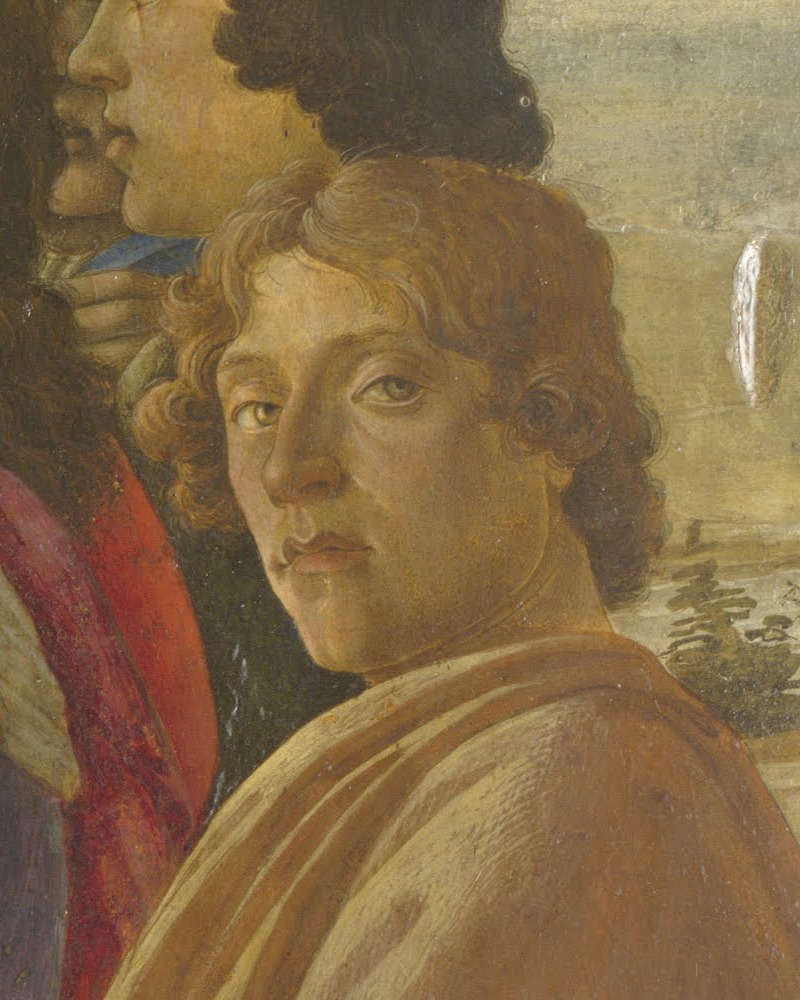
Sandro Botticelli (c. 1445–1510), born Alessandro di Mariano di Vanni Filipepi, was a Florentine painter of the Early Renaissance and the author of two of the best-known paintings in Italian art, The Birth of Venus and Primavera, both now in the Uffizi in Florence. He worked for the Medici and their circle, painted large mythological scenes, altarpieces, round Madonnas and portraits, and in Rome he painted three large frescoes in the Sistine Chapel. After his death he was all but forgotten for more than three centuries, until the Pre-Raphaelites rediscovered him in the late 19th century. His works are part of our collection of hand-painted reproductions of Sandro Botticelli paintings on canvas.
Every Botticelli painting in our gallery is painted by hand in oil on canvas, to order and in the size you choose; before dispatch we send you a photograph of the finished painting.
Sandro Botticelli paintings in our gallery
Life: the tanner’s son from Ognissanti who painted for the Medici
Botticelli was born in Florence, in a house on the street still called Borgo Ognissanti. He was one of several children of the tanner Mariano Filipepi; his birth date is not recorded, but his father’s tax returns show that he must have been born between 1444 and 1446. The nickname Botticelli, “little barrel”, came from his elder brother Giovanni, who was called Botticello apparently because of his round build. According to Vasari he first trained as a goldsmith, and from around 1461 he was apprenticed to Fra Filippo Lippi, one of the leading painters in Florence and a favourite of the Medici, who taught him to paint beautiful, melancholy figures with clear contours and only gentle contrasts of light and shade. By 1469 he had his own workshop, and in 1472 he took on his first assistant, Filippino Lippi, his master’s son. In 1474 he spent some months working in Pisa, and around 1475 he painted the Adoration of the Magi for Santa Maria Novella, a work Vasari singled out for praise and one that spread his name across the city. In 1481 Pope Sixtus IV summoned him to Rome with other leading Florentine and Umbrian painters to fresco the walls of the newly built Sistine Chapel; Botticelli painted three of the fourteen large scenes from the lives of Christ and Moses. He was back in Florence in 1482 and never again left the city for long. The 1480s were his most successful decade: it was then that he completed his great mythologies and many of his most famous Madonnas, for the Medici and the families allied to them. In the 1490s, Vasari says, he became a follower of the preacher Girolamo Savonarola; how far this changed him is uncertain, but his style grew more personal and more severe. The only painting he dated is the Mystic Nativity of 1500. In 1504 he sat on the committee that decided where Michelangelo’s David should stand. He never married and spent his whole life in the same neighbourhood. He died in May 1510 and was buried at the church of Ognissanti, where he had been baptised.
Style: the pure line, myth and round Madonnas
Botticelli’s style is recognised by its clear, flowing line. He draws his figures with soft, continuous contours, uses light and shadow sparingly and paints in light, almost pastel colours; John Ruskin saw linear rhythm in his paintings, Vasari saw grace. The originals are mostly painted in tempera on wooden panels, and on walls he worked in fresco. Mythological scenes on the scale of Primavera and The Birth of Venus were virtually unprecedented in Western art since antiquity; they illustrate no single text but draw on several poets and on the Neoplatonic philosophy of the humanists around Lorenzo de’ Medici. He was one of the first painters to use the tondo, a round painting some 115 to 145 cm across, and it was the round Madonnas, which he was more likely to paint himself than the rectangular ones, that became his signature. In portraits he usually shows women in profile and men in three-quarter view, and he likes an open window as a background. In his last years his figures grow smaller, their gestures more expressive and his colours less natural, which is why many describe his late style as Gothic or archaic. After his death his reputation was eclipsed for longer and more thoroughly than that of any other major European artist. The Pre-Raphaelites rediscovered him, the writer Walter Pater devoted a famous essay to him, the first monograph appeared in 1893, and between 1900 and 1920 more books were written about him than about any other painter.
His most famous works
His most famous work, The Birth of Venus, hangs in the Uffizi beside Primavera, and Primavera (c. 1480) is where our gallery begins: a large painting in tempera on wood, 203 x 314 cm. In a dark orange grove, on a meadow in flower, stand nine figures: on the left Mercury chases away the clouds with his staff, the three Graces dance in transparent veils, Venus stands in the centre with a blindfolded Cupid aiming his arrow above her, and on the right the blue-green Zephyrus seizes the nymph Chloris, who turns into Flora, goddess of flowers, in her dress strewn with blossoms. Some 500 plant species and about 190 different flowers have been identified on the meadow. An inventory of 1499 records the painting in the town palace of Lorenzo di Pierfrancesco de’ Medici, a cousin of Lorenzo the Magnificent; what it means is still debated. Venus and Mars (c. 1485), in tempera and oil on poplar, measures 69.2 x 173.4 cm, and its long, low shape suggests it was set into wall panelling or a piece of furniture. Venus watches, wide awake, as Mars sleeps, little satyrs play with his armour and one blows a conch shell in his ear; the wasps around his head may be a pun on the Vespucci family, whose name means “little wasps”. The National Gallery in London bought it in 1874. The Adoration of the Magi (c. 1475, 111 x 134 cm) was commissioned by Gaspare del Lama for his altar in Santa Maria Novella. Members of the Medici family appear among the Magi and their train: Cosimo the Elder kneels before the Child, and beside him his sons and his grandsons Lorenzo and Giuliano are traditionally identified; the man in the yellow-brown cloak at the right edge, who looks straight out at us, is accepted by most scholars as Botticelli himself. The painting is in the Uffizi. Venus and the Three Graces Presenting Gifts to a Young Woman (c. 1483–1485) is a fresco from the Villa Lemmi near Florence, which belonged to Giovanni Tornabuoni; it was probably made for the wedding of his son Lorenzo to Giovanna degli Albizzi in 1486, and the young woman holding out a white cloth is often taken to be the bride. It was found under a coat of whitewash in 1873, taken off the wall and transferred to canvas, and it is now in the Louvre in Paris. The Calumny of Apelles (c. 1494–1495) is a smaller panel, 62 x 91 cm, in which Botticelli recreated a lost painting by the ancient Greek painter Apelles from the description by Lucian that Alberti had recommended to artists: a king with donkey’s ears listens to Ignorance and Suspicion, Calumny with a torch drags her victim by the hair, and on the left stand Remorse, an old woman in black, and the naked figure of Truth pointing to heaven. He may have painted it for himself; it is in the Uffizi. The Madonna of the Magnificat (c. 1481–1483) is a round painting 118 cm across: with the Child on her lap, Mary writes the Magnificat, the hymn from the Gospel of Luke, while the Child guides her hand and two angels hold a crown over her head. It too is in the Uffizi. Portrait of a Young Woman (c. 1475), in the Galleria Palatina of the Palazzo Pitti, shows an unknown sitter in strict profile at a window; 19th-century critics called her Simonetta, after Simonetta Vespucci, but her features are very different from Simonetta’s presumed portraits. To see how Botticelli stands beside the other great masters, read our overview of the five most famous paintings in the world.
Frequently asked questions about Sandro Botticelli
Who was Sandro Botticelli?
A Florentine painter of the Early Renaissance (c. 1445–1510), a pupil of Fra Filippo Lippi and a painter of the Medici circle, whose Primavera and The Birth of Venus are among the most famous paintings in the world.
What did Sandro Botticelli paint?
Mythological scenes with Venus and the Graces, altarpieces and church frescoes, among them three large scenes in the Sistine Chapel, many Madonnas with the Child, a good number of them round tondi, portraits and, in his late years, smaller scenes from ancient history and drawings for Dante’s Divine Comedy.
Where can I see Botticelli’s original paintings?
Of the works in our gallery, Primavera, the Adoration of the Magi, the Calumny of Apelles and the Madonna of the Magnificat are in the Uffizi in Florence, Portrait of a Young Woman in the Galleria Palatina of the Palazzo Pitti, also in Florence, Venus and Mars in the National Gallery in London, and the fresco Venus and the Three Graces Presenting Gifts to a Young Woman in the Louvre in Paris.
Can I buy a hand-painted reproduction of a Botticelli painting?
Yes, our online gallery offers hand-painted reproductions of Sandro Botticelli paintings on canvas in the size you choose. The originals are not oil paintings on canvas: most are painted in tempera on wooden panels, Venus and Mars in tempera and oil on poplar, and Venus and the Three Graces is a fresco taken from the wall of a villa. We paint each copy by hand in oil on canvas, so you can have it rolled, stretched on a wooden stretcher bar or framed. Primavera is 314 cm wide, so all our sizes are smaller than it, while our largest Venus and Mars is slightly larger than the original. The Madonna of the Magnificat is round; we paint the round scene on a square canvas. Before delivery we send you a photograph of the painting to approve.
Leave a Reply