














Description
Leonardo da Vinci – Saint John the Baptist
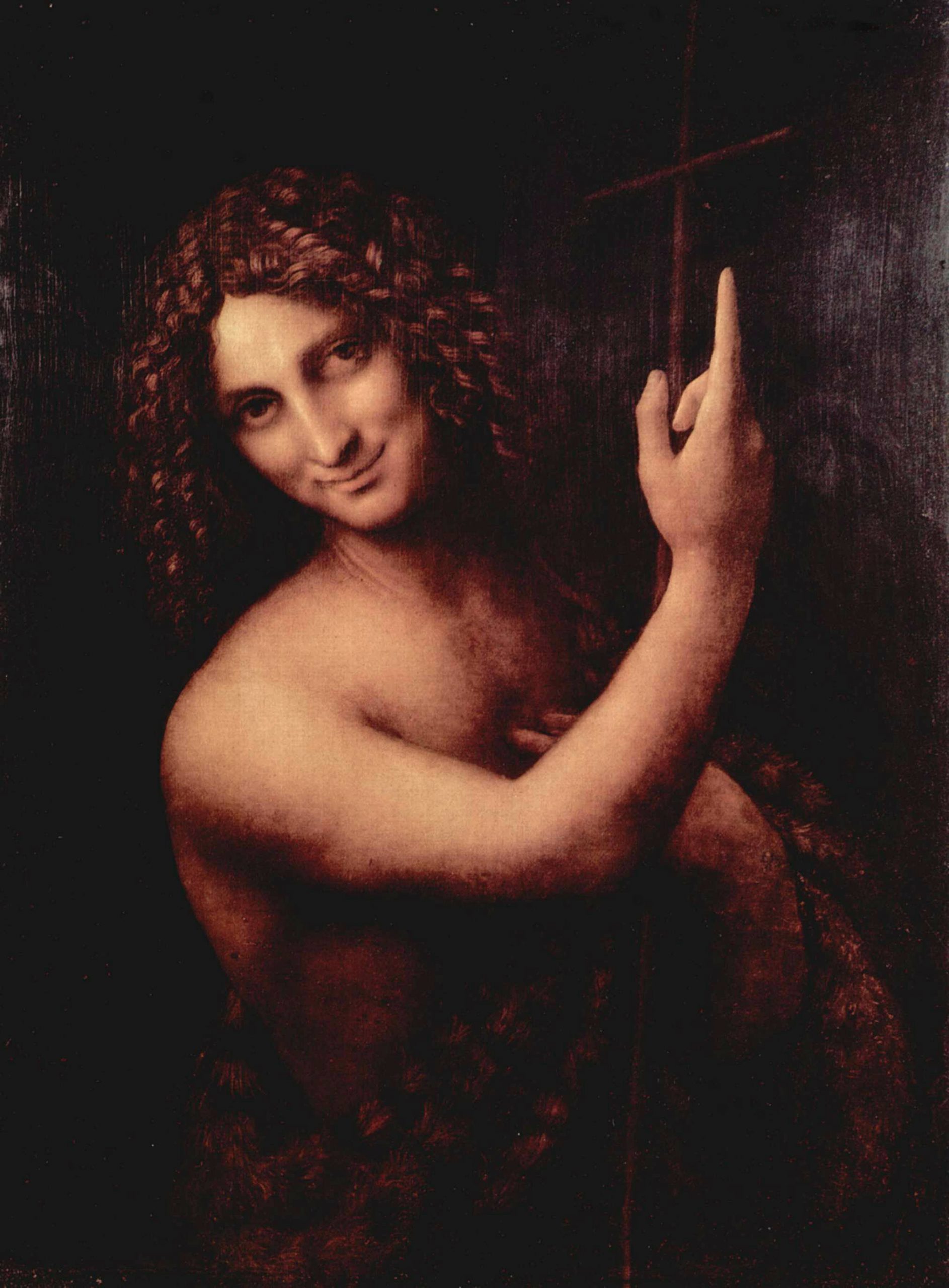
This is in all likelihood the last painting Leonardo made. A figure steps out of the darkness in a fur, holding a reed cross, one finger raised and pointing upward. The Louvre records it under inventory number INV 775, painted in oil on walnut, and dates it 1508–1519 – Leonardo’s final years.
The last painting
It took shape somewhere between 1513 and 1516, and Leonardo never finished it: at his death in 1519 the right arm and the fur were still incomplete. He delivered it to no patron – he took it with him when he moved to France in 1516 at the invitation of Francis I. Together with the Mona Lisa and The Virgin and Child with Saint Anne, it is among the works he kept to the end.
The gesture that carries the picture
Everything is built around a single gesture: the raised finger pointing up. John the Baptist announces the one who comes after him – so the finger is the explanation of the scene, not an ornament. Around him there is nothing: the background is complete darkness, out of which the light pulls only a face, a shoulder and an arm. With that sfumato Leonardo removed every hard edge; the smile is ambiguous, and the picture asks more than it preaches.
The painting that went to England and came back
Its route is unusual. Around 1518 it entered the French royal collection, then passed to the Duke Roger du Plessis de Liancourt, who gave it to King Charles I of England about 1630. After Charles was executed it was sold at auction in 1651, bought by the banker Everhard Jabach, and from him acquired by Louis XIV in 1662. It reached the Louvre in 1801.
Our hand-painted reproduction
The dark ground makes the painting quiet and concentrated, so it works well in a library, a study or a bedroom. Every hand-painted painting on canvas is made to order in our workshop and never printed. As canvas wall art or a painting on canvas this is one of the stranger Leonardos. Close to it in subject is his Salvator Mundi.
- Original: oil on walnut, 72.9 × 56.3 cm per the Louvre (also often cited as 69 × 57 cm)
- Dating: 1508–1519 per the museum; worked on around 1513–1516 and left unfinished
- Held at: Louvre, Paris, inv. INV 775 (MR 318); High Renaissance
- Our version: hand-painted on canvas, from 40 × 55 cm to 150 × 200 cm, from €600