


Description
Leonardo da Vinci – The Last Supper
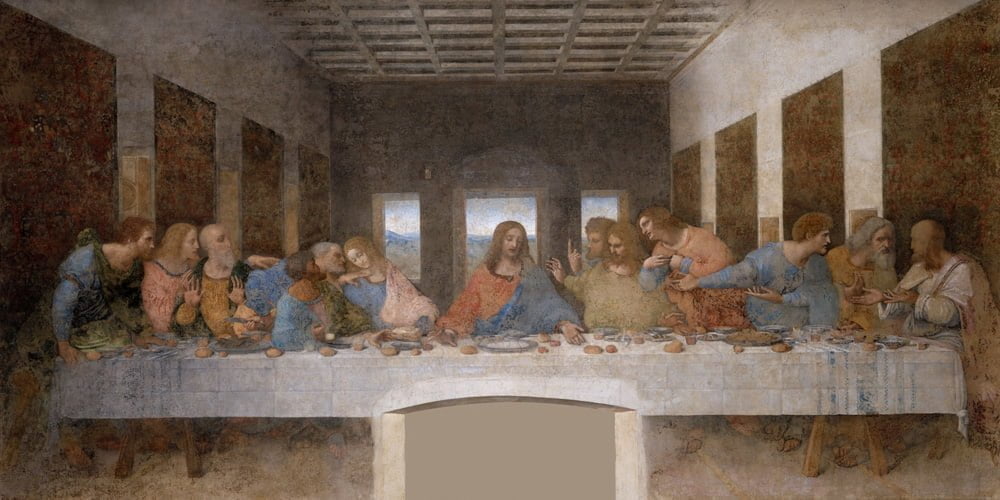
The Last Supper is, next to the Mona Lisa, Leonardo’s best-known work. It was made between 1495 and 1498 on the wall of the refectory – the dining hall – of the Dominican monastery beside the church of Santa Maria delle Grazie in Milan, where it still is. It measures 460 × 880 cm. Older sources often date it to about 1500. And one correction right at the start, because it explains everything about its condition: it is not a fresco.
The moment the painting catches
Leonardo did not depict the communion but the instant just after Jesus says that one of the twelve will betray him. Every apostle reacts differently – a gesture, a turn of the body, an expression. That was the new thing: psychological reactions like these had not been painted before. The apostles fall into four groups of three, which gives the scene its rhythm, while Christ remains alone at the centre, calm and balancing it all.
Why the painting is decaying
A true fresco is painted into wet plaster and binds with it. Leonardo wanted time for revisions and subtle tones, so he painted in tempera and oil on dry plaster. The paint layer never bonded to the wall, and the thin outer wall held damp. Flaking began soon after it was finished in 1498 – within the painter’s own lifetime. It is the same boldness that at the Battle of Anghiari ended with the wall no longer existing at all.
Twenty-one years of restoration
The last major campaign ran from 1978 to 1999 under Pinin Brambilla Barcilon. The refectory was turned into a sealed, climate-controlled room. Areas beyond saving were filled with watercolour in subdued tones, so they stay distinguishable from Leonardo’s own paint. The restoration drew criticism too – that little original Leonardo remains – and we say so, because it is part of the story.
The copies that keep what was lost
Because the original is so damaged, the early copies matter. The Giampietrino copy of about 1520, in London’s Royal Academy, was the restoration’s main reference. Andrea Solari’s copy is held by the Leonardo da Vinci museum at Tongerlo Abbey in Belgium: oil on canvas, roughly 794 × 418 cm (about 33 m²), and it still shows details that the original has lost.
Our hand-painted reproduction
The format is strongly elongated, so the painting suits a long wall – a dining room, a meeting room or a hallway. Every hand-painted painting on canvas is made to order in our workshop and never printed. As canvas wall art or a painting on canvas, the Last Supper is among the most frequently ordered subjects. Leonardo’s most famous work remains the Mona Lisa.
| Year of Creation: | 1495–1498 |
| Original size: | 460 cm x 880 cm (height × width) |
| Paint style: | High Renaissance |
| Original technique: | Tempera and oil on dry plaster |
| Located: | Santa Maria delle Grazie, Milan |
- Subject: The Last Supper, Leonardo da Vinci, 1495–1498
- Technique: hand-painted oil painting on canvas, reproduction
- Sizes: 9 dimensions, from 100 × 50 cm to 400 × 210 cm, stretched on a wooden frame on request
- Fact: the original is not a fresco, which is exactly why the paint began to flake in Leonardo’s lifetime
The video on this page (0:36) first shows a close-up of a group of apostles on our hand-painted copy of the painting The Last Supper, with a brush adding the last strokes, then the whole elongated canvas in a gold frame on an easel among frame samples and a close-up of the corner of the frame, and finally close-ups of the face of Christ and two apostles, where the weave of the canvas can be seen.