







































Description
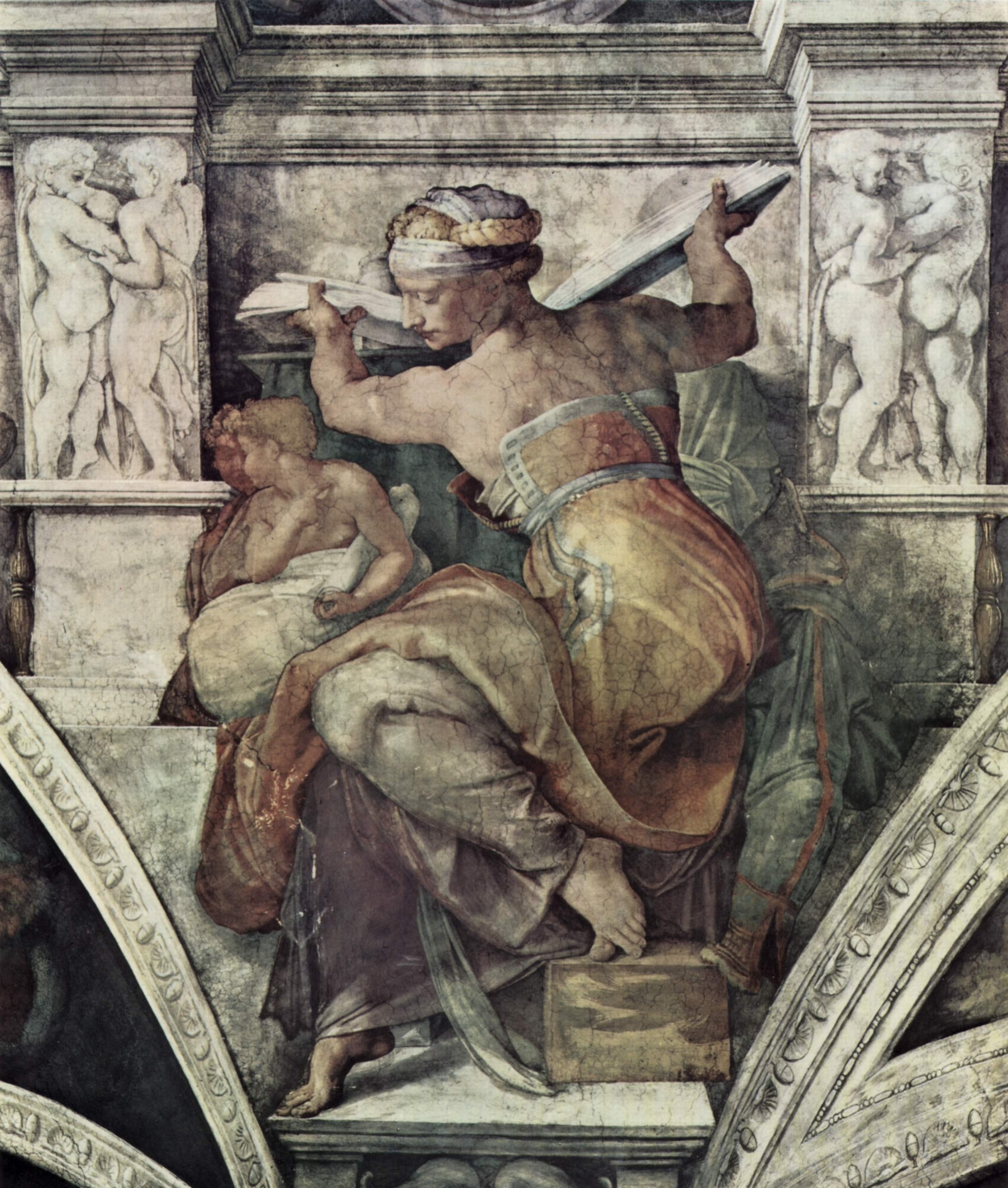
The Libyan Sibyl is one of the frescoes Michelangelo painted around 1511–1512 on the ceiling of the Sistine Chapel in the Vatican: a seer in a gold-yellow dress twists round on her throne and, with both arms, lifts a huge open book behind her back. On the ceiling the painted field is about 395 cm high and 380 cm wide, far larger than any size we paint. We paint her for you by hand and to order, in oils on canvas, in 8 portrait sizes from 40 x 49 to 172 x 200 cm or made to measure, and you receive a photograph of the finished painting before it ships.
| Title: | The Libyan Sibyl |
| Other titles: | La Sibilla Libica · Die Libysche Sibylle |
| Painter: | Michelangelo Buonarroti (1475–1564) |
| Year painted: | c. 1511–1512 |
| Original size: | about 395 cm x 380 cm (height x width) |
| Original technique: | Fresco |
| Painting style: | High Renaissance |
| Located at: | Sistine Chapel, Vatican City |
| Our reproduction: | Hand-painted oil on canvas, 8 sizes or made to measure |
The Libyan Sibyl – Michelangelo
What does The Libyan Sibyl show?
The sibyl sits on a stone throne, yet there is little stillness in her. She has turned her body so far that we see mostly her back; her head swings round into profile and her eyes are lowered. With arms spread wide she grips an enormous open book that stretches behind her shoulders and head, its pages fanning apart.
Her shoulders and arms are bare and full of light. A gold-yellow dress, belted with pale grey-blue bands, gives way to a lilac skirt in broad folds, and golden braids show beneath a turban of light cloth. One bare foot rests on its toes on a small stone block; the other stands at lower left.
On the left, beside her knee, sits a child with a scroll under his arm and a hand at his chin, a second child’s head in shadow behind him. On the pilasters either side, two pairs of naked putti are painted like grey marble reliefs.
Who were the sibyls, and what does the Libyan Sibyl mean?
The sibyls were prophetic women of the ancient world who lived at shrines and temples; people saw them as the mouthpiece of the gods, passing divine messages on to humankind. Renaissance readers took their prophecies as foretelling Christ, so five of them sit on the pope’s ceiling beside seven prophets of Israel.
Tradition knew ten sibyls, and Michelangelo chose five. Nobody knows why he picked these. O’Malley suggests that the four besides the Cumaean were chosen to cover a wide stretch of the world as it was then known: Africa, Asia, Greece and Ionia. In that reading the Libyan Sibyl stands for Africa. What she reads, the sources do not say; Michelangelo paints the physical effort, not a text.
Why is this sibyl so well known?
The twelve prophets and sibyls are the largest figures on the entire ceiling. Michelangelo thought of himself above all as a sculptor, and here he paints a body like a statue you could walk around: back, shoulder blades, upper arm and the profile of the face are all visible at once.
Between 1980 and 1989 the ceiling was cleaned of candle smoke and layers of varnish, and since then its light colours, closer to those of Michelangelo’s day, can be seen again. On this sibyl the gold-yellow, lilac and green look almost fresh.
To read further, try the English Wikipedia article; it covers the whole Sistine Chapel ceiling rather than this one figure, with a separate section on the sibyls.
Where is the original Libyan Sibyl?
The fresco is still on the Sistine Chapel ceiling in the Vatican, where prophets and sibyls are enthroned in the triangular fields between the windows.
Pope Julius II gave the commission. Michelangelo, who saw himself as a sculptor rather than a painter, accepted it reluctantly and even put forward his young rival Raphael instead. He painted the ceiling between 1508 and 1512, and the Libyan Sibyl around 1511–1512, in the last stage of the work.
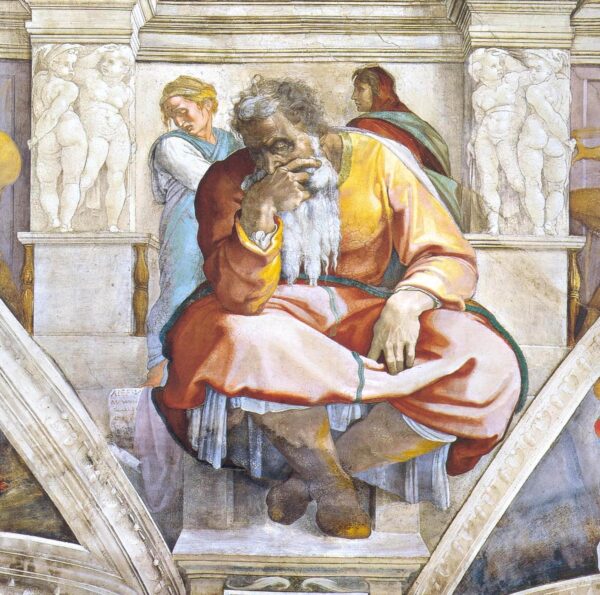
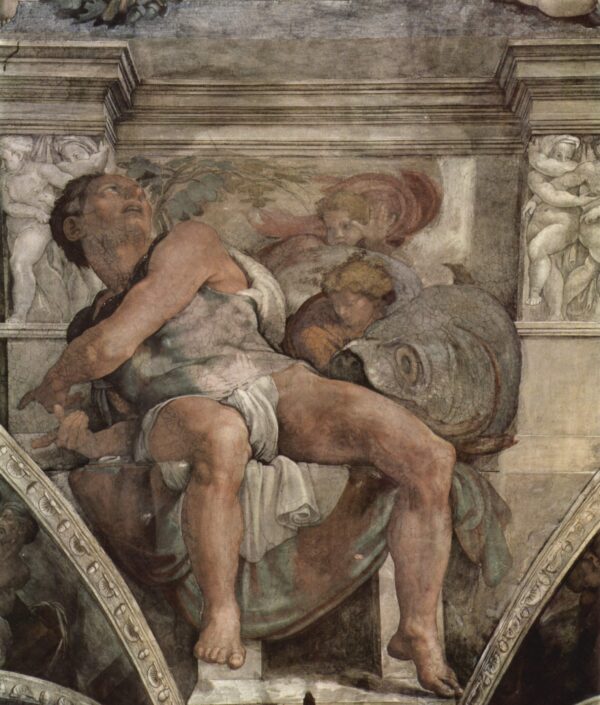
Below each figure is a painted marble tablet with its name, held up by a putto; the view we paint from shows the sibyl in her niche without that tablet. Above the altar of the same chapel sits Jonah, leaning far back and gazing upwards beside a great fish; we offer him as the painting The Prophet Jonah.
The Libyan Sibyl or another Michelangelo?
The Libyan Sibyl is a canvas painting for anyone who loves movement and warm colour, at home beside bookshelves or warm wood.
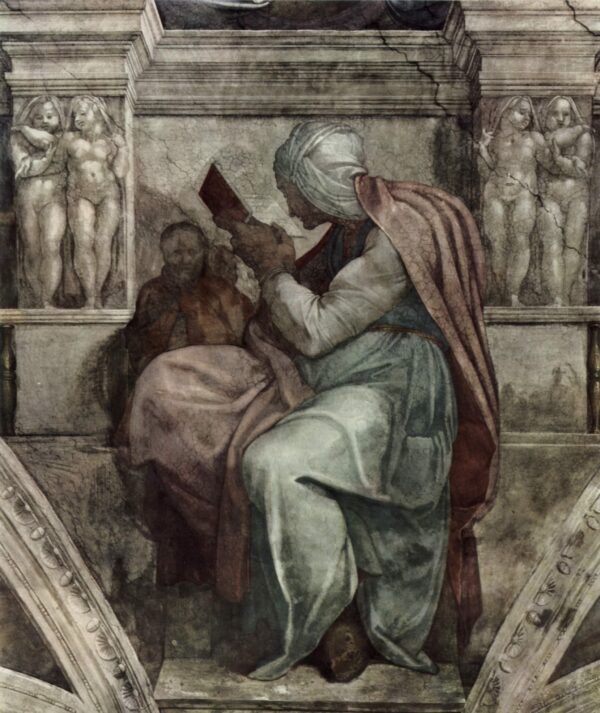
A calmer reader appears in The Erythraean Sibyl: seen in profile with her legs crossed, she leafs through a book on a lectern while a putto above her lights a lamp with a torch. For an older, massive seer with a white head cloth and muscular arms, look at The Cumaean Sibyl.
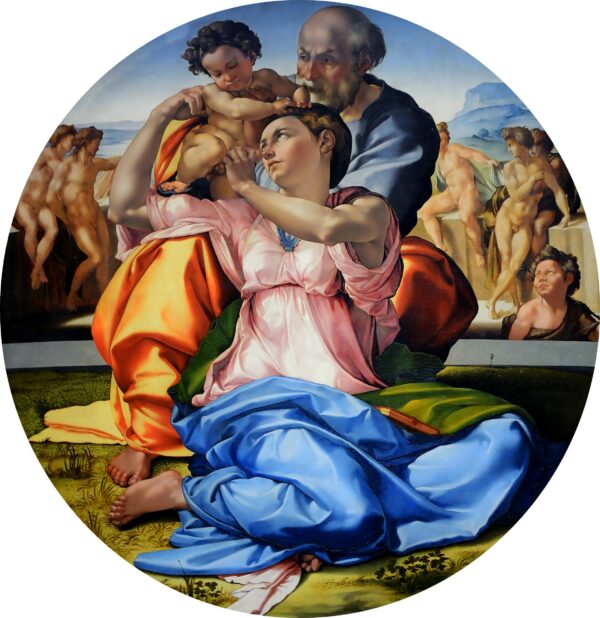
A young prophetess with a scroll and wide-open eyes is The Delphic Sibyl. All our famous Michelangelo paintings, prophets and sibyls included, are gathered on the Michelangelo page.
How is your sibyl painted on canvas?
The original is a fresco: the colours were laid into fresh plaster on the curved vault, high above the floor. Our Libyan Sibyl is an oil painting reproduction, hand-painted on canvas. The technique is different, but the subject and the relationships of colour stay, so you receive a real painting that can be stretched, framed and hung.
Work begins only after you order. The twisting body, the arms and the book are laid in first so the proportions hold, then the child and the painted stone; colour follows layer by layer, from shadow to light.
The bare back and arms need warm, soft skin tones, and the gold, lilac and green fabric needs clean folds. Up close you see real brushstrokes.
Which size is right for your wall?
In short: 40 x 49 or 46 x 55 cm for a shelf, a desk or a narrow wall, 64 x 76 or 72 x 85 cm for a bedroom or hallway, 90 x 107 or 120 x 140 cm above a sofa or sideboard, and 132 x 160 or 172 x 200 cm for a tall wall, a stairwell or a room with a high ceiling.
The Libyan Sibyl comes in 8 portrait sizes (width x height): 40 x 49, 46 x 55, 64 x 76, 72 x 85, 90 x 107, 120 x 140, 132 x 160 and 172 x 200 cm. The fresco on the ceiling is about 395 cm high and 380 cm wide; our largest size, 172 x 200 cm, reaches roughly half its height.
The format is almost square, so it sits well above a sofa or a bed. As a painting for the living room she is strongest at 90 x 107 or 120 x 140 cm. Hang her with the face a little above eye level.
Can I order another size or a frame?
Yes. For a different proportion we adapt the composition so the book, arms, turban, feet and the child stay whole, and your Michelangelo reproduction keeps its diagonal from raised book to foot. Send us the width and height through our made-to-measure request, and we will reply with a price and a lead time.
The sibyl can travel to you rolled, on a stretcher bar or already framed. Our workshop in Slovenia does the stretching and framing, and every painting we send leaves from there. In our 3D app you choose the frame; seeing the painting on your own wall is a separate service.
How long does delivery take, and how does it arrive?
The painting is ready to ship 15 to 45 working days after you confirm. Before we pack it, we send you a photograph of the finished painting; if you want a change, we make it before dispatch. Orders shipped inside Slovenia or elsewhere in the EU carry no customs charges, and our returns policy covers every order.
The Libyan Sibyl is a fine gift for a reader, a librarian, a teacher, a student of art history or anyone drawn to the Renaissance. When the right size is hard to guess, a wall art voucher leaves the choice to them.
Frequently asked questions
Where can I see the original?
In the Sistine Chapel in the Vatican, on the ceiling, in a triangular field between the windows.
What is the sibyl doing with the book?
She lifts a huge open book behind her back; the sources do not explain why.
Is it a print?
No. Each one is a hand-painted copy, made by our painter with brush and oil paint.
How large is the fresco in the chapel?
About 395 cm high and 380 cm wide; our largest size is 172 x 200 cm.
What is a sibyl?
A prophetess of the ancient world; the Renaissance read the sibyls as heralds of Christ.
Does it suit a living room or a bedroom?
Yes, both; for a bedroom a medium size works best.
Can you paint it in a different size?
Yes, send us the width and height you want and we will reply with a price and a date.
How long is the wait?
15 to 45 working days; a photograph of the finished painting reaches you before dispatch.
- Subject: a sibyl in gold-yellow and a light turban twists round to lift a huge open book.
- Original: fresco, c. 1511–1512, about 395 x 380 cm (height x width), on the Sistine Chapel ceiling, Vatican City.
- Ours: hand-painted to order in oils on canvas, 8 portrait sizes from 40 x 49 to 172 x 200 cm or made to measure.
- Worth knowing: in O’Malley’s reading of the ceiling, the Libyan Sibyl stands for Africa among its five sibyls.