







































Description
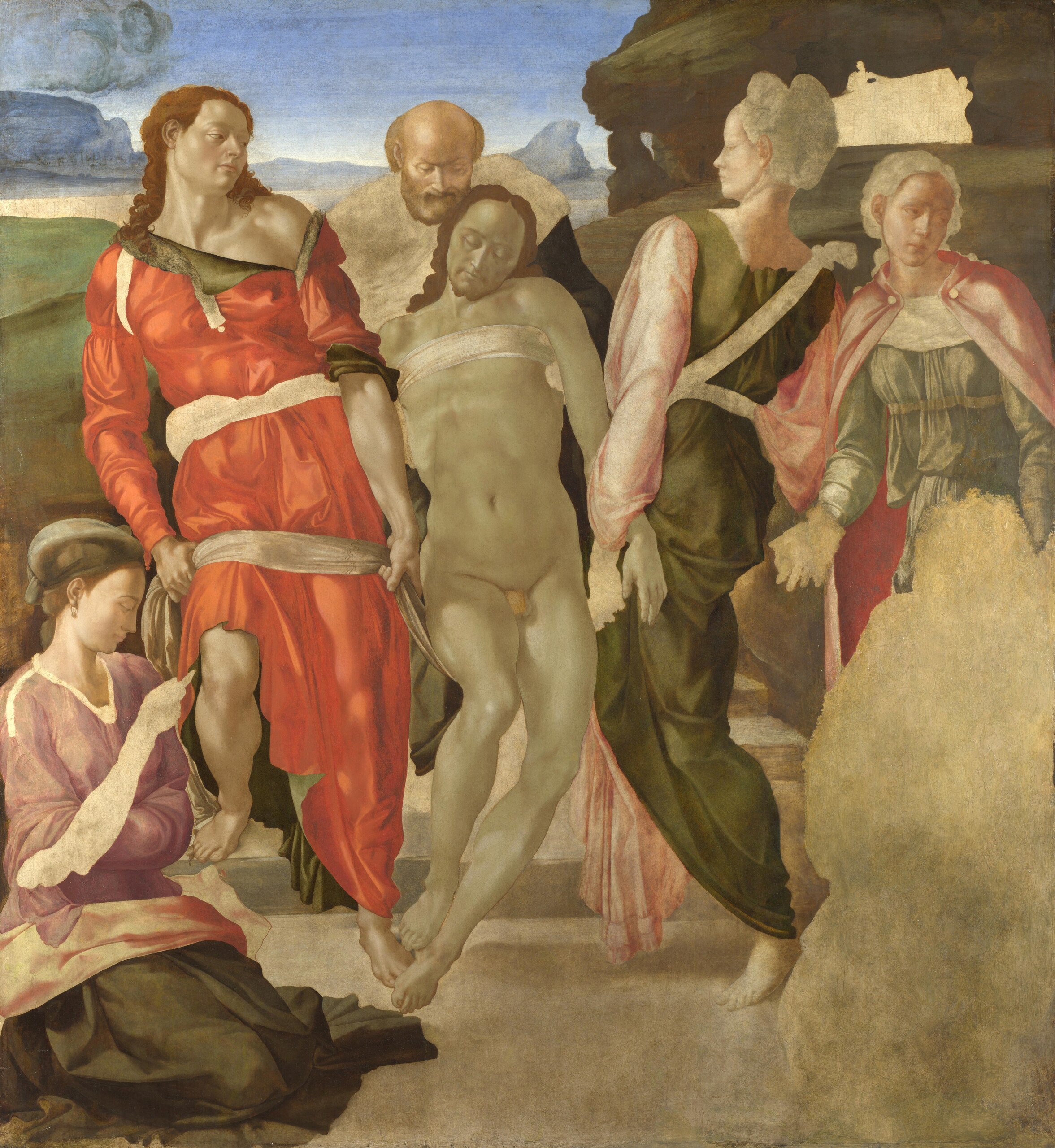
The Entombment is an unfinished painting by Michelangelo from around 1500–1501: the dead Christ, naked, is carried almost upright up a flight of steps towards the tomb, which was to be painted into the rock at the top right. The original, oil on panel, is 161.7 cm high and 149.9 cm wide and belongs to the National Gallery in London. We paint it for you by hand in oils on canvas, in one of 7 portrait sizes between 104 x 115 and 234 x 244 cm or made to measure, and send you a photograph of the finished painting before dispatch.
| Title: | The Entombment |
| Other titles: | La Deposizione nel sepolcro · Die Grablegung |
| Painter: | Michelangelo Buonarroti (1475–1564) |
| Year painted: | c. 1500–1501 |
| Original size: | 161.7 cm x 149.9 cm (height x width) |
| Original technique: | Oil on panel |
| Painting style: | High Renaissance |
| Located at: | National Gallery, London, United Kingdom |
| Our reproduction: | Hand-painted oil on canvas, 7 sizes or made to measure |
The Entombment – Michelangelo
What does The Entombment show?
Christ’s body hangs at the centre of the panel. It is naked, the head has dropped towards the right shoulder and the eyes are closed. He is not laid flat, as in most versions of this scene, but held nearly upright on long bands of pale cloth that pass under his arms and around his hips.
On the left a long-haired young man in an orange-red gown takes the weight, one foot raised onto a higher step. A bald, bearded old man leans in behind Christ’s head. On the right a figure in dark green with pink sleeves holds the other end of the bands, and behind her stands a woman in a rose-pink cloak.
At the lower left a woman in pinkish violet kneels with lowered eyes. The lower right corner was never painted: only the bare brownish ground shows there. Behind them opens a landscape of blue sky and distant mountains, with a dark overhanging rock at the top right.
Who are the figures, and what is happening?
The Gospels tell how, after the Crucifixion, the body of Jesus was taken down from the cross and laid in a tomb cut into the rock. Michelangelo chooses the moment when it is carried up the steps to the entrance of that tomb.
The figures are hard to name, since Michelangelo painted men and women much alike. The young man in red is probably Saint John the Evangelist. The bearded man behind Christ may be Joseph of Arimathea, who gave up his own tomb for the burial, or Nicodemus. The kneeling woman is possibly one of the Three Marys, perhaps Mary Magdalene; the two figures on the right remain uncertain.
According to Wikipedia, the empty corner at the lower right was meant for a kneeling Virgin Mary. Showing the body upright was unusual for this subject; it may point to the coming Resurrection and to the raising of the bread at Mass.
Why is this unfinished panel so admired?
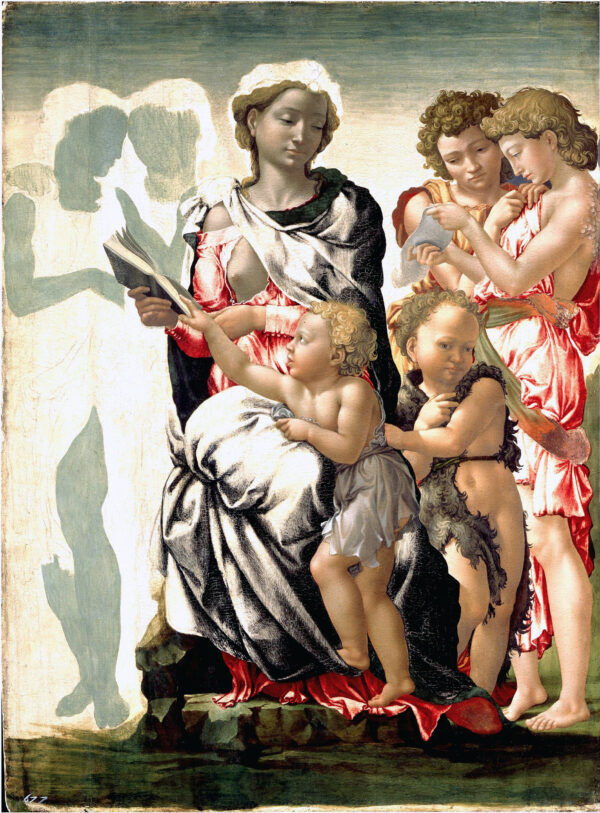
Michelangelo thought of himself above all as a sculptor, the maker of the David and the Pietà, and only a handful of paintings are attributed to him. Among them is The Manchester Madonna, which also hangs in the National Gallery.
Because the work was left unfinished, it shows how he painted: instead of sketching the whole composition first, he completed one area after another, as a fresco or tempera painter would. Bare patches of ground sit next to fully modelled faces, and on the rocks you can see where he scratched paint away.
Christ’s firm body, modelled as if carved from marble, and the light falling from the left betray the sculptor. The English Wikipedia article on this panel covers its history and the debate about who painted it.
Where is the original, and how did it reach London?
The original is in the National Gallery in London under the number NG790.
Documents found in 1981 show that in 1500 Michelangelo was commissioned to paint a panel for a funerary chapel in Sant’Agostino in Rome, and later returned the money. This panel is probably that commission, left unfinished when he went back to Florence in 1501. The National Gallery’s catalogue suggests he left to secure the great block of marble that became his David.
By the 1650s the panel belonged to the Farnese collection. In 1868 the National Gallery bought it from Robert Macpherson, a Scottish photographer living in Rome. Today the panel is generally given to him, although some scholars think a pupil may have painted it from his drawing.
The Entombment or another Michelangelo?
The Entombment is a canvas painting for people drawn to the Renaissance, to Christian art and to Michelangelo the sculptor. Its grave, quiet mood suits a study, a library, a wide hallway or a sitting room with a high ceiling.
For a brighter, more domestic subject, look at The Doni Tondo, where Mary, Joseph and the Child appear in clear, strong colours. Quite different again is the early work The Torment of Saint Anthony, in which winged demons attack the old saint high in the air.
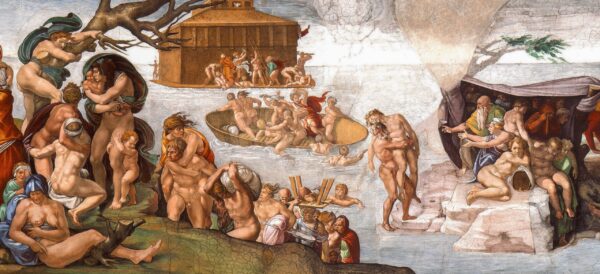
To see Michelangelo as the painter of the Sistine ceiling, choose The Deluge, one of the first scenes he painted there. All the famous Michelangelo paintings we offer are gathered on the Michelangelo page.
How is our version painted?
The original is oil on wood; we paint ours in oils on canvas, starting only once you order. The painter first draws the steps, the rock and the six figures, then lays in the colour in thin layers, from shadow towards light.
Christ’s pale body takes the most care: Michelangelo modelled it like a statue, so its form must come from soft transitions between light flesh and greenish-grey shadow.
The unfinished parts, the empty corner and the pale patches on the robes, are painted as they survive on the panel. This Michelangelo reproduction has a living surface where a raking light picks out the brushstrokes, and as an oil painting reproduction in warm earth tones it looks calm by day.
Which size suits which wall?
In short: 104 x 115 or 120 x 125 cm above a sideboard, in a study or a hallway; 130 x 145 or 150 x 160 cm above a sofa or in a dining room; 170 x 180 cm for a large sitting-room wall; 196 x 203 or 234 x 244 cm for a tall room, a stairwell, a hall or a chapel.
We paint The Entombment in 7 portrait sizes (width x height): 104 x 115, 120 x 125, 130 x 145, 150 x 160, 170 x 180, 196 x 203 and 234 x 244 cm. The panel itself measures 149.9 cm across and 161.7 cm in height, so 150 x 160 cm comes closest: practically the same width and 1.7 cm lower.
Six full-length figures need room, so even the smallest size is over a metre wide. As a painting for the living room it works best at 150 x 160 or 170 x 180 cm. Hang it so that Christ’s head sits a little above eye level, since the panel was meant to be seen from below.
Can I order another size or a frame?
Yes. For a different width or height we widen or narrow the composition so that every figure stays whole. Send us the size you have in mind and we will reply with a price and a lead time.
We ship it rolled, on a stretcher bar or framed in our workshop in Slovenia. Our 3D app lets you choose only the frame moulding for The Entombment; seeing the painting on your own wall is a separate service.
A gilded or dark brown wooden frame suits the warm earth colours and the red gown.
How long does delivery take, and how is it sent?
The painter starts once you confirm your order, and your Entombment is ready to ship within 15 to 45 working days. Before it leaves you receive a photograph of the finished painting, and we make any change you ask for. Orders within Slovenia and the rest of the EU travel without customs duties, and our returns policy covers every purchase.
It makes a fitting gift for a lover of Renaissance art or for a parish. If you are unsure which size would suit, give a wall art voucher instead.
Frequently asked questions
Where can I see the original panel?
In the National Gallery in London, where it carries the number NG790.
Who is carrying Christ’s body?
Probably Saint John the Evangelist in red and a bearded old man, perhaps Joseph of Arimathea or Nicodemus.
Is it a print?
No, it is a hand-painted copy in oils on canvas.
How big is the original?
It is 161.7 cm high and 149.9 cm wide; our nearest size is 150 x 160 cm.
Why is the lower right corner empty?
Michelangelo never finished the panel; a kneeling Virgin Mary was planned there.
Is it suitable for a bedroom?
The subject is solemn; it suits a sitting room, study or hallway better than a bedroom.
Could my painting be made in an unlisted size?
Yes. Send us the width and height, and we reply with a price and a delivery date.
How long will I wait for it?
Allow 15 to 45 working days; you see a photograph of it before dispatch.
- Subject: the dead, naked Christ is carried upright up the steps to a rock tomb, with a young man in red on the left and a kneeling woman below.
- Original: c. 1500–1501, oil on panel, 161.7 x 149.9 cm, unfinished, National Gallery, London.
- Ours: painted by hand to order in oils on canvas, in one of 7 portrait sizes from 104 x 115 to 234 x 244 cm or made to measure.
- Worth knowing: the National Gallery bought the panel in 1868.