







































Description
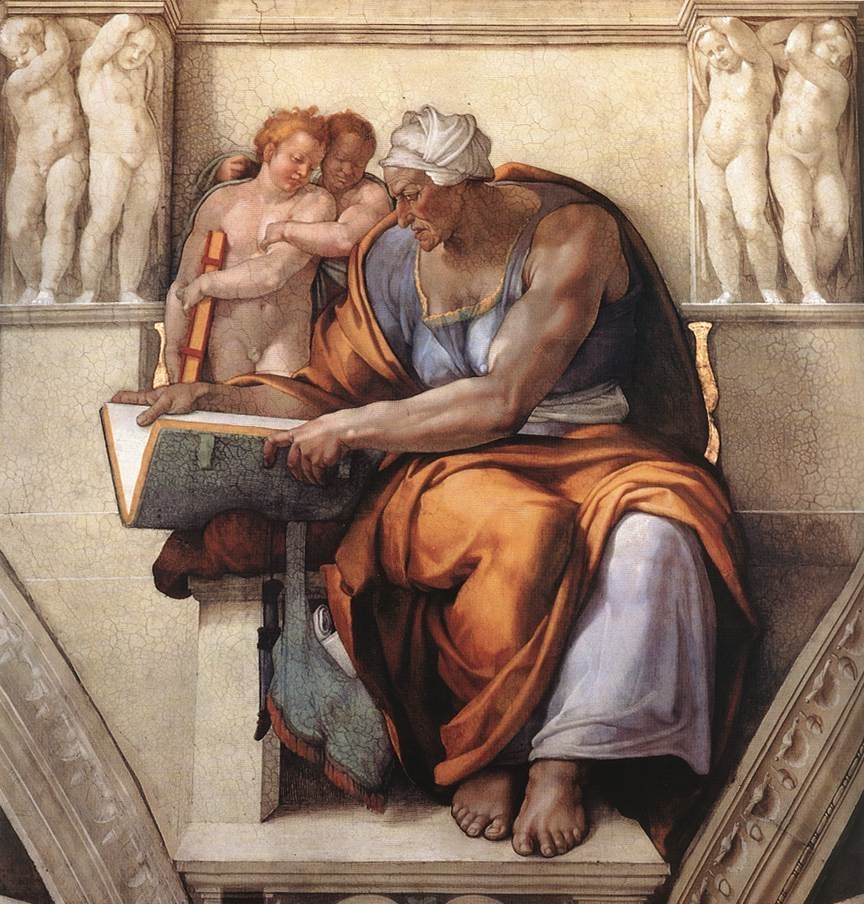
The Cumaean Sibyl is a fresco Michelangelo painted around 1510 on the ceiling of the Sistine Chapel in the Vatican: a massive old woman with a white head cloth and muscular arms sits on a stone throne and bends over a large open book. On the ceiling the field is about 375 cm high and 380 cm wide, many times larger than any size we paint. Our painter makes it to order in oils on canvas, in 4 near-square sizes from 43 x 47 to 70 x 70 cm or made to measure, and before dispatch you receive a photograph of the finished painting.
| Title: | The Cumaean Sibyl |
| Other titles: | La Sibilla Cumana · Die Cumäische Sibylle |
| Painter: | Michelangelo Buonarroti (1475–1564) |
| Year painted: | c. 1510 |
| Original size: | about 375 cm x 380 cm (height x width) |
| Original technique: | Fresco |
| Painting style: | High Renaissance |
| Located at: | Sistine Chapel, Vatican City |
| Our reproduction: | Hand-painted oil on canvas, 4 sizes or made to measure |
The Cumaean Sibyl – Michelangelo
What does The Cumaean Sibyl show?
An old woman of extraordinary bulk sits on the canvas. Her head is wrapped in a white cloth, her sharp-nosed face is turned to the left in profile, eyes lowered to the book. Her bare arms are so muscular that you would sooner expect them on a blacksmith than on a seer.
Over a blue-violet dress with a deep neckline she wears a wide orange-red mantle that falls from her shoulders across her knees almost to the floor. A pale, nearly white skirt shows beneath it, and her bare feet rest on a stone base.
She holds the big green-bound book open at her right side, one hand on its edge, the fingers of the other following the lines. A greenish fringed bag hangs below the book. Behind the sibyl’s back, on the left of the painting, stand two naked children; the one with reddish curls carries a closed book under his arm, the other presses close to his shoulder. On the pilasters either side of the niche, pairs of small naked putti are painted as white marble.
Who was the sibyl of Cumae?
In the ancient world the sibyls were prophetic women who lived at shrines and temples and passed on the messages of the gods. This one takes her name from her oracle at Cumae.
The Roman poet Virgil quotes her in his Fourth Eclogue, announcing that a new progeny sent from heaven would bring back the Golden Age. Many in the Renaissance read those lines as foretelling the birth of Jesus.
Twelve figures who foretold a Messiah sit on the ceiling: seven prophets of Israel and five sibyls.
Why Michelangelo chose these five out of ten possible sibyls is not known. The historian O’Malley suggests that four of them were picked to cover Africa, Asia, Greece and Ionia; in that reading the Cumaean is the one who stands outside the map.
Why is this sibyl so famous?
The prophets and sibyls are the largest figures on the whole ceiling, yet among them the Cumaean is the one people remember. Michelangelo does not paint her as a frail old woman but as a body with the weight of a marble statue, its back, forearms and knees as if carved.
Age here means persistence rather than weakness: the sibyl keeps reading, intent and unhurried.
In the most widely held view, the Cumaean Sibyl was painted in the middle of the chapel, in the same phase as the prophet Ezekiel. Only then did Michelangelo see his first scenes from the floor, and he painted the figures on a larger scale. The English Wikipedia article on the Sistine Chapel ceiling as a whole describes how the work progressed.
Where is the fresco today?
The fresco is still in place on the ceiling of the Sistine Chapel in the Vatican, about 20 metres above the floor. The colours were laid into fresh, damp plaster and bonded with it chemically.
Pope Julius II entrusted the ceiling to Michelangelo, who worked on it from 1508 to 1512.
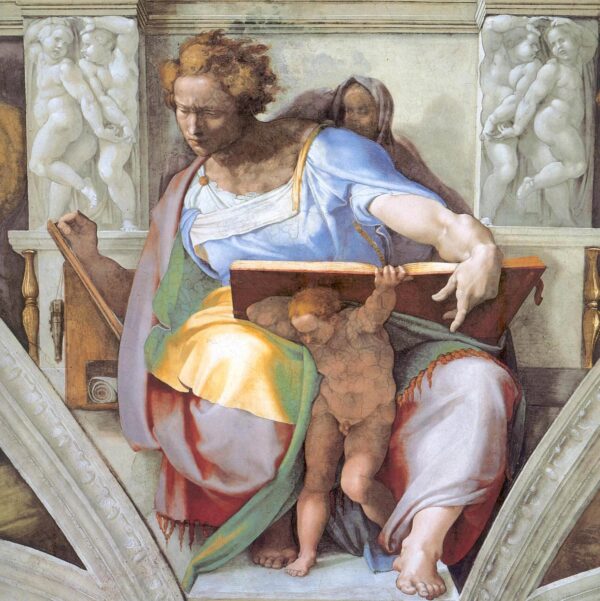
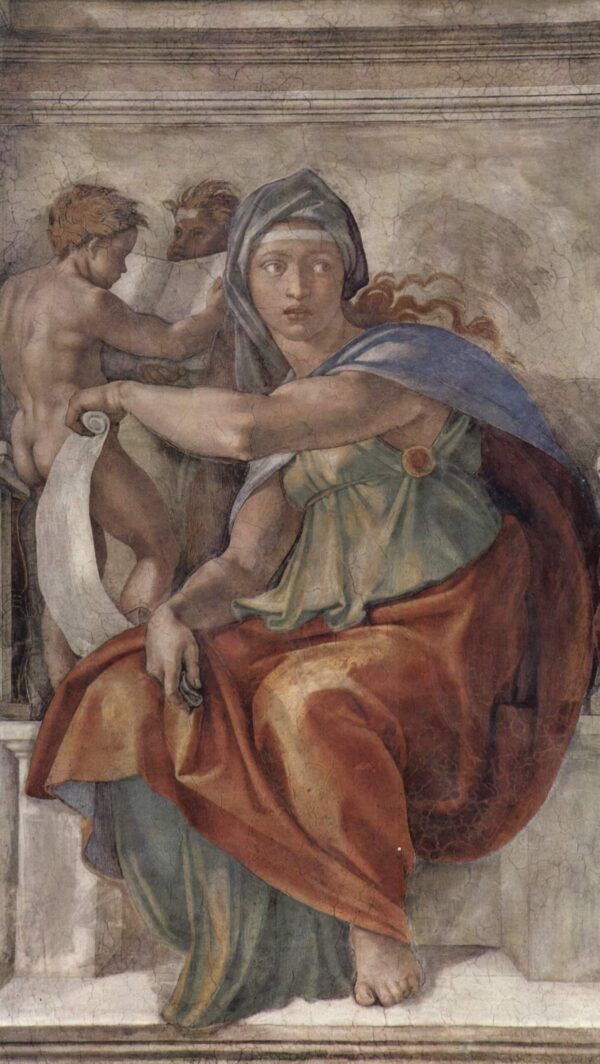
The Cumaean Sibyl sits on one of the long sides of the chapel, between the prophets Isaiah and Daniel. On the same side, nearer the main entrance, is the young seer shown in The Delphic Sibyl. Below the Cumaean’s throne a putto holds a painted marble tablet inscribed CVMAEA; our painting, like the source we paint from, shows the sibyl in her niche without the tablet.
The Cumaean Sibyl or another sibyl?
The Cumaean Sibyl is a canvas painting for anyone more drawn to character and strength than to charm. The near-square format suits a library, a study or a hallway.
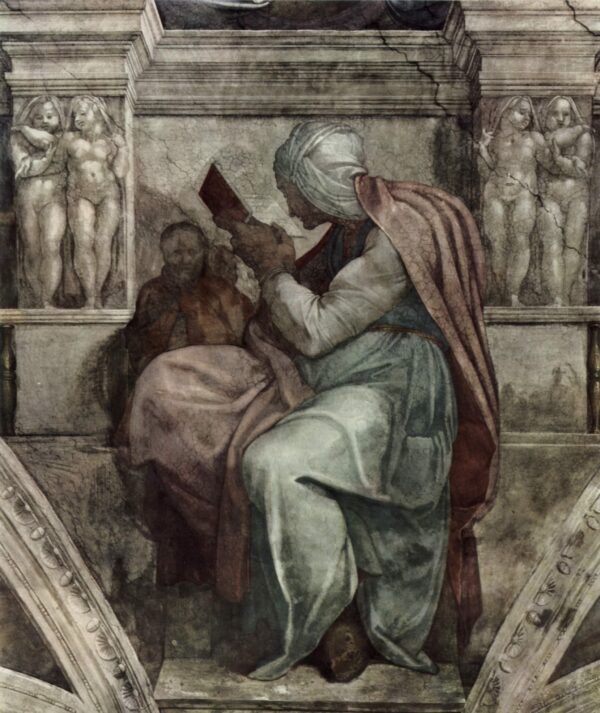
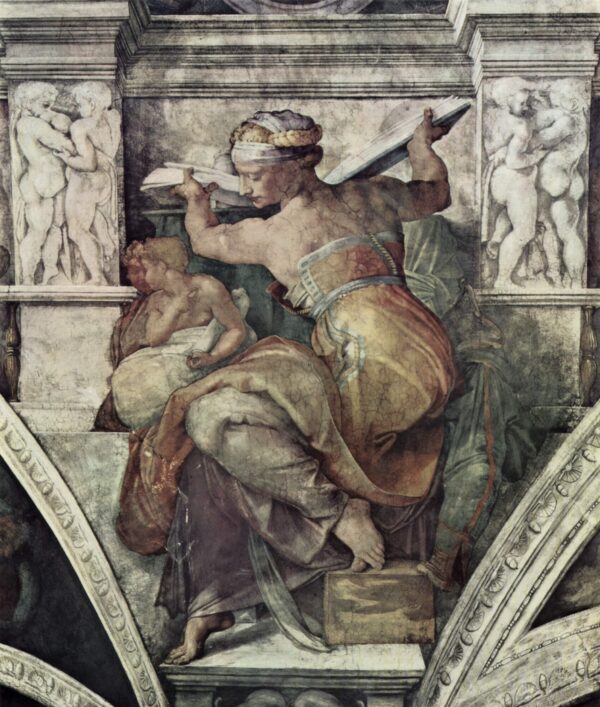
For another great book, see The Libyan Sibyl: the seer twists round and lifts a huge open book down from behind her. The Persian Sibyl is old too, hunched over a small book held close to her eyes. A calm profile with crossed legs belongs to The Erythraean Sibyl, who leafs through a book on a lectern while a putto above her lights a lamp.
All the sibyls and prophets we paint are on the Michelangelo page, next to our other famous Michelangelo paintings.
How does our painter turn a fresco into oil on canvas?
Plainly put: Michelangelo painted the sibyl straight into the plaster of the curved ceiling, while yours will be an oil painting reproduction made by hand on canvas. The fresco is the model, the technique is entirely different, and what arrives is a painting you can stretch, frame and hang.
The Cumaean Sibyl is painted only after you order it. The painter starts with drawing, fixing where the head, shoulders, book and children fall. Then he builds the colour in layers, from dark underpainting to bright highlights.
The arms and the mantle take the most work. The muscles need soft transitions between light and shadow, the orange-red mantle deep folds with warm reflections.
The finished surface is real oil paint, with brush marks you can feel.
Which size fits which wall?
In short: 43 x 47 cm for a shelf, a desk or a narrow wall by a door, 50 x 52 cm for a hallway or bedroom, 60 x 60 cm above a chest of drawers or in a reading corner, and 70 x 70 cm above an armchair, a small sofa or a fireplace.
The Cumaean Sibyl comes in 4 near-square sizes (width x height): 43 x 47, 50 x 52, 60 x 60 and 70 x 70 cm. The fresco on the ceiling is about 375 cm high and 380 cm wide, more than five times our largest size of 70 x 70 cm.
As a painting for the living room, 70 x 70 cm is the best choice, above an armchair or next to a wall of books.
Can I order another size and a frame?
Of course. If you need a taller or wider format, we adapt the composition so that the head cloth, the book, the bare feet and both children behind her shoulder stay whole. In any format this Michelangelo reproduction keeps the weight and calm of the seated sibyl. Send us the width and height you need, and we will reply with a price and a lead time.
The sibyl can travel rolled, stretched on a stretcher bar or already framed. Before the sibyl leaves, our Slovenian workshop stretches and frames her to your choice. You choose the frame in our 3D app; seeing the painting on your own wall beforehand is a separate service.
When will it arrive, and how is it delivered?
Work starts as soon as you confirm your order, and within 15 to 45 working days the painting is ready to ship. You first get a photograph of the finished canvas, and any change you ask for is made before we pack it. There are no customs charges within Slovenia or the rest of the EU, and our returns policy applies to every order.
The Cumaean Sibyl makes a fine gift for a teacher, a librarian or anyone who loves books and antiquity. If the size is still open, a wall art voucher leaves the choice to the person who receives it.
Frequently asked questions
Where can I see the original fresco?
On the ceiling of the Sistine Chapel in the Vatican, about 20 metres above visitors, between Isaiah and Daniel.
What is the sibyl reading?
A large open book bound in green; its text is not named.
Is this a print?
No. You receive a hand-painted copy, laid onto canvas in oils with a brush, stroke by stroke.
How large is the fresco?
About 375 cm high and 380 cm wide; our largest size is 70 x 70 cm.
Why does the sibyl have such muscular arms?
The fresco does not say; Michelangelo simply shows her old and immensely strong at once.
Is it right for a bedroom or a library?
Yes, it is calm and absorbed; it works just as well in a study or living room.
Can you paint it to other dimensions?
Yes. Tell us the width and height, and we will reply with a price and the date your sibyl will be ready.
How long is the wait?
15 to 45 working days; you see the finished sibyl in a photograph before dispatch.
- Subject: a massive old woman in a white head cloth, orange-red mantle and blue-violet dress reads a large open book; two children stand behind her.
- Original: c. 1510, fresco, about 375 x 380 cm (height x width), Sistine Chapel ceiling, Vatican City.
- Ours: painted by hand to order in oils on canvas, 4 near-square sizes from 43 x 47 to 70 x 70 cm or made to measure.
- Worth knowing: Virgil gave the Cumaean Sibyl the prophecy of a new Golden Age, which the Renaissance read as pointing to Christ.