
Description
Village Road, Auvers – the dark, early Cézanne
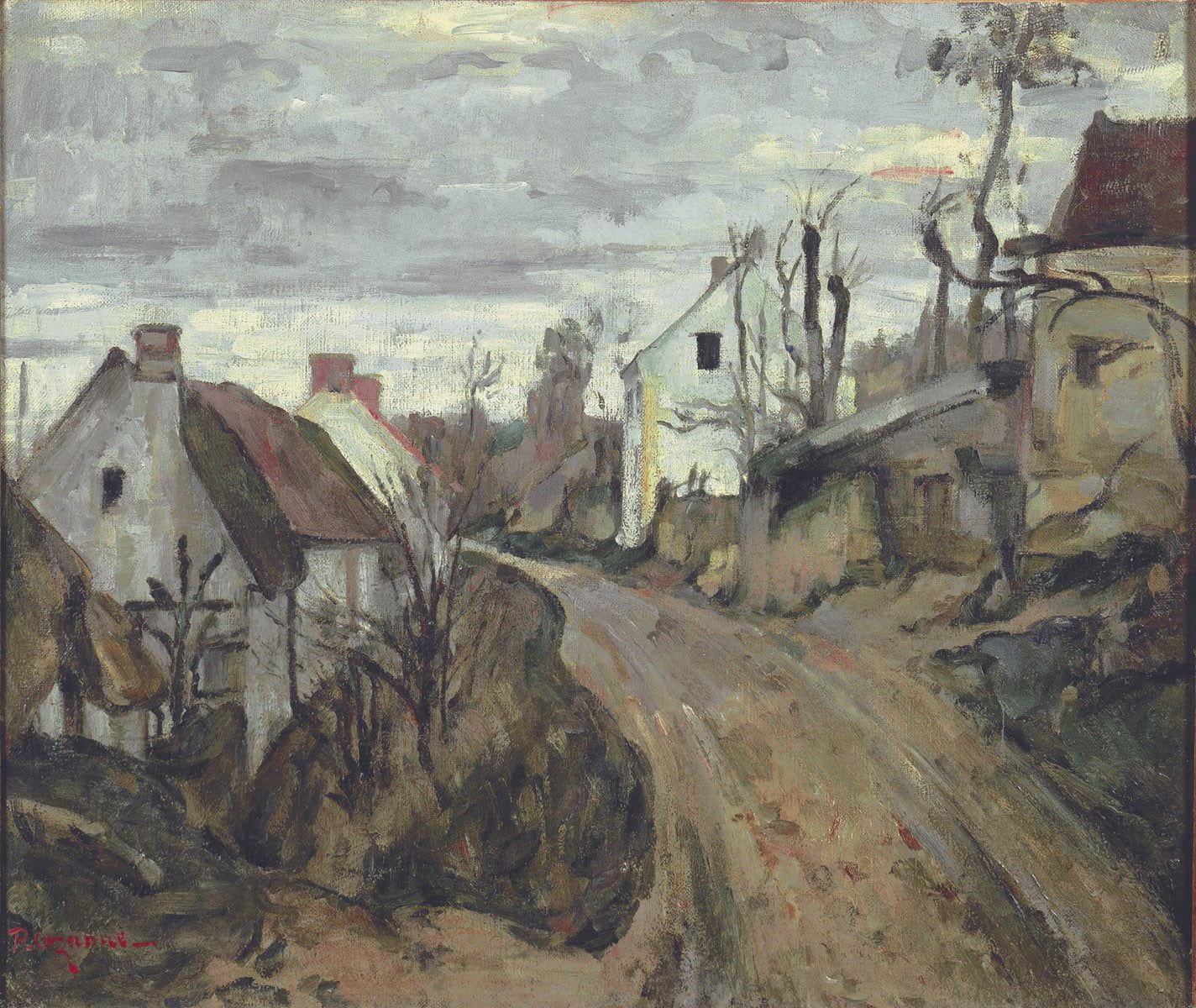
Village Road at Auvers is an early work from the beginning of the 1870s, when Cézanne’s palette was still heavy and earthen. A muddy road winds between low houses under a grey sky; the trees are bare. Our hand-painted reproduction on canvas brings this restrained, almost northern subject into your home, painted in oil on canvas.
Before the light arrived
This canvas shows Cézanne before the turn: the colours are dirty greens, browns and greys, the paint is thickly laid, and the scene is without sun. That is precisely what makes it valuable – it shows where the painter came from, before Pissarro turned him towards a lighter palette and towards working outdoors.
A village we know because of another painter
Auvers-sur-Oise is best known today as the place where Vincent van Gogh died in 1890. Seventeen years earlier Cézanne worked there – in the same village, on the same roads, but in an entirely different manner and without van Gogh’s drama.
What you see on the canvas
The road climbs from the foreground towards the middle and disappears behind the houses; on the left stands a white house with a dark roof, and on the right a bare bank rises with trees on it. The original is painted in oil on canvas and by the collection’s record measures 55.5 × 46 cm.
Earth tones for a quiet room
This early canvas lives on a thick application of paint that print cannot imitate – which is why we paint it by hand. It is available in ten sizes and to your own measurements. The subdued brown-grey scale suits older, darker furniture. Which frame to choose our 3D preview will show you. Among our reproductions of famous paintings you will find Cézanne’s other village and road subjects: The House of Père Lacroix in Auvers, Road at Chantilly and Bend in Forest Road.
- Subject: Village Road, Auvers, Paul Cézanne, 1872–1873
- Technique: hand-painted painting, oil on canvas, reproduction
- Sizes: 10 formats, stretched on a wooden stretcher frame on request, or made to your measurements
- Fact: painted at Auvers seventeen years before Vincent van Gogh died in the same village