



Description
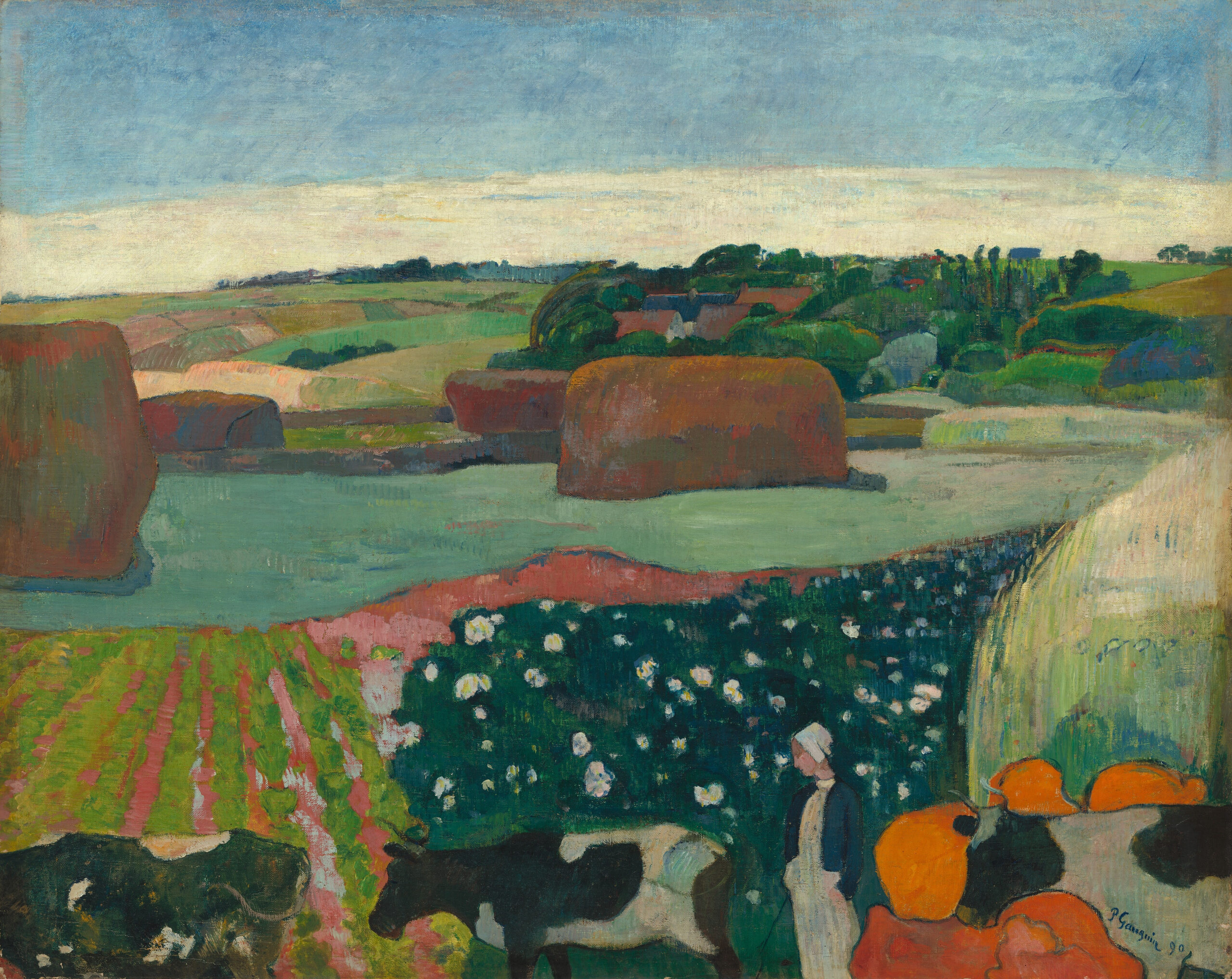
Haystacks in Brittany – the museum records the work as a gift in memory
Two large brown haystacks stand in the middle of the field, one taller and sharply pointed, the other lower and broad. Below them stretches light green grass with black and white cows grazing on it. A band of meadow runs across the foreground, strewn with small white and reddish flowers laid on in short dabs of colour. At the left edge two figures in orange headscarves bend to work in the grass. Behind the stacks a rolling green slope rises, and above it a pale, almost colourless sky. At the lower right a signature with a year is painted in. The work is held by the National Gallery of Art in Washington under inventory number 1972.9.11; it was painted in 1890.
Not bought and not bequeathed, but given in memory
The museum record notes no purchase for this canvas. The work entered the collection as a gift from the W. Averell Harriman Foundation, and specifically in memory of Marie N. Harriman. The record therefore attaches to the painting the name of a person who is not painted in it and whom nothing connected to it but the giver’s wish. This is common in museum records and almost never read; here it is the only account of how the canvas passed into public hands.
The painting is built in horizontal bands
If the eye travels upward, the scene falls apart into bands: the flowering meadow, then the band with the stacks and the cows, then the slope, then the sky. Each band has its own colour and its own density of stroke. Depth does not come from perspective but from the sequence of these bands laid one above another.
Two brown masses in an otherwise green field
The stacks are the only large dark shapes in the scene and carry an almost architectural weight: the first rises to a point, the second lies like a low roof. That is exactly why the eye reads them as buildings rather than as gathered fodder, although the title calls them what they are.
People and animals at the same scale
The figures at the left edge are painted at the same size as the cows and with the same quantity of paint. They are neither singled out nor diminished; they belong to the work going on in that field. The scene therefore reads as an account of labour rather than a scene with a hero.
How a hand-painted reproduction is made
Every painting here is made by hand in oil on canvas, stroke by stroke. In this motif the flowering meadow in the foreground is the hardest part: it is made of hundreds of small dabs that must stay separate, or the meadow becomes one even green area and the painting loses its liveliest passage. Before dispatch you receive a photograph of the finished work for approval. Nothing on these pages is printed; the colour is mixed and laid on again for each canvas.
- Subject: two haystacks in a field, cows and two figures at work.
- Technique: oil on canvas, short dabs of colour in the foreground.
- Sizes: landscape format, from 40 x 32 cm to 200 x 160 cm; 80 x 64 cm and 100 x 80 cm are often chosen.
- Of note: by the museum record the work is a gift in memory of a named person.
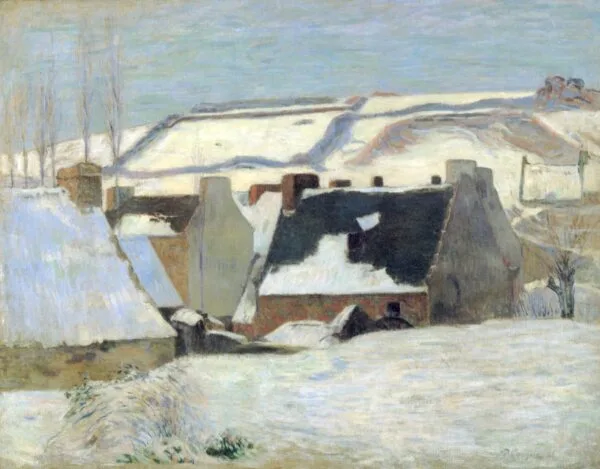
The same country, its buildings, its people and its winter: A Farm in Brittany, Breton Peasant Women and Winter Landscape (Vinterlandskap). The museum record gives the measurement as height by width: 74.3 x 93.6 cm.