







































Description
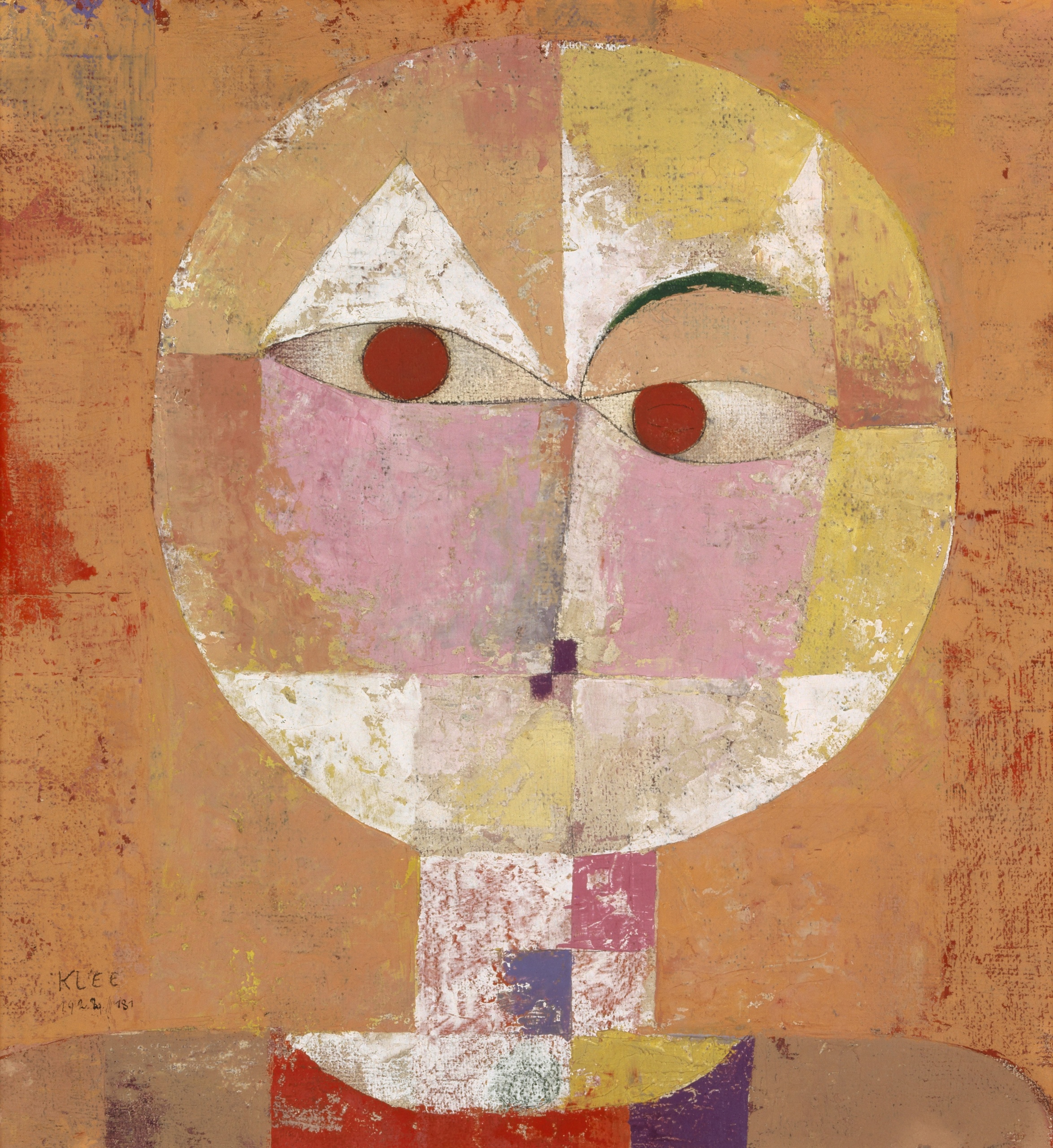
Senecio is a painting by Paul Klee from 1922: a round head that fills almost the whole surface is split into rectangles of orange, pink, yellow and white, and two round red eyes look out of it, one beneath a white triangle, the other beneath a dark green arched brow. The original is a small work in oil on canvas mounted on panel, only 40.3 x 37.4 cm, and it belongs to the Kunstmuseum Basel in Switzerland. Our painter paints it for you by hand on canvas, in oil or acrylic, in 8 upright, nearly square sizes from 40 x 41 to 190 x 200 cm or made to measure. Before we pack it, you receive a photograph of the finished work.
| Title: | Senecio |
| Other titles: | Head of a Man Going Senile (alternative English title) |
| Painter: | Paul Klee (1879–1940) |
| Year painted: | 1922 |
| Original size: | 40.3 cm x 37.4 cm (height x width) |
| Original technique: | Oil on canvas mounted on panel |
| Painting style: | Modernism |
| Located at: | Kunstmuseum Basel, Basel, Switzerland |
| Our reproduction: | Hand-painted in oil or acrylic on canvas, 8 sizes or made to measure |
Senecio – Paul Klee
What does Senecio show?
A large circle, which you read at once as a head, takes up nearly the whole surface. It sits on a warm orange ground that is rubbed thin in places, so red patches and the weave of the support show through. The circle is not a single colour: vertical and horizontal lines divide it into fields of pale pink, yellow, white and orange, as if it had been stitched together from patches.
The eyes are two round red discs set in thin, almond-shaped lids. The left one sits under a sharp white triangle, the right one under a dark green arc that reads as a raised eyebrow. The eyes are not level, so the face seems to look slightly sideways, with a puzzled air.
The mouth is a tiny dark violet mark made of two small squares. Below the head stands a narrow neck of white, pink and violet squares, and at the bottom a broad band of red and violet opens out, which you can read as a collar or as shoulders. At the lower left Klee wrote his name and the year 1922.
What does the name Senecio mean?
The painting has a second title, Head of a Man Going Senile.
English Wikipedia explains that the flat squares inside the circle resemble a mask or the coloured patches of a harlequin, and that this is where the title comes from: a reference to Senecio, an artist and performer.
The triangle over one eye and the curve over the other give the illusion of a raised eyebrow, so the face can look suspicious, kindly surprised or a little confused, depending on who is looking.
Why does this face hold the eye?
It is often called a cubist work, because it breaks the face into flat planes. Yet it stays soft and warm: the colours are pastel, the edges gently blurred, and the surface cracked and worn in places, like an old plastered wall.
Klee was a Swiss-born German artist who played the violin from childhood, in an orchestra too. Rilke wrote that his drawings seemed like transcriptions of music.
A short Wikipedia article on Senecio, in English, presents the work as an example of Klee’s principle that simple graphic elements are set in motion by energy from the artist’s mind.
Where is the original, and how big is it?
The original belongs to the Kunstmuseum Basel in Switzerland, where it is listed under inventory number 1569. Klee painted it in 1922, during the years he taught at the Bauhaus, where he worked from 1921 to 1931 alongside Wassily Kandinsky.
The work is small, measuring 40.3 x 37.4 cm (height x width). English Wikipedia describes it as oil on canvas mounted on panel, while the museum’s own record gives oil on gauze.
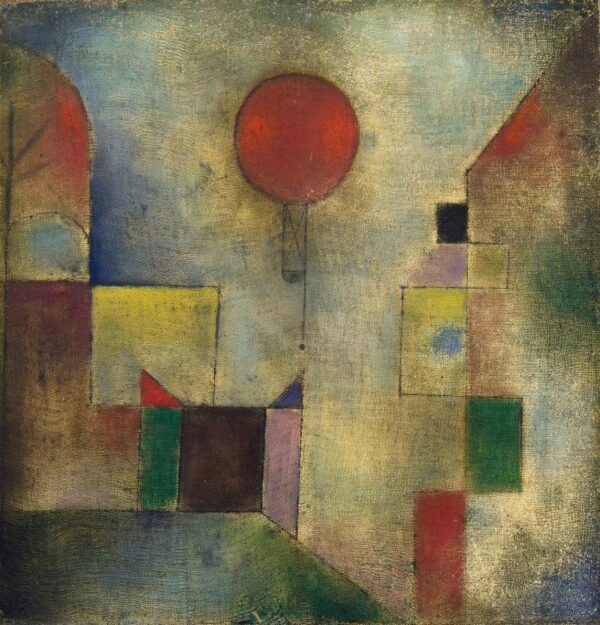
From the same year comes Red Balloon, a small oil on gauze with a red balloon floating above little houses built of coloured rectangles.
Senecio or another Klee?
Senecio is a canvas painting for anyone who wants a single face on the wall that looks back at them.
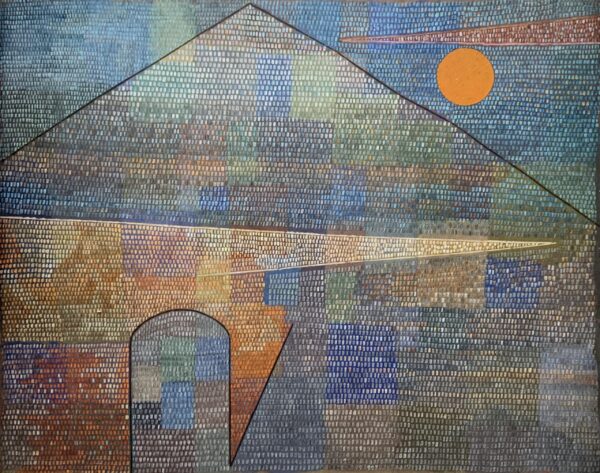
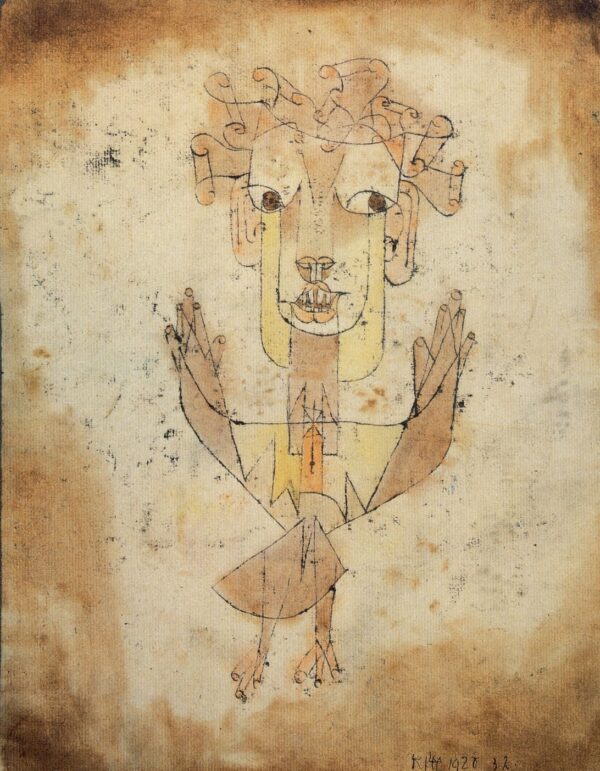
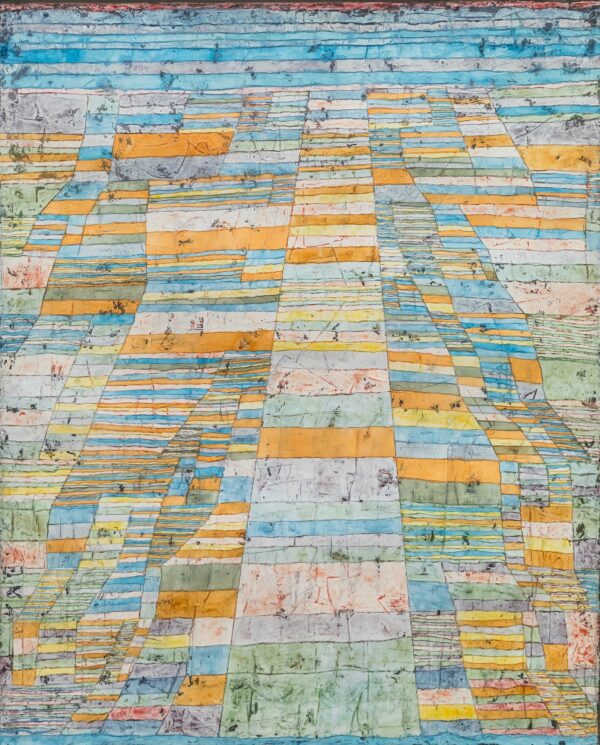
If Klee’s mysterious figures appeal to you, Angelus Novus, an angel with raised hands from 1920, is a close companion. If you prefer bands of colour without a face, take a look at Highways and Byways, and for a really large wall there is Ad Parnassum, scattered with thousands of tiny dots of colour.
You will find all the famous Paul Klee paintings we paint to order together on our Paul Klee page.
How do we hand-paint Senecio on canvas?
Klee’s original is a small oil on canvas mounted on panel, barely more than 40 cm tall. Ours is an oil painting reproduction on fresh canvas: the painter works in oil or acrylic, in the size you choose, and builds it up layer by layer, so it hangs on your wall like any other painted work.
He first draws the circle of the head and the boundaries between the fields, because the eyes, the triangle and the arched brow must sit exactly where they belong. Then he lays in the orange ground and the coloured fields of the face, and last of all adds the red eyes, the green brow, the violet mouth and the thin lines of the lids.
Which size fits which wall?
In short: 40 x 41 or 45 x 50 cm for a shelf, a hallway or a narrow wall beside a door, 59 x 65 and 77 x 85 cm above a chest of drawers or a bed, 100 x 105 cm above a sofa, and 125 x 140, 145 x 160 or 190 x 200 cm for a large empty wall that the head should own.
We paint Senecio in 8 upright, nearly square sizes (width x height): 40 x 41, 45 x 50, 59 x 65, 77 x 85, 100 x 105, 125 x 140, 145 x 160 and 190 x 200 cm. The original measures 37.4 x 40.3 cm (width x height), so most of our sizes enlarge the small work considerably; at 190 x 200 cm the face is about five times as wide as it is in Basel.
As a painting for the living room it looks best at 100 x 105 or 125 x 140 cm above the sofa, where the warm orange brings warmth into the room.
Can I have a different size or a frame?
Yes. If your wall calls for other proportions, we place the head so that the circle, the eyes and the neck stay whole, and we widen or narrow only the orange ground. Send us the size you need and we will reply with a price and a delivery date.
It comes to you rolled, stretched on a stretcher bar or ready framed. Our workshop in Slovenia handles the stretching and framing and gets each painting ready for its journey. You choose the frame in our 3D app, which is for picking the moulding only; seeing the painting on your own wall is a separate service.
A slim frame in pale wood or a plain white moulding suits the warm orange tones.
When will the painting arrive?
Once you confirm the order, the painter gets to work, and Senecio is ready to ship within 15 to 45 working days. Before packing we send you a photograph of the finished painting; if you would like something corrected, we do it.
Parcels within Slovenia and to the rest of the EU travel free of customs duties, and every order falls under our returns policy.
The red-eyed head makes a witty present for a birthday, a new flat or a friend who loves modern art. If you do not know their wall, give them a wall art voucher and let them pick the size.
Frequently asked questions
Where can I see the original?
At the Kunstmuseum Basel in Switzerland, where it carries inventory number 1569.
What can I see in the painting?
A round head made of coloured fields, with two red eyes, a narrow neck and shoulders, set on an orange ground.
Is it a print?
No. It is a hand-painted copy: our painter works it with brushes on canvas, using oil or acrylic.
How large is the original?
It measures 40.3 x 37.4 cm (height x width); our sizes go all the way up to 190 x 200 cm.
Could I get Senecio in a size missing from your list?
Yes. Tell us the width and height you want, and we will send an offer with a price and a date.
How long does it take to make?
From 15 to 45 working days; before dispatch you also get a photograph of the finished painting.
Would Senecio suit a child’s room, or work as a gift?
Yes. The wide-eyed face feels friendly, and as a present it is a witty choice for anyone who likes modern art.
Why is one eyebrow higher than the other?
The triangle and the curve above the eyes create the look of a raised eyebrow, so the expression seems curious or sceptical.
- Subject: a round head of orange, pink, yellow and white fields with two red eyes and a raised eyebrow.
- Original: oil on canvas mounted on panel, 1922, 40.3 x 37.4 cm, Kunstmuseum Basel.
- Ours: a Paul Klee reproduction painted by hand in oil or acrylic on canvas, 8 sizes from 40 x 41 to 190 x 200 cm, or made to measure.
- Worth knowing: the work has a second title, Head of a Man Going Senile; Klee painted it during his Bauhaus years.