







































Description
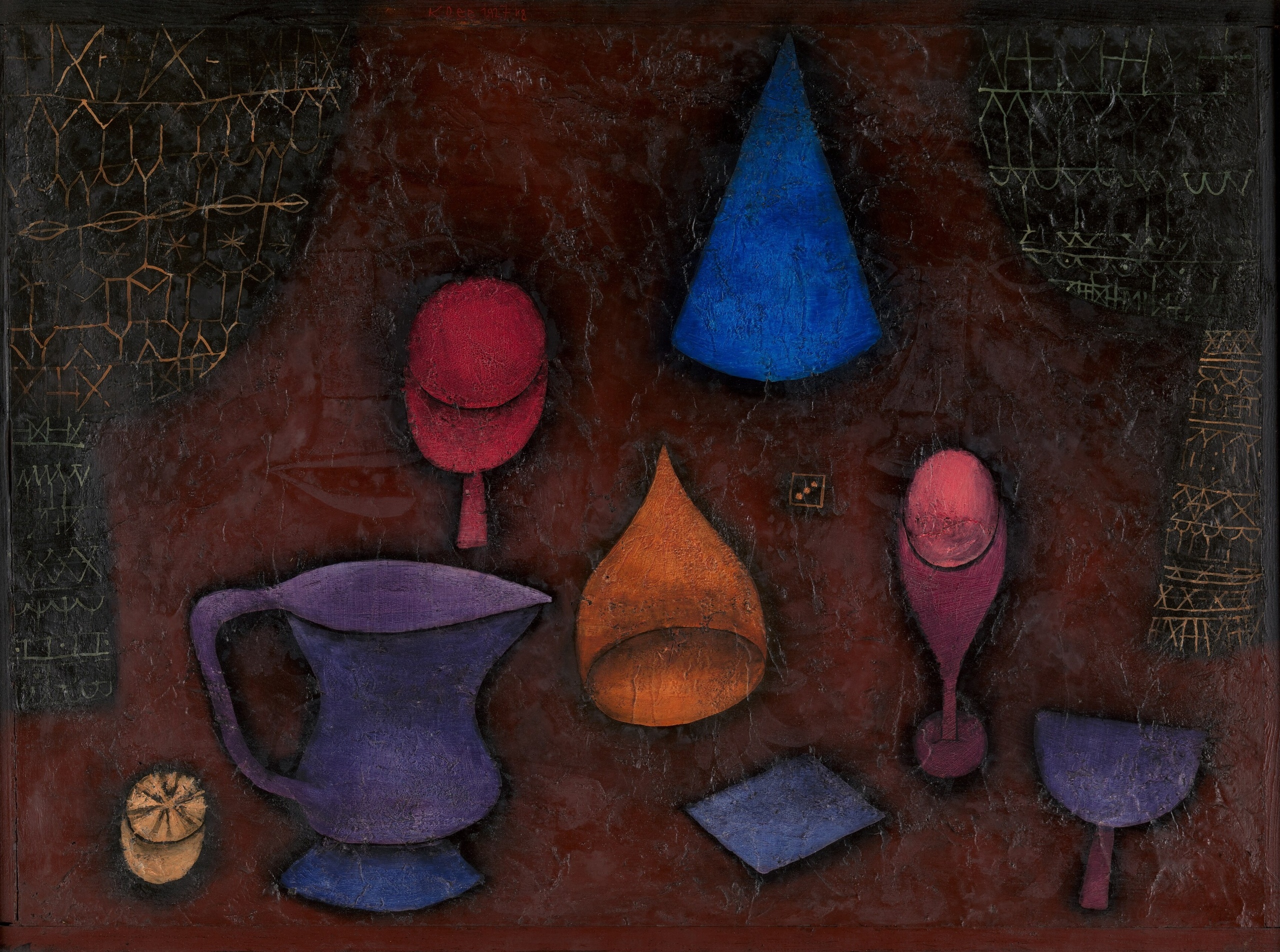
Still Life is a painting by Paul Klee from 1927: on a dark red, rough ground stand a blue cone, a red goblet-like form, an orange drop shape, a pink egg in a tall cup, a violet jug and a violet bowl, while dark curtains with scratched light patterns hang at either side. Klee made the original on a thick plaster panel of about 47.9 x 64.1 cm, and it now belongs to The Metropolitan Museum of Art in New York. Our painter paints it for you by hand on canvas, in oil or acrylic, in 8 landscape sizes from 40 x 30 to 200 x 148 cm, or made to measure. You see a photograph of the finished painting before it ships.
| Title: | Still Life |
| Other titles: | Stillleben (Töpfe, Frucht, Osterei und Gardinen) (German title) · Still Life (Pots, Fruit, Easter Egg and Curtains) (English translation) |
| Painter: | Paul Klee (1879–1940) |
| Year painted: | 1927 |
| Original size: | 47.9 cm x 64.1 cm (height x width) |
| Original technique: | Painted on a plaster panel |
| Painting style: | Modernism |
| Located at: | The Metropolitan Museum of Art, New York, USA |
| Our reproduction: | Hand-painted in oil or acrylic on canvas, 8 sizes or made to measure |
Still Life – Paul Klee
What does Klee’s Still Life show?
The scene is set on a rough, red-brown ground crossed by fine cracks. At the upper left and right, almost black areas are covered with thin white and yellow lines, arches, zigzags, little stars and crosses that recall lace: the curtains named in the full German title.
Between them stand eight simple objects, spaced almost evenly. At the top centre rises a large blue cone; to its left a red form on a short stem looks like a goblet. In the middle stands an orange drop shape, and on the right a pink egg sits in a tall, slender cup.
At the lower left a violet jug with a handle and a narrow spout fills much of the space, beside a small yellow half-sphere, cut open. Below are a violet diamond and, at the bottom right, a violet bowl on a short foot. Near the centre sits a tiny square with three dots, like the face of a die; Klee’s small red signature runs along the top edge.
What does the long German title tell us?
In brackets, the full German title lists what is painted: pots, fruit, Easter egg and curtains. These are vessels, fruit and an egg, not abstract signs.
German Wikipedia names a cone, a goblet, half a lemon, a jug, a cut onion, a piece of paper, an Easter egg and a cup. The egg in its cup and the jug are easy to spot; the yellow half-sphere may be the half lemon, the violet diamond the piece of paper.
The objects stand at equal distances, as if on a stage, framed by the curtains. Klee recorded no deeper message, so the honest reading is the one the title offers: a quiet arrangement of everyday things turned into a play of colour and shape.
Why do so many people love this still life?
Klee simplified the forms and used only primary colours and their complementaries: the blue cone near the orange drop, the yellow half-sphere near the violet jug. On the dark ground each object glows like a lamp in a dark room.
Klee was born in 1879 in Münchenbuchsee near Bern, to a German music teacher and a Swiss singer. He played the violin from childhood, and his 1914 trip to Tunisia with August Macke and Louis Moilliet became his breakthrough in colour.
This work has no English Wikipedia article of its own; the Wikipedia article on Paul Klee, in English, covers the painter, his Bauhaus years and the fate of his works under the Nazis.
Where is the original, and what is it made of?
The original belongs to The Metropolitan Museum of Art in New York, where it has been part of the Berggruen Klee Collection since 1984. Klee made it in 1927, while teaching at the Bauhaus, where he worked from 1921 to 1931.
Klee did not paint on canvas but on a thick plaster panel, reinforced with wire mesh and set in a deep wooden frame. The panel measures about 47.9 x 64.1 cm (height x width); the product photograph shows it without that frame.
From the same year comes Variations (Progressive Motif), an almost square field of pale bands filled with fine parallel lines, which belongs to the same New York museum.
Still Life or another Klee?
Still Life is a canvas painting for anyone who loves everyday objects seen in a new light, at home in a dining room, a kitchen or an open living space warmed by its dark red.
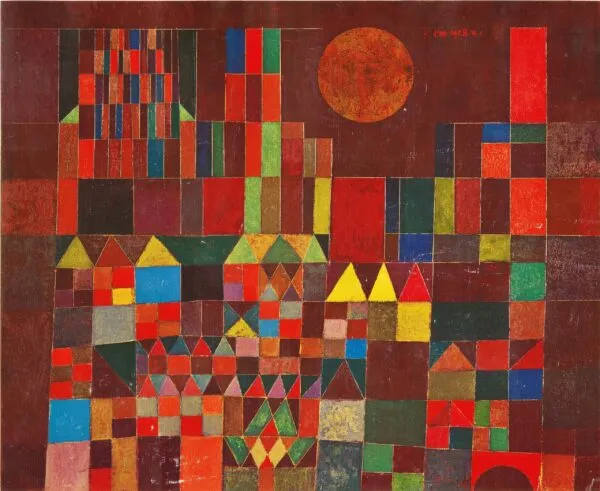
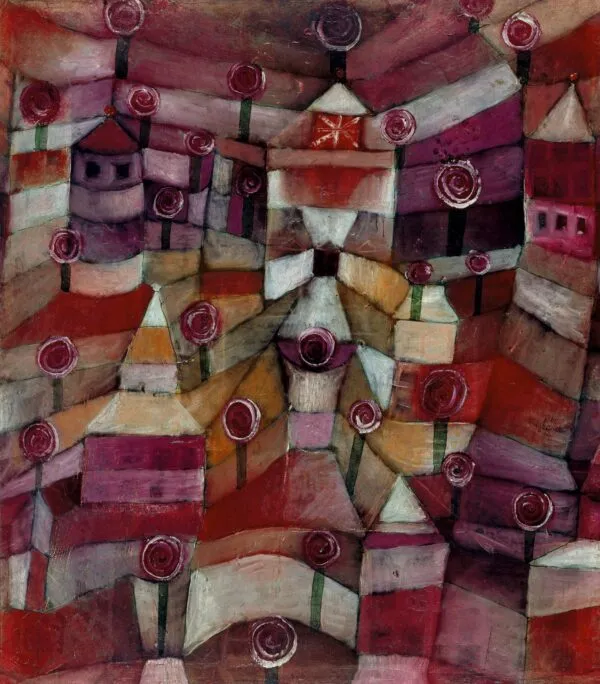
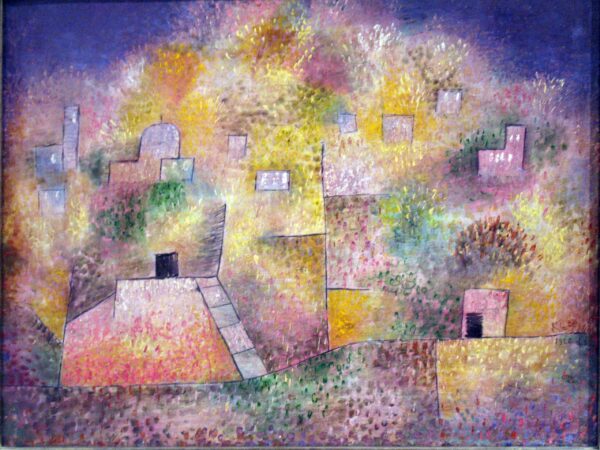
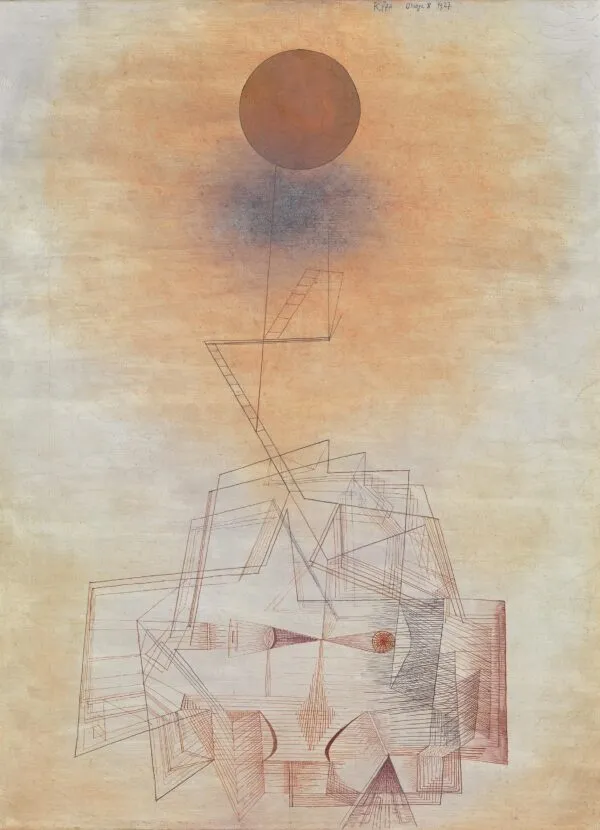
If you like colours glowing on a dark ground, look at Oriental Pleasure Garden from 1925, sprinkled with dabs of colour around white houses. For fine lines there is Rotating House, and for a gentler subject the watercolour Angel, Still Groping from 1939.
All the famous Paul Klee paintings in our range are gathered on one page: Paul Klee.
How do we hand-paint Still Life on canvas?
The original is painted on plaster, not on canvas. Ours is an oil painting reproduction on canvas, made in oil or acrylic in the size you choose, and it hangs like any other painting, without the weight of the plaster.
The painter first lays down the dark red ground in several layers for depth and a slightly uneven surface. Then he draws the objects and fills them with pure blue, orange, pink and violet; last, with a fine brush, he adds the pale lace of the curtains and the little die. Thicker and thinner layers suggest the roughness of the plaster.
Which size suits which wall?
In short: 40 x 30 or 53 x 38 cm for a kitchen or a shelf, 65 x 50 and 87 x 62 cm above a table or a chest of drawers, 98 x 70 and 125 x 90 cm above a sofa, and 160 x 115 or 200 x 148 cm for a long wall in a dining room or living space.
We paint Still Life in 8 landscape sizes (width x height): 40 x 30, 53 x 38, 65 x 50, 87 x 62, 98 x 70, 125 x 90, 160 x 115 and 200 x 148 cm. The plaster panel measures about 64.1 x 47.9 cm (width x height), so the smaller sizes stay close to its scale and the largest is roughly three times as wide. The large, simple objects take the enlargement well.
As a painting for the living room it looks best at 125 x 90 or 160 x 115 cm above the sofa, where the dark red calms a pale wall.
Can I order another size or a frame?
Yes. For other proportions we keep the objects and curtains whole and change only the dark ground between them. Tell us your wall measurements and we will come back with a price and a completion date.
It arrives rolled, stretched or framed, as you prefer; our workshop in Slovenia stretches and frames every painting. Since Klee set his panel in a deep wooden frame, a deep frame in dark wood suits it well. You pick the moulding in our 3D app, which is for choosing the frame only; a view of the painting on your own wall is a separate service.
When will my painting arrive?
Once you confirm the order, the painter starts, and Still Life is ready to ship within 15 to 45 working days. Before dispatch we send you a photograph of your finished painting and make any change you ask for.
Parcels within Slovenia and to other EU countries travel without customs duties, and every order is covered by our returns policy.
With its Easter egg it makes a lovely present for a new home, a keen cook or Easter. If you do not know their wall, give a wall art voucher and let them choose the size.
Frequently asked questions
Where is the original kept?
At The Metropolitan Museum of Art in New York, in the Berggruen Klee Collection since 1984.
Which objects can I see?
A blue cone, a red goblet, an orange drop, a pink egg in a cup, a violet jug, a yellow half-sphere, a diamond and a bowl.
Is it a print?
No, it is a hand-painted copy, brushed on canvas by our painter in oil or acrylic.
How big is the original?
About 47.9 x 64.1 cm (height x width); our sizes go up to 200 x 148 cm.
Do you paint sizes beyond the eight listed?
Yes. Give us the width and height, and we will send an offer with a price and a completion time.
How long do making and delivery take?
15 to 45 working days until dispatch, and you see a photograph of it first.
Does it suit a dining room, or work as a gift?
Yes. Vessels, fruit and an egg feel at home in a dining room or kitchen, and it suits a new home or Easter.
What are the pale lines at the sides?
The lace curtains of the title, which look as if they had been scratched into the dark red surface.
- Subject: a blue cone, a red goblet, an orange drop, a pink Easter egg, a violet jug and a bowl between dark lace curtains.
- Original: painted on a thick plaster panel, 1927, about 47.9 x 64.1 cm, The Metropolitan Museum of Art, New York.
- Ours: your Paul Klee reproduction, hand-painted in oil or acrylic on canvas in 8 sizes from 40 x 30 to 200 x 148 cm or to measure.
- Worth knowing: the full German title lists pots, fruit, an Easter egg and curtains; Klee made it during his Bauhaus years.