







































Description
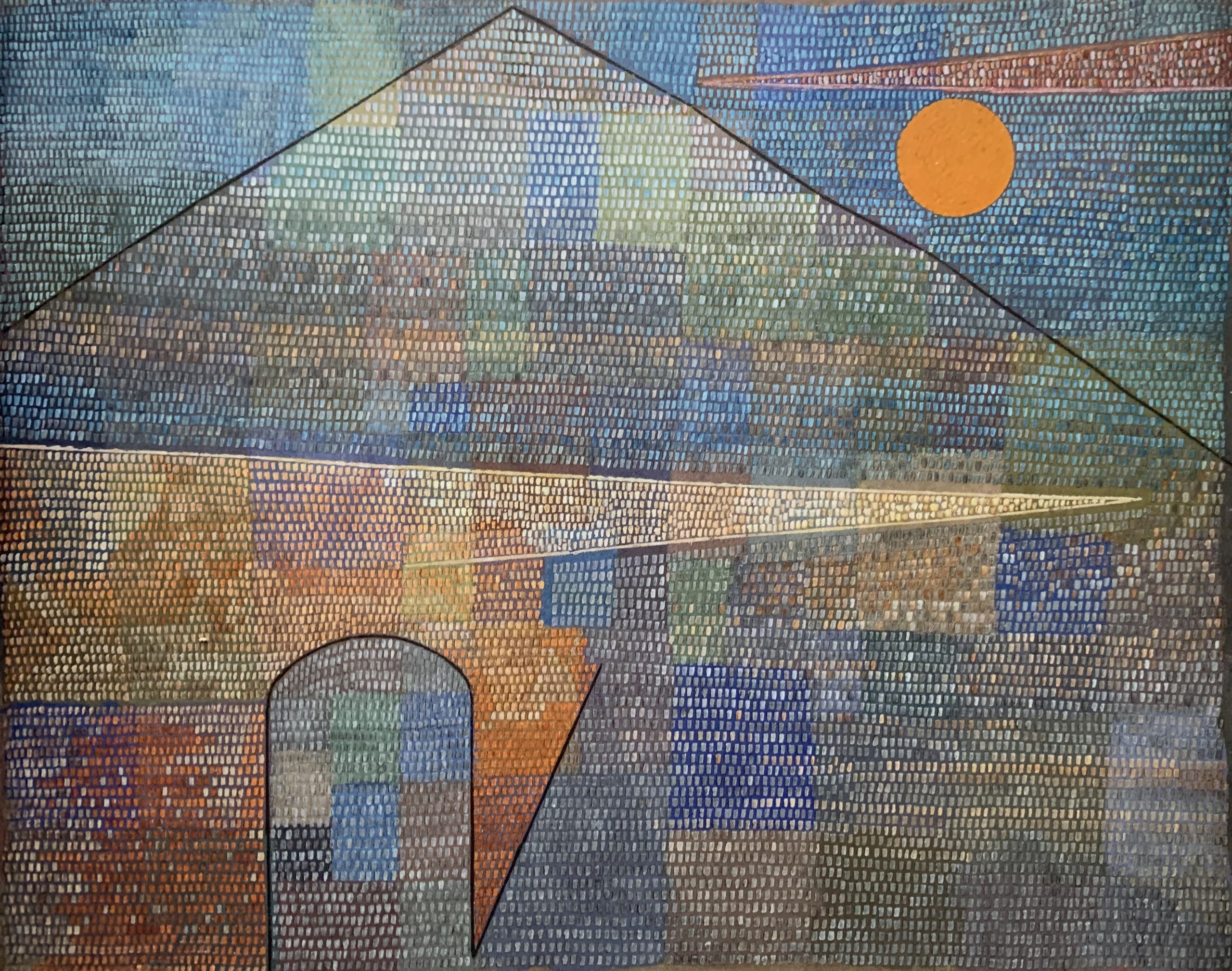
Ad Parnassum is a large painting by Paul Klee from 1932: thousands of tiny dots of colour lie over a grid of soft blue, grey, ochre and pink fields, and across it all stretches a great black-outlined triangle that reads as a pyramid, a roof or a mountain. An orange sun glows at upper right, and an arched doorway opens at lower left. The original is tempera on canvas, 100 x 126 cm, in the Kunstmuseum Bern. Our painter paints it for you by hand in oil or acrylic on canvas, in 4 landscape sizes from 95 x 75 to 190 x 150 cm or made to measure; before it leaves us, you receive a photograph of your finished painting.
| Title: | Ad Parnassum |
| Other titles: | Ad Parnassum (Latin) · To Parnassus (literal translation) |
| Painter: | Paul Klee (1879–1940) |
| Year painted: | 1932 |
| Original size: | 100 cm x 126 cm (height x width) |
| Original technique: | Tempera on canvas |
| Painting style: | Modernism |
| Located at: | Kunstmuseum Bern, Bern, Switzerland |
| Our reproduction: | Hand-painted in oil or acrylic on canvas, 4 sizes or made to measure |
Ad Parnassum – Paul Klee
What does Ad Parnassum show?
At first glance you see a surface covered in small dots of colour, set in rows like the stones of a mosaic. Beneath them Klee laid out larger rectangular fields in blue, grey, greenish, ochre and pink, so the surface seems to shimmer as you look.
A large triangle drawn with a thin black line runs across this grid. It starts at the left edge, climbs almost to the top and drops away to the right. The upper half is cooler, in blues and greys; the lower half is warmer, in orange, brick red and brown.
At upper right sits a solid orange disc, and beside it a narrow reddish wedge runs towards the edge. Across the middle stretches a pale, almost white band that tapers to a point on the right. At lower left a black line draws an arch like a door, and next to it a slanting line drops down, closing a narrow triangle with the door.
What do the triangle and the orange disc mean?
Klee did not record exactly what he painted, so the readings stay open. The great outline can be seen as a pyramid, the roof of a house or a mountain. English Wikipedia names its likely sources as the Egyptian pyramids, the Niesen above Lake Thun in Klee’s native Switzerland, and Parnassus, the mountain of the title.
The Latin title Ad Parnassum means “to Parnassus” and points to the climb rather than the summit itself. The orange disc to the right above the pyramid is read as the Sun. The pale band and the doorway have no official explanation; every viewer may read them in their own way.
That openness is part of the appeal: up close it is pattern, from across the room a landscape.
Why is Ad Parnassum seen as a masterpiece?
It is considered the masterpiece of Klee’s pointillist phase, when he built his works from countless small marks of colour. It was painted at a turning point in his style, which is why it is often named among his key works.
The Zentrum Paul Klee in Bern gave it an exhibition of its own, open from June 2007 to May 2008.
The Wikipedia article on Ad Parnassum, in English, gives a short account of how it was made and how it is read.
Where is the original, and how was it made?
The original belongs to the Kunstmuseum Bern in Switzerland, accession number G 1427. Klee was born in 1879 in Münchenbuchsee near Bern, so the painting is, in a sense, at home.
He painted it in 1932 while teaching at the Düsseldorf Academy, three years after his trip to Egypt. Before that, from 1921 to 1931, he had taught at the Bauhaus alongside Wassily Kandinsky.
His method was deliberate. First he laid large squares of muted colour on unprimed canvas, then he stamped small squares over them, first in white, then in other diluted colours.
Ad Parnassum or another Klee?
Ad Parnassum is a canvas painting for anyone who wants a field of colour on the wall that the eye can wander over for a long time. From a distance you see the pyramid and the sun; up close, thousands of dots in every shade.
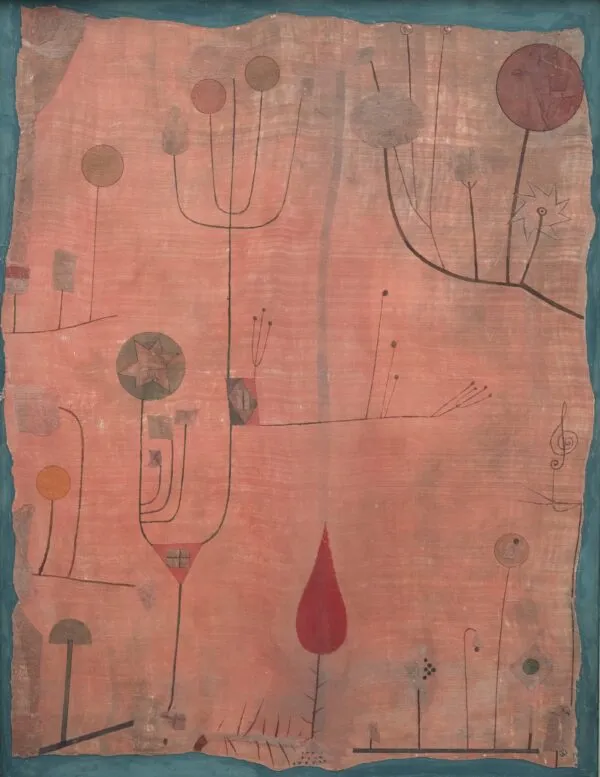
After the Egypt trip Klee also painted Highways and Byways, where the landscape splits into horizontal bands. If you prefer a darker ground with fairy-tale motifs, choose Fish Magic. If playful, simple subjects appeal to you, there are Senecio, a face built from coloured squares, and Red Balloon.
The famous Paul Klee paintings we hand-paint to order are all listed on our Paul Klee page.
How do we hand-paint Ad Parnassum?
To be clear: Klee’s original is tempera on canvas, with the small squares stamped on. Ours is an oil painting reproduction made by hand on canvas in oil or acrylic, layer by layer.
The work follows Klee’s own order. The painter first divides the canvas into large fields of calm colour, then sets down tiny touches with the tip of the brush, row after row, pale ones first and coloured ones after. Finally he draws the black outlines of the triangle and the door and paints the orange sun.
Every touch is made by hand, so up close your painting will differ slightly from the original, while from across the room it looks just as calm and bright.
Which size suits which wall?
In short: 95 x 75 cm above a chest of drawers or by a desk, 120 x 95 cm above a sofa or bed, 150 x 120 cm for a large empty wall, and 190 x 150 cm for a spacious living area or entrance hall.
We paint it in 4 landscape sizes (width x height): 95 x 75, 120 x 95, 150 x 120 and 190 x 150 cm. We leave out smaller sizes on purpose: the dotted surface needs room, or the tiny marks blur into a grey haze. The original is 126 cm wide and 100 cm high, so our largest size is about one and a half times as big.
As a painting for the living room it works best where you can step close and step back: up close you see single dots, from the sofa the pyramid and the sun. Hang the lower edge 20 to 30 cm above the backrest and pick a width of about two thirds of the furniture below.
Can I order a custom size or a frame?
Yes. If your wall needs other proportions, we adapt the composition carefully so the pyramid, the sun and the door stay whole. With a surface this dense, though, we advise keeping the shorter side at 75 cm or more. Send us your preferred size and we will reply with a price and a date.
You choose how it travels: rolled, already stretched, or with its frame. Our workshop in Slovenia does the stretching and framing and gets every painting our painters finish ready for the road. You pick the moulding in our 3D app, which is for frame choice only; seeing the painting on your own wall is a separate service.
A plain natural-wood moulding or a thin dark profile suits the cool blues and warm oranges.
When will the painting arrive, and how is it sent?
The painter starts as soon as you confirm your order. The dense surface takes time, yet the painting ships within 15 to 45 working days. Before packing, we send you a photograph of your finished painting and make any changes you ask for.
No customs duties apply within Slovenia or the rest of the EU, and our returns policy covers every order.
Ad Parnassum is a fine gift for someone who loves mountains, travel or music; Klee played the violin from childhood. If you do not know the wall, a wall art voucher lets the recipient choose the work and the size.
Frequently asked questions
Where can I see the original?
At the Kunstmuseum Bern in Switzerland, where it is held as accession number G 1427.
Is the triangle a pyramid or a mountain?
Both readings work: it is seen as an Egyptian pyramid, the Niesen or Parnassus, and also as a roof.
Is this a print?
No. You receive a hand-painted copy, made with a brush by our painter in oil or acrylic.
Why is there no size below 95 x 75 cm?
Because the tiny dots run together on a small surface, so we offer it only from 95 x 75 cm upwards.
Can you paint a size that is not listed?
Yes. Send us the width and height, and we will send an offer with a price and a completion date.
How long does it take to make?
It is ready in 15 to 45 working days, and you see it in a photograph before it ships.
Is Ad Parnassum right for a bedroom or as a present?
Yes. The calm blues sit well above a bed, and as a gift it pleases lovers of mountains and travel.
How big is the original?
It measures 100 x 126 cm (height x width), larger than most Klee works, which are often small pieces on paper.
- Subject: a large black-outlined triangle over a grid of colour dots, an orange sun at upper right and an arched door at lower left.
- Original: tempera on canvas, 1932, 100 x 126 cm, Kunstmuseum Bern.
- Ours: a Paul Klee reproduction painted by hand in oil or acrylic on canvas, 4 landscape sizes from 95 x 75 to 190 x 150 cm, or made to measure.
- Worth knowing: the dense dotted surface needs room, so we offer no size below 95 x 75 cm.