







































Description
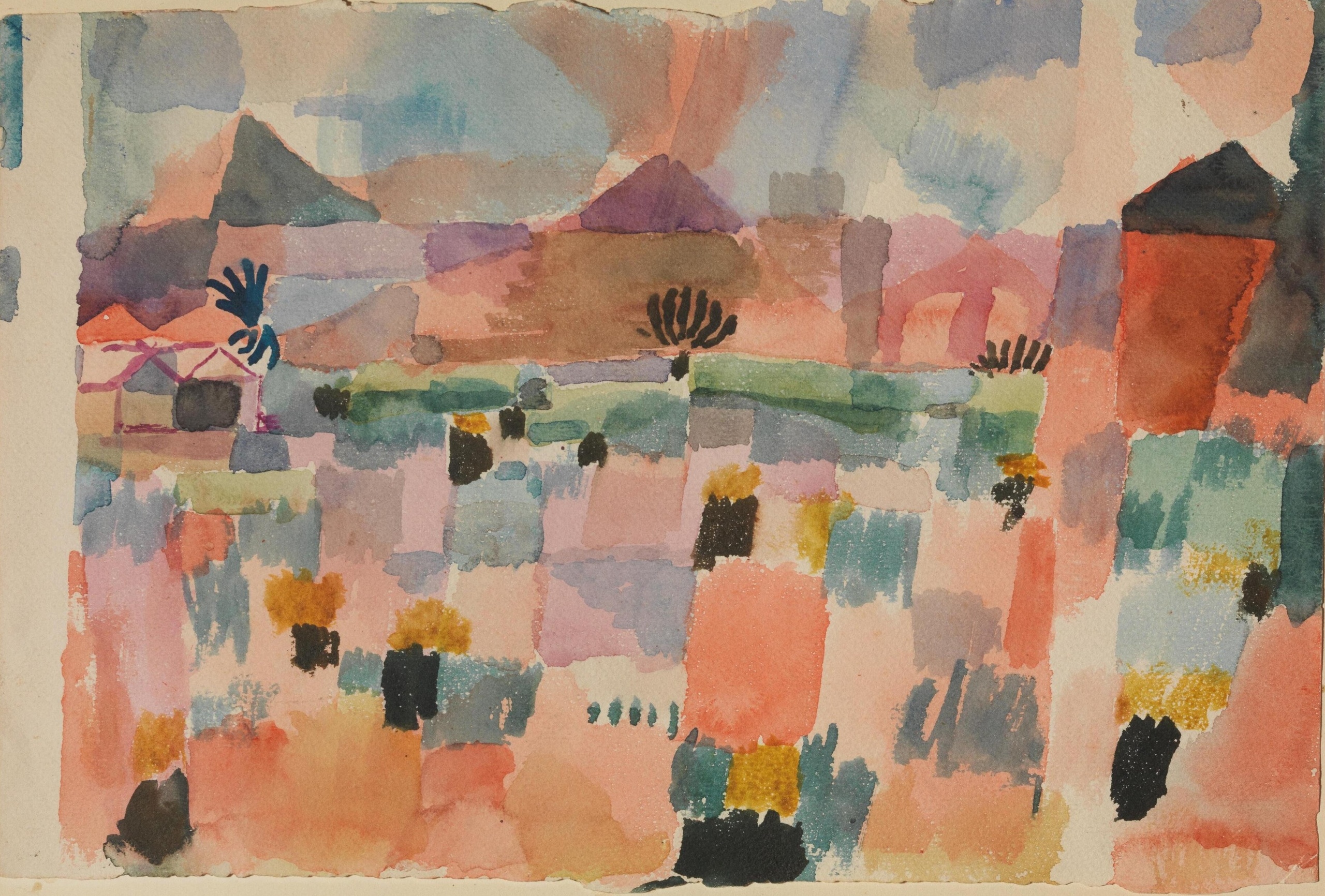
St. Germain near Tunis is a watercolour Paul Klee painted in April 1914 on his journey to Tunisia: soft violet peaks rise under a blue-grey sky, dark palm crowns stand in front of them, and below spreads a mosaic of pink, salmon and blue patches, as if you were looking down on fields and gardens. The original is a small sheet of paper on cardboard, just 21.8 x 31.5 cm, held by the Centre Pompidou in Paris. Our painter brings it onto canvas by hand, in oil or acrylic, in 8 landscape sizes from 45 x 30 to 196 x 137 cm or made to measure. Before dispatch you receive a photograph of the finished work.
| Title: | St. Germain near Tunis |
| Other titles: | St. Germain near Tunis (Inland) (full English title) · St. Germain b. Tunis (landeinwärts) (Klee’s German inscription) |
| Painter: | Paul Klee (1879–1940) |
| Year painted: | 1914 |
| Original size: | 21.8 cm x 31.5 cm (height x width) |
| Original technique: | Watercolour on paper on cardboard |
| Painting style: | Modernism |
| Located at: | Centre Pompidou, Musée National d’Art Moderne, Paris, France |
| Our reproduction: | Hand-painted in oil or acrylic on canvas, 8 sizes or made to measure |
St. Germain near Tunis – Paul Klee
What does St. Germain near Tunis show?
The top of the sheet is a sky built from translucent patches of blue-grey, pale pink and lavender. Beneath it rise two triangular peaks: the left one greyish mauve, the middle one darker and clearly violet.
Across the middle run a green band and a grey one, and above them the dark crowns of a few palms open out like fans; the one on the left is painted blue. Thin pink strokes at the left edge sketch a small house, while at the upper right stands a dark building with a steep roof and a reddish-orange wall.
The lower half is filled with many roughly rectangular patches of pink, salmon, grey-blue and lilac, with narrow gaps of white paper left between them. Scattered among them are dark green, almost black bushes with ochre tops. You can read them as fields, gardens and small plots running towards you in loose rows.
What does “inland” mean in the title?
Below the sheet Klee wrote the year, the number 217 and a German title ending in the word landeinwärts, meaning towards the interior of the country. So the view turns away from the coast and looks into the hinterland, towards fields, palms and hills.
The watercolour was made during the twelve-day trip to Tunisia in April 1914 that Klee took with his painter friends August Macke and Louis Moilliet. Klee was deeply struck by the quality of the light there.
English Wikipedia’s biography says that on this trip Klee did not set out to imitate nature. He looked for compositions that follow its formative principle, and he set the scenery into a grid in which it dissolves into colour harmony. That is exactly what happens here: the fields are not drawn but laid side by side like coloured tiles.
Why does this small watercolour draw people in?
The Tunisian journey is seen as Klee’s artistic breakthrough. He wrote, in essence, that colour had taken hold of him and that he was now a painter.
Back home he painted his first purely abstract work, In the Style of Kairouan, made of coloured rectangles and a few circles. The coloured rectangle became his basic building block; some scholars liken it to a musical note, since Klee had played the violin from childhood.
For more on the painter’s life, from the Bauhaus to his last years, see the English Wikipedia article on Paul Klee; it is written in English and is about the painter, as this watercolour has no article of its own.
Where is the original kept, and how big is it?
The original is in the collection of the Musée National d’Art Moderne at the Centre Pompidou in Paris, where it is registered under inventory number AM 81-65-876.
It is a watercolour on paper mounted on cardboard, measuring only 21.8 x 31.5 cm (height x width), a little larger than a sheet of A4.
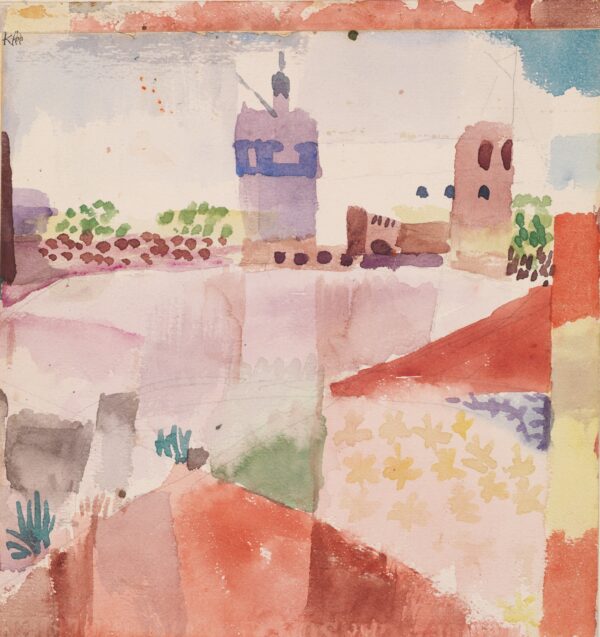
The name of a Tunisian place also appears in the title of Hammamet with Its Mosque, Hammamet being a town on the coast. Another Tunisian city that turns up in Klee’s biography is Kairouan, which gives its name to Episode at Kairouan.
St. Germain near Tunis or another Klee?
St. Germain near Tunis suits anyone who loves light, travel and southern landscapes.
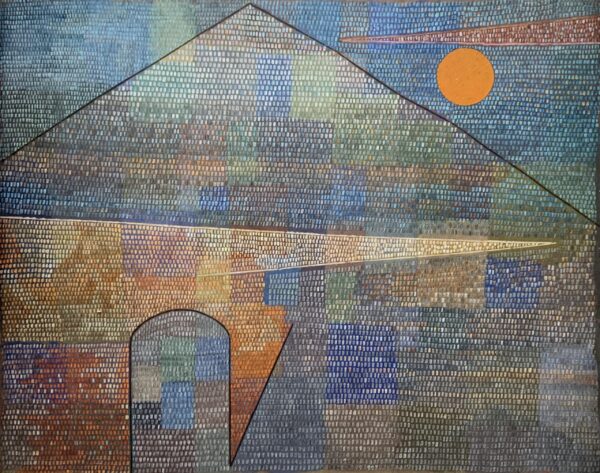
If you prefer stronger colour and stricter geometry, take a look at Castle and Sun. If you are curious how Klee the violinist turned music into painting, Polyphony will appeal, its title borrowed from music written for several voices at once.
The other famous Paul Klee paintings in our range are waiting for you on our Paul Klee page.
How do we hand-paint St. Germain near Tunis on canvas?
Klee’s original is a watercolour on paper, not a canvas painting. Ours is painted by hand on canvas: the painter works in oil or acrylic, in the size you have chosen, so it hangs on the wall like any other painted work.
Choose oil and your copy becomes a true oil painting reproduction, built up layer by layer. The painter matches the transparency of the watercolour with thin, diluted glazes, and leaves light gaps between the patches to stand in for the white paper.
He first sets out the large areas of sky, mountains and fields, then adds the green band, the palms and the two houses, and finally the dark bushes with their ochre tops.
Which size is right for your wall?
In short: 45 x 30 or 56 x 40 cm for a shelf, a desk or a narrow hallway, 63 x 45 and 83 x 57 cm above a chest of drawers or a dining table, 105 x 75 cm above a sofa or bed, and 140 x 93, 155 x 105 or 196 x 137 cm for a wide wall in a living room or an open-plan space.
We offer it in 8 landscape sizes (width x height): 45 x 30, 56 x 40, 63 x 45, 83 x 57, 105 x 75, 140 x 93, 155 x 105 and 196 x 137 cm. Klee’s sheet measures 31.5 x 21.8 cm (width x height), so even the smallest size enlarges it slightly, and the largest stretches the landscape to about six times its width.
As a painting for the living room it looks its best at 105 x 75 or 140 x 93 cm above the sofa, where the pinks and blues bring light into the room.
Is another size or a frame possible?
Yes. If you need different proportions, we adapt the landscape so that the mountains, palms and houses stay whole, and only lengthen or shorten the band of fields at the bottom. The character of Klee’s sheet is kept. For a quote, send us the size your wall needs and we will reply with a price and a date.
You can have the painting rolled, stretched on a stretcher bar or ready framed. Our workshop in Slovenia does the stretching and, if you wish, the framing, and gets every painting ready for the road. You pick the moulding in our 3D app, which is only for choosing the frame; viewing the painting on your own wall is a separate service.
The watercolour’s pastel tones go well with a slim frame in pale wood or a white moulding that echoes the white paper between the patches.
When will the painting you ordered arrive?
The painter starts as soon as you confirm the order, and the painting is ready to ship in 15 to 45 working days. Before packing you receive a photograph of the finished work, and if you would like a change, we make it.
Shipments within Slovenia and to the rest of the EU travel without customs duties, and every order is covered by our returns policy.
This sunny Tunisian landscape makes a lovely present for someone who loves to travel. If you are unsure which size would fit, give a wall art voucher and leave the choice to them.
Frequently asked questions
Who holds the original?
The Centre Pompidou in Paris (Musée National d’Art Moderne), inventory number AM 81-65-876.
What can I see in the painting?
A landscape near Tunis with violet mountains, palms, two houses and a field of pink, salmon and blue patches.
Is it a print?
No. What you receive is a hand-painted copy: the painter applies it with brushes to canvas, in oil or acrylic.
How large is the original?
Only 21.8 x 31.5 cm (height x width); our sizes run from 45 x 30 to 196 x 137 cm.
Can I order a size outside the eight listed?
Of course. Send us the width and height and we will put together a quote for that size.
How long will I wait for my painting?
From 15 to 45 working days after you confirm the order; before dispatch we send you a photograph.
Is this landscape right for a bedroom, or as a gift?
Yes. The soft pastel tones are calm, so it belongs above a bed, and as a present it pleases anyone who loves to travel.
Why is the landscape split into rectangular patches?
On the Tunisian trip Klee broke the scenery into a grid of coloured areas so that it would dissolve into colour harmony rather than copy nature.
- Subject: a landscape near Tunis: violet mountains, palms, two houses and fields of pink, salmon and blue patches.
- Original: watercolour on paper on cardboard, 1914, 21.8 x 31.5 cm, Centre Pompidou, Paris.
- Ours: a Paul Klee reproduction painted by hand in oil or acrylic on canvas, 8 landscape sizes from 45 x 30 to 196 x 137 cm, or made to measure.
- Worth knowing: the watercolour was made on Klee’s trip to Tunisia in April 1914, together with August Macke and Louis Moilliet.