







































Description
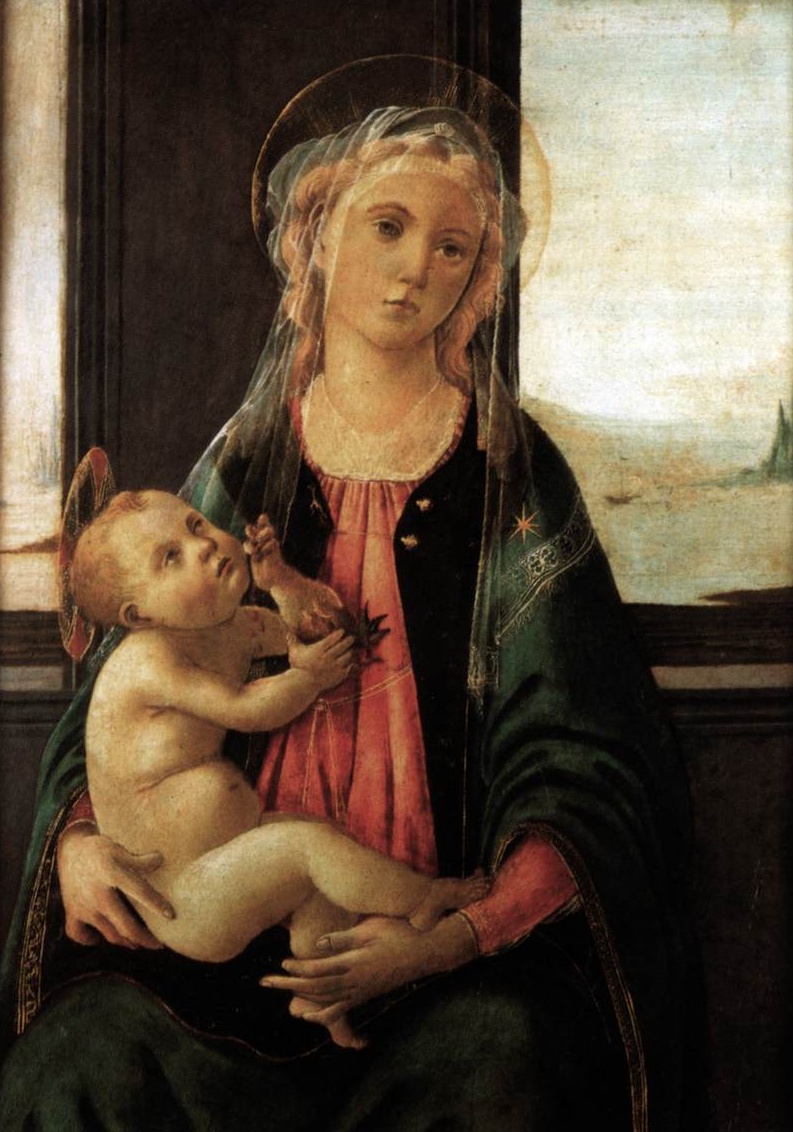
The Virgin of the Sea, in Italian Madonna del Mare, is a small panel of about 1477 attributed to Sandro Botticelli, though some scholars give it to the young Filippino Lippi: Mary, in a transparent veil and a red dress under a dark cloak, holds the naked Christ Child on her lap with an opened pomegranate in his hands, while a window behind them looks out on a calm sea. The original, tempera on panel, measures only 40 x 28 cm and belongs to the Galleria dell’Accademia in Florence. Our painter paints it for you by hand in oil on canvas in 7 portrait sizes from 30 x 45 to 65 x 92 cm or made to measure, every one of them larger than the Florentine panel. When your painting is finished, we send you a photograph of it.
| Title: | The Virgin of the Sea |
| Other titles: | Madonna del Mare (Italian title) · Madona del Mare (Slovene title) |
| Painter: | Sandro Botticelli (c. 1445–1510) |
| Year painted: | c. 1477 |
| Original size: | 40 cm x 28 cm (height x width) |
| Original technique: | Tempera on panel |
| Painting style: | Early Renaissance |
| Located at: | Galleria dell’Accademia, Florence, Italy |
| Our reproduction: | Hand-painted in oil on canvas, 7 sizes or made to measure |
The Virgin of the Sea – Sandro Botticelli
What does The Virgin of the Sea show?
Mary sits in an interior and fills almost the whole of the upright panel. Her head is tilted slightly, and a fine, barely visible veil lies over her fair curls.
She wears a red dress with a round neckline and over it a dark cloak edged in gold. On the shoulder that is on our right a small gold star shines.
On her knee sits the naked, plump Christ Child, who has a halo too. With his small hands he holds a fruit in front of his mother’s breast and looks up at her face. Mary’s own gaze passes beside us into the distance.
Behind the figures stands a dark wall with a window. Through the bright opening we see a smooth stretch of sea with a small ship, a shore with a tall tree on the right, and a pale, almost white sky.
What do the pomegranate, the star and the sea mean?
The Child holds an opened pomegranate from which he has taken a few seeds. The fruit is read as a sign of Mary’s fertility and her royal dignity, and the red of the seeds foreshadows the blood of the Passion.
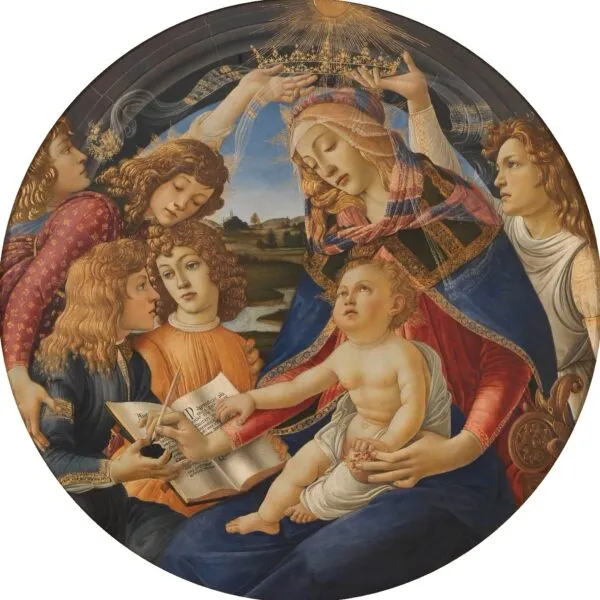
The same symbol returns in the round painting Madonna of the Pomegranate, where the fruit again lies in the Child’s hands.
The star on the cloak and the sea beyond the window belong together. One of Mary’s old titles is Stella maris, star of the sea, and the sources link the view of the coast to exactly that name.
Why is The Virgin of the Sea well known?
It takes its name from the soft seascape that opens through the window in the background.
The transparent veil, Mary’s clothes and the rounded forms of the Child, with his look of slight melancholy, are considered typical of Botticelli.
Scholars see in the drawing an echo of Filippo Lippi’s linear manner, made firmer by a more energetic modelling on the example of Andrea del Verrocchio.
The authorship remains open. Later overpainting makes a sure judgement difficult: Ulmann gave the panel to Botticelli in 1893, Ronald Lightbown to the young Filippino Lippi, and many studies and restorations have not settled the question. There is no English Wikipedia article; a short entry is in the Italian Wikipedia article, which is written in Italian.
Where is the original today?
The Virgin of the Sea is kept in the Galleria dell’Accademia in Florence. The panel comes from the Florentine convent of Santa Felicita.
The dating is as cautious as the attribution. The Italian article places it around 1477, the French and Spanish ones around 1480–1481.
Sandro Botticelli, to whom the panel is most often given, was born Alessandro di Mariano di Vanni Filipepi around 1445 in the Ognissanti quarter of Florence, the son of a tanner. According to Vasari he first trained as a goldsmith and then learned painting under Filippo Lippi. He died in 1510.
The Virgin of the Sea or another Botticelli?
The Virgin of the Sea suits anyone who wants a quiet, personal scene. Its upright format and modest sizes work well in a bedroom, a study, a hallway or a prayer corner.
If you like a Mary who holds her Child close, see Madonna della Loggia. A scene in which an angel joins mother and child is Madonna and Child with an Angel, and a Madonna tied to the sacrament of the Eucharist is Madonna of the Eucharist.
More famous Botticelli paintings, all painted to order, wait on our Sandro Botticelli page.
How do we hand-paint The Virgin of the Sea?
The original is not an oil painting but tempera on a wooden panel of just 40 x 28 cm. Our painter makes your oil painting reproduction with oil colours on canvas, one layer after another, so we can send it rolled, stretched on a stretcher bar or framed.
First he sketches Mary, the Child and the window opening on the canvas. Then he lays in the dark areas of wall and cloak, the red dress, and the light sea and sky.
Faces, the Child’s skin and the hands are built up slowly, with fine passages from light into shadow. Last come the details that give the panel its character: the transparent veil, the gold borders, the star on the shoulder, both haloes and the red seeds of the pomegranate.
Which size suits which wall?
In short: the two smallest sizes above a bedside table or on a narrow wall, the middle ones over a bed or chest of drawers, the two largest for the living room.
We paint The Virgin of the Sea in 7 portrait sizes (width x height): 30 x 45, 35 x 50, 40 x 55, 45 x 65, 50 x 75, 59 x 81 and 65 x 92 cm. The original measures only 28 x 40 cm (width x height), so every one of our sizes is larger; the smallest, 30 x 45 cm, is only a little larger, and the largest is more than twice as tall.
For the feeling of a small devotional panel, choose 30 x 45 or 35 x 50 cm. At 45 x 65 or 50 x 75 cm Mary’s face and the sea beyond the window read well from the middle of the room. As a painting for the living room, 59 x 81 or 65 x 92 cm works best.
Can I have another size, and which frame suits it?
Yes. If you need a different ratio, we keep Mary, the Child and the window whole and adjust the dark wall at the edges or the lower part of the cloak. Send us the size you would like and you will soon have a price and a delivery time.
We send the painting rolled in a sturdy tube, stretched on a stretcher bar or ready framed. Our workshop in Slovenia stretches and frames every canvas painting we ship and packs it with care.
You choose the moulding in our 3D app; a view of the painting on your own wall is a separate service. The warm reds and golds of this scene suit a slim gilt frame or a dark wooden one.
When will your Virgin of the Sea arrive?
Your Virgin of the Sea is ready to ship 15 to 45 working days after we confirm the order. As soon as it is finished you receive a photograph, and any changes you ask for are made before packing.
Within Slovenia and to the other EU countries it travels without customs formalities, and our returns policy applies to every order.
A scene of mother and child makes a fine gift for a christening, a wedding or a new home. If you do not know the wall it is meant for, give a gift voucher so that the recipient can choose the painting and the size.
Frequently asked questions
Where can I see the original?
In the Galleria dell’Accademia in Florence; the panel comes from the convent of Santa Felicita.
Who painted this Madonna?
It is attributed to Sandro Botticelli, though some scholars think of the young Filippino Lippi; the question is open.
Is this a print?
No. It is a hand-painted copy that our painter makes with a brush in oil on canvas.
How big is the original?
Only 40 x 28 cm (height x width); all our sizes are larger.
Can I have The Virgin of the Sea in another size?
Yes. Tell us the width and height and we will send you a quote with price and delivery time.
When is the Madonna shipped, and how does it travel?
From 15 to 45 working days until dispatch; rolled, stretched or framed.
Does it suit a bedroom or a nursery?
Yes. The tender scene of mother and child and the calm sea create a quiet, warm mood.
What does the fruit in the Child’s hands mean?
The pomegranate is read as a sign of Mary’s fertility and dignity; its red seeds point to the blood of Christ.
- Subject: Mary in a transparent veil and the naked Christ Child with a pomegranate before a window that looks out on a calm sea.
- Original: tempera on panel, c. 1477, 40 x 28 cm, Galleria dell’Accademia, Florence; attributed to Botticelli or Filippino Lippi.
- Ours: a Sandro Botticelli reproduction hand-painted in oil on canvas, 7 sizes from 30 x 45 to 65 x 92 cm or made to measure.
- Worth knowing: the name comes from the sea beyond the window; the star on the cloak recalls Mary’s title Stella maris.