







































Description
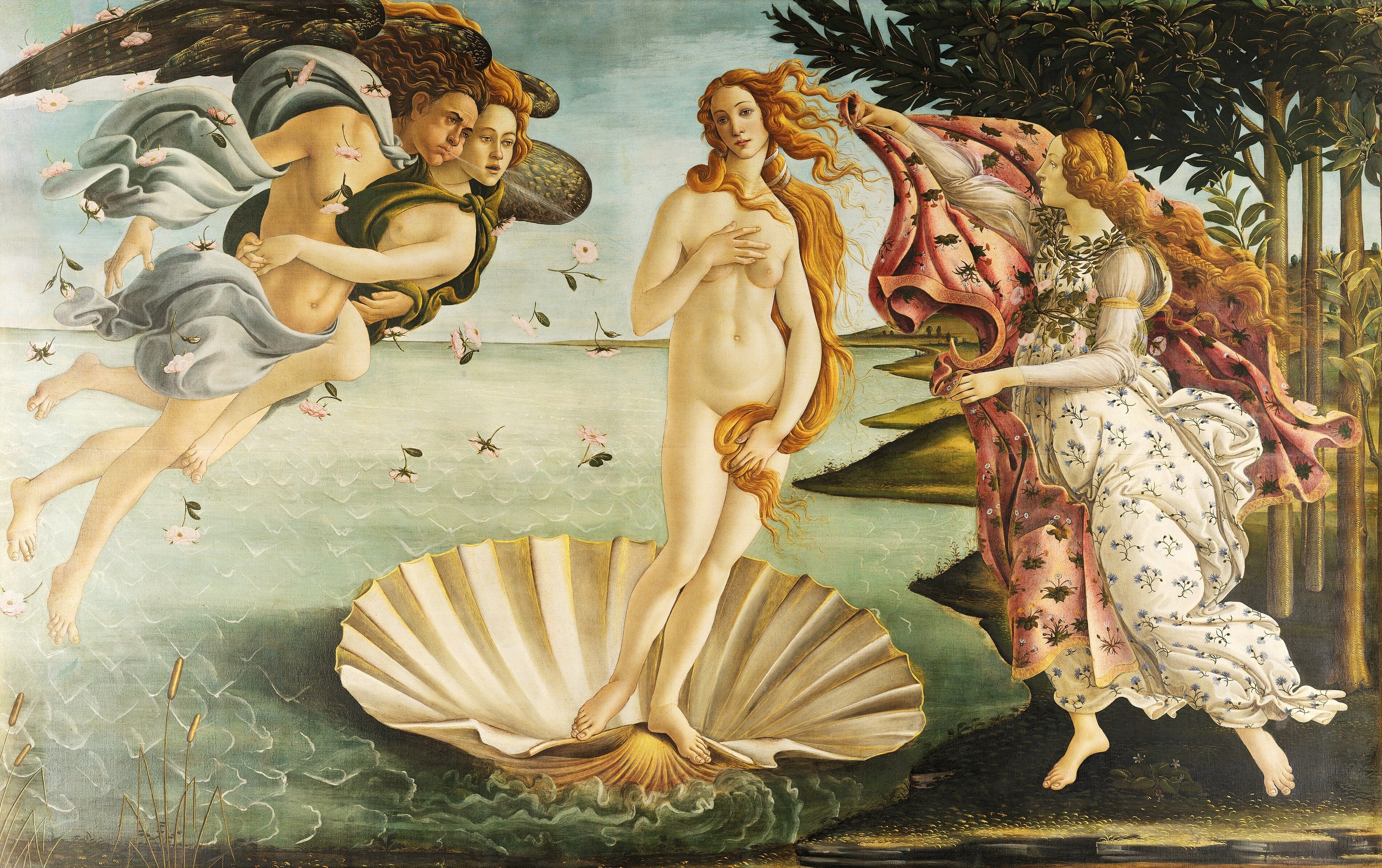
The Birth of Venus is a painting by Sandro Botticelli from around 1484–1486: the goddess of love stands nude on a giant shell, the wind god Zephyr blows her ashore, and a young woman waits there with a flowered cloak. The original, tempera on canvas, 172.5 x 278.5 cm, hangs in the Uffizi Gallery in Florence. Our painter paints it for you by hand in oil on canvas, in 5 landscape sizes from 100 x 63 to 200 x 130 cm or made to measure. Before your Venus leaves us, we send you a photo of it.
| Title: | The Birth of Venus |
| Other titles: | Nascita di Venere (Italian title) · Rojstvo Venere (Slovene title) |
| Painter: | Sandro Botticelli (c. 1445–1510) |
| Year painted: | c. 1484–1486 |
| Original size: | 172.5 cm x 278.5 cm (height x width) |
| Original technique: | Tempera on canvas |
| Painting style: | Early Renaissance |
| Located at: | Uffizi Gallery, Florence, Italy |
| Our reproduction: | Hand-painted in oil on canvas, 5 sizes or made to measure |
The Birth of Venus – Sandro Botticelli
What does The Birth of Venus show?
In the centre Venus stands on a huge scallop shell that is just reaching the shore. She is nude, her body gently curved; her right hand covers her breast, and her left holds her long red-gold hair, which falls to her knees, against her body. Her gaze is calm and a little distant.
From the left two winged figures fly in, locked in an embrace. The man with puffed cheeks is Zephyr, god of the west wind, wrapped in a blue-grey mantle; the woman beside him, in a green cloak, blows more gently. Pink roses tumble through the air around them.
On the right, on a shore lined with slender laurels, one of the Horae, goddesses of the seasons, leans towards Venus in a white dress scattered with blue cornflowers. She wears a girdle of roses and a green garland round her neck, and holds out a pink cloak patterned with daisies to wrap the goddess in.
What story does the painting tell?
In Greek myth the goddess of love was born from the sea already fully grown. Botticelli does not paint the birth itself but the moment the wind carries her to land. Its present title dates only from the 19th century.
The closest literary source is one of the ancient Homeric Hymns: the moist breath of Zephyros carries Aphrodite over the waves to Cyprus, where the Horae welcome her and dress her in heavenly clothes. The shore is therefore probably Cyprus or Cythera.
The meaning is often read through Florentine Neoplatonism: the beauty of the body was meant to lift the mind towards the beauty of divine love. Others see it as a wedding painting, and the laurels on the right as a pun on the name Lorenzo.
Why is the painting so famous?
The Birth of Venus is among the most famous paintings anywhere, an emblem of the Italian Renaissance. Western art had hardly seen mythological scenes on this scale since antiquity, still less a large female nude at the centre of a composition.
Venus’s pose follows ancient statues of the Venus Pudica type, the modest Venus who shields her body with her hands. Botticelli gave her a long neck and an elongated torso, and her weight sits so far over her left leg that she could not really stand like this.
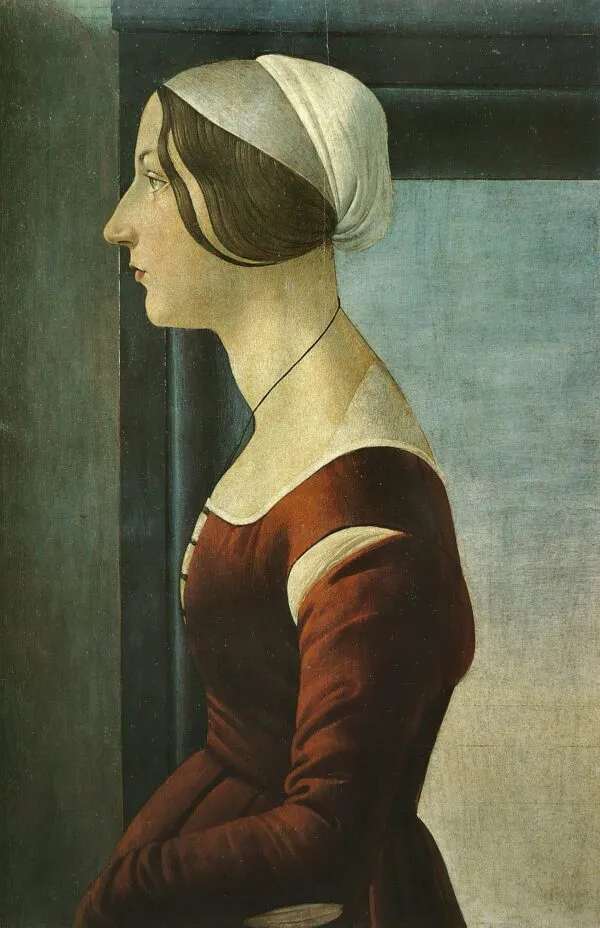
Tradition links the face of Venus with the Florentine beauty Simonetta Vespucci, said to have been admired by Lorenzo and Giuliano de’ Medici. Since 2002 a detail of that face has appeared on the Italian ten-cent euro coin.
It is always discussed alongside Botticelli’s other great mythology in the same gallery, Primavera, though the two were not painted as a pair. The Wikipedia article on the painting, in English, goes further into its sources and readings.
Where is the original today?
The original hangs in the Uffizi Gallery in Florence, where it arrived in 1815 from the Medici Villa di Castello.
Who commissioned it is not recorded. In 1908 Herbert Horne proposed Lorenzo di Pierfrancesco de’ Medici, a cousin of Lorenzo the Magnificent, and nearly every writer followed him for decades. But that branch’s 1499 inventory, published in 1975, does not list the Venus, so the patron remains unknown.
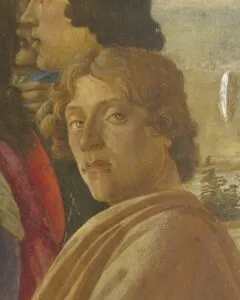
Botticelli, born Alessandro Filipepi around 1445, was a Florentine tanner’s son who, Vasari says, trained as a goldsmith before learning painting under Filippo Lippi. Apart from the Sistine Chapel in Rome in 1481–82, he seldom worked away from Florence; he died in 1510.
The Birth of Venus or another Botticelli?
The Birth of Venus is a canvas painting for anyone who wants light, sea and one clear figure at the centre. Its pale blue-green and pink tones suit a calm room and a broad wall above a sofa or bed.
Botticelli painted the ancient gods more than once. Pallas and the Centaur shows the goddess of wisdom holding the centaur by his hair, and Venus and Mars shows the same goddess of love awake beside the sleeping god of war. For a very different, late and devout Botticelli, see The Mystical Nativity, with its ring of dancing angels above the stable.
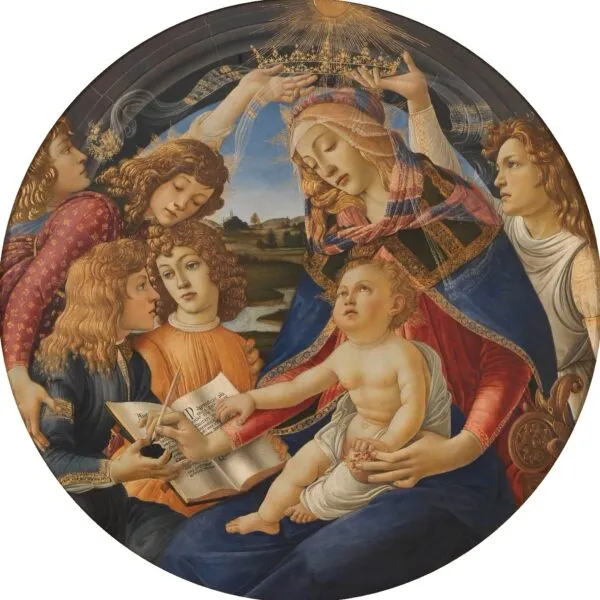
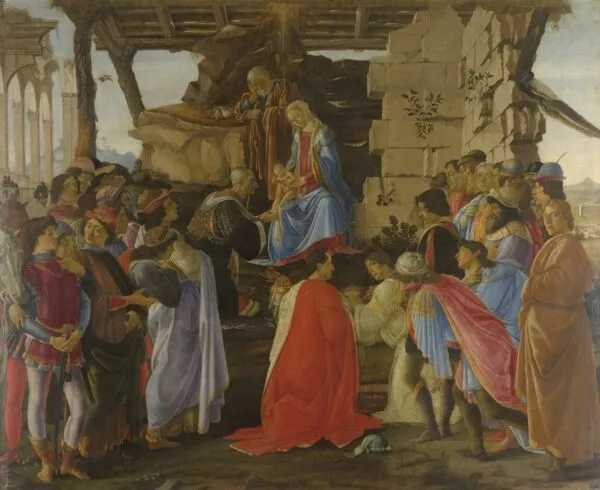
Madonnas, portraits and mythologies: all the famous Botticelli paintings we offer are on our Sandro Botticelli page.
How do we hand-paint The Birth of Venus?
Botticelli’s original is not an oil painting: it is tempera on canvas, unusual for him, as he mostly worked on wooden panels. It is made of two pieces of canvas sewn together and measures 172.5 x 278.5 cm.
Ours is a Sandro Botticelli reproduction painted by hand in oil on canvas, layer by layer. That is why we can send it rolled in a tube, stretched on a stretcher bar or already framed.
The painter first draws the four figures, the shell and the shore, then lays in the pale sky and the blue-green sea, kept almost flat as Botticelli left them.
He models the bodies with soft passages of light, since no figure in the original casts a shadow. Last come the strands of hair, the ribs of the shell, the laurel leaves, the cornflowers and the falling roses.
Which size suits which wall?
In short: 100 x 63 cm for a smaller wall, a hallway or a bedroom, the middle sizes above a chest of drawers or a bed, 130 x 80 cm and up for a large living-room wall.
We paint The Birth of Venus in 5 landscape sizes (width x height): 100 x 63, 115 x 70, 130 x 80, 165 x 100 and 200 x 130 cm. The original in the Uffizi measures 278.5 x 172.5 cm (width x height), so every one of our sizes is smaller; the largest, 200 x 130 cm, reaches about 72 per cent of its width.
From 100 x 63 to 115 x 70 cm it sits well above a bed or a dining table. As a painting for the living room it comes into its own at 165 x 100 or 200 x 130 cm, where single roses read clearly from the sofa.
Can I have another size, and which frame suits it?
Yes. For other proportions the four figures and the shell stay whole and only the sky, sea or shore at the edges change, so your oil painting reproduction still shows the whole scene. Write to us with your custom size and we will quote a price and a delivery date.
Our workshop in Slovenia stretches and frames it if you wish and packs it carefully for the journey. The 3D app on our site is for picking the moulding; a view of the painting on your own wall is a separate service.
When will your Birth of Venus arrive?
Your Venus is ready to ship 15 to 45 working days after your order is confirmed. When it is finished we send you a photograph and make any changes you ask for before packing.
No customs are charged within the EU, and every order is covered by our returns policy.
Venus among the roses makes a lovely wedding or anniversary present. Unsure of the size? Give a wall art voucher and let them choose the painting and the size themselves.
Frequently asked questions
Where can I see the original Venus?
In the Uffizi Gallery in Florence, where it came from the Villa di Castello in 1815.
Who are the winged figures on the left?
Zephyr, god of the wind, and a woman Vasari called Aura; some see her as the nymph Chloris.
Is it a print?
No. It is a hand-painted copy in oil on canvas: our painter brushes every strand of hair and every flower.
How large is the original?
172.5 x 278.5 cm (height x width); all our sizes are smaller.
Can you paint the Venus in a size that is not listed?
Yes. Tell us the width and height, and we will send a price and a date.
How long until the Venus ships, and how?
15 to 45 working days until dispatch; rolled, stretched or framed.
Is the nude suitable for a bedroom or a living room?
Yes. She is painted with restraint, and the pale colours calm a room.
Why does Venus stand on a shell?
The giant shell is imaginary, but it already appears in ancient images of the sea-born goddess.
- Subject: Venus nude on the shell, the wind god Zephyr with his companion, and a Hora with a flowered cloak on the laurel shore.
- Original: tempera on canvas, c. 1484–1486, 172.5 x 278.5 cm, Uffizi Gallery, Florence.
- Ours: hand-painted in oil on canvas, 5 sizes from 100 x 63 to 200 x 130 cm, or made to measure.
- Worth knowing: Vasari saw it with the Primavera at the Medici villa of Castello outside Florence.