







































Description
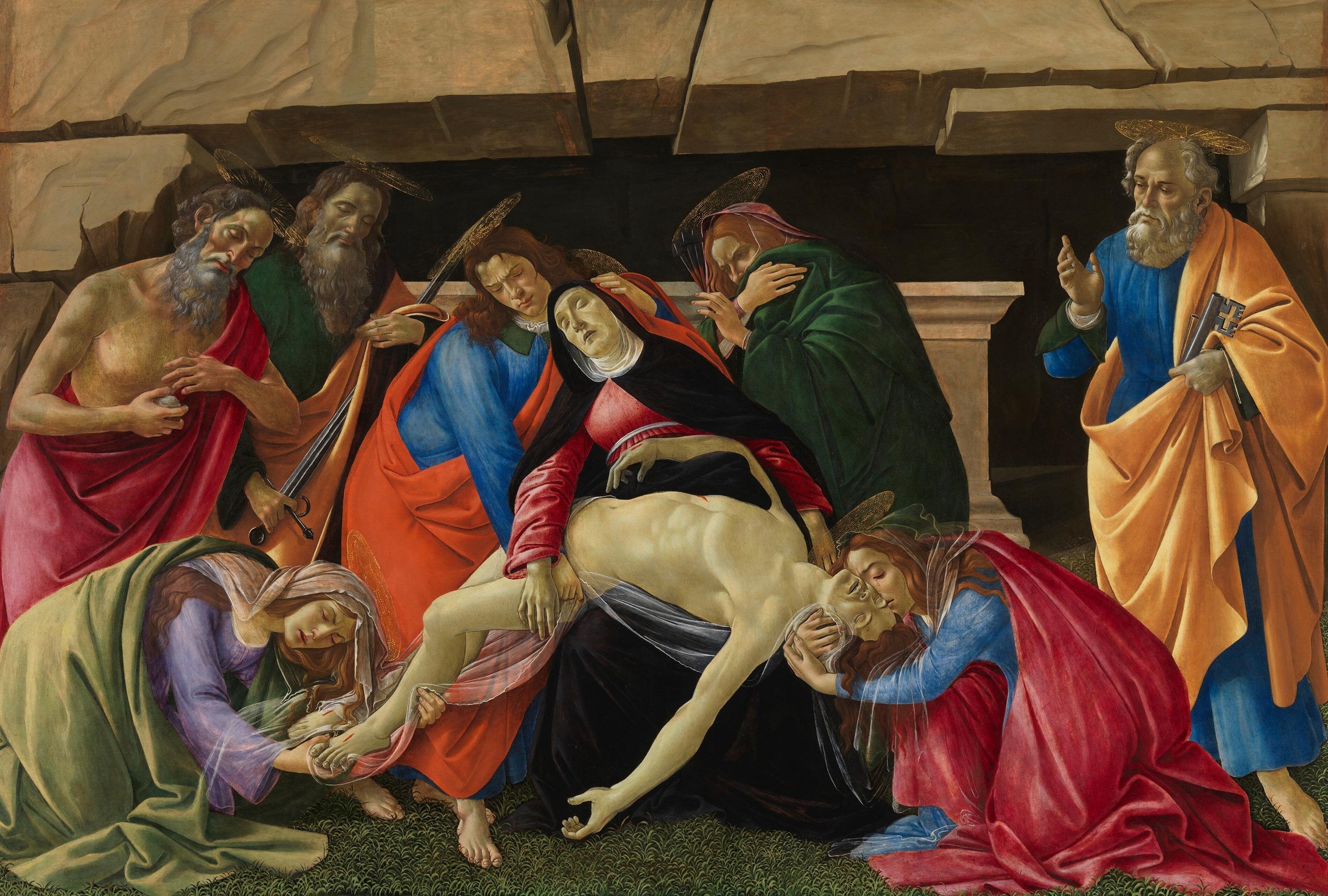
Lamentation over the Dead Christ is the panel Sandro Botticelli painted around 1490–1492 for the Florentine church of San Paolino: before the dark mouth of a rock tomb, the body of Christ lies across the lap of the fainting Virgin, John and the three Marys grieve around them, and Saints Jerome, Paul and Peter stand at the sides. The original, tempera and oil on a poplar panel measuring 140 x 207 cm, hangs in the Alte Pinakothek in Munich. Our painter hand-paints it for you in oil on canvas, in 7 landscape sizes from 60 x 39 to 190 x 130 cm or made to measure. A photograph of the finished painting reaches you before we ship it.
| Title: | Lamentation over the Dead Christ |
| Other titles: | Compianto sul Cristo morto (Italian title) · Objokovanje mrtvega Kristusa (Slovene title) |
| Painter: | Sandro Botticelli (c. 1445–1510) |
| Year painted: | c. 1490–1492 |
| Original size: | 140 cm x 207 cm (height x width) |
| Original technique: | Tempera and oil on poplar panel |
| Painting style: | Early Renaissance |
| Located at: | Alte Pinakothek, Munich, Germany, inv. 1075 |
| Our reproduction: | Hand-painted in oil on canvas, 7 sizes or made to measure |
Lamentation over the Dead Christ – Sandro Botticelli
What does Lamentation over the Dead Christ show?
The panel is wide and low, almost one and a half times as wide as it is tall. A cracked rock face of horizontal stone slabs closes off the background above the dark entrance of the tomb; in front of it runs the edge of a stone sarcophagus, and thick green grass covers the foreground.
In the centre sits the Virgin in a black mantle with red sleeves. Eyes closed, head falling back, she faints with grief. The young John the Evangelist, in blue and orange, holds her from behind and supports her head. Across her knees lies the pale, lifeless body of Christ, bent into an arc, one arm hanging almost to the ground.
On the right a woman in a red cloak over a blue dress kneels, holds his head in both hands and presses her cheek to his face. Lower left, a woman in a violet dress and pale green cloak bends to the ground and holds his feet through a transparent veil. The third, wrapped in dark green, stands behind the Virgin and hides her face in her hands.
At the left edge stands Saint Jerome as a hermit, bare to the waist, in a red cloak and holding a stone. Behind him Saint Paul, dressed in green, leans in with a long sword. On the right Saint Peter stands in a blue robe and yellow mantle with the keys in his hand. Every figure is barefoot, and thin elliptical haloes of gold float above their heads.
What story does the scene tell, and what does it mean?
After the Crucifixion his body was taken down from the cross, and his friends mourned over him before he was laid in the tomb. Botticelli therefore paints the moment between the Deposition and the Entombment: the tomb behind the group already stands open.
A Lamentation in which the Virgin cradles the body of her son is popularly known as a Pietà, Italian for pity.
The three saints at the edges did not witness the event. Jerome, Paul and Peter are there for devotional rather than narrative reasons: Paul was the patron of the church of San Paolino, and the stone in Jerome’s hand recalls how the hermit beat his breast with it in penance.
Why does this Botticelli painting matter?
The sad, shaken expressions of the figures were something new in Botticelli’s art. He worked on the panel at about the time Savonarola began preaching in Florence.
Under the spiritual influence of those sermons, Botticelli turned away from the allegorical subjects that had made him a favourite of the Medici court, in favour of a more intimate and searching religious reflection.
Scholars usually place the work in the artist’s late phase. Forced gestures, the arched body and hard contrasts of red against black, green and yellow set it far from the gentle harmony of his early pictures.
The same unrest runs through The Mystical Nativity of about 1500, the only painting Botticelli dated himself. The English Wikipedia article gives a short account in English.
Where is the original, and where does it come from?
The original is on display in the Alte Pinakothek in Munich under inventory number 1075.
The scholar J. Mesnil established that the panel comes from the Florentine church of San Paolino. After the suppression of the religious orders it probably entered the grand-ducal collections and from there the Uffizi; in the 19th century it passed into Bavarian hands.
Lamentation over the Dead Christ or another Botticelli?
For a serious, quiet religious scene rather than decoration, this is a canvas painting with lasting force. Its wide format sits well above a sofa or a long sideboard.
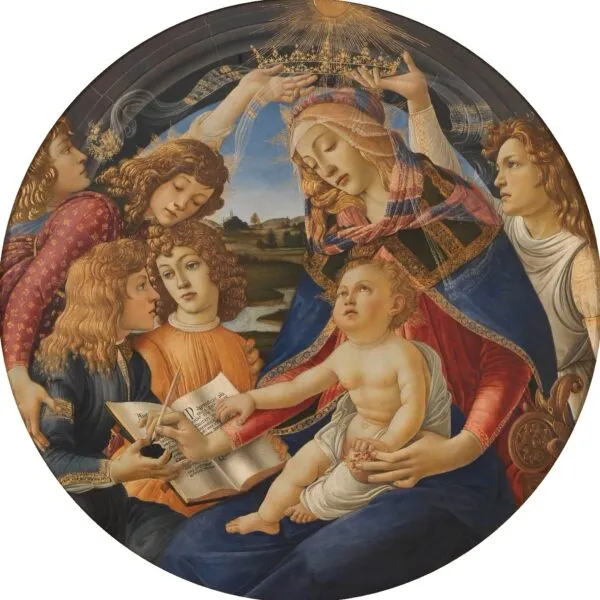
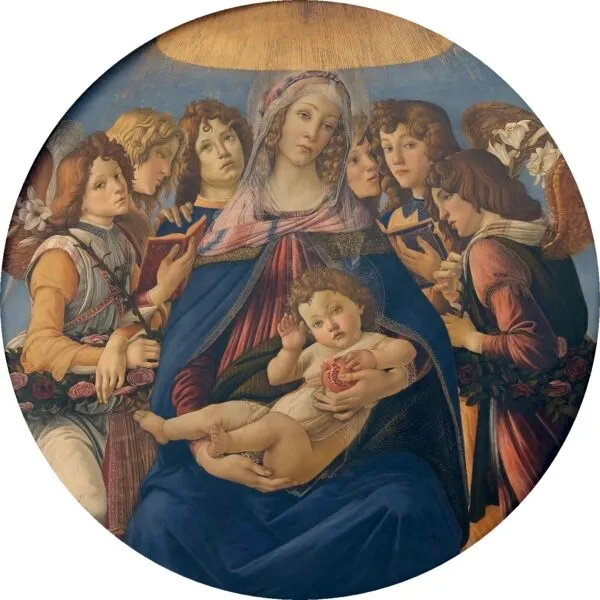
Among his Marian scenes, see the Cestello Annunciation, where the Virgin bends, almost swaying, towards the angel Gabriel. The Madonna of the Pomegranate offers a round composition with the Virgin, the Child and six angels, and the crowded Adoration of the Magi a scene in which tradition recognises the Medici.
Our page Sandro Botticelli gathers these and other famous Botticelli paintings that we paint in oil to order.
How do we hand-paint Lamentation over the Dead Christ?
Botticelli painted the original in tempera and oil on a poplar panel of 140 x 207 cm. Our Sandro Botticelli reproduction is made in oil on canvas: the painter builds up the colour layer by layer, so we can send the canvas rolled, stretched on a stretcher bar or already framed.
First he transfers the composition: the rock face, the dark entrance of the tomb and the arc of Christ’s body. Then he lays in the broad fields of colour in the mantles, from the Virgin’s black to Peter’s yellow and Jerome’s red.
He builds up the pale body of Christ and the mourners’ faces slowly, in thin layers. Last come the sheer veils and the fine gold lines of the haloes. The result is an oil painting reproduction you can study up close, brushstroke by brushstroke.
Which size suits which wall?
In short: small sizes over a desk, medium ones over a chest of drawers, the largest over a sofa or on a long empty wall.
We paint Lamentation over the Dead Christ in 7 landscape sizes (width x height): 60 x 39, 70 x 45, 90 x 60, 100 x 68, 130 x 90, 150 x 100 and 190 x 130 cm. The original measures 207 x 140 cm (width x height), so every one of our sizes is smaller; the largest, 190 x 130 cm, reaches about 92 % of its width.
The smallest size, 60 x 39 cm, suits a hallway, a shelf or a quiet prayer corner. From 70 x 45 to 100 x 68 cm it works above a chest of drawers or a bed. As a painting for the living room it comes into its own from 130 x 90 cm upwards.
Can I order another size, and which frame suits it?
Of course. For a different ratio we keep all nine figures whole and adjust only the rock above them, the grass in front or the margin beside Saint Peter. Send us the custom size you need and we will reply with a price and a delivery date.
We send the canvas rolled in a sturdy tube, stretched on a wooden stretcher bar or framed. Our workshop in Slovenia stretches, frames and packs it with care. You choose the moulding in our 3D app; seeing the painting on your own wall is a separate service.
When will your Lamentation over the Dead Christ arrive?
Painting and drying take 15 to 45 working days from the confirmation of your order. When the painting is finished we send you a photograph of it, and any change you ask for is made before packing.
Within Slovenia and to the other EU countries it travels without customs duties, and every order is covered by our returns policy.
It makes a fitting Easter gift for lovers of Renaissance religious art. If you do not know the recipient’s wall, give a gift voucher and let them choose the painting themselves.
Frequently asked questions
Where can I see the original?
In the Alte Pinakothek in Munich, inventory number 1075.
Who are the saints at the sides?
Jerome with his stone and Paul with his sword on the left, Peter with the keys on the right.
Is this a print?
No. You receive a hand-painted copy in which our painter brushes every face, veil and fold.
How big is the original?
140 x 207 cm (height x width); even our largest size, 190 x 130 cm, is smaller.
Can you paint the Lamentation in a size not on the list?
Yes. Tell us the width and height you want, and we reply with a price and a date for your Lamentation.
How long does the Lamentation take, and how does it travel?
It ships within 15 to 45 working days, rolled, stretched or framed.
Does the Lamentation suit a bedroom or a living room?
Given its solemn subject, a living room or a prayer corner suits it better than a bedroom.
What does the scene mean?
Christ’s friends mourn over his body between the Deposition and the Entombment.
- Subject: the dead Christ on the fainting Virgin’s lap, mourners before a rock tomb, Saints Jerome, Paul and Peter at the sides.
- Original: tempera and oil on poplar panel, painted around 1490–1492, 140 x 207 cm, Alte Pinakothek, Munich.
- Our painting: hand-painted in oil on canvas, 7 landscape sizes from 60 x 39 to 190 x 130 cm or made to measure.
- Worth knowing: the panel was made for the Florentine church of San Paolino, whose patron is Saint Paul with the sword.