







































Description
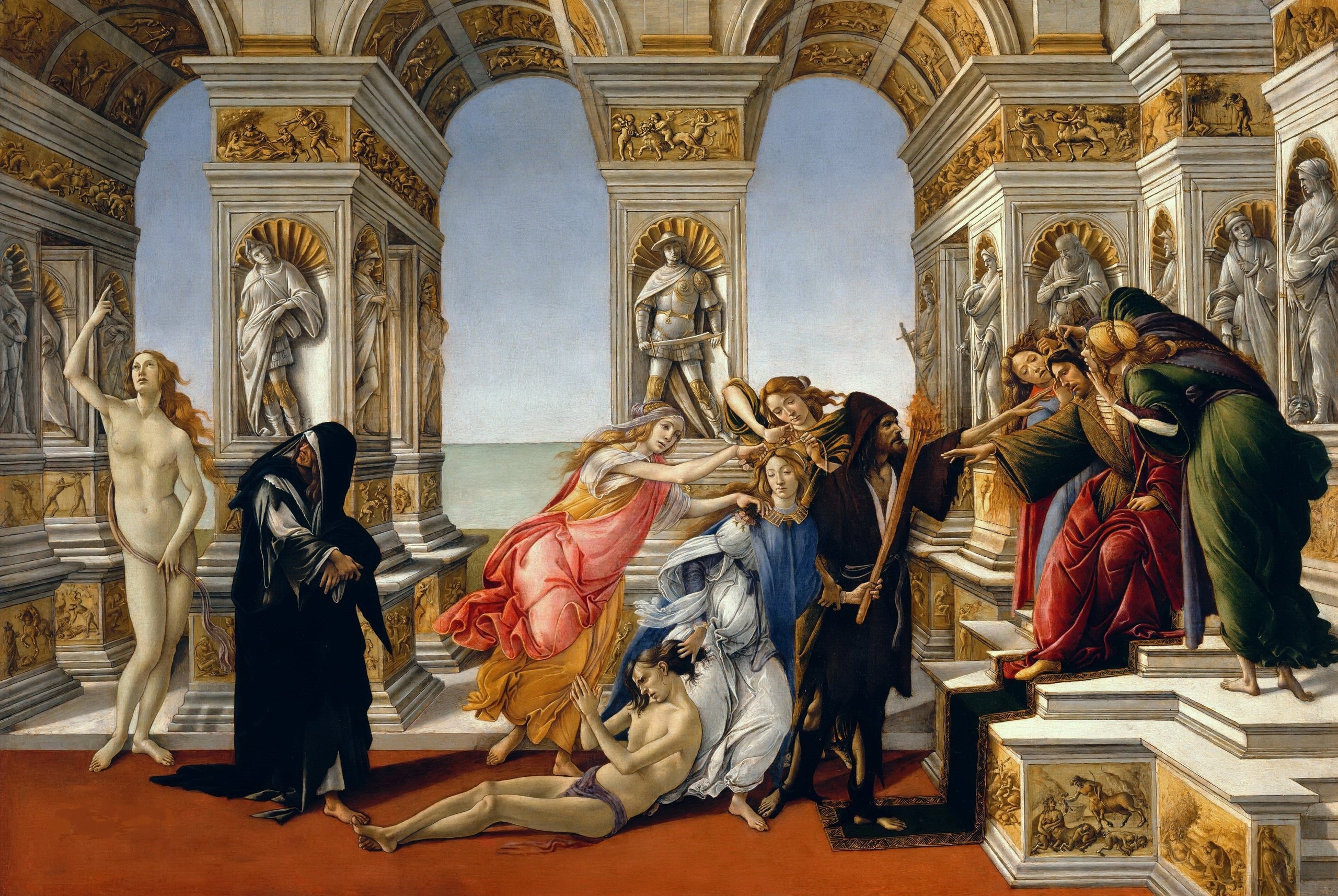
Calumny of Apelles is a painting by Sandro Botticelli from the mid-1490s: in a marble hall open to the sea, a king with donkey’s ears sits enthroned while two women whisper into them, Calumny, holding a torch, drags a nearly naked young man across the floor by his hair, and on the left an old woman in black turns towards the nude figure of Truth, who points to heaven. The original, tempera on panel measuring 62 x 91 cm, is in the Uffizi Gallery in Florence. Our painter recreates the scene for you by hand in oil on canvas, in 8 landscape sizes from 45 x 30 to 200 x 130 cm or made to measure. You receive a photograph of the finished painting before it is dispatched.
| Title: | Calumny of Apelles |
| Other titles: | La calunnia di Apelle (Italian title) · Apelova kleveta (Slovene title) |
| Painter: | Sandro Botticelli (c. 1445–1510) |
| Year painted: | c. 1494–1495 |
| Original size: | 62 cm x 91 cm (height x width) |
| Original technique: | Tempera on panel |
| Painting style: | Early Renaissance |
| Located at: | Uffizi Gallery, Florence, Italy |
| Our reproduction: | Hand-painted in oil on canvas, 8 sizes or made to measure |
Calumny of Apelles – Sandro Botticelli
What does Calumny of Apelles show?
The scene takes place in a sumptuous hall of white marble. Massive piers carry arches and vaults, statues of warriors and cloaked men stand in the niches, and almost every surface is covered in gilded reliefs. Three tall arches open onto a calm grey-blue sea.
On the right, on a dais reached by white steps, sits a king with long donkey’s ears and a red cloak. Ignorance and Suspicion stand beside him, holding his ears and speaking into them. He reaches towards the approaching group, but with his eyes lowered he cannot see it. Before the throne stands a bearded, hooded man in a dark cloak, Rancour or Envy, who holds a hand up to the king’s eyes.
In the centre Calumny, in white and blue and carrying a flaming torch, drags a nearly naked young man across the floor by his hair. The victim’s ankles are crossed as if for a crucifixion, and he raises his joined hands in prayer. Her two attendants, Perfidy in red and yellow and Fraud behind her, are meanwhile dressing her hair.
On the left Repentance, an old woman in ragged black clothes, turns back towards Truth. Truth stands completely nude and points to heaven with a raised hand.
What story does Botticelli tell?
The Greek painter Apelles made a painting about slander in the Hellenistic period that is now lost. We know it only from the description by the writer Lucian in his essay On Calumny.
According to Lucian, a rival named Antiphilos had accused Apelles before Ptolemy IV of Egypt of taking part in a conspiracy. Apelles came close to execution until a captured rebel confirmed his innocence.
Lucian’s account was popular in Renaissance Italy. Leon Battista Alberti praised it in his influential treatise De pictura of 1435 and recommended it to artists as a subject.
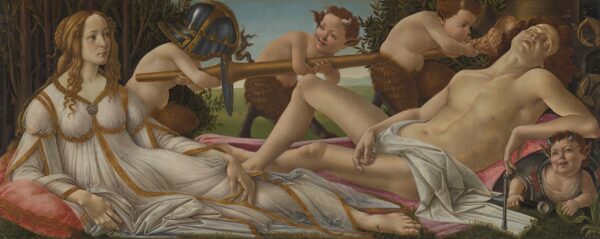
Some ten years earlier, for Venus and Mars, he had borrowed the little satyrs playing with the armour of Mars from another description by Lucian.
It is often suggested that Botticelli had a particular slandered person in mind, perhaps himself or the preacher Savonarola. That remains speculation.
Why is the painting so well known?
Calumny of Apelles is probably the last of Botticelli’s secular paintings to survive. On a panel of only 62 x 91 cm he fitted nine figures and a whole gallery of statues.
Since neither Lucian nor Alberti describes the setting, Botticelli invented the throne room himself. The reliefs show classical heroes, creatures from ancient myth and battle scenes, and some quote his own earlier works, among them the story of Nastagio degli Onesti and the Return of Judith to Bethulia.
The figure of Truth clearly derives from the Venus of his Birth of Venus.
The living figures are thin, elongated and rather mannered, unlike the calm statues. The Wikipedia article on the painting, written in English, goes into more detail.
Where is the original, and where did it come from?
The original hangs in the Uffizi Gallery in Florence, where it has been since 1773 at the latest. Before that it belonged to the Medici collection in the Pitti Palace.
Ronald Lightbown thinks Botticelli may first have painted it for himself. Some decades later Giorgio Vasari saw it in the house of the son of the Florentine banker Antonio Segna Guidi and wrote that it had been a gift from Botticelli.
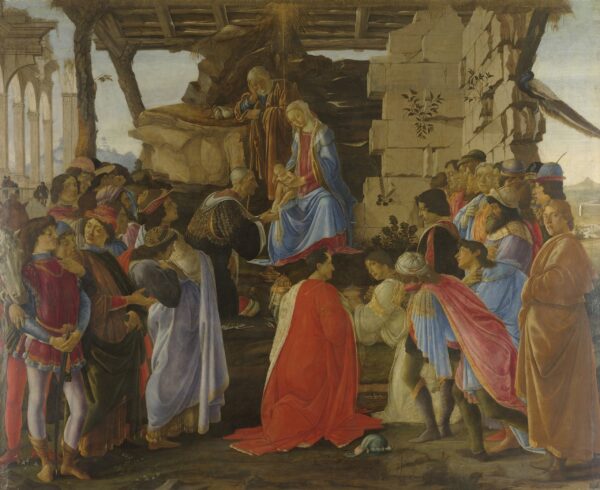
The same museum holds his Adoration of the Magi of about 1475.
Sandro Botticelli was born in Florence around 1445, the son of a tanner, and trained under Filippo Lippi. He lived all his life in the same Florentine neighbourhood and died in 1510.
Calumny of Apelles or another Botticelli?
This Sandro Botticelli reproduction suits anyone who likes a story that makes them think: about gossip, blind judgement and the truth that arrives last.
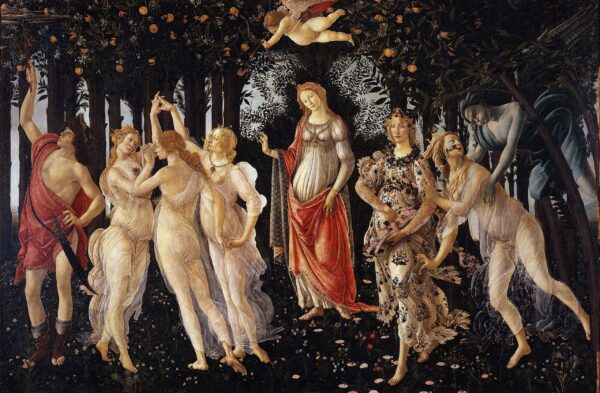
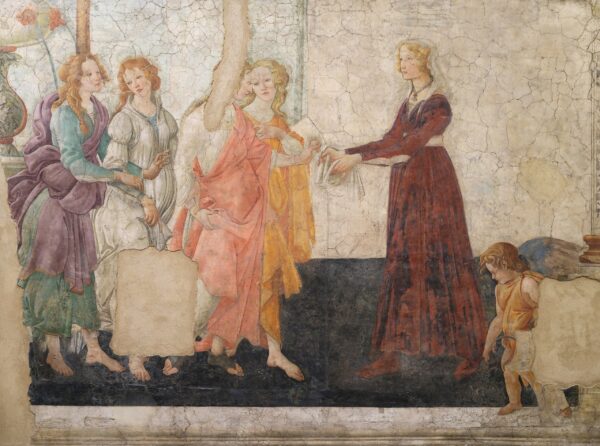
If you prefer Botticelli in a lighter mood, look at Primavera or at the fresco from the Villa Lemmi, Venus and the Three Graces Presenting Gifts to a Young Woman, in soft pastel tones.
Our whole range of famous Botticelli paintings, each one painted to order, is on the Sandro Botticelli page.
How do we hand-paint Calumny of Apelles?
Botticelli’s original is tempera on a wooden panel, 62 x 91 cm. Ours is an oil painting reproduction, hand-painted in oil on canvas layer by layer, so it can be sent rolled, stretched on a stretcher bar or framed.
The painter first lays out the perspective of the hall: the piers, the arches, the steps of the throne and the straight line of the sea. The nine slender figures follow in thin layers.
The decoration takes longest: the gilded reliefs, the grey-white statues in their niches and the gold hems of the robes. The flame of the torch and the transparent veils come last.
Which size suits which wall?
In short: up to 83 x 57 cm for a study or hallway, 105 x 75 cm and above for a living room.
We paint Calumny of Apelles in 8 landscape sizes (width x height): 45 x 30, 56 x 40, 63 x 45, 83 x 57, 105 x 75, 120 x 83, 155 x 105 and 200 x 130 cm. The original measures 91 x 62 cm (width x height). Sizes from 45 x 30 to 83 x 57 cm are smaller, 105 x 75 cm is a little larger, and from 120 x 83 cm upwards they are much larger than the panel in Florence.
The smallest sizes suit a narrow wall, a desk or a shelf; 83 x 57 and 105 x 75 cm hang well above a chest of drawers or a bed. As a painting for the living room it is strongest at 155 x 105 or 200 x 130 cm: on a large canvas the reliefs and statues read better than on the small museum panel.
Can I order another size or a frame?
If you need different proportions, all nine figures stay whole and we adjust only the marble architecture at the edges. Send us the size you have in mind and we will reply with a price and a date for your Calumny.
We ship it rolled in a tube, stretched on a stretcher bar or framed. Our workshop in Slovenia does the stretching and framing and packs every canvas painting for the journey. You pick the moulding in our 3D app; seeing the painting on your own wall is a separate service.
When will the painting arrive?
The painting is ready for dispatch 15 to 45 working days after you confirm your order. When it is finished we send you a photograph, and any corrections you ask for are made before packing.
Within Slovenia and the rest of the EU it travels without customs duties, and every order is covered by our returns policy.
For a lawyer, a historian or a lover of the Renaissance, it is a gift that starts conversations. Not sure about their wall? With a wall art voucher they can pick the size of their Calumny themselves.
Frequently asked questions
Where can I see the original?
In the Uffizi Gallery in Florence, where it has hung since 1773 at the latest.
Who is the nude woman on the left?
She is Truth, pointing to heaven with a raised hand; Botticelli based her on his own Venus.
Is it a print?
No. Every brushstroke is the painter’s, so what you receive is a hand-painted copy in oil on canvas.
How big is the original panel?
62 x 91 cm (height x width), so smaller than our sizes from 105 x 75 cm upwards.
Can you paint Calumny of Apelles in a size not listed here?
Yes. Tell us the width and height and we will send you a quote.
How long does the painting take, and how does it reach me?
15 to 45 working days; your Calumny of Apelles comes rolled, stretched or framed, after you have seen a photograph of it.
Is it a good choice for a gift or a living room?
Yes. Its warm golds and reds suit a living room, a study or a library.
Why does the king have donkey’s ears?
Botticelli gave him the ears of King Midas; in Lucian the judge simply has very large ears.
- Subject: a king with donkey’s ears, Calumny dragging her victim by the hair, and the nude Truth.
- Original: tempera on panel, c. 1494–1495, 62 x 91 cm, Uffizi Gallery, Florence.
- Ours: in oil on canvas, 8 landscape sizes from 45 x 30 to 200 x 130 cm or a size of your choice, all by hand.
- Worth knowing: Botticelli rebuilt a lost work by the ancient painter Apelles from Lucian’s description.