







































Description
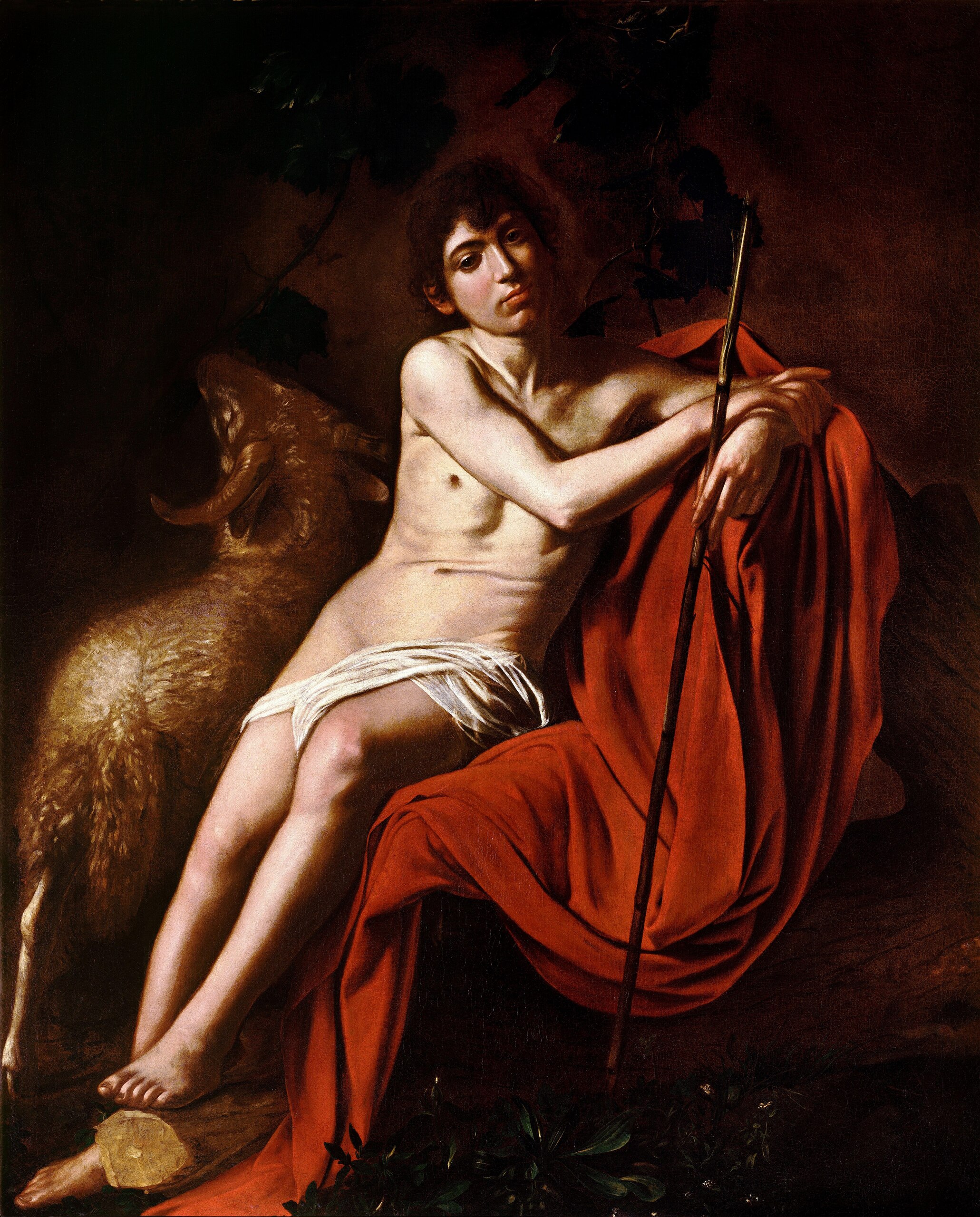
Saint John the Baptist is one of the last paintings Caravaggio made, painted in Naples in 1610: the young John is nude but for a white cloth across his lap and sits leaning back on a large red cloak in a dark wilderness, a thin reed staff in his hands, while a ram nuzzles at him from the left. The original, oil on canvas, is 159 cm high and 124 cm wide and belongs to the Galleria Borghese in Rome. Our painters make it for you by hand in oils on canvas, in 8 portrait sizes from 40 x 49 to 150 x 195 cm or to a size of your own, and you see the finished painting in a photograph before it is dispatched.
| Title: | Saint John the Baptist |
| Other titles: | San Giovanni Battista · Johannes der Täufer |
| Painter: | Michelangelo Merisi da Caravaggio (1571–1610) |
| Year painted: | 1610 |
| Original size: | 159 cm x 124 cm (height x width) |
| Original technique: | Oil on canvas |
| Painting style: | Baroque, tenebrism |
| Located at: | Galleria Borghese, Rome, Italy |
| Our reproduction: | Hand-painted oil on canvas, 8 sizes or made to measure |
Saint John the Baptist – Caravaggio
What does Saint John the Baptist show?
A single young man sits on the tall canvas. He is nude except for a white cloth over his lap, and a great red cloak spreads around and beneath him, filling almost the whole right half of the composition. His body tilts slightly back, as if he were resting.
His arms are crossed over one knee, and his hands hold a thin reed that rises like a staff beside his shoulder. From the left a ram with a curled horn leans in towards him, and dark vine leaves hang out of the shadows above his head.
John is not preaching, and he does not point to heaven. His head tips a little to one side and his gaze is tired and thoughtful, almost sad. Light falls from the left, catching shoulder, chest and knee, while everything else stays in a brownish dark.
Who was John the Baptist, and how is the painting read?
In the Gospels John the Baptist is the prophet who lived in the wilderness, preached repentance and baptised people in the river Jordan; Jesus too was baptised by him.
Caravaggio takes no dramatic moment from this story. There is no crowd, no river, no baptism. What remains is a young man, an animal and silence, so the scene feels like a short pause on a long road.
Some scholars see in the youth not John at all but a Good Shepherd, since a ram stands beside him and he holds a staff.
Why is this painting held in such regard?
Because it is among the very last works Caravaggio painted. It was made in the spring of 1610 in Naples, in the year of the painter’s death, and was meant for Cardinal Scipione Borghese in Rome.
The saint is painted from a live model, with no halo and no flattery, like a youth you might pass in the street. Hard light cuts him out of the dark: this is the tenebrism that made Caravaggio famous.
The colour is built with unusual economy too: nearly the whole canvas stays in browns and deep shadow until a single broad field of red cloth cuts across it. If you want to read more about the painter’s life, the English Wikipedia article on Caravaggio covers it; there is no separate English article on this painting.
Where is the original, and how did it get there?
The original is in the Galleria Borghese in Rome, where it carries inventory number 267. The canvas is 159 cm high and 124 cm wide.
Caravaggio painted it for Cardinal Scipione Borghese. At first it did not hang in today’s Galleria but in the Palazzo Borghese.
In the same Roman gallery you can also see David with the Head of Goliath, where the young, bare-chested David holds out the head of the defeated giant at arm’s length.
Saint John the Baptist or another Caravaggio?
Saint John the Baptist is a canvas painting for anyone drawn to a quiet, thoughtful figure and a strong red against a dark ground.
A similar youth, with a white cloth and one bare shoulder, appears in Bacchus, where the young god of wine holds out a shallow goblet of red wine. Even more absorbed in himself is the young man of Narcissus, who kneels at the water’s edge and gazes at his reflection.
If the calm of an inward-turned figure appeals to you, look too at Penitent Magdalene, where a young woman sits with her head bowed. All the famous Caravaggio paintings we paint to order are gathered on our Caravaggio page.
How does our painter paint Saint John?
Each John is painted only after you order it. The painter works in oils on canvas, layer by layer: first a dark, warm ground, then the brush draws the diagonal of the body, the staff and the outline of the ram, so the composition holds before the colour arrives.
Next comes the skin. He builds the light passages of shoulder, chest and knee slowly, in many thin layers, so they stay soft and warm. The red cloak takes deep folds running from near black to vivid scarlet, and the ram’s fleece gets fine, loose strokes.
The result is a Caravaggio reproduction with real relief in the paint and brushwork you can see up close. An oil painting reproduction like this changes in half-light: in the evening, under a warm lamp, the red cloak almost catches fire and the body steps out of the dark.
Which size works on which wall?
In short: 40 x 49 or 45 x 60 cm for a narrow wall beside a door or above a bedside table, 58 x 75 or 73 x 94 cm for a hallway or study, 84 x 103 or 110 x 135 cm above a sofa or bed, and 120 x 155 or 150 x 195 cm for a tall wall, a stairwell or a spacious dining room.
Saint John the Baptist comes in 8 portrait sizes (width x height): 40 x 49, 45 x 60, 58 x 75, 73 x 94, 84 x 103, 110 x 135, 120 x 155 and 150 x 195 cm. The closest to the original is 120 x 155 cm, which is 4 cm narrower and 4 cm shorter.
Because the figure sits diagonally across the whole canvas and the red cloak carries much of the composition, it needs a little room to breathe. As a painting for the living room the best choice is 84 x 103 or 110 x 135 cm above the sofa, while the smaller sizes sit well over a desk.
Can I choose another size or a frame?
Yes. For a size of your own we arrange the composition so that the staff, the ram’s head and the young man’s feet stay on the canvas and the cloak keeps its weight. Send us the width and height you have in mind, and we will reply with a price and a lead time.
John travels rolled, stretched on a stretcher bar or framed. Stretching and framing are done by our workshop in Slovenia, which also readies Saint John for the journey. You pick the frame in our 3D app, which is only there to help you choose the moulding; seeing the painting on your own wall is a separate service.
When will the painting arrive, and how does it travel?
We start painting as soon as you confirm your order, and John is ready to leave within 15 to 45 working days. Before dispatch we send you a photograph of the finished painting; if you would like anything changed, we do it before packing. Within Slovenia and the rest of the EU there are no customs charges, and our returns policy applies to every order.
It makes a fine gift for anyone called John, Johanna or Jan, or for a christening or confirmation in a family that loves old art. Unsure which size they would like? Give a wall art voucher and the choice is theirs.
Frequently asked questions
Which museum holds the original?
The Galleria Borghese in Rome, under inventory number 267.
Why is there a ram beside John?
Because of the ram and the staff, some scholars read the young man as a Good Shepherd.
Is it a print on canvas?
No. Every piece is a hand-painted copy, made by the painter with brush and oil paints.
How large is Caravaggio’s original?
It is 159 cm high and 124 cm wide; our nearest size is 120 x 155 cm.
When and where did Caravaggio paint it?
In the spring of 1610 in Naples, in the last year of his life.
Does it suit a bedroom or a lounge?
Yes. In a bedroom it feels calm; in a lounge the red cloak becomes a strong accent of colour.
Will you paint John in a size that is not on the list?
Of course. Send us the width and height, and we answer with a price and a lead time.
How long does it take to make?
15 to 45 working days; before dispatch you receive a photograph of the completed painting.
- Subject: the young Saint John the Baptist, nude but for a white cloth over his lap, sits on a red cloak in a dark wilderness, a reed staff in his hands and a ram at his side.
- Original: 1610, oil on canvas, 159 x 124 cm, Galleria Borghese, Rome.
- Ours: painted by hand in oils on canvas, in 8 portrait sizes from 40 x 49 to 150 x 195 cm or made to measure.
- Worth knowing: Caravaggio painted it in Naples for Cardinal Scipione Borghese, in the last year of his life.