







































Description
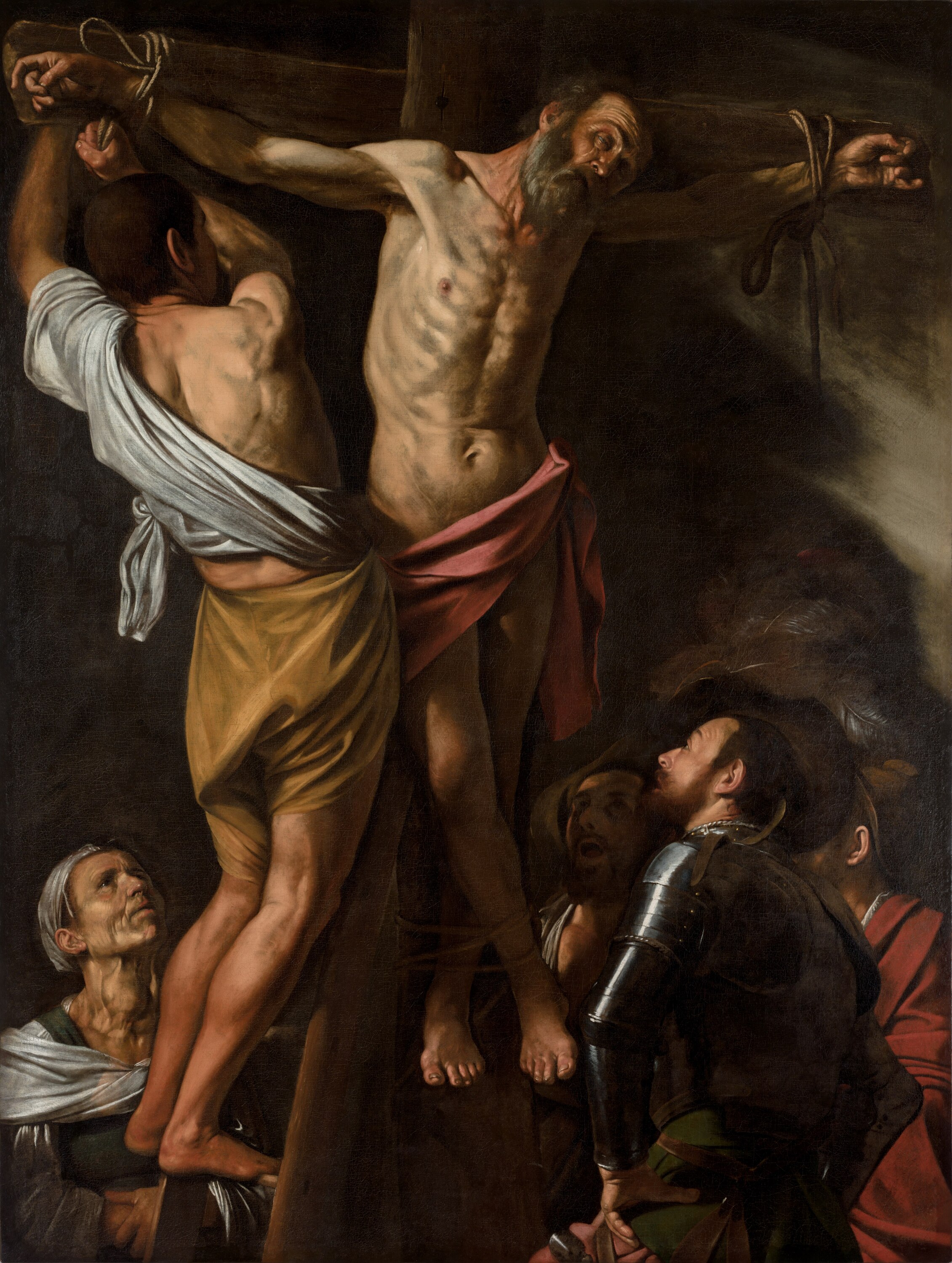
The Crucifixion of Saint Andrew is a painting by Caravaggio from 1607: the old, gaunt apostle hangs on a cross, tied with ropes, and looks up into the light, an executioner on a ladder reaches for the knots, and from below an old woman with a goitre and the armoured Roman proconsul gaze up at him. The original, oil on canvas, is 202.5 cm high and 152.7 cm wide and belongs to the Cleveland Museum of Art in the United States. Our painter paints it for you by hand in oil on canvas in 6 portrait sizes, from 92 x 127 to 180 x 230 cm, or to measure, and before it ships we show you the finished painting in a photograph.
| Title: | The Crucifixion of Saint Andrew |
| Other titles: | Crocifissione di sant’Andrea · Die Kreuzigung des heiligen Andreas |
| Painter: | Michelangelo Merisi da Caravaggio (1571–1610) |
| Year painted: | 1607 |
| Original size: | 202.5 cm x 152.7 cm (height x width) |
| Original technique: | Oil on canvas |
| Painting style: | Baroque, tenebrism |
| Located at: | The Cleveland Museum of Art, Cleveland, USA |
| Our reproduction: | Hand-painted oil on canvas, 6 sizes or made to measure |
The Crucifixion of Saint Andrew – Caravaggio
What does The Crucifixion of Saint Andrew show?
The canvas is upright and more than two metres tall, with the cross rising through its centre. On it hangs the apostle Andrew, an old, wasted man wearing only a loincloth. No nails hold him to the wood; ropes do, wound around his wrists, arms and legs.
His head is tipped back and his eyes are turned upward, into the light that falls on his pale body. Beside the cross an executioner stands on a ladder and stretches his hands toward the ropes, as if about to untie them.
On the left an old woman with a goitre at her throat lifts her face; on the right the proconsul in metal armour does the same, and both look up at the saint above them. When an appraiser listed the work in Valladolid in 1653, he counted three executioners and a woman.
What is the story of Saint Andrew?
According to tradition, Andrew was martyred in Patras, in Greece. He was bound to the cross with ropes, survived on it for two days and kept preaching until the crowd, now converted, demanded his release.
The Roman proconsul Aegeas, whom Caravaggio places in the lower right corner, then ordered him taken down. His men could not do it: as Wikipedia tells it, they were struck by a miraculous paralysis, because the saint had prayed to be allowed to die a martyr. Caravaggio paints the very moment the hands falter at the knots.
From the 17th century onward Andrew is usually shown on a diagonal cross, but Caravaggio, Wikipedia says, probably followed the 16th-century belief that he died on an ordinary Latin cross. The martyrdom of another apostle on a cross is the subject of The Crucifixion of Saint Peter.
Why is this painting held in such regard?
Because it shows a miracle rather than violence. The executioner has frozen in mid-movement, and every face turns upward to the old man whom no one can take down any more.
Because it was prized from the start. In 1653, in the family palace of the Dukes of Benavente in Valladolid, it was valued at 1,500 ducats, by far the highest figure of any painting in their collection.
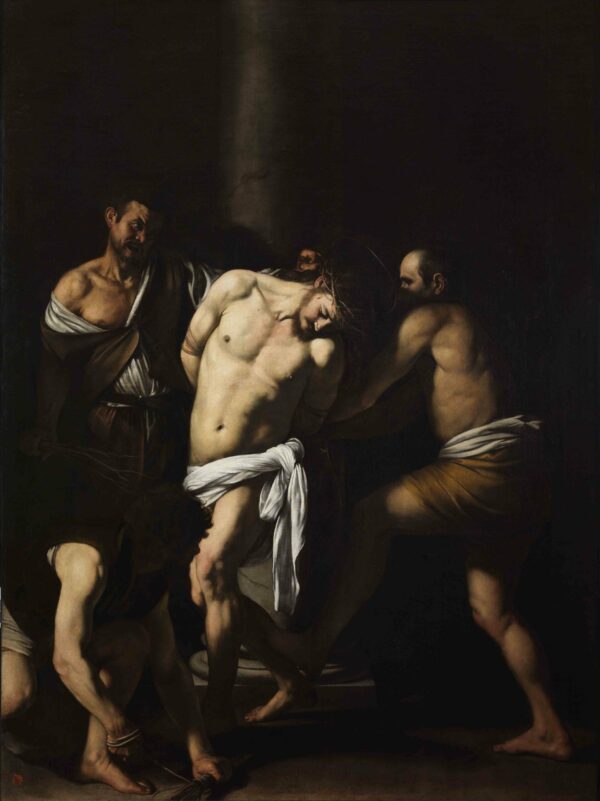
And because it shows Caravaggio in his Naples years, building a scene out of deep darkness and a single strong light. Christ at the Column comes from the same period. The English Wikipedia article lists the other versions.
Where is the original of The Crucifixion of Saint Andrew?
In the United States, at the Cleveland Museum of Art, under accession number 1976.2. The museum bought it in 1976 from the Arnaiz collection in Madrid, two years after its rediscovery.
It was almost certainly commissioned by the Spanish Viceroy of Naples, Juan Alonso Pimentel de Herrera, 5th Duke of Benavente, who was especially devoted to Saint Andrew and helped renovate the saint’s crypt in Amalfi Cathedral. When he left Naples on 11 July 1610, after seven years in office, he took the painting with him to Spain.
There it hung in the family palace in Valladolid. In 1653, after the death of the 7th Duke, the appraiser Diego Valentín Díaz described it as a large painting of a nude Saint Andrew in an ebony frame and gave the painter as “micael angel caraballo”. Three other versions are known: one in the private Spier Collection in London, attributed to Caravaggio again since 2011, and two copies, in Toledo and Dijon.
The Crucifixion of Saint Andrew or another Caravaggio?
This is a serious, composed canvas painting for a tall wall: a hallway with a high ceiling, a staircase or a library.
If you would like another scene of a saint from the same years, there is The Burial of Saint Lucy of 1608, with two gravediggers at work in an empty stone vault. For a conversion in a blaze of light, see The Conversion on the Way to Damascus.
Among the famous Caravaggio paintings our painters make to order, all gathered on the Caravaggio page, Andrew stands out because almost the whole scene looks upward, toward one figure on the cross.
How does our painter paint your Saint Andrew?
Every Crucifixion of Saint Andrew is painted to order, in oil on canvas and in several layers. The painter first covers the canvas with a dark tone and sets down the upright of the cross, the slant of the ladder and the heads below before any detail begins.
Then the body is built up: the pale skin over the ribs, the taut ropes at the wrists, the folds of the loincloth. Special care goes into the upturned faces and the glints on the proconsul’s armour.
A Caravaggio reproduction painted by hand has a different surface from a print: brushstrokes show in the light passages, and the darks stay deep and warm. That is why an oil painting reproduction of this scene changes a little from day to day with the light in the room.
Which size for which wall?
In short: 92 x 127 or 105 x 145 cm above a chest of drawers or in a hallway, 120 x 160 or 136 x 180 cm above a sofa, and 150 x 205 or 180 x 230 cm for a wall with a high ceiling or beside a staircase.
Because the scene holds many figures and details, we offer it in 6 portrait sizes (width x height), all large enough for the faces to stay legible: 92 x 127, 105 x 145, 120 x 160, 136 x 180, 150 x 205 and 180 x 230 cm. The closest to the original is 150 x 205 cm, which is 2.7 cm narrower and 2.5 cm taller.
As a painting for the living room, 120 x 160 or 136 x 180 cm works well above a sofa or on an open wall.
Can I get a different size or a frame?
Yes. For an alcove or an unusual ceiling height, send us the width and height you want and we will reply with a price and a production time.
Your painting can travel rolled, stretched on a stretcher bar or framed; our workshop in Slovenia does the stretching and the framing. You pick the frame in our 3D app, which is for choosing a frame only; seeing the painting on your own wall is a separate service.
In 1653 it hung in an ebony frame, so a dark, almost black frame suits it well.
When and how does the painting arrive?
Work begins on the day your order arrives, and the painting is ready to ship within 15 to 45 working days. Before that we send you a photograph of the finished Saint Andrew, and make any changes you ask for. Nothing is charged at customs inside Slovenia or anywhere in the EU, and every order is covered by our returns policy.
The Crucifixion of Saint Andrew is a thoughtful gift for an Andrew or an Andrea. If the recipient should choose the size, give them a wall art voucher.
Frequently asked questions
Where is the original today?
At the Cleveland Museum of Art in the United States, which bought it in 1976.
Why is the saint tied with ropes?
Tradition says he was tied, not nailed, and so lived two days on the cross, preaching.
Is this a print or a real painting?
A real painting: every Saint Andrew we send is a hand-painted copy in oil colours on canvas.
What are the dimensions of the original?
It is 202.5 cm high and 152.7 cm wide; our closest size is 150 x 205 cm.
Who are the two figures below the cross?
On the left an old woman with a goitre, on the right the Roman proconsul Aegeas in armour.
Is it suitable for a bedroom?
The scene is serious, so it fits a living room, hallway or library better than a bedroom.
Can you paint Saint Andrew in an unlisted size?
Yes. Write to us with the measurements you need and we will send a price and a date.
How long will I wait?
From 15 to 45 working days; you see a photograph of the finished painting before it ships.
- Subject: the apostle Andrew, tied to the cross, looks into the light while an executioner reaches for the ropes.
- Original: 1607, oil on canvas, 202.5 x 152.7 cm, Cleveland Museum of Art, Cleveland (USA).
- Ours: your Saint Andrew, painted by hand in oil on canvas, in 6 portrait sizes from 92 x 127 to 180 x 230 cm or made to measure.
- Worth knowing: in 1653 it was valued at 1,500 ducats in Valladolid, more than any other painting the Dukes of Benavente owned.