







































Description
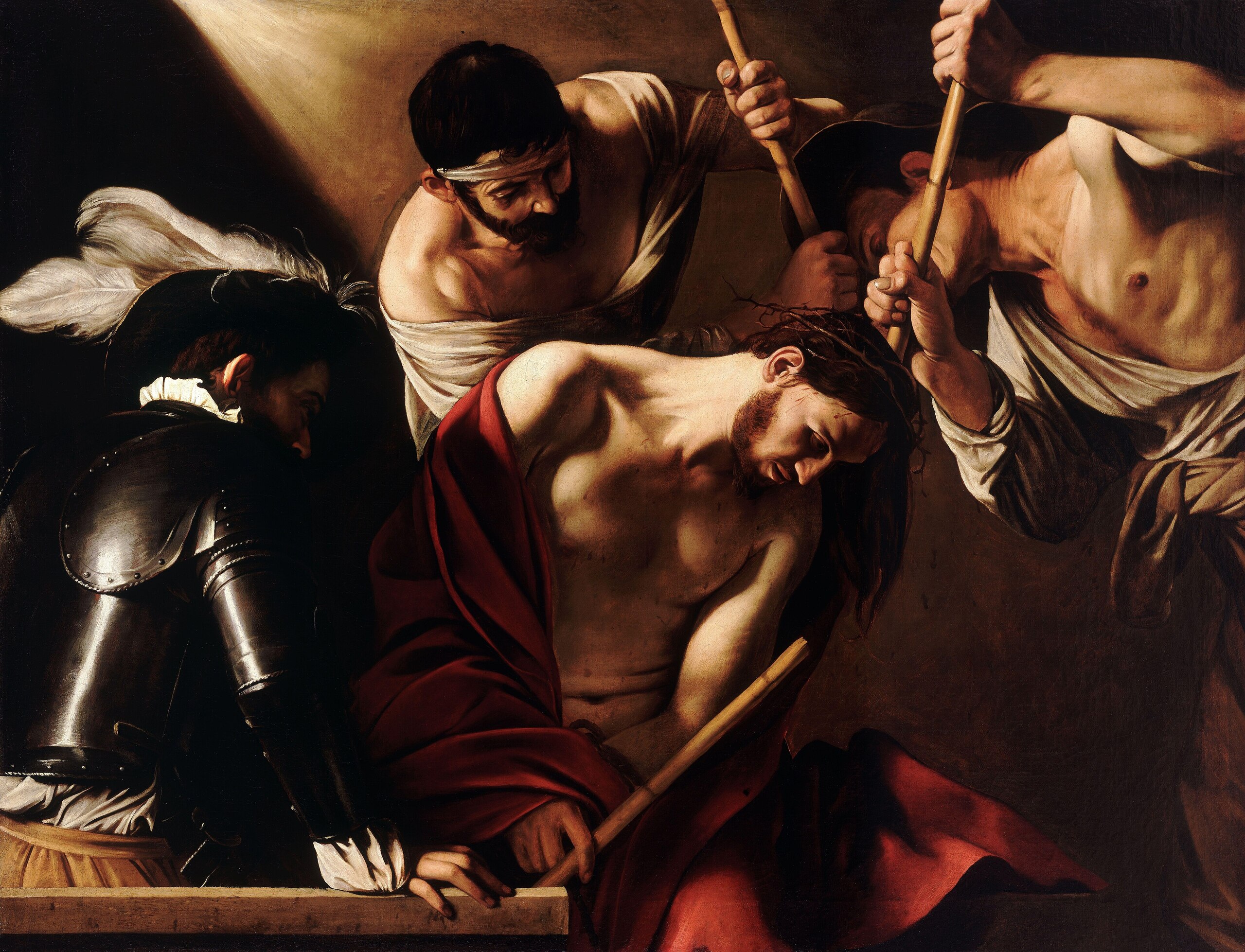
The Crowning with Thorns is a painting by Caravaggio, probably made around 1602–1604 or possibly as late as 1607, since its date is disputed: Christ, bare to the waist and wrapped in a red cloak, sits bowed with a reed in his bound hands while two tormentors use sticks to force the crown of thorns onto his head, and in the foreground a man in armour leans on a rail and watches. The original, oil on canvas, is 127 cm high and 165.5 cm wide and hangs in the Kunsthistorisches Museum in Vienna. Our painter paints it for you by hand in oil on canvas in 8 landscape sizes, from 56 x 41 to 200 x 159 cm, or to measure, and you receive a photograph of the finished work before it ships.
| Title: | The Crowning with Thorns |
| Other titles: | Incoronazione di spine · Die Dornenkrönung |
| Painter: | Michelangelo Merisi da Caravaggio (1571–1610) |
| Year painted: | c. 1602–1604 or c. 1607 |
| Original size: | 127 cm x 165.5 cm (height x width) |
| Original technique: | Oil on canvas |
| Painting style: | Baroque, tenebrism |
| Located at: | Kunsthistorisches Museum, Vienna, Austria |
| Our reproduction: | Hand-painted oil on canvas, 8 sizes or made to measure |
The Crowning with Thorns – Caravaggio
What do we see in The Crowning with Thorns?
The scene is wide and tightly packed. Christ sits at the centre. His upper body is bare and turned forward, his head lowered, and a red cloak falls over his shoulders and knees. In his tied hands he holds a thin reed.
Behind him stand two tormentors. Each grips a stick and uses it to push the crown of thorns down onto Christ’s head. Their arms and sticks cross above him.
Right at the front, turned away from the viewer, a man in armour props himself on a rail. The light comes from the upper left: it slides across Christ’s shoulders and the red cloak, catches on the breastplate, and everything else sinks into darkness.
What does the crowning mean?
The Crowning with Thorns is a scene from the Passion. Before the crucifixion a crown of thorns was forced onto Christ’s head to mock his claim to authority.
Wikipedia points to two further details. The bent, twisted body of Christ was influenced by the Belvedere Torso, the famous ancient sculpture. And the canvas was designed as a supraporte, meant to hang over a doorway.
From the same days of the Passion come the scenes we offer as The Flagellation of Christ and as Ecce Homo. Of the three, the crowning is the most enclosed and the quietest.
Why is this painting held in such high regard?
Caravaggio’s patron Vincenzo Giustiniani was an intellectual as well as a collector. Late in life he wrote a paper on art that sorted painters into twelve grades of accomplishment. In the highest he placed only two, Caravaggio and Annibale Carracci, as the ones who best combined realism and style.
The cruelty of the two men hammering home the thorns and the bored slouch of the figure at the rail are observed straight from life. Christ suffers real pain and bears it with patient endurance.
All of it sits within a classical composition of horizontals and diagonals that cross and pull against each other. The English Wikipedia article covers the history and style of the work in more depth.
Where is the original of The Crowning with Thorns?
The original hangs in the Kunsthistorisches Museum in Vienna, where it is catalogued under inventory number GG 307.
According to Caravaggio’s biographer Giovanni Bellori, it was made for Vincenzo Giustiniani, and it can be traced convincingly to his collection. That would place it before 1606, the year the painter fled Rome. Peter Robb, by contrast, dates it to 1607, when Caravaggio was in Naples.
In 1809 the Imperial ambassador, Baron Ludwig von Lebzelter, bought it in Rome, yet it did not reach Vienna until 1816. Wikipedia also mentions a second Crowning with Thorns of about 1604 attributed to Caravaggio. Our version follows the Vienna composition.
The Crowning with Thorns or another Caravaggio?
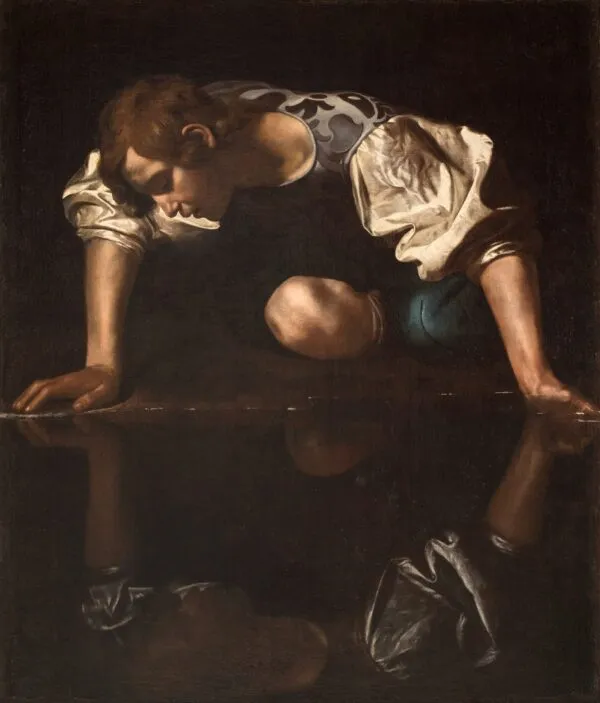
If you want the moment that comes next, look at Ecce Homo: there Pontius Pilate presents to the crowd a Christ who already wears the crown of thorns and has his hands bound. The Vienna scene also pairs well with Christ at the Column, in which Christ is tied to a column among three tormentors.
A different but equally tense moment comes with The Denial of Saint Peter, one of Caravaggio’s last works: a soldier and a maidservant point at the old Peter, who raises his hands to his chest and denies knowing Jesus.
The Caravaggio page gathers the famous Caravaggio paintings we offer. Among them The Crowning with Thorns is the canvas painting with the most unusual first purpose, since it was meant for the space above a door.
How does our painter paint your Crowning with Thorns?
We begin each Crowning with Thorns only once you have ordered it, building it in layers of oil on canvas. The painter first covers the canvas with a dark underpainting and draws in the crossing sticks, the rail and the outlines of all four figures.
Then, step by step, he builds the light falling from the upper left: on Christ’s shoulders and chest, on the folds of the red cloak and on the metal sheen of the armour in front. The crown of thorns gets thin, sharp strokes.
A hand-painted copy has brushstrokes you can feel in the light passages and, in the dark ones, a depth no print reaches. Because an oil painting reproduction responds to the light in the room, Christ’s body looks even more sculpted under a lamp at night than it does by day.
Which size for which wall?
In brief: 56 x 41 or 70 x 52 cm for a smaller wall or above a door, 80 x 59 or 101 x 74 cm for a hallway or over a chest of drawers, 110 x 85 or 140 x 110 cm above a sofa, and 160 x 123 or 200 x 159 cm for a large bare wall.
We paint The Crowning with Thorns in 8 landscape sizes (width x height): 56 x 41, 70 x 52, 80 x 59, 101 x 74, 110 x 85, 140 x 110, 160 x 123 and 200 x 159 cm. The closest to the original is 160 x 123 cm, which is 5.5 cm narrower and 4 cm lower.
Since it was conceived for the space over a door, you can hang it higher than usual, above a door frame or a tall cupboard, in sizes up to 101 x 74 cm. As a painting for the living room, over a sofa, it comes into its own at 140 x 110 or 160 x 123 cm, where faces and hands read clearly from across the room.
Can I order another size or a frame?
Of course. The composition rests on crossing diagonals and horizontals, so when we adapt it to other proportions we make sure no line loses its direction and all four figures stay whole. For your Crowning with Thorns, tell us the width and height you need and we will send you a price and a lead time.
You can have the painting rolled in a tube, stretched on a stretcher bar or ready framed. Stretching and framing are handled by our own workshop in Slovenia. You pick the frame in our 3D app, which is there for frame choice alone; a view of the painting on your own wall is a separate service.
When will the painting arrive, and how?
We start painting as soon as your order arrives, and the painting is ready to ship within 15 to 45 working days. Before it goes, you get a photograph of the finished work, and any changes you ask for are still made. Shipping within Slovenia and the rest of the EU involves no customs, and our returns policy applies to every order.
It makes a considered gift for a lover of the Baroque or of sacred art. If the recipient should pick the size, a wall art voucher hands that choice over.
Frequently asked questions
Where can I see the original?
In the Kunsthistorisches Museum in Vienna, Austria.
What are the two men with sticks doing?
They are pressing the crown of thorns onto Christ’s head with their sticks, while the man in armour calmly looks on.
Is this a print or a real painting?
It is not a print. Every Caravaggio reproduction we sell is painted with a brush and oil paints on canvas.
How large is the original?
It measures 127 x 165.5 cm (height x width); our nearest size is 160 x 123 cm.
Where was the work meant to hang?
As a supraporte, that is, above a doorway, as Wikipedia reports.
Will it suit a bedroom or a living room?
The scene is too serious for most bedrooms; it sits better in a living room, a study, a library or above a hallway door.
Will you paint it in a size you do not list?
Yes. Give us the width and height, and a price and a date come back to you.
How long does it take to make?
15 to 45 working days, and you receive a photograph of the finished painting before dispatch.
- Subject: Christ in a red cloak holding a reed, two tormentors pressing the crown of thorns onto his head with sticks, a man in armour looking on.
- Original: c. 1602–1604 or c. 1607, oil on canvas, 127 x 165.5 cm, Kunsthistorisches Museum, Vienna.
- Ours: hand-painted in oils, on canvas, in any of 8 landscape sizes between 56 x 41 and 200 x 159 cm, or to measure.
- Worth knowing: The painting was designed as a supraporte to hang over a doorway, and it reached Vienna in 1816.