



Description
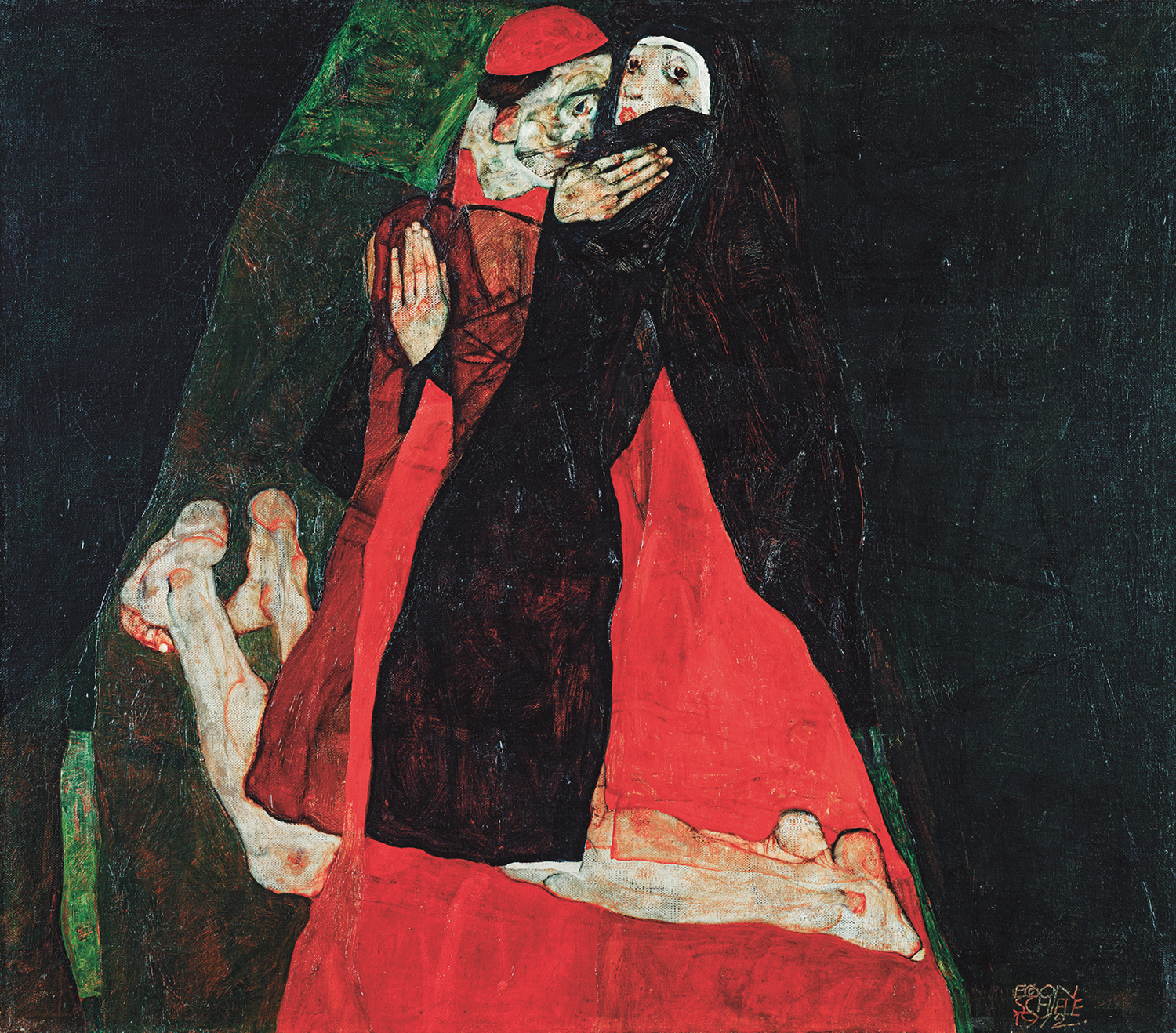
Cardinal and Nun (Caress) is a work of 1912 by Egon Schiele: a cardinal in red and a nun in a black habit, kneeling in an embrace against an almost black ground. The original is held by the Leopold Museum in Vienna under inventory number 455; it measures 80.5 x 70 cm and is in landscape format. We paint it by hand in oils, in fifteen sizes or to your own measurement, and before dispatch we send you a photograph of the finished work for approval.
| Title: | Cardinal and Nun (Caress) |
| Other titles: | Caress · Liebkosung · Kardinal und Nonne |
| Painter: | Egon Schiele (1890–1918) |
| Year: | 1912, signed and dated lower right “EGON SCHIELE 1912” |
| Original size (width × height): | 80.5 cm x 70 cm (the museum does not label the axes; landscape format) |
| Original technique: | Oil on canvas |
| Style: | Expressionism |
| Location: | Leopold Museum, Vienna (inv. 455) |
| Our reproduction: | hand-painted oil on canvas, 15 sizes from 45 x 38 cm to 180 x 160 cm, or a made-to-measure size |
Cardinal and Nun (Caress) – Egon Schiele
Who is in the painting?
A cardinal and a nun. The Austrian painter Egon Schiele (1890–1918) painted them in 1912, and in his lifetime the work carried the title Caress (Liebkosung): according to the museum it was presented and published under that title, but not sold. Cardinal and Nun is the name by which it is widely known, and the museum’s record gives both, as Caress (Cardinal and Nun). The two figures are types, not portraits: the record names no sitters, and neither do we.
What is on the canvas?
Two figures kneel close together against an almost black ground. On the left is the cardinal, in a red skullcap and a red robe; he leans towards the nun, and his head touches hers. The nun, on the right, wears a black habit with a white coif that frames her face. Her eyes are wide open and look straight out of the picture, as if she had just turned her head towards whoever is watching. A hand lies against her cheek and throat, and between the two bodies, against the cardinal’s chest, two palms are pressed together as in prayer. Below, the red of the robe widens into a broad scarlet expanse that fills most of the lower half; out of it come bare feet and lower legs, pale and outlined in thin orange-red strokes: on the left a pair of bent legs, at the lower right the soles of two feet. Behind the pair rises a dark green shape, a brighter green at the upper left and along the lower left edge. Together the two figures form a tall triangle that narrows towards their heads. In the lower right corner the signature and date stand in three short lines of capitals: EGON / SCHIELE / 1912.
Why does this painting matter?
For three reasons, each supported by the museum’s own record. The first is the title: the work is widely known as Cardinal and Nun, but its actual title is Caress, and under that title it was presented and published in Schiele’s lifetime, though not sold. The second is the comparison with Klimt: in the museum’s reading, Schiele’s Caress looks like the dark sister of The Kiss (Lovers) of 1907/08 by Gustav Klimt (1862–1918). The third is its history: after 1939 the canvas passed through the hands of the dealer Friedrich Welz, in 1945 the US occupying power secured it, and in 1948 it was restituted; the museum publishes the whole chain, which we set out below. The record’s catalogue references run from Otto Nirenstein’s book of 1930 (no. 107) to Tobias Natter’s catalogue of 2017 (no. 116).
What does the painting mean?
In the museum’s reading, it is about desire and prohibition. The museum’s text (signed VG, 2021) calls the depiction a beacon: a cardinal dressed in red caresses a nun in a dark habit, who, caught in the act or distressed, turns towards the beholders. The praying hands become pliers, the cardinal red stands for fiery desire, and the naked calves symbolise carnal sin. Four years earlier Klimt had painted an ode to love; where his abyss is stylised, Schiele, the museum writes, affords a glimpse into the abysses of human desires, above all the libido, which cannot be impeded by prohibitions and conventions. By exposing man’s libidinous nature, he presents his symbolism of inner turmoil, of ruptures and polarities, shaped by Eros and Thanatos – the pleasure principle and the death drive. That is the reading of the house that holds the work, and we give it as theirs.
Where does the work come from, and why was it restituted?
The Leopold Museum publishes its own provenance research, step by step. The first owner it names is Dr. Heinrich Rieger in Vienna, from 1918 to 1939. From 1939 to 1945 the work was with Friedrich Welz, in Vienna and Salzburg. In September 1945 the US occupying power secured it in Salzburg; in December 1947 it was taken into custody by the Federal Monuments Office in Salzburg, in its depot in the Salzburg Residenz; and in May 1948 it was restituted to Dr. Robert Rieger and Tanna Berger. For that step the record cites a partial ruling of the Salzburg Regional Court of 31 May 1948 in restitution case RK 108/48. From 1950 to 1957 the work belonged to the Österreichische Galerie Belvedere in Vienna; the record cites a sale agreement of 27 December 1950 between Dr. Christian Broda, acting for Dr. Robert Rieger and Tanna Berger, and the gallery. From 1957 to 1994 it belonged to Dr. Rudolf Leopold, and since 1994 to the Leopold Museum Private Foundation. The step to Leopold was an exchange, not a sale: by a protocol of 7 February 1957 the gallery gave him this work and Two Crouching Women, and took in return Klimt’s Poppy Field, a Dutch Landscape by Rudolf Ribarz and a Salzburg figure of a saint. Among its sources the museum cites the People’s Court file in the criminal case against Friedrich Welz and a dossier on this painting by Michael Wladika, dated 30 April 2011.
Who Heinrich Rieger was is recorded on another page of the same museum. The settlement text it publishes on its record of Portrait of Wally Neuzil describes him as a Jewish art collector who was murdered in 1942 at the Theresienstadt concentration camp, and states that in 1947 US forces delivered paintings Welz had acquired from Rieger to the Federal Monuments Office. The note below summarises this chain.
Provenance
The painting was owned by the Vienna collector Dr. Heinrich Rieger (1918–1939) and then passed under the Nazi regime to the dealer Friedrich Welz. After the war it was restituted in May 1948 to Dr. Robert Rieger and Tanna Berger, and from 1950 to 1957 it was in the Österreichische Galerie Belvedere; it is now held at the Leopold Museum in Vienna.
Where does this work sit among Schiele’s works?
Among Schiele’s canvases on our shelf. From the same year and the same museum comes The Hermits, a square canvas of 181 x 181 cm. A year earlier, in 1911, came The Lyricist, likewise painted in oils on canvas and likewise in the Leopold Museum. From 1917 are Reclining Woman, also in the Leopold Museum, and the landscape Four Trees, formerly in the Belvedere and in private ownership since its restitution in 2020. The full selection is in the Egon Schiele gallery, with more on his life in our article about Egon Schiele.
How is our hand-painted version made?
A painter works every canvas in oils, stroke by stroke: a hand-painted copy made for your order, not a machine print. Three passages are the hardest here. The first is the red: the darker red of the robe above and the brighter scarlet below must stay two colours, or the figures flatten into a single shape. The second is the black, in which the nun’s habit still has to be told apart from the almost black ground. The third is the two faces, small against the whole canvas and yet carrying all of its expression. The original is painted in oils on canvas, and so is our copy. When the work is finished we photograph it and send you the photograph for approval, and only then does it ship. This work has not yet been photographed in our workshop; we will add photographs to this page once we have them. Like every canvas we send, it can arrive stretched on a wooden stretcher bar; you choose that under the Stretcher option.
Which size for which wall?
Short answer: the landscape format is only a little wider than it is high, so it sits well above low, wide furniture. Closest to the original is our 80 x 70 cm: it is 5 mm narrower and exactly as high. For a narrow wall or a hallway, 45 x 38 cm, 50 x 45 cm or 60 x 55 cm work; above a chest of drawers or a desk, 70 x 60 cm or 80 x 70 cm; above a sofa in a living room, 110 x 95 cm or 120 x 105 cm; on a large wall, a stairwell or in a tall room, 170 x 150 cm and 180 x 160 cm. A canvas painting at these sizes needs distance: close up, the scarlet expanse breaks into single strokes, and the two faces come together only from a few metres away. A hand-painted painting hangs best with its centre at eye level, roughly 145–150 cm from the floor; above a sofa, 15–25 cm above the backrest.
Custom size, stretcher bar and frame
If none of the fifteen sizes suits your wall, we paint the work to your own measurement. If you choose “YES” under the Stretcher option, the canvas comes stretched on a wooden stretcher bar, ready to hang. Our 3D application is for choosing a frame only, not for showing the work on your wall; seeing it on your wall is a separate service. The frame is chosen separately and need not be part of the order.
Delivery and guarantee
We paint to order and deliver to sixteen countries in the European Union, among them Slovenia, Croatia, Austria, Italy, Hungary and Germany; the United Kingdom and Ireland are not currently among them. Before dispatch we send you a photograph of the finished work to approve, and our returns policy applies to every order. Production time depends on the size and on the studio’s workload.
Frequently asked questions
Who are the cardinal and the nun in Schiele’s painting?
They are types, not portraits: the Leopold Museum’s record names no sitters. On the left a cardinal in a red skullcap and robe leans towards a nun in a black habit and white coif, and the two kneel close together against an almost black ground. The nun’s wide-open eyes look straight out of the picture, as if she had just turned towards the viewer.
Why is Cardinal and Nun also called Caress?
Caress (Liebkosung) is the work’s actual title: under it the painting was presented and published in Schiele’s lifetime, though not sold. Cardinal and Nun is the name by which it became widely known, and the Leopold Museum gives both, as Caress (Cardinal and Nun).
Is Cardinal and Nun a response to Klimt’s The Kiss?
The two are often compared. In the Leopold Museum’s reading, Schiele’s Caress of 1912 looks like the dark sister of The Kiss (Lovers), painted by Gustav Klimt in 1907/08. Where Klimt’s abyss is stylised, Schiele offers a glimpse into the abysses of human desire.
What does Cardinal and Nun mean?
For the Leopold Museum it is about desire and prohibition. The praying hands become pliers, the cardinal red stands for fiery desire and the naked calves symbolise carnal sin, while the nun turns towards the viewer as if caught in the act. The museum reads it as Schiele’s symbolism of inner turmoil, shaped by Eros and Thanatos.
Where is Cardinal and Nun today?
In the Leopold Museum in Vienna, under inventory number 455. Under the Nazi regime it passed from the collector Heinrich Rieger to the dealer Friedrich Welz; in May 1948 it was restituted to Robert Rieger and Tanna Berger, belonged to the Belvedere from 1950 to 1957 and came to Rudolf Leopold in an exchange in 1957.
Does it work as a gift?
Yes; if you are unsure which size to choose, there is a gift voucher.
- Subject: a cardinal in red and a nun in a black habit kneeling in an embrace, bare feet and lower legs on a scarlet expanse, an almost black ground.
- Original: 1912, oil on canvas, 80.5 x 70 cm, signed and dated lower right, Leopold Museum, Vienna, inv. 455.
- Ours: hand-painted in oils, 15 sizes or made to measure, stretched on a stretcher bar if you choose Stretcher: “YES”.
- Worth knowing: the actual title is Caress; in the museum’s reading the work is the dark sister of Klimt’s The Kiss.