







































Description
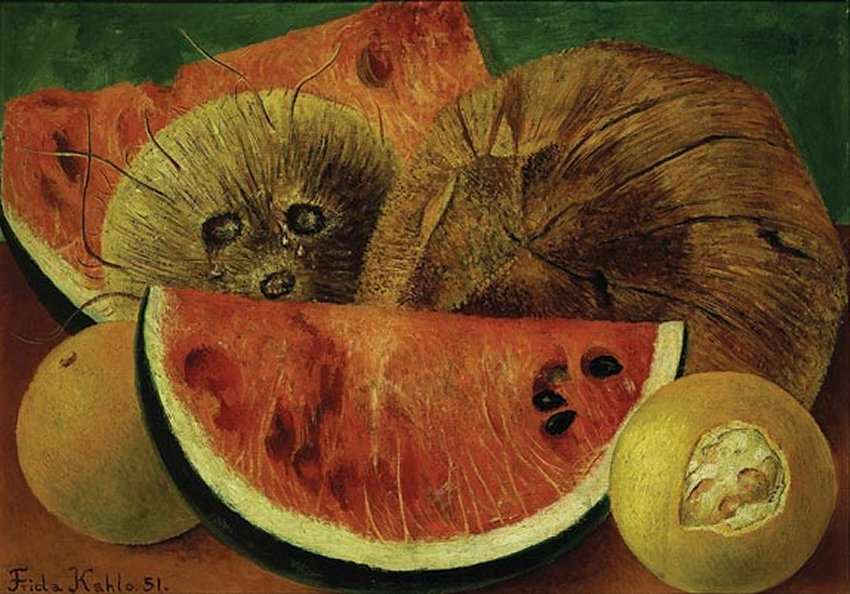
Coconuts is a small still life Frida Kahlo painted in 1951: two coconuts, a thick slice of watermelon and two melons sit on a brown table against a dark green ground, and the coconut on the left has three dark spots that look like a weeping face. The original, oil on masonite, is only 25.4 cm high and 34.6 cm wide and belongs to the Museo de Arte Moderno in Mexico City. Our painter paints it in oil colours on canvas in one of three landscape sizes, 53 x 38, 60 x 42 or 65 x 49 cm, or made to measure, and every one of them is larger than the original. Before the parcel leaves, we send you a photograph of the finished work.
| Title: | Coconuts |
| Other titles: | Cocos · Kokosnüsse |
| Painter: | Frida Kahlo (1907–1954) |
| Year painted: | 1951 |
| Original size: | 25.4 cm x 34.6 cm (height x width) |
| Original technique: | Oil on masonite |
| Painting style: | Mexican modernism |
| Located at: | Museo de Arte Moderno, Mexico City |
| Our reproduction: | Hand-painted oil on canvas, 3 sizes or made to measure |
Coconuts – Frida Kahlo
What does the painting Coconuts show?
The two coconuts take up almost the whole upper half of the composition. The one on the left is smaller and paler, covered in brownish fibre with long, thin hairs sticking out of it. On its underside sit three dark hollows arranged like two eyes and a mouth, and beneath one of these “eyes” a white drop glints like a tear.
The coconut on the right is bigger and darker, its husk streaked with lengthwise brown fibres that the artist drew in dense, fine strokes. Behind both rises a broad wedge of watermelon with orange-red flesh, reaching almost to the top edge.
At the front lies a thick slice of watermelon turned towards the viewer. Its red heart is mottled with darker patches, a few black seeds sit on the right, and a white band and a dark green rind frame it. Bottom left is a whole yellowish melon; bottom right, a melon with a hole cut into it, through which its pale, seedy interior shows.
How did this late still life come about?
Frida Kahlo spent most of 1950 in the ABC Hospital in Mexico City, where her spine was operated on again with a bone graft. Once discharged, she was largely confined to the Blue House (La Casa Azul) in Coyoacán, getting about with a wheelchair and crutches.
A year later, in this final stretch of her life, she painted the coconut still life. At the time she was painting mostly fruit and flowers, sometimes adding political symbols such as flags or doves.
Her hand changed in those same years. Brushstrokes that had once been delicate and careful became hastier, her colour bolder. You can see it in the shaggy fibres of the coconuts and in the restless, blotchy red surface of the watermelon.
Why does this small picture hold the eye?
Most lists of famous Frida Kahlo paintings are led by her self-portraits, which make up the largest part of her work. Here it is different: the face looking back at us is not hers but is made of three dark spots on a coconut shell.
That play between object and face keeps the eye longer than fruit on a table normally would.
For more on her life and the still lifes of her last years, read the English Wikipedia article on Frida Kahlo; there is no separate article on this work.
Where is the original kept?
The original is in the collection of the Museo de Arte Moderno (Museum of Modern Art) in Mexico City.
The same museum bought her painting The Two Fridas of 1939 in 1947. It was an important purchase for her, as she had struggled to make a living from her art until the mid to late 1940s.
If you would like these two coconuts at home, you can choose between a print and handwork. Our hand-painted copy has real layers of oil paint that rise slightly on the fibres and seeds, a depth no print can match.
Coconuts or another Kahlo still life?
This canvas painting is small, warm and a little mysterious.
If you like watermelons, look at Viva la Vida (Watermelons) from 1954, one of her last works, with a zigzag-cut fruit and an inscription on a slice. From 1952 comes Living Nature, which brings together cut fruit, oranges and a white dove.
A coconut already turns up in the much earlier The Bride Frightened at Seeing Life Opened of 1943, where a small doll in a wedding dress peeks out from behind a watermelon among papaya, pineapple and bananas.
Everything of hers that we offer, from the self-portraits to the still lifes, is gathered on the Frida Kahlo page.
How does our painter paint the coconuts?
Frida Kahlo painted the still life on masonite; our painter transfers it in oil colours to a canvas that can be stretched, rolled or framed.
He begins by drawing the outlines of the two coconuts, the slice and the melons, then lays in the dark green ground and the reddish brown table. Next he builds up the forms in thin layers: the coconuts get several coats of brown, ochre and near-black, the watermelon flesh lighter and darker patches as in the original.
He pulls the fibres with a fine brush, one beside the next, and adds the long hairs of the left coconut last. The three “eyes” and the white drop beneath them call for a steady hand, since they decide whether the face comes alive.
The surface stays smooth and the colours clear and bright, as in the original. The result is a Frida Kahlo reproduction with visible brushwork, and since each order is painted on its own, every oil painting reproduction that leaves our hands has a character of its own.
Which size suits which wall?
In short: 53 x 38 cm for a kitchen or a narrow hallway, 60 x 42 cm above a chest of drawers or a bedside table, and 65 x 49 cm for a dining room or as a painting for the living room beside a bookcase or an armchair.
There are three landscape sizes (width x height): 53 x 38, 60 x 42 and 65 x 49 cm. All are larger than the original, which measures just 34.6 x 25.4 cm. The closest is 53 x 38 cm, which is 18.4 cm wider and 12.6 cm taller.
A small format belongs where you stand close to the wall: by the dining table, above the kitchen counter, in the entrance hall or over a desk.
Can I have another size and a frame?
The original is a good third wider than it is tall, so we can also paint it in a size that is not on the list, for example a larger one for the wall above a sofa. Tell us the width and height you have in mind, and we will send you a quote with the price and the time needed.
The coconuts can come to you rolled, stretched on a stretcher bar or ready framed. As with every painting we send out, our workshop in Slovenia does the stretching and framing.
You pick the frame in our 3D app, which is there for choosing frames only; seeing the painting on your own wall is a separate service.
How long does it take, and how will it reach me?
Once you confirm the order, the painter starts work, and within 15 to 45 working days the coconuts are painted. Before dispatch we send you a photograph of the finished painting; if you would like anything done differently, we make the changes.
Parcels to Slovenia and other EU countries pass through no customs procedure, and our returns policy applies to every order.
If you are not sure which size would suit, give a voucher for a work of art and let the recipient choose.
Frequently asked questions
Where can I see the original of this still life?
At the Museo de Arte Moderno in Mexico City.
Why does the coconut seem to be crying?
The left coconut has three dark spots like eyes and a mouth, and under one “eye” sits a white drop that looks like a tear.
Will I receive a print?
No. Our painter paints it with a brush and oil colours on canvas.
How big is the original?
It is 25.4 cm high and 34.6 cm wide, smaller than any of our sizes.
Can I order it larger?
Yes, we paint it in the width and height you choose and tell you the price and timing in advance.
How soon will it arrive?
Painting takes 15 to 45 working days, then we ship, with no customs within the EU.
Is it a good fit for a kitchen or as a gift?
Yes, the small format and warm fruit look right in a kitchen or dining room, or as a present for someone who loves Mexico.
What does this work mean?
The artist did not say; it dates from 1951, when after a long hospital stay she mostly stayed at home and painted still lifes.
- Subject: two coconuts, the left one with a tearful “face”, a slice of watermelon and two melons against a dark green ground.
- Original: 1951, oil on masonite, 25.4 x 34.6 cm, Museo de Arte Moderno, Mexico City.
- Ours: oil on canvas, hand-painted to your order in 53 x 38, 60 x 42 or 65 x 49 cm, or made to measure.
- Worth knowing: Every size we offer is larger than the original, so the coconut fibres and watermelon seeds show clearly on the canvas.