













Description
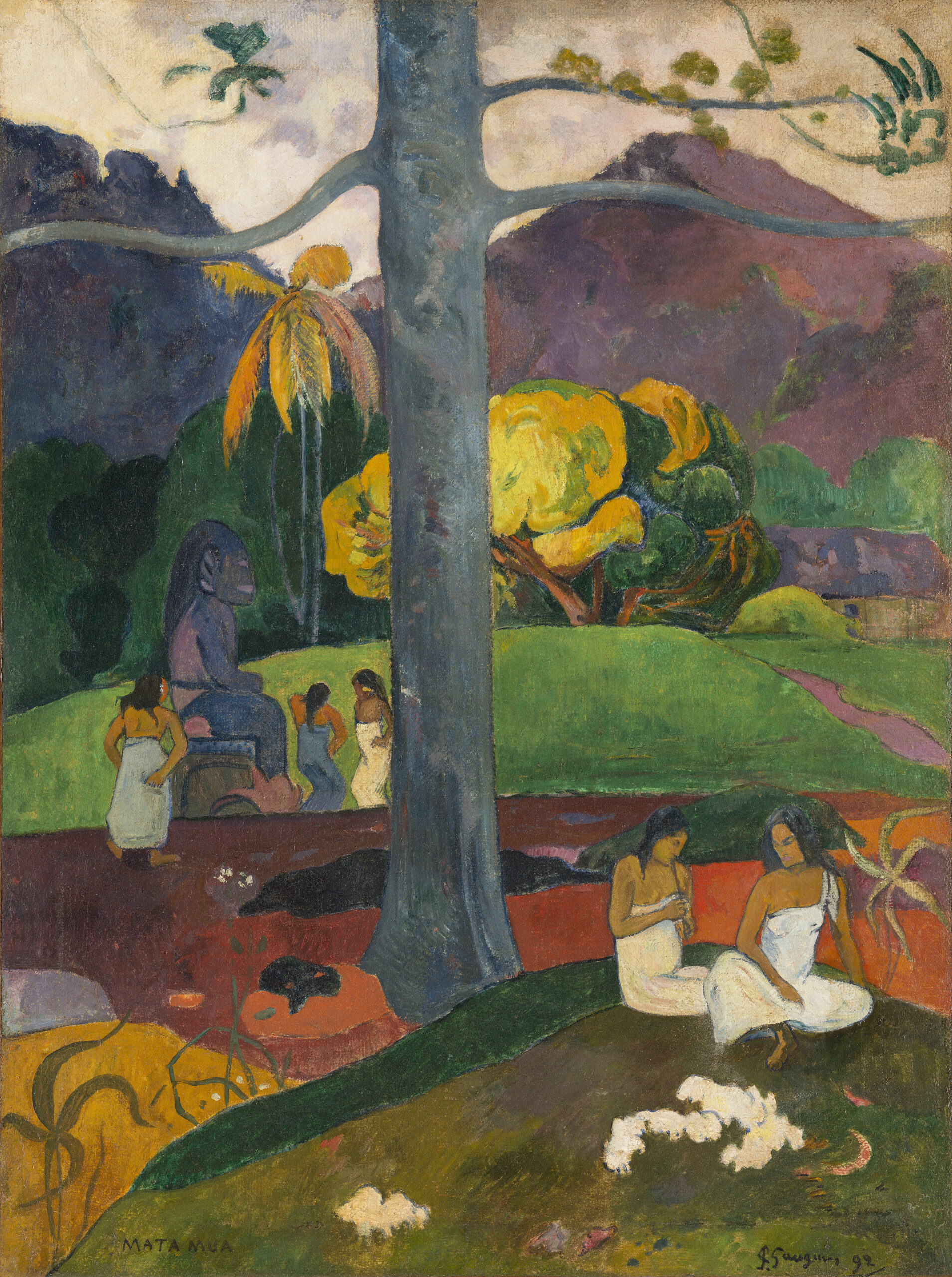
Mata Mua (In Olden Times) – a single trunk that cuts the picture in two
A grey-blue tree trunk rises the whole height of the canvas, so thick and so exactly placed that it halves the picture. Near the top a branch crosses it, running horizontally across the whole scene. To the left of the trunk a large grey-blue statue sits on a stone base, and three small female figures stand before it, one in a white and pink dress, two in darker clothes. To the right of the trunk, in the foreground, two women sit on the grass in white clothing; one holds something in her hands, the other looks ahead of her. Behind them a yellow-flowering tree opens out. Below, a band of dark red earth crosses the picture, and white blossoms are scattered over the grass. In the background rise violet-grey mountains. The work is held by the Museo Nacional Thyssen-Bornemisza in Madrid under the inventory number CTB.1984.8.
Two halves, two different scenes
The trunk is not only a tree but a border. On the left side a rite is taking place: the figures are turned towards the statue, standing bowed and gathered. On the right side nothing in particular happens – two women sit and rest. The same place, the same day, two entirely different actions, separated by a single vertical band of colour. It is this division that gives the picture its tension.
The statue under the trees
The figure on the left is carved and motionless, far larger than the women in front of it, and painted in a cold grey-blue that is repeated nowhere else in the picture. The museum record does not describe it; what we can say is what we see – that it is of stone, that it sits, and that the people before it are small.
The yellow tree and the white clothing
The colours are divided so simply that they can be counted: the yellow flowering tree in the middle, the dark red earth below, the violet mountains above, and the white clothing that repeats on both sides of the trunk. White is the only colour that crosses from one half to the other, and it is what holds the two halves together.
How a hand-painted reproduction is made
Every reproduction here is hand-painted in oil on canvas, stroke by stroke. In this motif the trunk is the hardest part: it has to be still enough to work as a vertical and at the same time alive enough not to become a mere line. Before dispatch you receive a photograph of the finished work for approval.
- Subject: a tall trunk down the middle, a statue with people on the left, two seated women on the right.
- Technique: oil on canvas, broad areas of colour and one emphatic vertical.
- Sizes: portrait format, from 30 x 40 cm to 150 x 200 cm; 60 x 80 cm and 90 x 120 cm are often chosen.
- Of note: title and signature are painted into the lower corners, one on each side of the trunk.
If the same period interests you, see also There is the Temple (Parahi te marae), Her Name was Vairaumati and Nevermore (O Tahiti). The museum gives the measurement as height by width: 91 x 69 cm, a portrait format.