







































Description
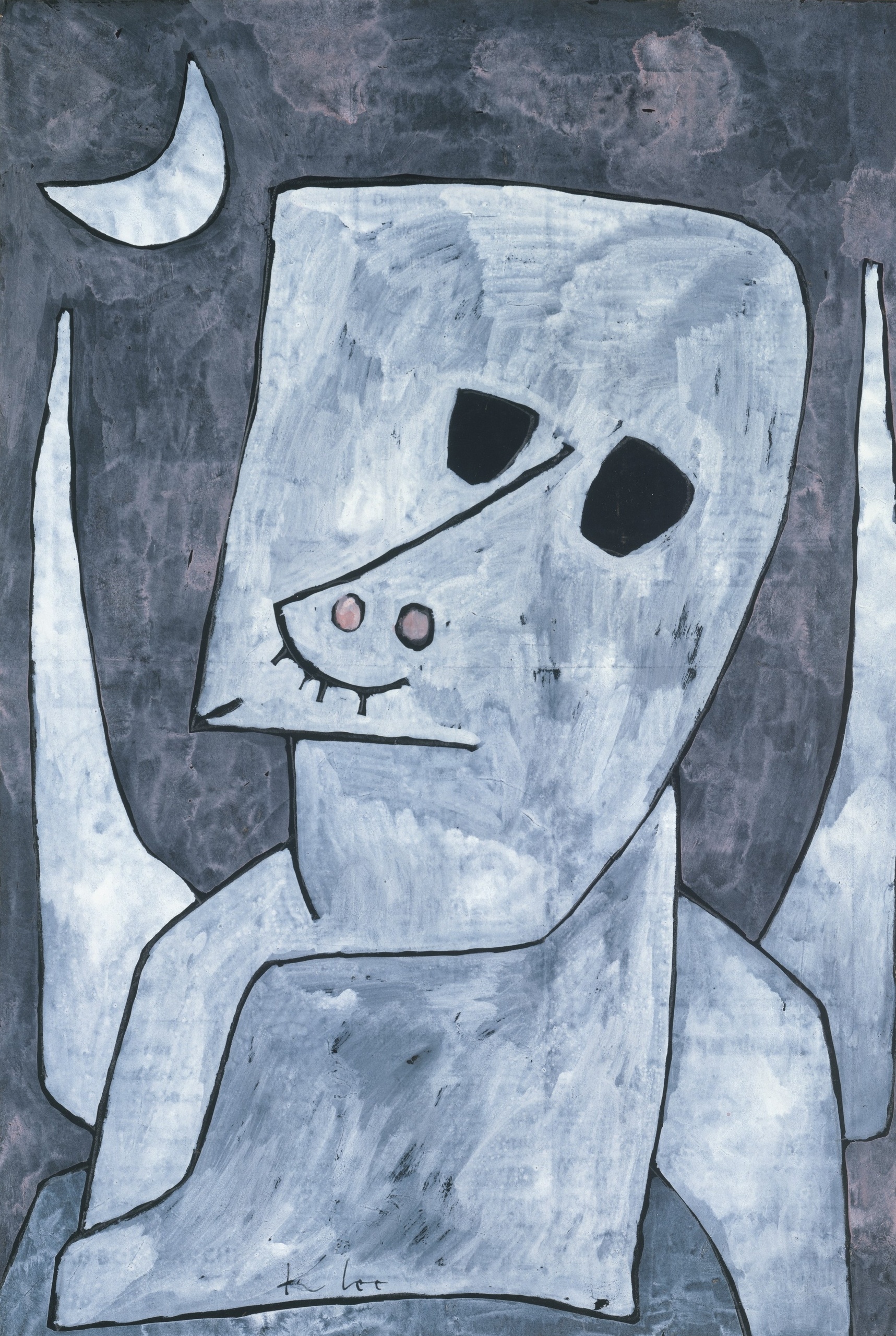
Angel Applicant is a painting by Paul Klee from 1939: a grey-blue figure with a big head, black empty eyes and a nose with two reddish dots stands against a dark ground, a white crescent moon shines at the top left, and two pointed wings rise at its sides. The original is a watercolour with India ink and graphite on paper mounted on cardboard, 65.4 x 44.5 cm, and it belongs to The Metropolitan Museum of Art in New York. Our painter paints it for you by hand on canvas, in oil or acrylic, in 8 upright sizes from 30 x 45 to 140 x 200 cm or made to measure. Even before we pack it, we send you a photograph of it.
| Title: | Angel Applicant |
| Other titles: | Engel-Anwärter (German title) · Angelo aspirante (Italian title) |
| Painter: | Paul Klee (1879–1940) |
| Year painted: | 1939 |
| Original size: | 65.4 cm x 44.5 cm (height x width) |
| Original technique: | Watercolour, India ink and graphite on paper on cardboard |
| Painting style: | Modernism |
| Located at: | The Metropolitan Museum of Art, New York, USA |
| Our reproduction: | Hand-painted in oil or acrylic on canvas, 8 sizes or made to measure |
Angel Applicant – Paul Klee
What does Angel Applicant show?
A single figure stands in the middle, turned straight towards us. The torso and arms are built from broad, slab-like blocks held in by thick black lines and shaded inside with icy greys, grey-blues and whites. The composition is close to symmetrical and very still.
The head is unusually large and fills much of the upper half. It holds two black, empty eyes, and below them a nose with two small reddish dots. The mouth is a thin curve with a few short strokes: some people see a smile in it, others a grimace. Two pointed wing shapes rise at the sides.
The background is dark, a mottled grey-violet, perhaps a night sky. At the top left a white crescent moon breaks into it, also outlined in black. Klee worked his signature quietly into the figure itself, low down in the body.
What does the title Angel Applicant mean?
In 1939 Klee painted a great many angels, after showing them only now and then in earlier years. His angels are not heavenly beings but in-between creatures with human weaknesses and moods. Their titles call them forgetful, ugly, incomplete or poor.
This figure is more an applicant than a finished angel: it stands somewhere between the human and the divine. The word applicant can be taken literally or with irony, since it has a faintly bureaucratic ring, as if a form had been handed in and were still waiting for an answer.
At the time Klee was suffering from an incurable illness. Beyond that, the safest reading stays with what you can see.
Why do Klee’s late angels move so many people?
At first sight the figure looks simple, almost childlike: a few thick black lines, pale fields and two dots. The angel is neither triumphant nor frightening but unsure and very human, which brings it closer to us than a shining heavenly messenger.
Born at Münchenbuchsee, near Bern, in 1879, Klee was the son of a Swiss singer and a German music teacher, and he played the violin from childhood. Rilke said his drawings were like transcriptions of music; the black outline of this angel runs like one long melody.
For his life, from the Blue Rider and the Bauhaus to his last years in Switzerland, see the Wikipedia article on Paul Klee, written in English; it is about the painter, not this work.
Where is the original kept, and what is it made of?
The original belongs to The Metropolitan Museum of Art in New York, where it is listed under accession number 1984.315.60. Klee made it in 1939 in Bern, where he had returned at the end of 1933 after the Nazis dismissed him from the Düsseldorf Academy.
It is watercolour, India ink and graphite on paper mounted on cardboard, and the sheet measures 65.4 x 44.5 cm (height x width).
From the same year and the same Bern period comes Conquest of the Mountain, where two tiny figures climb a slope built of thick black signs.
Two years earlier, in 1937, the Nazis hung seventeen of his works in the Degenerate Art exhibition and seized 102 from public collections.
Angel Applicant or another Klee?
Angel Applicant is a canvas painting for a room where you want calm: the cool greys and whites settle the wall, and the big head gives it character.
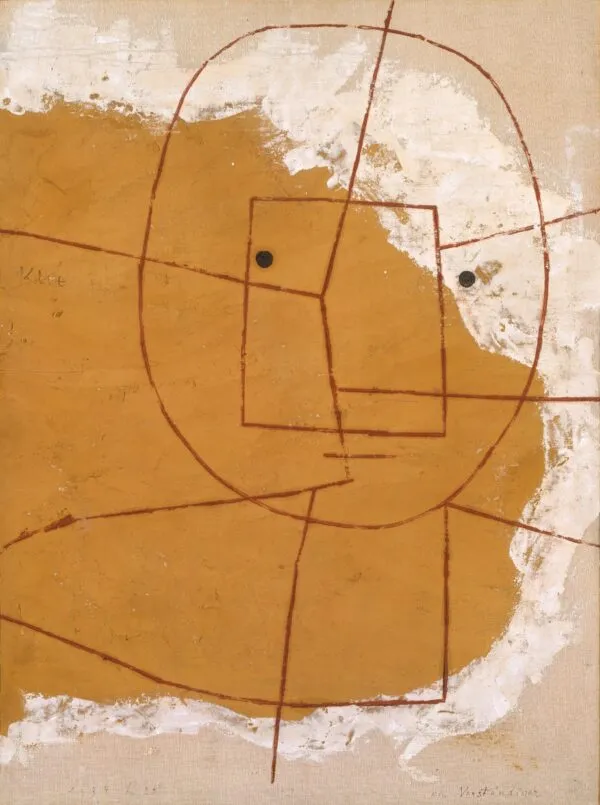
If you like Klee’s faces made of lines, look at One Who Understands, where thin red lines draw a head on a warm ochre field. If warmer colours appeal, you will enjoy Rose Garden, with its little town and spiral roses, and gentle and quiet too is The Lamb, a white lamb among bands of colour.
All the famous Paul Klee paintings we paint to order are gathered on our Paul Klee page.
How do we hand-paint Angel Applicant on canvas?
The original is not an oil painting but a sheet of paper on which Klee worked in watercolour, ink and graphite. Ours is an oil painting reproduction on canvas: the painter works in oil or acrylic, in the size you choose, and builds it up layer by layer, so it hangs on your wall like any painted work.
First he draws the outlines of the figure, the moon and the wings on the dark ground, keeping the body blocks and the big head in proportion. Then he fills the fields with grey, grey-blue and white layers and lets the brushstrokes show.
The black outlines, the empty eyes and the two reddish dots on the nose come last.
Which size suits which wall?
In short: 30 x 45 or 40 x 56 cm for a shelf or a narrow wall, 45 x 65 and 58 x 85 cm above a chest of drawers or a desk, 75 x 110 and 85 x 125 cm above a sofa or a bed, and 110 x 155 or 140 x 200 cm for a tall wall where the angel can stand like a large, quiet guest.
We paint Angel Applicant in 8 upright sizes (width x height): 30 x 45, 40 x 56, 45 x 65, 58 x 85, 75 x 110, 85 x 125, 110 x 155 and 140 x 200 cm. The sheet measures 44.5 x 65.4 cm (width x height), so the larger sizes enlarge it a great deal: at 140 x 200 cm the figure is about three times as tall as it is in New York.
As a painting for the living room it works best at 75 x 110 or 85 x 125 cm above the sofa, where the cool tones sit well with warm wood and fabrics.
Can I have a different size or a frame?
Yes. If you need other proportions, we place the figure so that the head, the wings and the moon stay whole, and we widen or narrow only the dark ground. Tell us which custom size you need and we will reply with a price and a date.
The angel can travel to you rolled, stretched on a stretcher bar or ready framed; our workshop in Slovenia does the stretching and framing. Choose the frame in our 3D app, which only handles the moulding; a view of the painting on your own wall is a separate service. A slim black or dark grey frame suits the greys and whites.
How long do making and delivery take?
After you confirm the order, the painter starts work, and the painting is ready to ship within 15 to 45 working days. Before packing we send you a photograph of the finished painting; if you would like a change, we make it.
Within Slovenia and the rest of the EU no customs duties are due on the parcel, and our returns policy covers the order.
The quiet, pensive figure makes a lovely present for anyone fond of modern art, or give a wall art voucher and let them pick the size.
Frequently asked questions
Where is the original?
At The Metropolitan Museum of Art in New York, accession number 1984.315.60.
What is in the picture?
A grey-blue figure with a big head, black eyes and two wings, against a dark ground with a crescent moon.
Will I get a print?
No. You get a hand-painted copy, made with brushes on canvas by our painter, in oil or acrylic.
How big is the original?
The sheet measures 65.4 x 44.5 cm (height x width); our sizes go up to 140 x 200 cm.
Can I order a size that is not listed?
Yes. Send us the width and height you want and we will prepare an offer with a price and a date.
How many days will I wait?
Between 15 and 45 working days, and before dispatch you receive a photograph of the finished work.
Is it right for a bedroom, or as a gift?
Yes. The cool, calm tones suit a bedroom or a study, and as a gift it will please anyone fond of Klee.
Is it really an angel?
More an applicant than a finished angel: a being between the human and the divine, with human weaknesses and moods.
- Subject: a grey-blue figure with a big head, empty black eyes, two wings and a white crescent moon on a dark ground.
- Original: watercolour, India ink and graphite on paper mounted on cardboard, 1939, 65.4 x 44.5 cm, The Metropolitan Museum of Art.
- Ours: a Paul Klee reproduction painted by hand in oil or acrylic on canvas, 8 sizes from 30 x 45 to 140 x 200 cm, or made to measure.
- Worth knowing: in 1939 Klee, already incurably ill, painted many angels with entirely human weaknesses.