







































Description
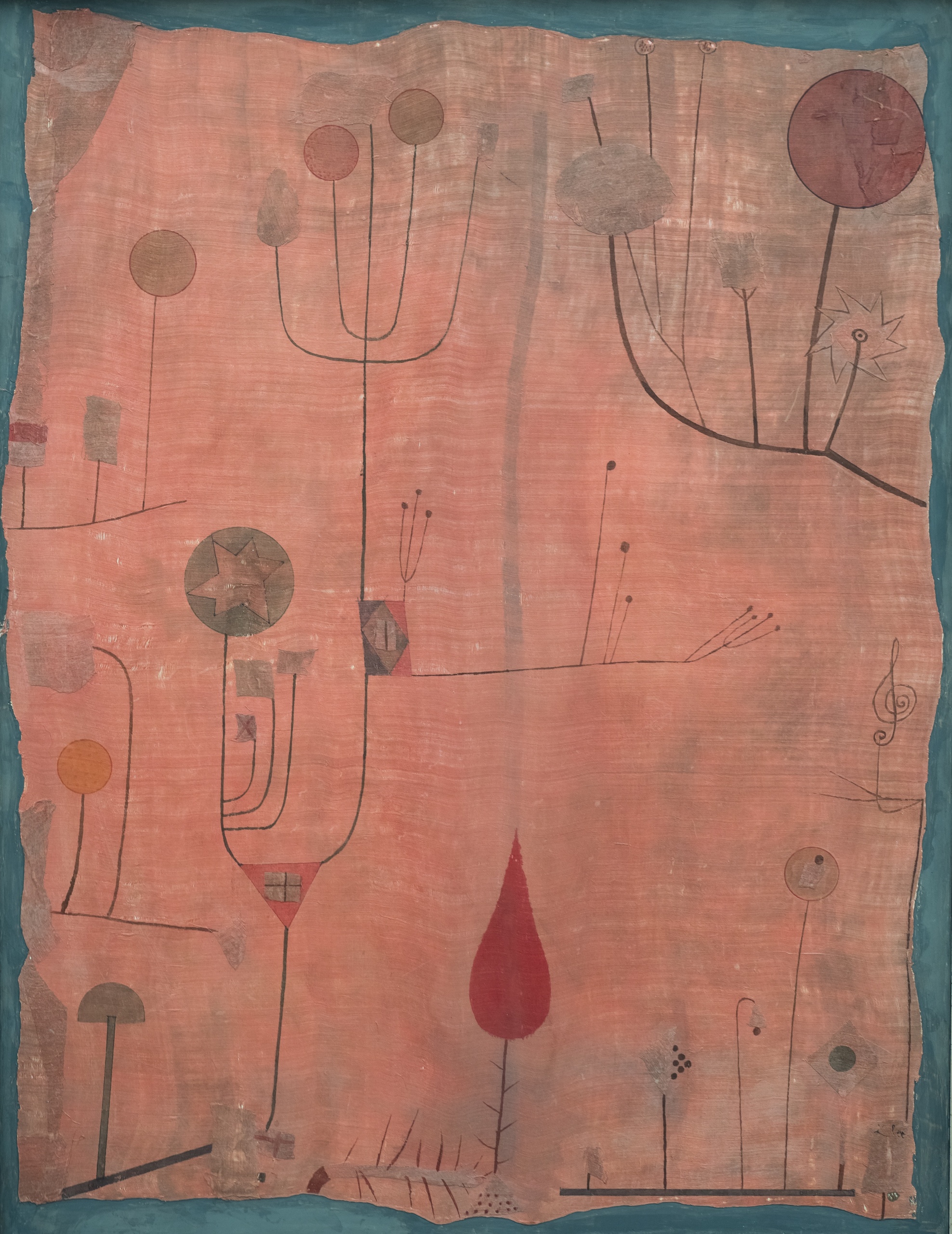
Fruits on Red is a painting by Paul Klee from 1930: on a soft salmon-red field framed by a dark teal border, thin dark stems and branches grow small round fruits, and a red drop stands at the bottom centre. The original is a watercolour on silk measuring 61.2 x 46.2 cm, held by the Städtische Galerie im Lenbachhaus in Munich. Our painter recreates it for you by hand on canvas, in oil or acrylic, in one of 8 upright sizes between 30 x 40 and 156 x 200 cm, or made to measure. You receive a photograph of your finished painting before it ships.
| Title: | Fruits on Red |
| Other titles: | Früchte auf Rot (German title) · Frutti su rosso (Italian title) |
| Painter: | Paul Klee (1879–1940) |
| Year painted: | 1930 |
| Original size: | 61.2 cm x 46.2 cm (height x width) |
| Original technique: | Watercolour on silk |
| Painting style: | Modernism |
| Located at: | Städtische Galerie im Lenbachhaus, Munich, Germany |
| Our reproduction: | Hand-painted in oil or acrylic on canvas, 8 sizes or made to measure |
Fruits on Red – Paul Klee
What does Fruits on Red show?
Almost the whole surface is a salmon-red piece of silk with uneven, almost frayed edges, laid on a dark teal ground. Fabric threads, paler streaks and greyish patches show through the colour, like an old tablecloth washed many times.
Thin dark lines run across the red field, and the eye reads them at once as stems, stalks and branches. Round fruits in brown, pink, orange and violet hang from their tips, and one of them has a star drawn inside. At the upper right a large violet disc rises from a curved branch beside a spiky star with a tiny eye.
At the bottom centre a red drop sits on a thin stem with small side twigs, like a little tree. Near the right edge there is a sign that looks like a treble clef, and crosses, dots, small squares and a red triangle are scattered between the plants. Right at the lower right, in small letters, is Klee’s signature.
What does the title Fruits on Red mean?
The title says two things: there are fruits, and the ground is red. Klee wrote down nothing more, and our sources give no reading confirmed by the museum, so we stay with what can be seen: little plants bearing fruit, sprouting from thin horizontal lines as if from garden beds.
It feels like a page from a botanical sketchbook, jotted down in a few quick strokes; painted on silk, the scene stays light and airy.
The treble clef at the right edge makes many people think of music. Klee played the violin from childhood, for a while in an orchestra too, and Rilke wrote that his drawings seemed like transcriptions of music. The work does not say whether the sign is meant as a note.
Why does this small garden hold the eye?
The work shows how little Klee needed: a fine line, a circle and a warm colour. From those three a whole garden grows, and the eye can stroll through it step by step.
A trip to Tunisia in 1914 with August Macke and Louis Moilliet gave Klee his breakthrough in colour, and colour stayed at the heart of his work from then on.
The work has no Wikipedia article of its own, so we suggest the English Wikipedia article on Paul Klee; it is written in English and covers the painter, his life and his work.
Where is the original kept, and how big is it?
The original belongs to the collection of the Städtische Galerie im Lenbachhaus in Munich, where it is catalogued as FH 222. Klee made it in 1930, in his last stretch of teaching at the Bauhaus, where he taught from January 1921 to April 1931 alongside Wassily Kandinsky.
It is a watercolour on silk, 61.2 x 46.2 cm (height x width), fairly large for Klee, who made many works on smaller sheets of paper, gauze or board.
From 1931 to 1933 he taught at the Düsseldorf Academy; in 1937 the Nazis put seventeen of his pictures in the so-called Degenerate Art exhibition and took 102 of his works from public collections. He died in 1940.
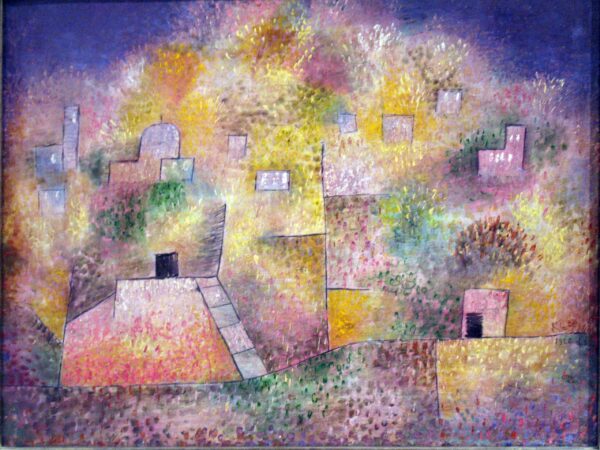
The same Munich museum also holds Rose Garden from 1920, a small town of houses and towers with round red roses blooming between them.
Fruits on Red or another Klee?
Fruits on Red is a canvas painting for people who love quiet and small details; its warm red sits well above a bed, in a dining room or in a reading corner.
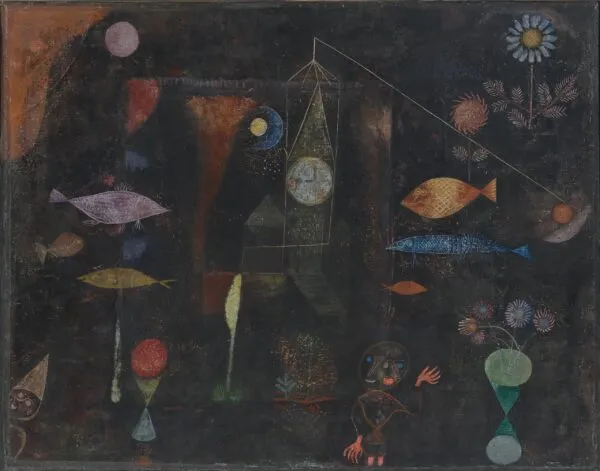
If you are after light inside a dark colour, look at The Goldfish, where a golden fish glows in almost black blue water. Playful and full of movement is Conquest of the Mountain from 1939, while One Who Understands is quiet and thoughtful, a face of thin lines on an ochre field.
More works by this master, among them the famous Paul Klee paintings we offer, are waiting on our Paul Klee page.
How do we hand-paint Fruits on Red on canvas?
Klee’s original is a watercolour on thin silk, not an oil. Ours is an oil painting reproduction on canvas: the painter works in oil or acrylic, in the size you pick, and on its stretcher bar it hangs like any other painted work.
First he lays in the teal border and the salmon-red field, layer by layer, in thinner and denser coats, then adds the paler streaks and greyish patches in diluted paint so the ground breathes like silk.
Then a fine brush pulls the stems and branches, light and a little shaky, as Klee drew them. Last come the round fruits, the stars, the crosses, the treble clef and the red drop, each in its own place.
Which size suits which wall?
In short: 30 x 40 or 36 x 48 cm for a shelf, a hallway or a narrow wall, 47 x 62 and 60 x 81 cm above a chest of drawers or a bedside table, 77 x 100 cm above a bed or sofa, and 95 x 128, 120 x 160 or 156 x 200 cm for a large wall in a living or dining room.
We paint Fruits on Red in 8 upright sizes (width x height): 30 x 40, 36 x 48, 47 x 62, 60 x 81, 77 x 100, 95 x 128, 120 x 160 and 156 x 200 cm. The original measures 46.2 x 61.2 cm (width x height), so the four largest sizes enlarge it; at 156 x 200 cm the work is more than three times as wide as it is in Munich, and the fine lines take the enlargement well.
As a painting for the living room it looks its best at 95 x 128 or 120 x 160 cm, where the red field warms the whole wall; the smaller sizes suit a kitchen, bedroom or home office.
Is another size or a frame possible?
Yes. If you need different proportions, we widen or narrow the red field and the teal border and arrange the stems and fruits so that each one keeps its place. Send us the measurements you want for a price and delivery time.
Your painting reaches you rolled, stretched on a stretcher bar or ready framed. Our workshop in Slovenia does the stretching and framing and prepares each piece for a safe journey. Our 3D app is where you pick the frame moulding, and only that; a view of the painting on your own wall is a separate service.
A slim dark wood or walnut-coloured frame suits the warm red, though it also looks good simply stretched and unframed.
When will my painting arrive?
Once you confirm the order the painter starts, and the painting is ready to ship within 15 to 45 working days. Before packing you get a photograph of it, and we make any changes you ask for.
Shipments within Slovenia and to other EU countries travel without customs duties, and every order is covered by our returns policy.
The red garden of fruits is a lovely housewarming or wedding present. Not sure about the size? A wall art voucher lets them pick.
Frequently asked questions
Where is the original on display?
At the Städtische Galerie im Lenbachhaus in Munich, catalogued as FH 222.
What is painted on the red field?
Thin stems and branches with round fruits, a red drop, stars, crosses and a treble clef sign.
Will I get a print?
No. Every piece is a hand-painted copy, made with brushes on canvas in oil or acrylic.
How large is the original?
It measures 61.2 x 46.2 cm (height x width); our largest size is 156 x 200 cm.
Can I order my own size?
Of course. Give us the width and height, and we will send an offer with a price and a date.
How long do I wait for the painting?
From 15 to 45 working days, and before dispatch you get a photograph of the finished work.
Would these red fruits suit a bedroom or make a good gift?
Yes. The calm warm red suits a bedroom, and the little fruits with their musical sign make an affectionate gift.
What does the treble clef mean?
Klee played the violin from childhood but never explained the sign, so its meaning stays open.
- Subject: thin stems and branches with round fruits, a red drop and a treble clef on a salmon-red field.
- Original: watercolour on silk, 1930, 61.2 x 46.2 cm, Städtische Galerie im Lenbachhaus, Munich.
- Ours: a Paul Klee reproduction painted by hand in oil or acrylic on canvas, 8 sizes from 30 x 40 to 156 x 200 cm, or made to measure.
- Worth knowing: Klee made the work in 1930, in his last years of teaching at the Bauhaus.