







































Description
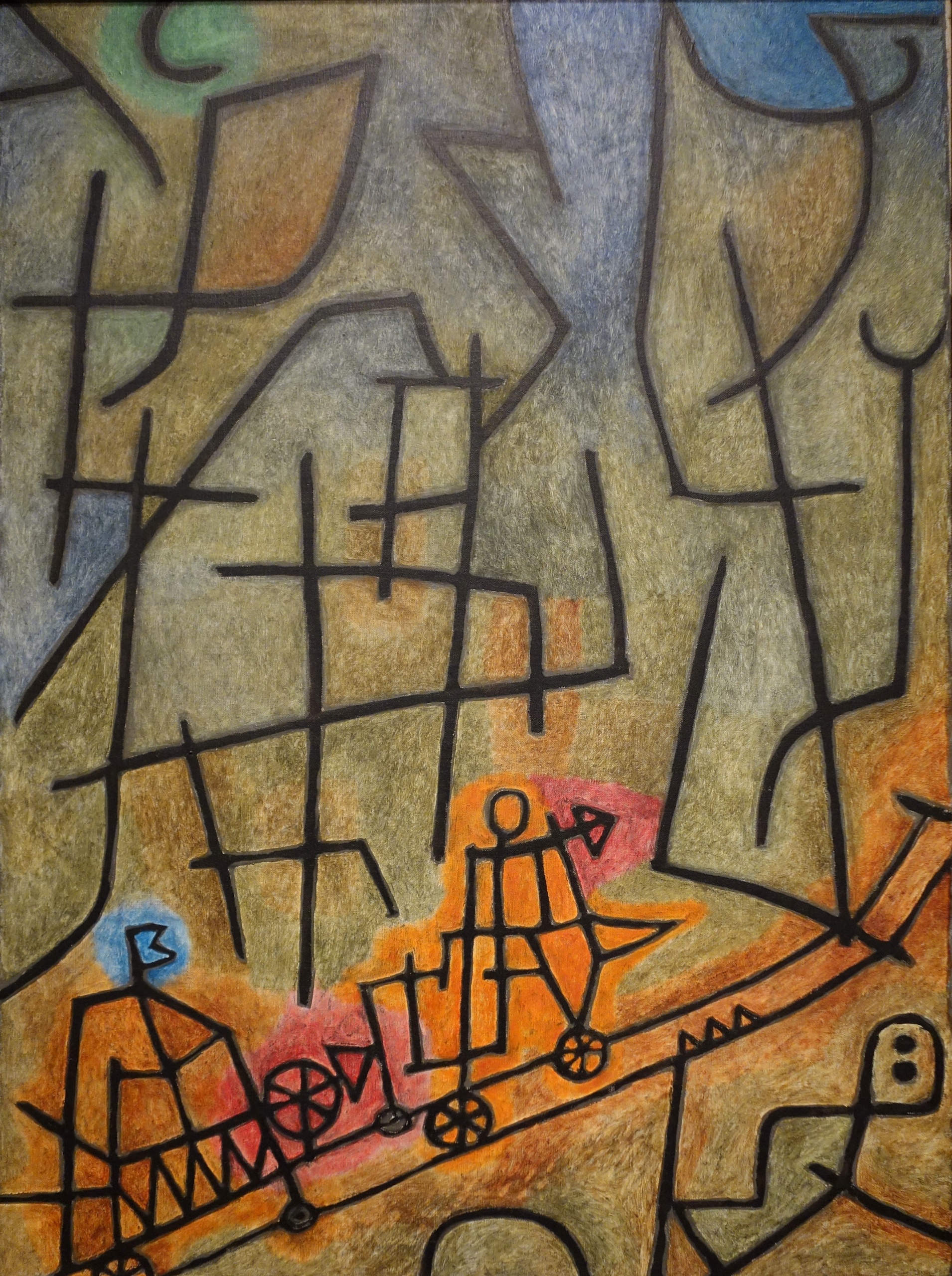
Conquest of the Mountain is a painting by Paul Klee from 1939: thick black bars and hooks build a mountain like a scaffold over a blue, ochre and olive ground, while at the bottom two tiny figures on wheeled carts climb a slanting orange band. The original is oil on cotton, 95 x 70 cm, which is unusually large for Klee, and it belongs to The National Museum of Modern Art, Tokyo. We hand-paint it to order on canvas, in oil or acrylic, in 8 upright sizes between 30 x 40 and 151 x 200 cm, or to your own measurements. Once the mountain is painted, and before it is packed, we send you a photograph of your finished painting.
| Title: | Conquest of the Mountain |
| Other titles: | Eroberung des Berges (German title) · La conquista della montagna (Italian title) |
| Painter: | Paul Klee (1879–1940) |
| Year painted: | 1939 |
| Original size: | 95 cm x 70 cm (height x width) |
| Original technique: | Oil on cotton |
| Painting style: | Modernism |
| Located at: | The National Museum of Modern Art, Tokyo, Japan |
| Our reproduction: | Hand-painted in oil or acrylic on canvas, 8 sizes or made to measure |
Conquest of the Mountain – Paul Klee
What does Conquest of the Mountain show?
Most of the surface is taken up by heavy black lines. Some are straight bars with crosspieces, others bend into hooks and arcs, and together they grow into a tall, broken mountain that looks like a framework of beams. Behind them lies a soft, grainy ground of grey-blue, ochre and olive; at the top left a green arc opens, at the top right a patch of blue, like a scrap of sky.
An orange band cuts across the lower part, rising at a slant from the left edge towards the right. Two figures drawn in a handful of strokes stand on it, each on a cart with spoked wheels, so that together they look like a little train working its way uphill, with a reddish glow spreading behind them.
Above the left-hand cart floats a blue circle with a mark that resembles a letter. At the lower right sits a small dark sign that can be read as a head with two dots, and tiny teeth line the edge of the band. The scene is playful: people and machines setting off to take a mountain made entirely of signs.
What does the title tell us?
The title speaks of conquering a mountain, and the scene takes it literally: carts with tiny passengers push upwards while the mountain rises over them like a wall of black strokes. Our sources give no explanation from Klee himself, so we do not invent one.
What you can see is how Klee builds the landscape. He draws the mountain, the people and the carts with the same sturdy line, as if all of them were letters of one script that had lined up into a climb.
The work was made in Bern in 1939 and belongs to Klee’s late output. The painter died a year later, in June 1940.
Why does this mountain hold the eye?
Klee often worked small, on paper, gauze or board. This painting is different: painted on cotton, it stands almost a metre tall, and the black strokes are bold enough to read from across a room.
The thick lines have a rhythm that recalls handwriting or a musical score. Klee played the violin from childhood, in an orchestra too, and the poet Rilke wrote that his drawings seemed like transcriptions of music.
This painting has no Wikipedia article of its own. To learn more about the painter, read the English Wikipedia article on Paul Klee, which covers his life and work.
Where is the original, and how big is it?
The original belongs to The National Museum of Modern Art, Tokyo, where it is listed under inventory number O01219. It is oil on cotton and measures 95 x 70 cm (height x width).
Born in 1879 in Münchenbuchsee near Bern, Klee taught at the Bauhaus from 1921 to 1931 beside Wassily Kandinsky, then at the Düsseldorf Academy until 1933. In 1937 the Nazis showed seventeen of his works in the Degenerate Art exhibition, and 102 of his works were seized from public collections.
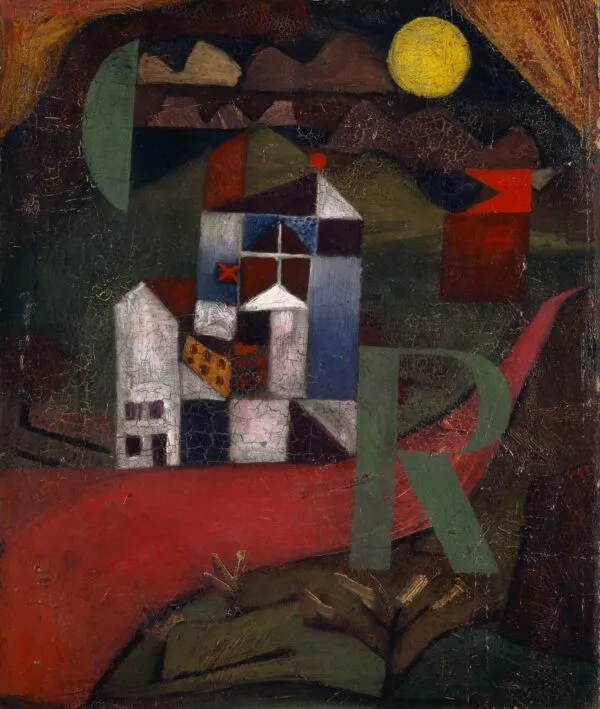
The same year as the mountain also produced Angel Applicant, a grey-blue figure beneath a white crescent moon. Both works from 1939 show how the late Klee built his scenes from strong outlines.
Conquest of the Mountain or another Klee?
Conquest of the Mountain is a canvas painting for anyone who likes movement and a touch of humour on the wall; its upright format suits a tall wall or a stairwell.
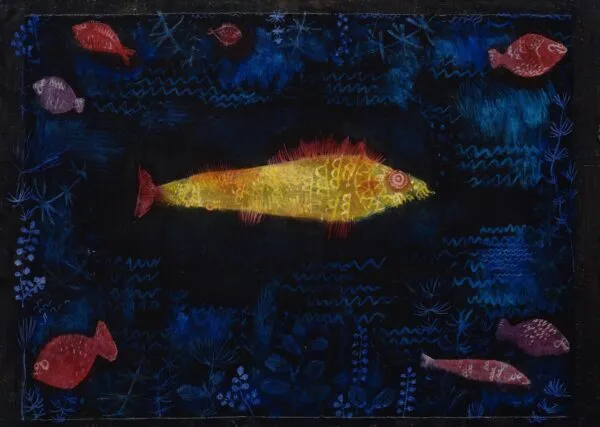
If you want a quieter face drawn in fine lines, look at One Who Understands from 1934. Delicate fruits on salmon-red silk come with Fruits on Red, and a glowing yellow fish in dark blue water with The Goldfish.
The famous Paul Klee paintings we paint to order are gathered on our Paul Klee page.
How do we hand-paint Conquest of the Mountain on canvas?
Klee’s original is oil on cotton. Ours is an oil painting reproduction on fresh canvas, worked in oil or acrylic in the size you pick, so it hangs on your wall like any other painted work.
The painter begins with the ground: layer upon layer he brushes in grey-blue, ochre and olive until the surface turns grainy and slightly rough. Then, with a loaded brush, he pulls the black bars, hooks and arcs, which have to keep the right rhythm.
Last come the orange band, the reddish glow, the carts with their wheels and the little figures. Because the original has a dense, worked texture, the painter makes sure the ground still breathes between the lines.
Which size fits which wall?
In short: the small sizes for a hallway or a work corner, the middle ones above a chest of drawers or a bed, the largest for a tall wall above the sofa or along the stairs.
We paint it in 8 upright sizes (width x height): 30 x 40, 40 x 52, 45 x 60, 58 x 75, 73 x 100, 91 x 127, 120 x 160 and 151 x 200 cm. The original measures 70 x 95 cm (width x height), so the smaller sizes scale it down and the larger ones enlarge it; at 151 x 200 cm the mountain is more than twice as tall as it is in Tokyo.
As a painting for the living room it works best at 91 x 127 or 120 x 160 cm above the sofa, where the black bars read from the doorway.
Can I have another size or a frame?
Yes. If your wall needs different proportions, we adjust the composition so that the mountain, the orange band and the carts stay whole. Send us the size you have in mind and we will come back with a price and a delivery date.
It can reach you rolled in a tube, stretched on a stretcher bar or framed. Our workshop in Slovenia does the stretching and framing and readies each painting for the journey. The frame is chosen in our 3D app, a tool for the moulding alone; a view of the painting on your own wall is a separate service. A slim dark frame or natural oak suits the black strokes.
How does delivery work, and how long does it take?
The painter starts once you confirm the order, and the painting is ready to ship within 15 to 45 working days. Before packing we send you a photograph of the finished piece, and if you would like a change, we make it.
Shipping inside Slovenia and across the EU involves no customs duty, and our returns policy applies to the mountain as to every order.
With its tiny climbers it makes a fine present for someone who has just reached a goal. Unsure of the size? Give a wall art voucher.
Frequently asked questions
Where does the original hang?
At The National Museum of Modern Art, Tokyo, under inventory number O01219.
What is in the picture?
A mountain of heavy black bars and hooks and, below it, two tiny figures on carts climbing an orange band.
Will I receive a print?
No. You receive a hand-painted copy, which our painter works with brushes on canvas, in oil or acrylic.
What are the dimensions of the original?
It measures 95 x 70 cm (height x width); our sizes run from 30 x 40 to 151 x 200 cm.
Can I order the mountain in a size that is not listed?
Yes. Give us the width and height, and we will reply with a price and a date.
How long will I wait for my painting?
Allow 15 to 45 working days for the mountain and its carts; a photograph reaches you before dispatch.
Is the mountain a good choice for a child’s room or a present?
Yes. Carts on wheels and little figures amuse children, and as a present it pleases hill walkers and Klee admirers alike.
What does the title Conquest of the Mountain mean?
It describes a climb, which the scene shows literally; the sources give no fuller explanation from Klee.
- Subject: a mountain of black bars and hooks over a blue, ochre and olive ground, with two figures on carts on an orange band below.
- Original: oil on cotton, 1939, 95 x 70 cm, The National Museum of Modern Art, Tokyo.
- Ours: a Paul Klee reproduction painted by hand in oil or acrylic on canvas, 8 sizes from 30 x 40 to 151 x 200 cm, or made to measure.
- Worth knowing: this is a large work for Klee; he painted it in Bern a year before his death.