







































Description
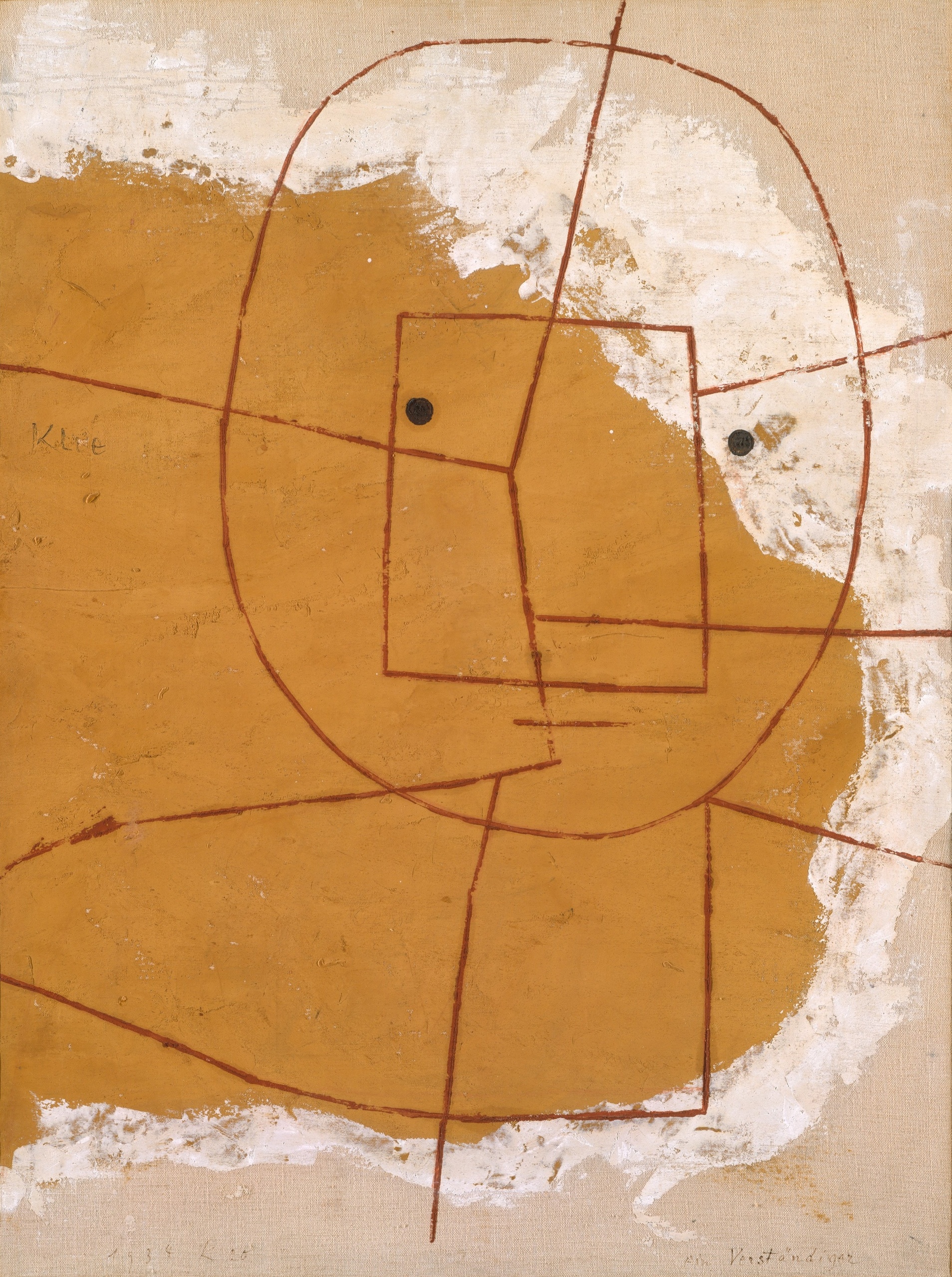
One Who Understands is a painting by Paul Klee from 1934: over a warm ochre field on a rough white ground, Klee drew in thin dark red lines a large rounded head with a square inside it and two tiny black dots for eyes, while long straight lines run out to the edges of the canvas. The original, in oil and gypsum on canvas, measures 54 x 40.6 cm and belongs to The Metropolitan Museum of Art in New York. Our painter paints it for you by hand on canvas, in oil or acrylic, in 8 upright sizes from 30 x 40 to 156 x 200 cm or made to measure.
| Title: | One Who Understands |
| Other titles: | Einer, der versteht (German title) · Tisti, ki razume (Slovene title) |
| Painter: | Paul Klee (1879–1940) |
| Year painted: | 1934 |
| Original size: | 54 cm x 40.6 cm (height x width) |
| Original technique: | Oil and gypsum on canvas |
| Painting style: | Modernism |
| Located at: | The Metropolitan Museum of Art, New York, USA |
| Our reproduction: | Hand-painted in oil or acrylic on canvas, 8 sizes or made to measure |
One Who Understands – Paul Klee
What does One Who Understands show?
Most of the canvas is covered by a warm ochre field, laid on as one patch with ragged edges. At the top, the right and the bottom a rough white ground shows through, and the paint is lumpy and scratched like dry plaster.
Across it Klee drew a large rounded head in thin dark red lines, shaped like an egg on end, with a square inside that reads as the plane of the face. The eyes are two black dots: the left one inside the square, the right one outside it, on the white. A short stroke suggests a mouth, and two vertical lines below the head give neck and shoulders.
Most unusual are the long straight lines that cross the head and run on to every edge of the canvas. The head hangs in a net, like a crossroads on a map.
What does the title mean, and who is the one who understands?
Klee did not paint a known person but a face of a few lines that the viewer completes, so we leave its identity open.
What we see is calm: two dots for eyes, a mouth closed in a thin line, a head upright and composed. The lines leaving it can be read as roads, wires in a network or thoughts linking the head to the world around it. That reading comes from the painting itself, not from any explanation by Klee.
Why does this quiet head hold the eye?
Because it says a lot with very little. One patch of colour, a few red lines and two dots are enough for a face that watches us calmly, and the white ground at the edges brings light and air.
Klee was a Swiss-born German painter, son of a music teacher and a singer, who played the violin from childhood, in an orchestra too. Rilke heard music in his drawings, likening them to its transcriptions.
The Wikipedia article on Paul Klee, in English, tells more of his life; it is about the painter, as this work has no article of its own.
Where is the original, and how did it come about?
The original belongs to The Metropolitan Museum of Art in New York, inventory number 1999.363.31. It is oil and gypsum on canvas and measures 54 x 40.6 cm (height x width).
Klee painted it in 1934. The year before, the Nazis had dismissed him from the Düsseldorf Academy, where he had taught since 1931 after ten years at the Bauhaus alongside Wassily Kandinsky. In late 1933 he and his family went back to Switzerland, to Bern.
In 1937 the Nazis put seventeen of his works in the so-called degenerate art exhibition and took 102 of his works from public collections. Klee died in 1940, leaving more than 9,000 works, many small, on paper or gauze; this head, though, he painted on canvas.
One Who Understands or another Klee?
One Who Understands is a canvas painting for a quiet wall: a study, a library, a waiting room or a reading corner, where the face of lines keeps silent company with someone thinking.
If you enjoy Klee’s playful scenes full of movement, look at Conquest of the Mountain; for another thoughtful figure, try Angel Applicant. For a gentler subject there is The Lamb, and for a blossoming, colourful scene Rose Garden.
All the famous Paul Klee paintings we paint to order, from thoughtful heads to angels and gardens, wait on our Paul Klee page.
How do we hand-paint this head on canvas?
Klee’s original is oil mixed with gypsum, which gives it a rough, chalky surface. Ours is an oil painting reproduction on fresh canvas, painted in oil or acrylic in the size you choose. From 51 x 67 cm upwards every one of our sizes is larger than the original, so the head gains room on the wall.
The painter first lays the white ground and leaves it rough, then spreads the ochre field over it with ragged edges. Once that is dry he draws the red lines with a fine brush: the outline of the head, the square, the neck and the long lines to the edge.
The two black eye dots come last, because the gaze of the whole face depends on where they sit. The lines stay slightly uneven, as in Klee’s hand, and never stiff, as if ruled.
Which size suits which wall?
In short: 30 x 40 or 40 x 51 cm for a shelf, a desk or a hallway, 51 x 67 and 58 x 75 cm for a narrow wall between two windows, 73 x 100 cm above a bed or a chest of drawers, 91 x 127 and 120 x 160 cm above a sofa, and 156 x 200 cm for a tall wall by the stairs.
One Who Understands comes in 8 upright sizes (width x height): 30 x 40, 40 x 51, 51 x 67, 58 x 75, 73 x 100, 91 x 127, 120 x 160 and 156 x 200 cm. The original measures 40.6 x 54 cm (width x height), so the larger sizes enlarge the head a great deal; at 156 x 200 cm it is almost four times as wide as in New York.
As a painting for the living room it works best at 91 x 127 or 120 x 160 cm, where the warm ochre picks up the wood and earth tones of the furniture.
Can I order another size or a frame?
Yes. If your wall needs other proportions, we keep the head and its lines whole and adjust only the ochre field and the white margin. Send us the size you have in mind and we will reply with a price and a delivery date.
The red-lined head reaches you rolled, stretched or framed; our workshop in Slovenia does the stretching and framing and protects every painting before it travels. You pick the moulding in our 3D app, while a view of the painting on your own wall is a separate service.
A slim frame in natural oak or walnut sits well with the ochre and the red.
When and how does the painting reach you?
The painter starts as soon as you confirm the order, and the head is ready to ship within 15 to 45 working days. Before packing we send you a photograph of the finished painting; if you want a line or shade changed, we change it.
The ochre head travels within Slovenia and to the rest of the EU without customs duties, and every order is covered by our returns policy.
As a gift it suits someone who always understands you. If you do not know their wall, give them a gift voucher and let them choose the size.
Frequently asked questions
Where does the original hang?
At The Metropolitan Museum of Art in New York, under inventory number 1999.363.31.
What is drawn in the painting?
A rounded head of thin red lines with a square, two black dots for eyes and long lines running to the edges, on an ochre field.
Is it a print?
No. The ochre head is a hand-painted copy, brushed onto canvas in oil or acrylic.
How large is Klee’s original?
It measures 54 x 40.6 cm (height x width); our sizes go up to 156 x 200 cm.
Can I get a size that is not among the eight?
Yes. Give us the width and height you need, and we will quote a price and a delivery time.
How long do I wait for the red-lined head?
From 15 to 45 working days after you confirm, with a photograph of the finished painting before dispatch.
Does it suit a bedroom, an office or a gift?
Yes. The calm colours suit a bedroom or a study, and as a present it is a kind gesture to someone who understands you.
What do the lines running to the edges mean?
Klee did not explain them; they recall a map or a network, so every viewer can read them in their own way.
- Subject: a rounded head of dark red lines with a square and two black eyes on an ochre field over a white ground.
- Original: oil and gypsum on canvas, 1934, 54 x 40.6 cm, The Metropolitan Museum of Art, New York.
- Ours: a Paul Klee reproduction painted by hand in oil or acrylic on canvas, 8 upright sizes from 30 x 40 to 156 x 200 cm, or made to measure.
- Worth knowing: Klee painted it a year after he lost his post at the Düsseldorf Academy and returned to Switzerland.