







































Description
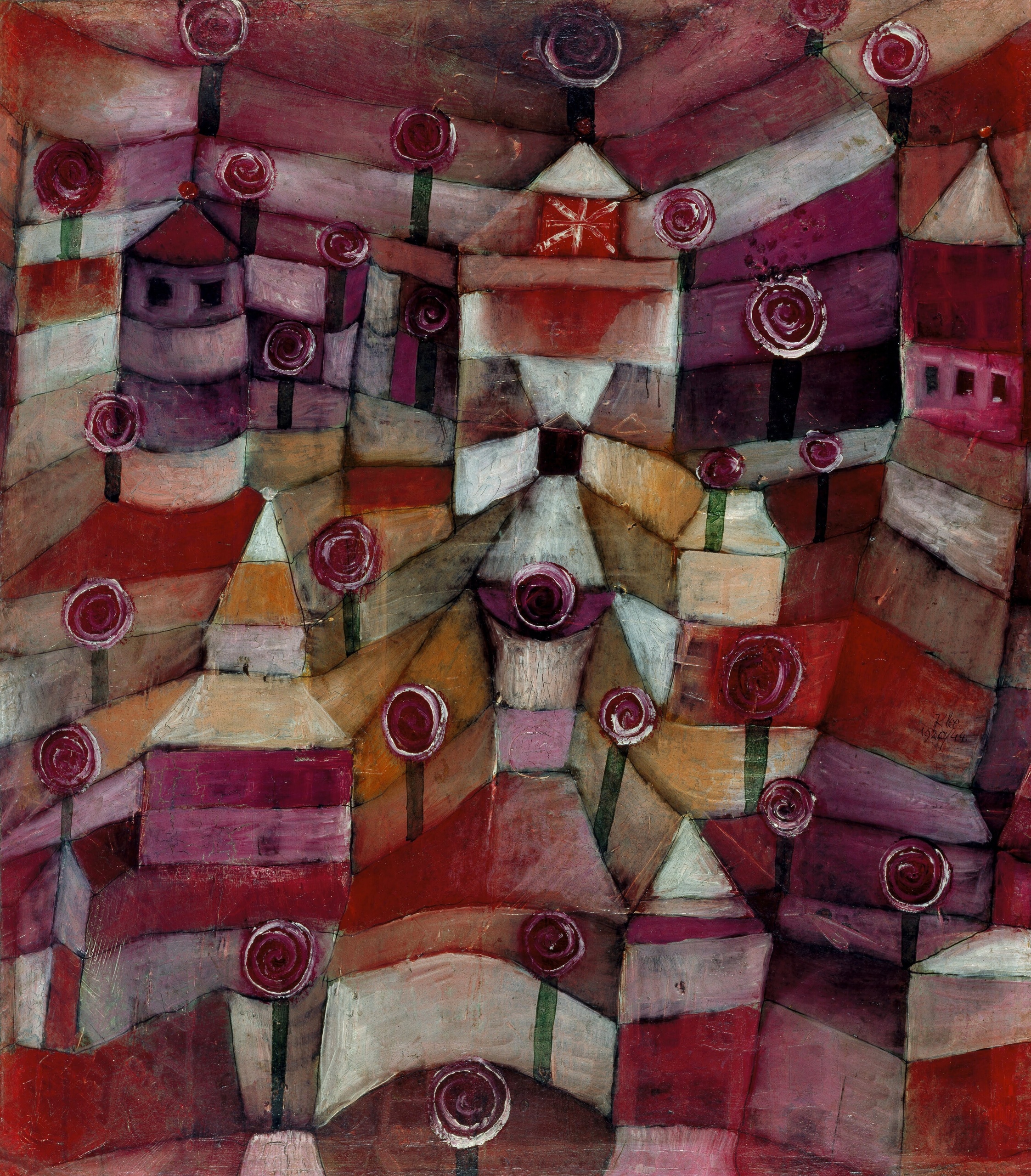
Rose Garden is a painting by Paul Klee from 1920: a little town of houses with pointed roofs and towers, in wine red, pink, violet, ochre and white, sits on curved bands that bend towards the centre like a funnel, and round red roses on thin stems bloom between the roofs. The original is a small oil on paper, 49 x 42.5 cm, in the Städtische Galerie im Lenbachhaus in Munich. We paint it for you by hand on canvas, in oil or acrylic, in one of 8 upright sizes from 36 x 43 to 172 x 200 cm or made to measure. Before we pack it, you receive a photograph of the finished painting.
| Title: | Rose Garden |
| Other titles: | Rosengarten (German title) · Il roseto (Italian title) |
| Painter: | Paul Klee (1879–1940) |
| Year painted: | 1920 |
| Original size: | 49 cm x 42.5 cm (height x width) |
| Original technique: | Oil on paper |
| Painting style: | Modernism |
| Located at: | Städtische Galerie im Lenbachhaus, Munich, Germany |
| Our reproduction: | Hand-painted in oil or acrylic on canvas, 8 sizes or made to measure |
Rose Garden – Paul Klee
What does Rose Garden show?
The houses catch the eye first. Small blocks with pointed roofs, square towers and dark little windows are stacked across the sheet, some wine red, some pink or violet, others ochre or chalky white. None of them stands on level ground: every row of buildings follows a curved band of colour, and the bands rise and sag like terraces on a hillside.
All those bands lean towards the middle. From left and right they slope down to a pale shape that narrows like the neck of a funnel, so your gaze always slides into the heart of the town.
Between the roofs grow the roses: round red blossoms drawn as spirals, each held up on a thin green or dark stem. They are scattered evenly over the whole surface.
At the top centre, under a white gable, a small red square holds a white star-like shape. On the right edge Klee signed the sheet and added the year 1920.
What could the roses among the houses mean?
The title names the scene plainly: a rose garden. What stays open is how garden and town belong together, because here the flowers do not grow in beds but right among the buildings, as tall as the towers.
Some viewers see a hill town in bloom, others a stage set or a map folded towards its centre. Our sources record no statement by Klee about this sheet, so we describe it as it is and leave the reading to you.
Why is Rose Garden so loved?
Its colours are warm and close to one another: rose, raspberry, plum, ochre and chalk white, laid on in soft, slightly worn layers. Nothing shouts, yet the whole sheet glows like a garden at dusk.
Klee, a Swiss-born German artist, came to colour slowly. He belonged to the Blaue Reiter circle around Kandinsky and Franz Marc, and a trip to Tunisia in 1914 with August Macke and Louis Moilliet was his breakthrough in colour.
He also played the violin from childhood, in an orchestra too, and the poet Rilke felt that his drawings seemed like transcriptions of music; the spirals here return like a refrain.
This painting has no Wikipedia page of its own; the English Wikipedia article on Paul Klee, written in English, is about the painter, his life and his work.
Where is the original kept, and how big is it?
The original belongs to the Städtische Galerie im Lenbachhaus in Munich, where it is catalogued as G 16102. Klee painted it in 1920, the year before he started teaching at the Bauhaus in January 1921, where he worked beside Wassily Kandinsky until 1931.
Although it is an oil painting, Klee did not paint it on canvas but on a sheet of paper measuring 49 x 42.5 cm (height x width).
From the same year comes The Lamb, a lamb built of bands of yellow, green, pink and blue beneath a red cross. The Lenbachhaus also holds Fruits on Red, a delicate watercolour on silk from 1930 in which fruits grow on thin stems.
In 1937 seventeen of his pictures hung in the Nazi “Degenerate art” exhibition, and 102 of his works were taken from public collections.
Rose Garden or another Klee?
Rose Garden is a canvas painting for anyone who prefers colour and pattern to a single figure.
If you would rather have one bright shape on a dark ground, look at The Goldfish, a glowing fish in deep blue water from 1925. For something quieter, One Who Understands from 1934 draws a face of fine red lines on a warm ochre field.
You will find all the famous Paul Klee paintings we make to order on our Paul Klee page.
How do we hand-paint Rose Garden on canvas?
Klee painted his garden in oil on paper. Ours is an oil painting reproduction on canvas: the painter works in oil or acrylic, in the size you choose, and builds the surface up layer by layer.
First he draws the curved bands, because every house sits on one of them and the funnel in the middle has to hold. Then come the blocks of the houses in their reds, pinks and violets, the ochre and white planes, and the dark windows.
The roses come last. In the original their spirals are drawn in light lines over the red, and our painter traces each spiral by hand so that the blossoms come alive above the roofs.
Which size fits which wall?
In short: 36 x 43 or 47 x 56 cm for a shelf, a hallway or the space beside a door, 54 x 65 and 72 x 85 cm above a chest of drawers or a bed, 90 x 107 or 102 x 122 cm above a sofa, and 133 x 160 or 172 x 200 cm for a large empty wall.
We paint Rose Garden in 8 upright sizes (width x height): 36 x 43, 47 x 56, 54 x 65, 72 x 85, 90 x 107, 102 x 122, 133 x 160 and 172 x 200 cm. The original sheet is 42.5 x 49 cm (width x height). Our two smallest sizes stay close to it, from 54 x 65 cm upwards they enlarge it, and at 172 x 200 cm the town is about four times as wide as in Munich.
As a painting for the living room it shines at 90 x 107 or 102 x 122 cm above the sofa, where the warm reds and pinks gather the room around them.
Can I order a different size or a frame?
Yes. If your wall needs other proportions, we keep the funnel in the centre and lengthen or trim the outer bands a little, so no house loses its roof. Tell us the size you need, and we reply with a price and a delivery date.
It travels to you rolled, stretched on a stretcher bar or framed. Our workshop in Slovenia does the stretching and framing and prepares each painting for transport. For the frame, our 3D app lets you compare mouldings and nothing more; showing the painting on your own wall is a separate service.
A slim dark wood frame deepens the wine reds, while a plain white or pale moulding keeps the pinks light.
When will your painting arrive?
Once you confirm the order, the painter begins, and Rose Garden is ready to ship within 15 to 45 working days. Before dispatch we send you a photograph of your finished painting, and if something should change, we change it.
Shipments within Slovenia and the rest of the EU pay no customs duties, and our returns policy covers every order.
With its roses and rosy roofs it makes a warm present for a wedding, an anniversary or anyone who loves gardens. If you are unsure of their wall, a gift voucher lets them choose the size.
Frequently asked questions
Where is the original?
In the Städtische Galerie im Lenbachhaus in Munich, under inventory number G 16102.
What is in the painting?
A town of small houses and towers in red, pink, violet, ochre and white, with round red roses on thin stems between them.
Is it a print?
No. You receive a hand-painted copy on canvas, worked with brushes in oil or acrylic by our painter.
How large is the original?
49 x 42.5 cm (height x width); our sizes run from 36 x 43 up to 172 x 200 cm.
Could you paint a size you do not list?
Yes. Give us the width and height and we will send an offer with a price and a date.
How long does delivery take?
The painting is ready to ship in 15 to 45 working days, and you see a photograph of it first.
Is it a good choice for a bedroom?
Yes. The soft rose and plum tones are calm, so it suits a bedroom as well as a living room.
Did Klee explain what the roses mean?
Our sources record no explanation from him; the title simply names a rose garden, and the reading is yours.
- Subject: houses and towers in wine red, pink, violet, ochre and white on curved bands, with red spiral roses between them.
- Original: oil on paper, 1920, 49 x 42.5 cm, Städtische Galerie im Lenbachhaus, Munich.
- Ours: a Paul Klee reproduction painted by hand in oil or acrylic on canvas, 8 sizes from 36 x 43 to 172 x 200 cm, or made to measure.
- Worth knowing: Klee painted it in 1920, the year before he began teaching at the Bauhaus.