







































Description
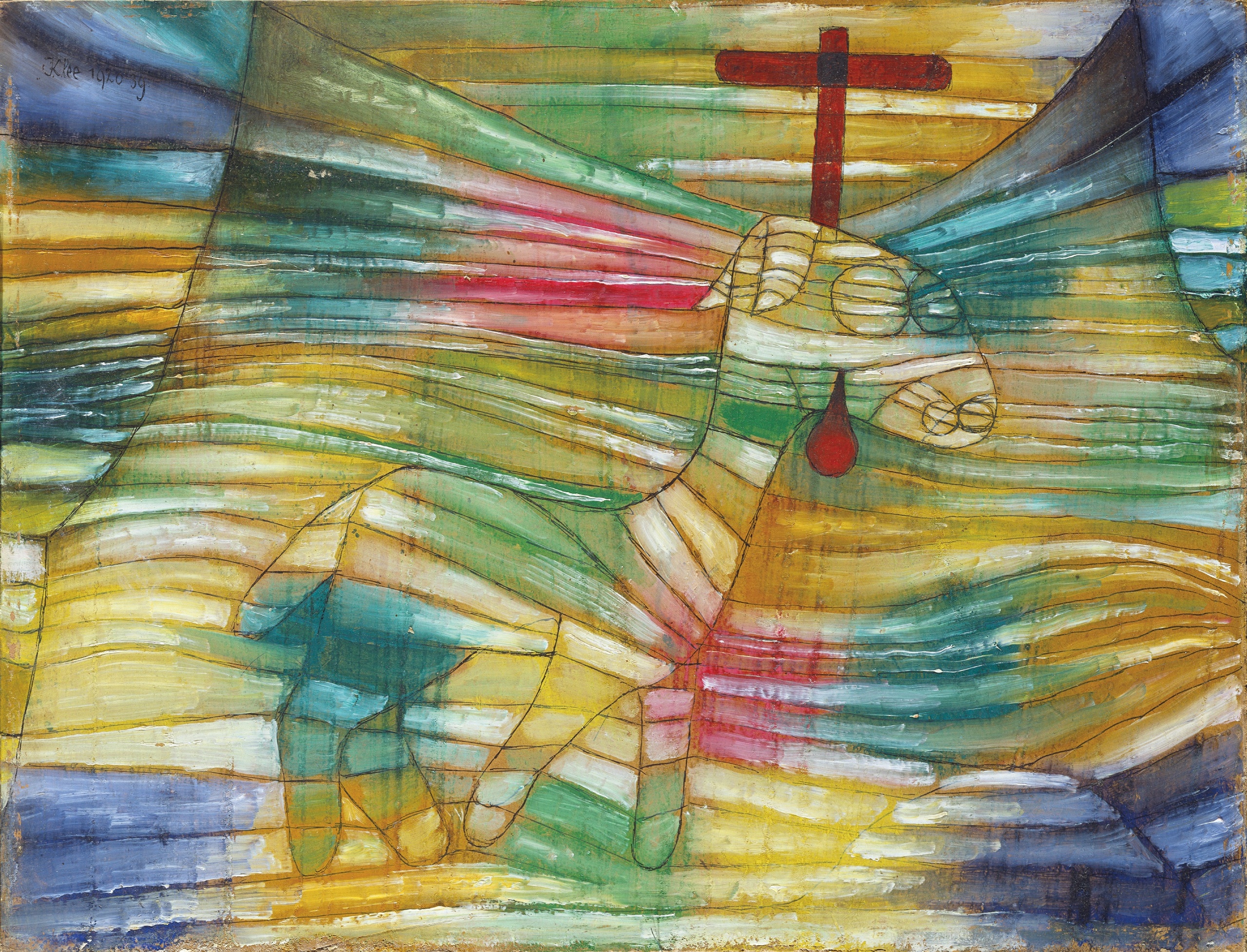
The Lamb is a painting by Paul Klee from 1920: a white lamb, drawn in fine dark lines, walks to the right, and its body is made of overlapping bands of yellow, green, pink and blue. Above it a red cross rises on a pole, a small red drop hangs near its head, and the background is built from the same bands of colour, like a landscape of stripes. The original is a small work in oil and pen and ink on cardboard, only 31.3 x 40.7 cm, kept at the Städel Museum in Frankfurt am Main. Our painter paints it for you by hand on canvas, in oil or acrylic, in 8 landscape sizes from 40 x 30 to 190 x 150 cm or made to measure. Before we pack the lamb, we send you a photograph of the finished painting.
| Title: | The Lamb |
| Other titles: | Das Lamm (German title) · L’agnello (Italian title) |
| Painter: | Paul Klee (1879–1940) |
| Year painted: | 1920 |
| Original size: | 31.3 cm x 40.7 cm (height x width) |
| Original technique: | Oil and pen and ink on cardboard |
| Painting style: | Modernism |
| Located at: | Städel Museum, Frankfurt am Main, Germany |
| Our reproduction: | Hand-painted in oil or acrylic on canvas, 8 sizes or made to measure |
The Lamb – Paul Klee
What does The Lamb show?
Horizontal bands of yellow, green, turquoise and pink run across the whole surface, separated by thin brown and black lines. In the corners they thicken into blue wedges, like hills on a horizon.
In the middle of this rippling field stands the lamb. Klee did not colour it in separately; he drew its outline in fine strokes over the bands of colour, so the body is see-through, and the same yellow, green and pink fields that surround it show through its belly and legs. The head turns to the right and carries a few tiny circles.
Above its back a slender pole rises with a red cross; together with the small drop below the head, it is the only patch of dense, dark red in the painting. At the upper left Klee wrote his name and the year 1920 in pen.
What does the lamb with the cross mean?
A lamb with a cross is an old Christian sign, known as the Lamb of God. Klee pares it down to the animal, the cross and the stripes.
What Klee meant by it is not recorded, so we stay with what can actually be seen: a delicately drawn animal walking through a world made of colour, and a sign that everyone recognises.
Why does this small painting catch the eye?
The colours do not sit neatly side by side as in a colouring book; they flow into one another and overlap, yellow turning to green, green to turquoise and blue. The outline of the lamb does not break this flow but floats on it, which is why the whole work feels light.
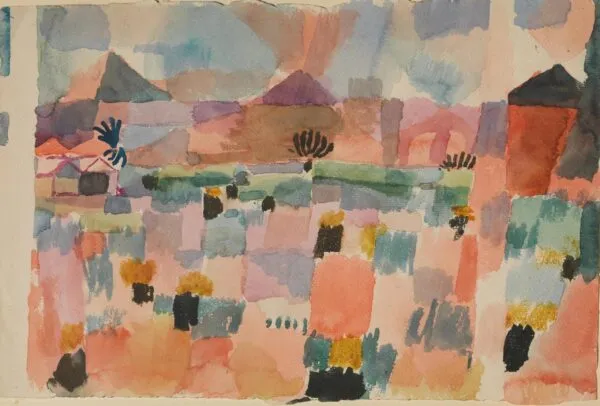
The Swiss-born German artist found his breakthrough in colour on a 1914 trip to Tunisia with August Macke and Louis Moilliet, six years before this work.
Klee played the violin from childhood, in an orchestra too, and Rilke felt that his drawings were like transcriptions of music; these stripes can recall a stave.
To read more about the painter, see the Wikipedia article on Paul Klee; it is in English and covers the artist, since this work has no article of its own.
Where is the original kept, and how big is it?
The original belongs to the Städel Museum in Frankfurt am Main, under inventory number 2104. Klee made it in 1920, a year before he began teaching at the Bauhaus in January 1921, where he stayed until April 1931.
The work is small, roughly the size of an A3 sheet: oil, with outlines in pen and ink, on cardboard.
From the same year comes Rose Garden, oil on paper, with a town of little houses under pointed roofs and red roses, now in the Städtische Galerie im Lenbachhaus in Munich. Both works show how Klee, just before the Bauhaus, built his scenes from bands of colour and small drawn signs.
The Lamb or another Klee?
The Lamb is a canvas painting for anyone who wants calm on the wall: the horizontal stripes settle the room, and the red cross gives the eye one clear point to rest on.
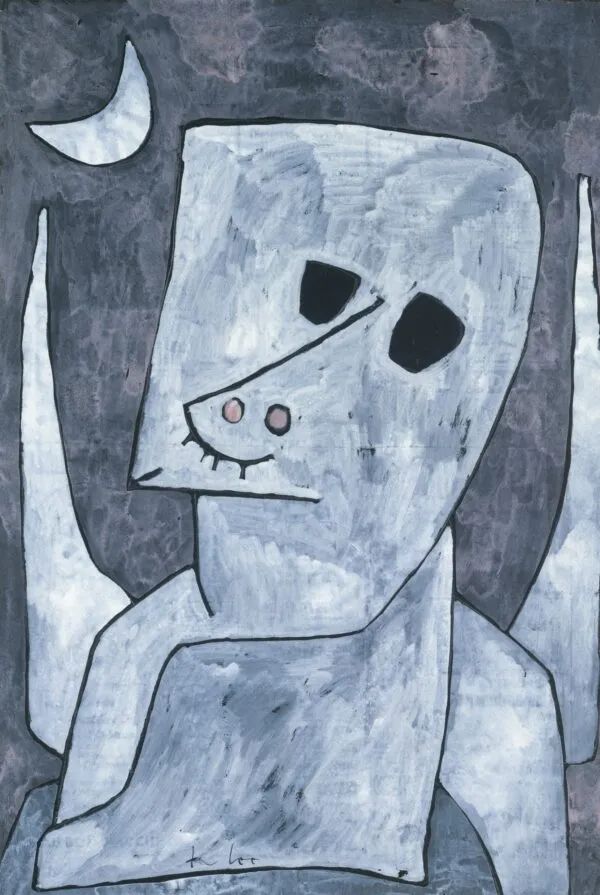
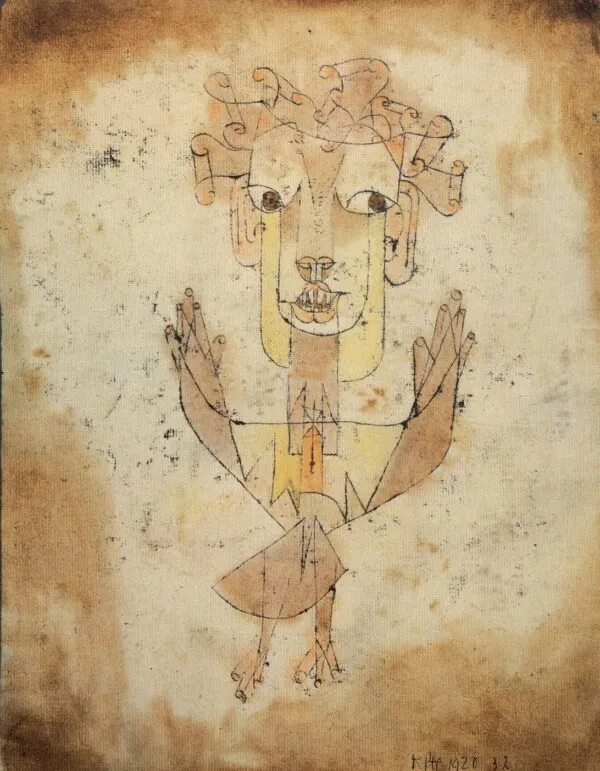
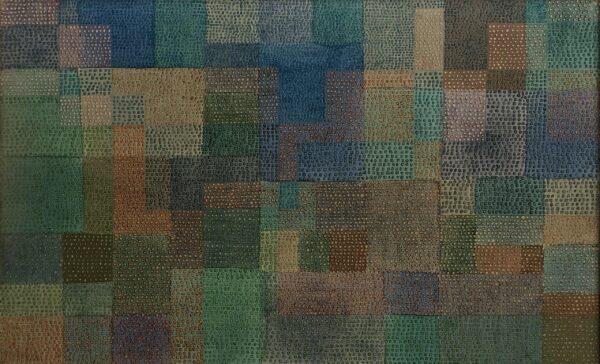
If you like Klee in softer tones, look at Fruits on Red, a watercolour on silk with thin stems and small fruits. Animal lovers will find a glowing yellow fish in deep blue water in The Goldfish, and a quiet, thoughtful figure appears in Angel Applicant from 1939.
The whole selection, from the lamb to the angels, is gathered on our Paul Klee page, among the famous Paul Klee paintings our painters make to order.
How do we hand-paint The Lamb on canvas?
Klee’s original is not an oil on canvas but a small work in oil and pen and ink on cardboard, 31.3 x 40.7 cm. Our oil painting reproduction is made on canvas instead, in oil or acrylic and in the size you choose, so it hangs on the wall like any painted canvas, only larger than the card in Frankfurt.
The painter first lays in the horizontal bands of colour and lets their edges blend softly. Once the layers are dry, he draws the dark lines between the stripes with a thin brush, then the outline of the lamb, which has to stay light and slim, as if a pen had drawn it.
Pole, cross and drop come last, in a dense, dark red, the one colour here that never flows.
Which size suits which wall?
In short: 40 x 30 or 50 x 40 cm for a shelf or a narrow wall, 60 x 45 and 75 x 58 cm above a chest of drawers or a bedside table, 95 x 75 and 120 x 95 cm above a sofa or a bed, and 150 x 120 or 190 x 150 cm for a large empty wall.
We paint The Lamb in 8 landscape sizes (width x height): 40 x 30, 50 x 40, 60 x 45, 75 x 58, 95 x 75, 120 x 95, 150 x 120 and 190 x 150 cm. The original measures 40.7 x 31.3 cm (width x height), so most of our sizes enlarge the small card considerably; at 190 x 150 cm the lamb is almost five times as wide as in Frankfurt.
As a painting for the living room it works best at 120 x 95 or 150 x 120 cm above the sofa, where the stripes stretch out like a quiet horizon.
Can I order another size or a frame?
Of course. If you need different proportions, we keep the lamb and the cross whole and lengthen or shorten only the stripes of the background; because it is made of bands, it adapts to almost any wall. Send us your own measurements and we will quote a price and a date for your lamb.
The lamb travels rolled, stretched on a stretcher bar or already framed.Our workshop in Slovenia does the stretching and framing and prepares each canvas for safe transport. You pick the frame in our 3D app, which is only for that choice; seeing the painting on your own wall is a separate service.
A plain natural wood frame suits the bright stripes, or a slim dark moulding that brings out the red cross.
When will The Lamb arrive?
Once you confirm the order, the painter starts work, and The Lamb is ready to ship in 15 to 45 working days. Before dispatch you get a photo of the finished painting, and if you would like anything changed, we change it.
Within Slovenia and across the EU it travels without customs duties, and every order is covered by our returns policy.
The calm, colourful lamb makes a lovely gift for a new home, a christening or a friend of modern art. If you cannot guess their wall, a wall art voucher lets the recipient pick the size.
Frequently asked questions
Where can I see the original?
At the Städel Museum in Frankfurt am Main, inventory number 2104.
What is shown in the painting?
A white lamb of coloured stripes walking right under a red cross on a pole, amid bright horizontal bands.
Is it a print?
No, it is a hand-painted copy: our painter works it with a brush on canvas, in oil or acrylic.
How big is the original?
Only 31.3 x 40.7 cm (height x width), while our sizes reach 190 x 150 cm.
Can I order a size that is not listed?
Yes. Send us the width and height you want, and we will reply with an offer, a price and a date.
How long will I wait?
Making it takes 15 to 45 working days, and before dispatch you receive a photo of the finished painting.
Where in the home does The Lamb fit best?
The landscape format suits a wall above a sofa, bed or sideboard, and the calm stripes work in a bedroom too.
What does the cross above the lamb mean?
A lamb with a cross is an old Christian sign, known as the Lamb of God.
- Subject: a white lamb of yellow, green, pink and blue stripes with a red cross on a pole above its back.
- Original: oil and pen and ink on cardboard, 1920, 31.3 x 40.7 cm, Städel Museum, Frankfurt am Main.
- Ours: a Paul Klee reproduction hand-painted in oil or acrylic on canvas, 8 sizes from 40 x 30 to 190 x 150 cm, or made to measure.
- Worth knowing: a lamb with a cross is an old Christian sign; Klee made the work a year before his Bauhaus years began.