







































Description
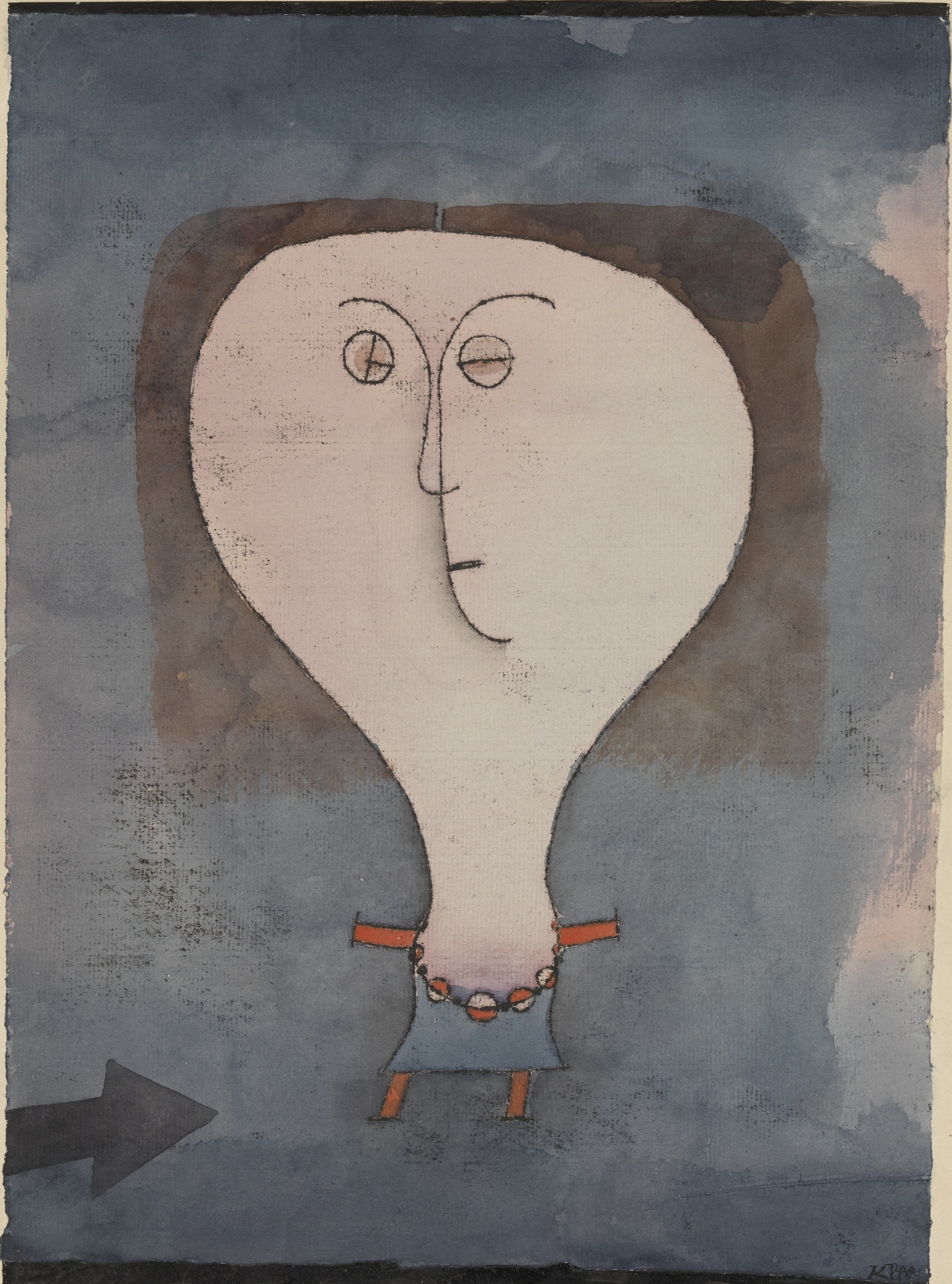
Fright of a Girl is a painting by Paul Klee from 1922: a huge, pale, pear-shaped head narrows into a thin neck, and below it stands a tiny figure in a blue dress, with a necklace of red beads and two little red legs. Two round eyes stare straight ahead, and a black arrow points at the girl from the lower left edge. The original is a small watercolour with ink on paper, only 29.7 cm tall, in the collection of the Solomon R. Guggenheim Museum in New York. Our painter paints it by hand on canvas, in oil or acrylic, in 8 upright sizes from 30 x 40 to 136 x 180 cm or made to measure. Before dispatch, we send you a photograph of the finished painting.
| Title: | Fright of a Girl |
| Other titles: | Schreck eines Mädchens (German title) · Lo spavento di una ragazza (Italian title) |
| Painter: | Paul Klee (1879–1940) |
| Year painted: | 1922 |
| Original size: | 29.7 cm x 22 cm (height x width) |
| Original technique: | Watercolour and ink on paper |
| Painting style: | Modernism |
| Located at: | Solomon R. Guggenheim Museum, New York, USA |
| Our reproduction: | Hand-painted in oil or acrylic on canvas, 8 sizes or made to measure |
Fright of a Girl – Paul Klee
What does Fright of a Girl show?
Almost the whole space is taken up by a head, milk-pale with a faint blush of pink. It is broad and round at the top, then tapers like a pear or a light bulb into a long, narrow neck. Behind it a brown patch of hair spreads out like a dark halo, and everything floats on a cool blue-grey ground that blurs like mist in places.
The face is made of a few thin black lines. Two arched brows run down into a long nose, which carries on into the outline of the cheek and chin. The eyes are small circles, each marked differently, and the mouth is just a short horizontal dash. The expression is frozen and solemn, and funny at the same time.
At the bottom, where the neck ends, sits a necklace of red and white beads, with a short blue dress below. Little red arms stick out at the sides, and two thin red legs hold the figure up. From the lower left corner a thick dark arrow aims at her, as if to show where the fright came from.
What does the scene mean?
The title names only the feeling: the girl has had a fright. What scared her, the painting does not say. The arrow points at her, so many viewers read it as a sign of danger or as the cause of the alarm, but that is only one possible reading.
The head has grown beyond all measure, while the body has shrunk to the size of a toy. Perhaps this is what fear looks like from the inside: the thought swells up, and the legs stay small and still. The face does not scream; it is quiet, struck stiff with surprise.
The joke is gentle, never cruel: we all know that moment of stopping dead, eyes wide open.
Why do so many people love this painting?
Klee is known for his childlike drawing and his gentle humour, which stayed with him through the Bauhaus years. Here, with a handful of lines and three colours, he tells a whole little story that a child understands as readily as a collector.
This work has no Wikipedia article of its own, so we point you to the English Wikipedia article on the painter Paul Klee, which covers his life and work.
Where is the original kept, and how large is it?
The original belongs to the collection of the Solomon R. Guggenheim Museum in New York, where it carries inventory number 48.1172.220. Klee painted it in 1922, when he was already teaching at the Bauhaus; he worked there from January 1921 to April 1931, alongside Wassily Kandinsky.
It is a watercolour with ink on paper, just 29.7 x 22 cm (height x width), roughly the size of an A4 sheet.
A year later he made Tropical Gardening, a long, narrow watercolour in glowing orange with tiny palms and plants, which the same museum holds.
Fright of a Girl or another Klee?
Fright of a Girl is a canvas painting for anyone who enjoys quiet humour and soft colour. The upright format, with a single figure in the middle, suits a narrow wall, a hallway or the space beside a bookcase.
If you like Klee’s fondness for puppets and toys, look at Jumping Jack from 1919, a figure with red cheeks and a yellow cap. Two strange opponents with thick black outlines face off in Public Duel, and for a calmer, almost misty room, choose Horizon, Zenith and Atmosphere.
More famous Paul Klee paintings from our range are gathered on the Paul Klee page.
How do we hand-paint Fright of a Girl on canvas?
Klee’s original is not an oil painting but a small sheet of paper worked in watercolour and ink. Ours is a hand-painted Paul Klee reproduction on canvas, made in oil or acrylic and in the size you choose, so it hangs on the wall like any other painting.
The painter first transfers the outline of the head, the neck and the arrow, because the pear shape must keep its soft curve. Then he lays in the blue-grey ground and the brown patch of hair in thin, translucent layers, so the feel of wet watercolour survives. The head stays light, with a gentle hint of pink.
Which size suits which wall?
In short: 30 x 40 or 40 x 52 cm for a bedside table, a shelf or a hallway, 45 x 60 and 58 x 75 cm above a bed or a desk, 73 x 100 cm above a chest of drawers or a sofa, and 91 x 127, 105 x 145 or 136 x 180 cm for a large, light wall where the girl should be the guest of honour.
There are 8 upright sizes (width x height): 30 x 40, 40 x 52, 45 x 60, 58 x 75, 73 x 100, 91 x 127, 105 x 145 and 136 x 180 cm. The original sheet measures only 22 x 29.7 cm (width x height), so every one of our sizes enlarges the work; at 136 x 180 cm the girl is about six times as tall as on the paper in New York. Because the shapes are large and clean, the expression loses nothing.
As a painting for the living room it works best at 73 x 100 or 91 x 127 cm, where the calm blue-grey settles the room. The smaller sizes are lovely in a child’s room, because the wide-eyed girl raises more smiles than shivers.
Is another size or a frame possible?
Of course. If your wall needs different proportions, we keep the girl, the arrow and the hair whole and widen or narrow only the blue-grey ground, so the oil painting reproduction keeps everything that matters. Send us your own measurements and we will reply with a price and a date.
Your girl travels rolled, stretched on a stretcher bar or already framed. Our workshop in Slovenia does the stretching and framing and packs every piece safely for the road. You pick the moulding in our 3D app, which is only for choosing the frame; a view of the painting on your own wall is a separate service.
When will the painting reach you?
Once you confirm the order, the painter starts, and the painting is ready to travel within 15 to 45 working days. Before packing you receive a photograph of the finished painting, and if you wish, we touch it up.
Within Slovenia and the EU there are no customs duties, and every order is covered by our returns policy.
The girl with the necklace is a tender, witty present for a birthday, a young family or a friend with a sense of humour. If you do not know her wall, give her a gift voucher and let her choose.
Frequently asked questions
Where is the original today?
At the Solomon R. Guggenheim Museum in New York, under inventory number 48.1172.220.
What does Klee’s watercolour depict?
A girl with a huge pale head, a tiny blue dress, a necklace of red beads and a black arrow pointing at her.
Is this a printed poster?
No, it is a hand-painted copy on canvas, which the painter works with brushes in oil or acrylic.
How big is the original sheet?
29.7 x 22 cm (height x width); our sizes go up to 136 x 180 cm.
Can you paint it to my own size?
Yes. Send us the width and height, and we will give you a price and a delivery date.
How long will I wait for my painting?
From 15 to 45 working days, and before dispatch we send you a photograph of the finished work.
Is it a good gift, or right for a child’s room?
Yes. The girl is more sweet than scary, and she makes a friendly gift for anyone who likes Klee or quiet humour.
What frightened the girl?
The painting does not say. The arrow points at her and can be read as the cause; the rest is left to the viewer.
- Subject: a girl with a huge, pear-shaped pale head, a blue dress, a red necklace and an arrow pointing at her.
- Original: watercolour and ink on paper, 1922, 29.7 x 22 cm, Solomon R. Guggenheim Museum, New York.
- Ours: painted by hand on canvas in oil or acrylic, 8 sizes from 30 x 40 to 136 x 180 cm, or made to measure.
- Worth knowing: Klee painted it during his Bauhaus years; every one of our sizes enlarges the small sheet.