







































Description
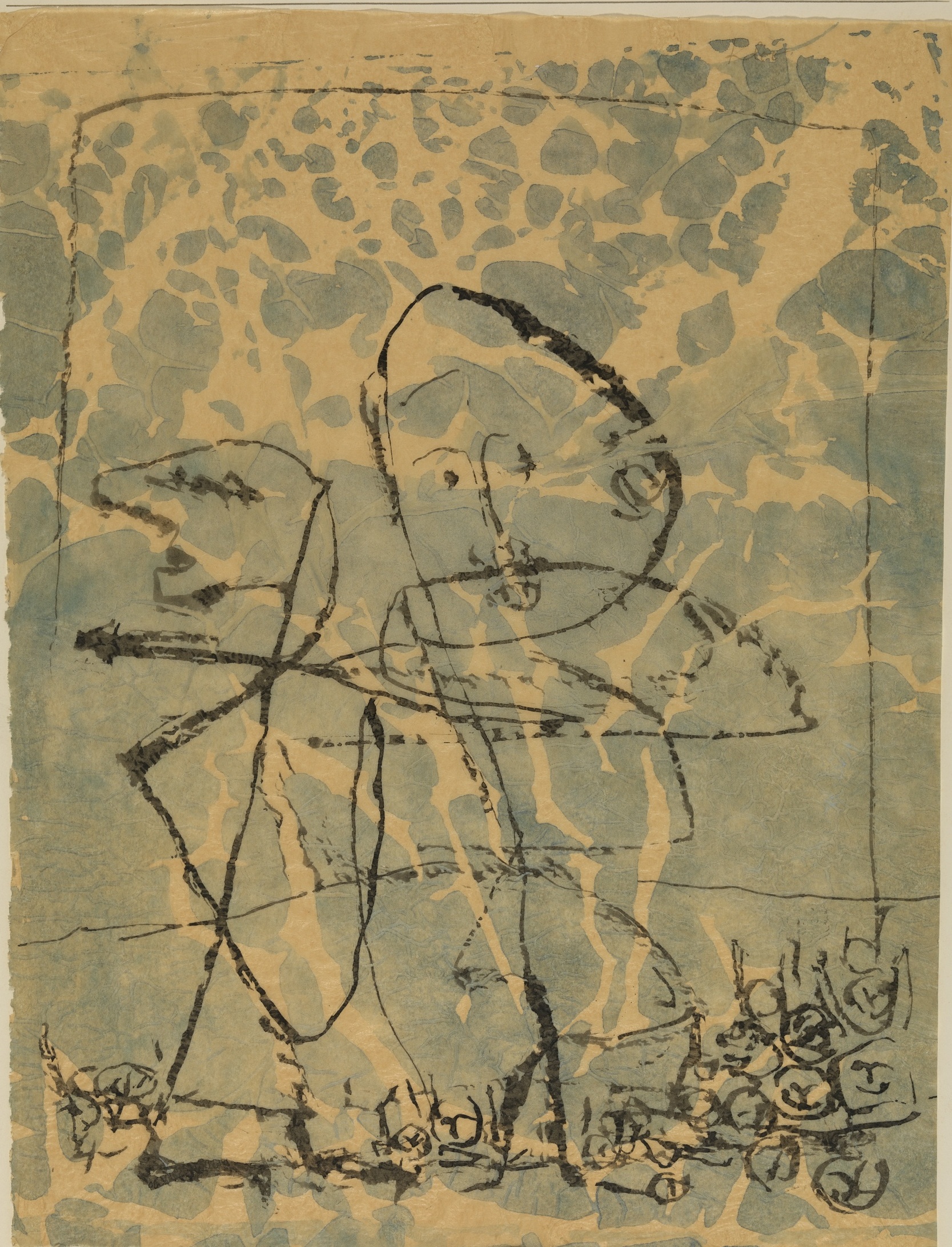
Public Duel is a painting by Paul Klee from 1932: two strange figures, drawn in thick, shaggy black brushstrokes, face each other, one with a beaked, bird-like head and a long arrow or lance, the other with a large mask-like face, while small scribbled faces crowd the bottom edge like spectators. The original is India ink and watercolour on thin tissue paper, 48.9 x 37.6 cm, held by the Solomon R. Guggenheim Museum in New York. Our painter paints it for you by hand on canvas, in oil or acrylic, in 8 upright sizes from 30 x 40 to 136 x 180 cm or made to measure. You see a photograph of the finished duel before we ship it.
| Title: | Public Duel |
| Other titles: | Öffentliches Duell (German title) · Duello pubblico (Italian title) |
| Painter: | Paul Klee (1879–1940) |
| Year painted: | 1932 |
| Original size: | 48.9 cm x 37.6 cm (height x width) |
| Original technique: | India ink and watercolour on tissue paper |
| Painting style: | Modernism |
| Located at: | Solomon R. Guggenheim Museum, New York, USA |
| Our reproduction: | Hand-painted in oil or acrylic on canvas, 8 sizes or made to measure |
Public Duel – Paul Klee
What does Public Duel show?
The scene is drawn in black ink, in thick, frayed strokes full of tiny gaps, as if the brush had skidded over a rough surface. Around the two creatures spreads a mottled ground of blue-grey patches on sand-coloured paper, like cracked stone or the surface of water.
On the left stands a figure with a beaked, bird-like head and a long pointed line, an arrow or a lance aimed to the left; its body is a few crossed strokes splayed like legs. The figure on the right is taller, with a mask-like face: a round eye, a long nose, a mouth and a half-circle at the side, perhaps an ear or an ornament. The two overlap, as if already tangled in the fight.
Along the bottom edge runs a crowd of small heads and signs, scribbled in a hurry like onlookers around the fighting ground, and a thin drawn line encloses the scene like a frame or a stage.
What does the title Public Duel mean?
The title names what you see: a duel fought before an audience, made public by the little faces along the bottom. Who the opponents are, and why they fight, Klee does not say.
The work dates from 1932, a year of political tension in Germany, when Klee was teaching at the Düsseldorf Academy. That is the date, not the meaning: no documented explanation ties the figures to real people or events, and we do not invent one.
Klee liked to hide meaning behind play. Some see a knightly tournament here, others a neighbours’ quarrel, others a dance of lines chasing each other across the paper; all three readings stay open.
Why does this ink drawing hold the eye?
Its strength is the line: a rough brush, almost as loose as a child’s, leaves grainy edges, so the figures seem alive and still on the move.
The cool blue-grey ground and the warm sand between the patches give the surface a calm, stony look, so the black lines stand out. There is humour too: the bird nose, the long lance and the crowd of tiny heads recall a puppet show.
Klee, born in Switzerland to a German music teacher and a Swiss singer, played the violin from childhood, and Rilke felt his drawings read like music written down; the little round heads repeated along the bottom edge keep just such a beat.
This work has no Wikipedia article of its own; the painter has one, the Wikipedia article on Paul Klee, in English.
Where is the original, and how was it made?
The original belongs to the Solomon R. Guggenheim Museum in New York, where it is catalogued as 48.1172.64. Klee drew it in India ink and watercolour on thin tissue paper, mounted on a second sheet. It measures 48.9 x 37.6 cm (height x width).
In 1932 Klee was teaching at the Düsseldorf Academy, his post from 1931 to 1933, after ten years at the Bauhaus (January 1921 to April 1931) beside Wassily Kandinsky.
In 1937 the Nazis put seventeen of his works in the “Degenerate art” exhibition and seized 102 of his works from public collections. He died in 1940.
Public Duel or another Klee?
Public Duel is a canvas painting for anyone who enjoys drawing, humour and muted blue-grey and sand tones, which sit well with pale wood, concrete and grey fabrics.
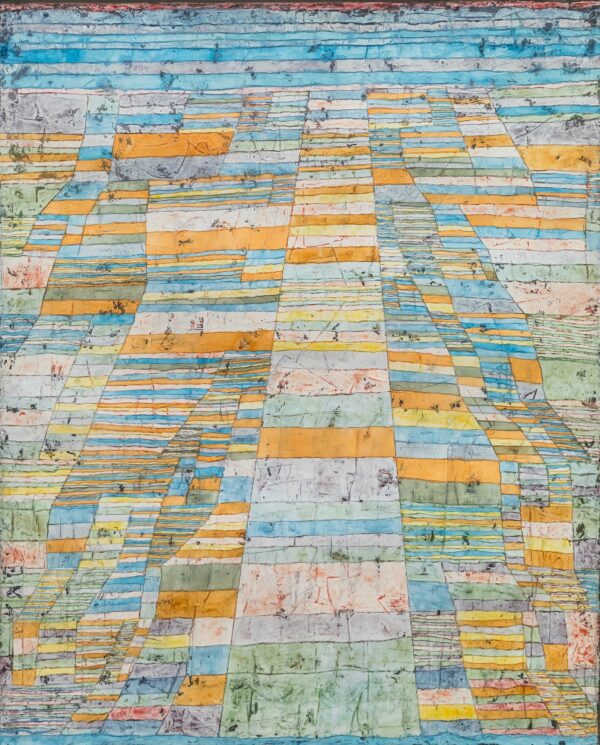
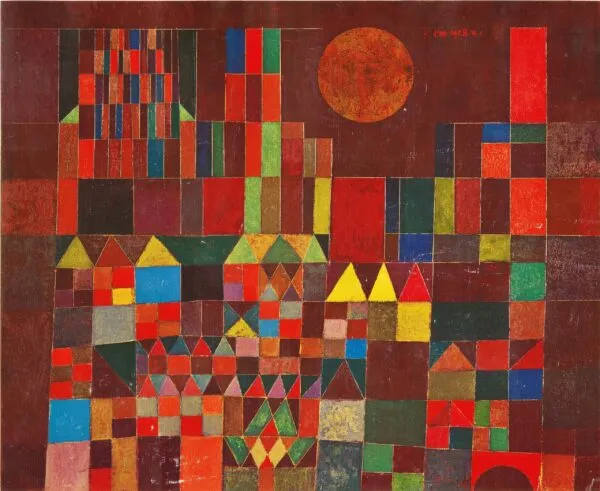
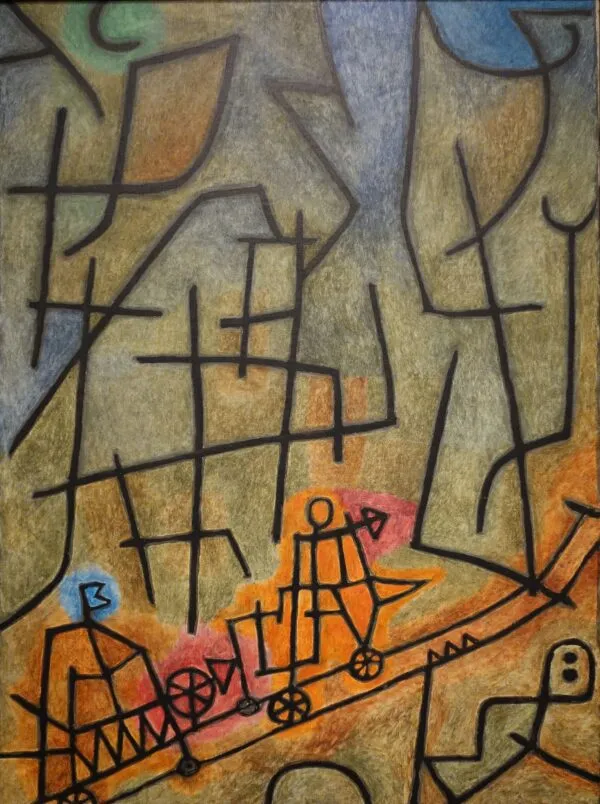
If Klee’s playful side appeals to you, look at Jumping Jack or Fright of a Girl, each built around a single figure. For a staged scene, see Introducing the Miracle, and for a quieter wall given over to the sky there is Horizon, Zenith and Atmosphere.
Klee’s full shelf of works we paint to order is on our Paul Klee page, which gathers all the famous Paul Klee paintings we offer.
How do we hand-paint Public Duel on canvas?
Klee’s original is ink and watercolour on tissue paper, not oil on canvas. What we send you is an oil painting reproduction of the duel, made by our painter in oil or acrylic on canvas in the size you choose, so it hangs like any painting on a stretcher.
He lays down the sandy ground, then the blue-grey patches, leaving pale veins between them. When it is dry, a broader brush pulls the black lines of the two figures, thick and slightly frayed, never ruled smooth.
Last come the crowd of tiny heads along the bottom and the thin frame line, with thin glazes to hint at the crinkled tissue paper. The whole work is built up layer by layer.
Which size suits which wall?
In short: 30 x 40 or 36 x 48 cm for a desk, a shelf or a hallway, 48 x 60 and 60 x 81 cm above a chest of drawers or a bed, 70 x 87 and 85 x 115 cm above a sofa, and 110 x 140 or 136 x 180 cm for a tall empty wall or a stairwell.
We paint Public Duel in 8 upright sizes (width x height): 30 x 40, 36 x 48, 48 x 60, 60 x 81, 70 x 87, 85 x 115, 110 x 140 and 136 x 180 cm. The original sheet measures 37.6 x 48.9 cm (width x height). The two smallest sizes are slightly smaller; the rest enlarge it, to over three times its width at 136 x 180 cm.
As a painting for the living room it works best at 70 x 87 or 85 x 115 cm, where the thick black lines carry across the room.
Can I order another size or a frame?
Yes. If your wall needs other proportions, we keep both figures and the row of spectators whole and adjust only the mottled ground at the edges. Tell us your custom size for Public Duel and we will come back with a price and a date.
Public Duel travels rolled, stretched on a stretcher bar or framed. Our workshop in Slovenia stretches, frames and packs it. The 3D app on our site is for choosing the moulding only; seeing the duel on your own wall is a separate service.
A slim natural oak frame or a narrow black moulding that echoes the ink lines suits it.
When will the painting reach you?
Confirm the order and the painter begins; Public Duel is ready to ship within 15 to 45 working days. Before it leaves, we send you a photograph of the finished painting and adjust a detail or two if you wish.
There are no customs duties within Slovenia or to the rest of the EU, and every order is covered by our returns policy.
Public Duel is a witty gift for a friend who loves an argument, a lawyer, or a couple who enjoy bickering in jest. Not sure of their wall? Give a wall art voucher and let them pick the size themselves.
Frequently asked questions
Where is the original kept?
At the Solomon R. Guggenheim Museum in New York, under accession number 48.1172.64.
Who are the two figures?
Two odd creatures, one with a bird’s head and a lance, the other with a mask-like face, in front of a crowd of tiny onlookers.
Will I receive a print?
No. You receive a hand-painted copy, brushed onto canvas by our painter in oil or acrylic.
How big is the original sheet?
It measures 48.9 x 37.6 cm (height x width); our sizes run from 30 x 40 to 136 x 180 cm.
Is Public Duel available in a size not listed?
Yes. Tell us the width and height and we will send an offer with a price and a production time.
How long will I wait?
Making it takes 15 to 45 working days, and before dispatch you get a photograph of the finished painting.
Would it suit an office or a bedroom?
Yes. The calm blue-grey and sand tones fit a workspace or a bedroom, and the black lines add character.
Why is the duel fought in front of spectators?
Klee left no explanation. The title and the tiny faces at the edge only tell us the fight happens before an audience.
- Subject: two strange figures in thick black lines, one with a bird’s head and a lance, one with a mask-like face, with tiny spectators below.
- Original: India ink and watercolour on tissue paper, 1932, 48.9 x 37.6 cm, Solomon R. Guggenheim Museum, New York.
- Ours: a hand-made Paul Klee reproduction in oil or acrylic on canvas, offered in 8 upright sizes from 30 x 40 to 136 x 180 cm or to measure.
- Worth knowing: Klee made it in 1932, while teaching at the Düsseldorf Academy.