







































Description
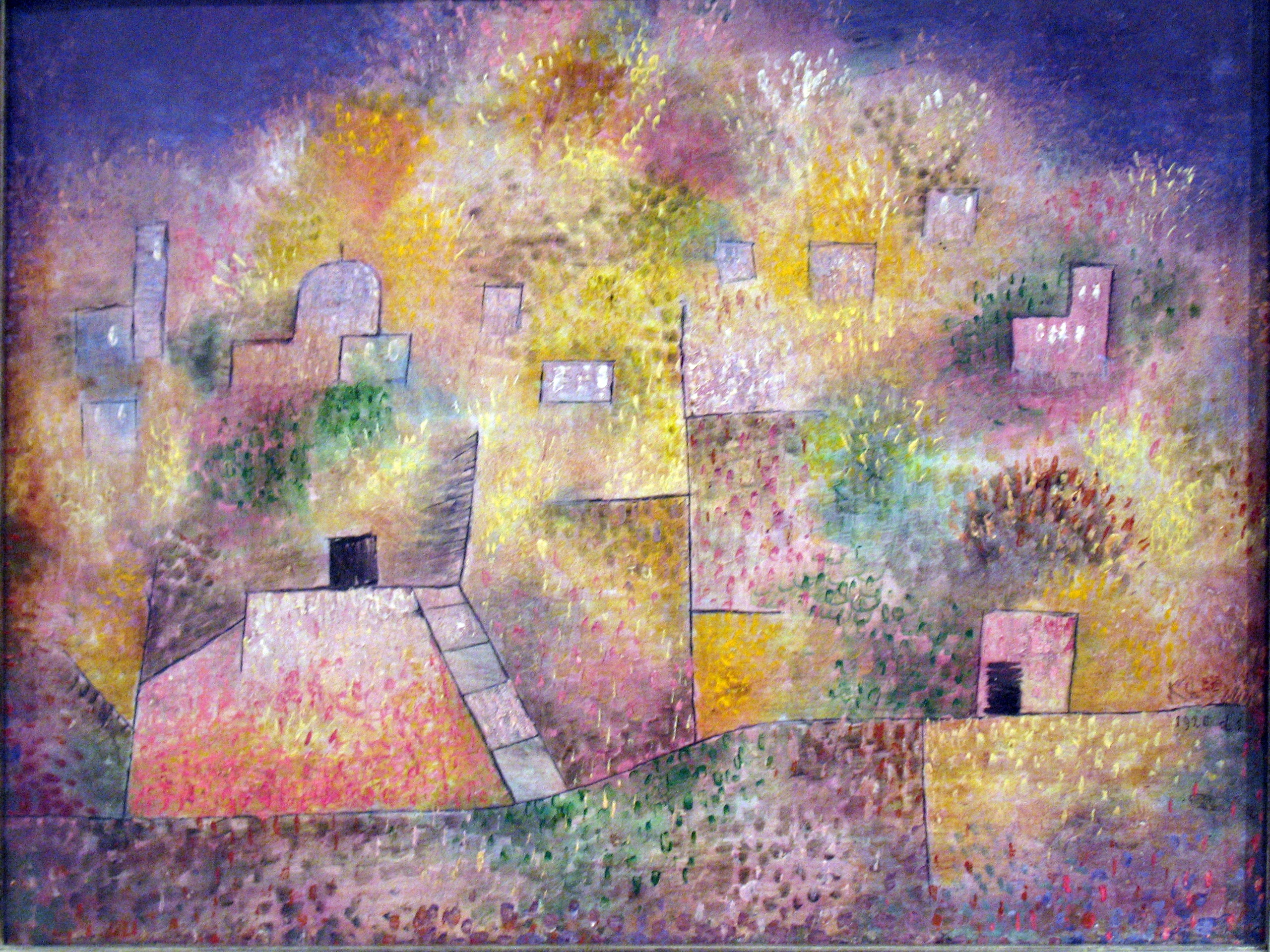
Oriental Pleasure Garden is a painting by Paul Klee from 1925: small cubic houses in white, pink and greyish lilac, with dark doors, windows and a flight of steps, stand among flowering shrubs, and the whole surface is covered in tiny dabs of yellow, pink, orange, green and violet, like blossoms lit up by the sun. The original is oil on cardboard, 41.1 x 52.1 cm, and belongs to The Metropolitan Museum of Art in New York. Our painter paints it for you by hand on canvas, in oil or acrylic, in 8 landscape sizes from 40 x 30 to 200 x 159 cm or made to measure. Before it leaves us, we show you a photograph of the finished work.
| Title: | Oriental Pleasure Garden |
| Other titles: | Orientalischer Lustgarten (German title) · Orientalski vrt užitkov (Slovene title) |
| Painter: | Paul Klee (1879–1940) |
| Year painted: | 1925 |
| Original size: | 41.1 cm x 52.1 cm (height x width) |
| Original technique: | Oil on cardboard |
| Painting style: | Modernism |
| Located at: | The Metropolitan Museum of Art, New York, USA |
| Our reproduction: | Hand-painted in oil or acrylic on canvas, 8 sizes or made to measure |
Oriental Pleasure Garden – Paul Klee
What does Oriental Pleasure Garden show?
The scene climbs in terraces from the bottom edge to the top. Along them stand houses, plain cubes and blocks outlined in thin dark lines, some white, others pale pink or greyish blue. At the upper left rises a building with a rounded roof and a slender tower; at the upper right, a pink house with a stepped outline and a row of small white windows.
At the lower left lies a broad pink terrace, with a strip of pale stone slabs climbing beside it like a stairway; on the right stands a yellowish wall. A dark doorway opens above the terrace, and a second one, crossed by horizontal strokes, sits in a little pink house at the lower right.
Between the houses grow bushes with no outline, made of brushstrokes alone: green clumps on the left and in the middle, a reddish-brown shrub on the right. The whole surface is sprinkled with short strokes and dots of yellow, pink, orange, white, green and violet. Only in the top corners does a deep blue-violet sky open up, so the middle glows like a garden in full bloom.
What does the title tell us?
The title promises a garden for rest and delight, yet names no place, so the scene reads as a daydream rather than a map.
Anyone who knows Klee’s life will think of his twelve-day trip to Tunisia in April 1914 with August Macke and Louis Moilliet, when the light of the country struck him deeply. Back home he painted his first purely abstract work, built from coloured rectangles and a few circles, with the city of Kairouan in its title.
He wrote then that colour had taken possession of him and that he and colour were one. English Wikipedia adds that he spent more than ten years exploring colour and that his design ideas drew on the colourful world of the Orient. Painted eleven years after that journey, Oriental Pleasure Garden recalls the light of North Africa: a link the painting suggests, not a portrait of a real garden.
Why do so many people love this garden?
In Klee’s work the coloured rectangle became the basic building block; some scholars compare it to a musical note, combined with others into a harmony of colour. Here those rectangles are houses and terraces, with countless sparks of colour flickering between them.
Klee played the violin from childhood, in an orchestra too, and Rilke wrote that his drawings seemed like transcriptions of music. The short strokes here repeat like notes, sparse in places and elsewhere gathered into chords of light.
The Wikipedia article on Paul Klee, written in English, tells more about him, the Tunisian trip and the Bauhaus years; it is about the painter, since this work has no article of its own.
Where is the original kept, and what size is it?
The original belongs to The Metropolitan Museum of Art in New York. Klee painted it in 1925, while teaching at the Bauhaus, where he worked from January 1921 to April 1931 alongside Wassily Kandinsky.
It is oil on cardboard and measures just 41.1 x 52.1 cm (height x width), small like most of his works.
The same New York collection holds the Still Life of 1927, painted on a thick plaster panel, with pots, fruit and an Easter egg on a dark red ground.
Oriental Pleasure Garden or another Klee?
Oriental Pleasure Garden is a canvas painting for anyone who wants warmth, flowers and light on the wall rather than hard contrasts.
If Klee’s houses appeal to you, look at Rotating House of 1921, a finely drawn house spinning around its centre. A town built entirely of coloured squares, with two towers, comes in Architecture of 1923, and if you prefer a mysterious emptiness, choose Limits of Reason, with its red sphere above a web of fine lines.
All the famous Paul Klee paintings we offer, from little houses and gardens to angels, are gathered on our Paul Klee page.
How do we hand-paint Oriental Pleasure Garden on canvas?
Klee’s original is a small oil on cardboard. Ours is an oil painting reproduction on canvas: the painter works in oil or acrylic, in the size you choose, building it up in layers so it hangs like any painted work.
First come a warm underlayer and the blue-violet sky in the corners, then the outlines of houses, towers, terraces and stairway, drawn with a fine brush and kept slightly uneven, as Klee drew them.
The longest stage follows: a multitude of short strokes in yellow, pink, orange, green and white, laid side by side and over one another. The painter keeps their rhythm, density and direction rather than copying each one, so the garden glows on canvas too. The dark doors and windows come last and give the houses depth.
Which size suits which wall?
In short: 40 x 30 or 50 x 38 cm for a hallway or kitchen, 65 x 49 and 80 x 63 cm above a chest of drawers or desk, 100 x 79 and 125 x 99 cm above a sofa or bed, 160 x 123 or 200 x 159 cm for a large dining-room or open-plan wall.
We paint Oriental Pleasure Garden in 8 landscape sizes (width x height): 40 x 30, 50 x 38, 65 x 49, 80 x 63, 100 x 79, 125 x 99, 160 x 123 and 200 x 159 cm. The original measures 52.1 x 41.1 cm (width x height). The two smallest sizes are a little smaller than the original; from 65 x 49 cm upwards we enlarge it, and at 200 x 159 cm the garden is almost four times as wide as in New York.
As a painting for the living room it is most convincing at 125 x 99 or 160 x 123 cm above the sofa, where the yellows and pinks bring the wall to life.
Is another size or a frame possible?
Of course. For other proportions we widen or narrow the scene so that the houses, stairway and dark doors stay whole, adjusting only the flowering background. Send us your own measurements for the garden and a price and date will follow.
Your garden can travel rolled, stretched on a stretcher bar or framed, and our workshop in Slovenia does the stretching and framing. The frame is chosen in our 3D app, which serves that choice alone, while a view of the painting on your own wall is a separate service.
When does the painting arrive, and how do I receive it?
The painter begins once you confirm the order, and the garden is ready to ship within 15 to 45 working days. Before it goes, we send you a photograph of the finished painting and make any change you ask for.
Shipments within Slovenia and to the other EU countries travel without customs charges, and our returns policy covers every order.
A flowering garden in warm colours is a lovely gift for a new home, a wedding or an anniversary; if the right size is a puzzle, a wall art voucher lets the recipient decide.
Frequently asked questions
Who owns the original?
The Metropolitan Museum of Art in New York, where it is part of the permanent collection.
What is painted in the picture?
Small cubic houses with dark doors, a stairway and terraces among flowering shrubs, all sprinkled with tiny strokes of colour.
Is this a print?
No, it is a hand-painted copy that the painter makes with brushes on canvas, in oil or acrylic.
How big is Klee’s original?
It measures 41.1 x 52.1 cm (height x width); our sizes go up to 200 x 159 cm.
Can I order different proportions?
Yes. Send us the width and height you need for an offer.
How long will I wait for the painting?
15 to 45 working days, with a photograph of the finished garden before dispatch.
Is the garden a good fit for a bedroom or as a present?
Yes. Its soft, warm colours feel calm and please anyone who loves flowers and light.
Does the painting show a real place?
The title names no place; the scene recalls Klee’s 1914 trip to Tunisia and the light he found there.
- Subject: cubic houses, a stairway and terraces among flowering shrubs, sprinkled with yellow, pink and violet strokes.
- Original: oil on cardboard, 1925, 41.1 x 52.1 cm, The Metropolitan Museum of Art, New York.
- Ours: a Paul Klee reproduction painted by hand in oil or acrylic on canvas, 8 landscape sizes from 40 x 30 to 200 x 159 cm, or made to measure.
- Worth knowing: Klee painted it during his Bauhaus years, and it recalls the light of Tunisia, which he visited in 1914.