







































Description
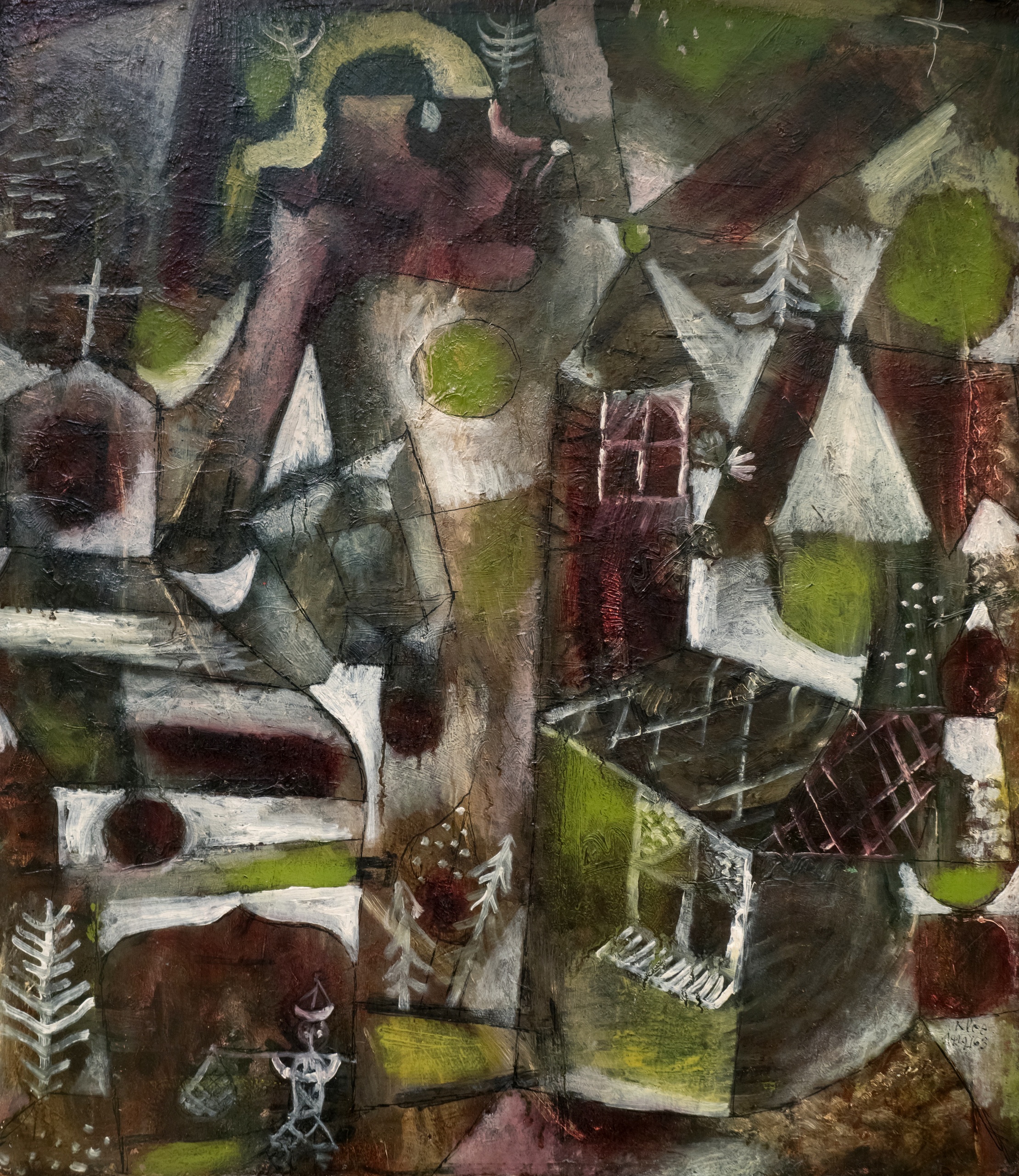
Swamp Legend is a painting by Paul Klee from 1919: a dark, densely worked landscape in which a church with a cross, small houses, a red door and, right at the bottom, a tiny figure with a pole across its shoulders hide among fir trees, triangular roofs and round yellow-green discs. The original is oil on cardboard, 47 x 40.8 cm, and has hung since 1982 in the Städtische Galerie im Lenbachhaus in Munich. Our painter paints it for you by hand on canvas, in oil or acrylic, in 8 upright sizes from 36 x 43 to 172 x 200 cm or made to measure. Before we pack it, we send you a photograph of the finished work.
| Title: | Swamp Legend |
| Other titles: | Sumpflegende (original German title) · Leggenda della palude (Italian title) |
| Painter: | Paul Klee (1879–1940) |
| Year painted: | 1919 |
| Original size: | 47 cm x 40.8 cm (height x width) |
| Original technique: | Oil on cardboard |
| Painting style: | Modernism |
| Located at: | Städtische Galerie im Lenbachhaus, Munich, Germany |
| Our reproduction: | Hand-painted in oil or acrylic on canvas, 8 sizes or made to measure |
Swamp Legend – Paul Klee
What does Swamp Legend show?
The scene is dark and crowded, like a village glimpsed through trees at dusk. Browns, deep violets and olive greens dominate, and between them bright white patches are cut by thin black lines into triangles, arcs and tilted rectangles.
At the upper left a church with a white cross on its roof stands among small houses with pointed white roofs. In the middle a dark red door with a little window opens, a slanting lattice like a fence or trellis lies beside it, and lower down a short run of white steps leads towards the centre.
White fir trees, drawn like fishbones, grow between the buildings, and round yellow-green discs hang over everything, to be read as suns, moons or treetops. At the lower left stands a tiny figure made of white lines, with a pole across its shoulders and something hanging from each end. The paint is scratched and crackled in places, and Klee signed the work at the lower right.
What is the legend about?
English Wikipedia places the work among the “cosmic landscapes” that Klee painted in large numbers between 1917 and 1919, expressing a symbolic view of nature. The colour spaces are abstract and the objects are arranged in a naive way. The same source says that in this dreamlike scenery the human figure itself becomes a piece of nature: the little figure at the bottom is no taller than the fir beside it.
In his diaries Klee wrote that, even as a child, landscape had seemed perfectly clear to him, a setting for the moods of the soul, but that a dangerous time was now beginning in which nature wanted to swallow him up, and that he nonetheless felt at peace. Which legend the title means, the sources do not say.
Why is this painting so well known?
It joins childlike signs, such as little houses, a cross and fir trees, to a dark, almost nocturnal palette.
Klee was born in 1879 in Münchenbuchsee near Bern. In 1911 and 1912 he belonged to the Blue Rider circle around Kandinsky and Franz Marc, and a trip to Tunisia in 1914 became his breakthrough in colour. He painted Swamp Legend five years later in Munich.
English Wikipedia has a short article on Swamp Legend, written in English.
Where is the original, and what happened to it?
Shortly after it was finished, Paul Küppers and his wife Sophie, later Sophie Lissitzky-Küppers, bought it directly from Klee in Munich. In 1926 Sophie lent it, together with 15 other modernist works, to the provincial museum in Hanover.
On 5 July 1937 the Nazis confiscated it there in their campaign against “degenerate art”, and from 19 July it hung in the defamatory exhibition of that name, on the so-called Dada wall. It later passed through several hands, and in 1982 the Gabriele Münter and Johannes Eichner Foundation and the city of Munich acquired it.
The heirs of Sophie Lissitzky-Küppers sought its return for decades. In July 2017 it became known that they had reached an agreement with the city: the heirs receive compensation, and the painting stays at the Lenbachhaus.
In the same year, 1919, Klee also painted Villa R on cardboard, a brighter landscape with a white villa, a red road and a large letter R in the foreground.
Swamp Legend or another Klee?
Swamp Legend is a canvas painting for people who like darker, mysterious scenes that cannot be taken in at a glance.
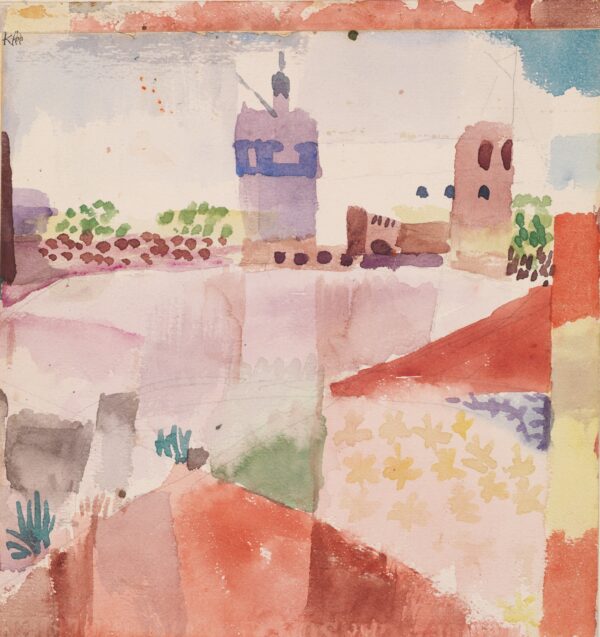
If you want more light, choose Hammamet with Its Mosque, a translucent watercolour from Klee’s 1914 trip to Tunisia. Castle and Sun builds a whole town from small coloured squares and triangles under an orange-red sun, and for a larger wall there is Polyphony, where thousands of tiny dots run across soft blocks of colour.
Our Paul Klee page brings together the famous Paul Klee paintings that we paint to order.
How do we hand-paint Swamp Legend on canvas?
Klee’s original is oil on cardboard, not canvas, and measures only 47 x 40.8 cm. Ours is an oil painting reproduction on canvas: the painter works in oil or acrylic, in the size you choose, so it hangs on your wall like any other painting.
He first divides the surface with thin lines into the same planes Klee used, then builds up the dark browns, violets and greens layer by layer. The white roofs, firs, cross and little figure come last, in thicker paint, so that they rise out of the darkness.
He suggests the scratched, crackled surface of the original with grainy strokes and marks drawn into the wet paint, so the surface stays rough and alive.
Which size suits which wall?
In short: 36 x 43 or 47 x 56 cm for a hallway, a shelf or a narrow wall, 54 x 65 and 72 x 85 cm above a chest of drawers or a bed, 90 x 107 and 102 x 122 cm above a sofa, and 133 x 160 or 172 x 200 cm for a large wall where the landscape can draw you in.
We paint Swamp Legend in 8 upright sizes (width x height): 36 x 43, 47 x 56, 54 x 65, 72 x 85, 90 x 107, 102 x 122, 133 x 160 and 172 x 200 cm. The original measures 40.8 x 47 cm (width x height), so our smallest size is slightly smaller and every other size enlarges it, the largest by more than four times.
As a painting for the living room it works best at 90 x 107 or 102 x 122 cm above a sofa or a bookcase, where the dark tones stand out against a pale wall.
Can I order another size or a frame?
Yes. If you need other proportions, the painter adds or trims a little of the dark ground at the edges, while the church, the door and the figure stay whole. Request a made-to-measure size and we will reply with a price and a delivery time.
We send it rolled, stretched on a stretcher bar or framed; the stretching and framing are done in our workshop in Slovenia. The frame is chosen in our 3D app, which serves only to pick the moulding; a view of the painting on your own wall is a separate service.
A narrow frame in dark wood suits the deep tones, while a patinated gold moulding picks up the yellow-green discs.
How and when is the painting delivered?
Once you confirm the order, the painter starts work, and Swamp Legend is ready for dispatch in 15 to 45 working days. Before it leaves we send you a photograph of the finished painting, and if you would like a change, we make it.
Within Slovenia and to other EU countries there are no customs duties, and our returns policy covers every order.
It makes a fine gift for anyone who loves fairy tales, forests or modern art. Not sure which size they would like? Give a wall art voucher so the choice is theirs.
Frequently asked questions
Where can I see the original Swamp Legend?
In the Städtische Galerie im Lenbachhaus in Munich, where it has hung since 1982.
What is in the painting?
A dark, dreamlike landscape with a church, small houses, firs, yellow-green discs and a tiny figure at the lower left.
Is this a print?
No, it is a hand-painted copy: our painter lays down every brushstroke on canvas, in oil or acrylic.
How big is Klee’s original?
47 x 40.8 cm (height x width); our sizes go up to 172 x 200 cm.
Can I have a size that is not listed?
Yes, send us the width and height and we will prepare an offer with a price and a delivery time.
How soon will it arrive?
Painting takes 15 to 45 working days, and you see a photograph of the finished work before dispatch.
Is it suitable for a bedroom or as a present?
Yes, the muted dark tones suit a bedroom, and as a present it pleases lovers of modern art.
What does the little figure at the bottom mean?
Wikipedia says that in this dreamlike scene the human figure becomes a piece of nature, which is why it is as small as the firs around it.
- Subject: a dark landscape with a church, small houses, white firs, yellow-green discs and a tiny human figure.
- Original: oil on cardboard, 1919, 47 x 40.8 cm, Städtische Galerie im Lenbachhaus, Munich.
- Ours: a Paul Klee reproduction hand-painted in oil or acrylic on canvas, 8 upright sizes from 36 x 43 to 172 x 200 cm, or made to measure.
- Worth knowing: the Nazis seized the painting in 1937; the dispute over its ownership ended only with an agreement in 2017.