







































Description
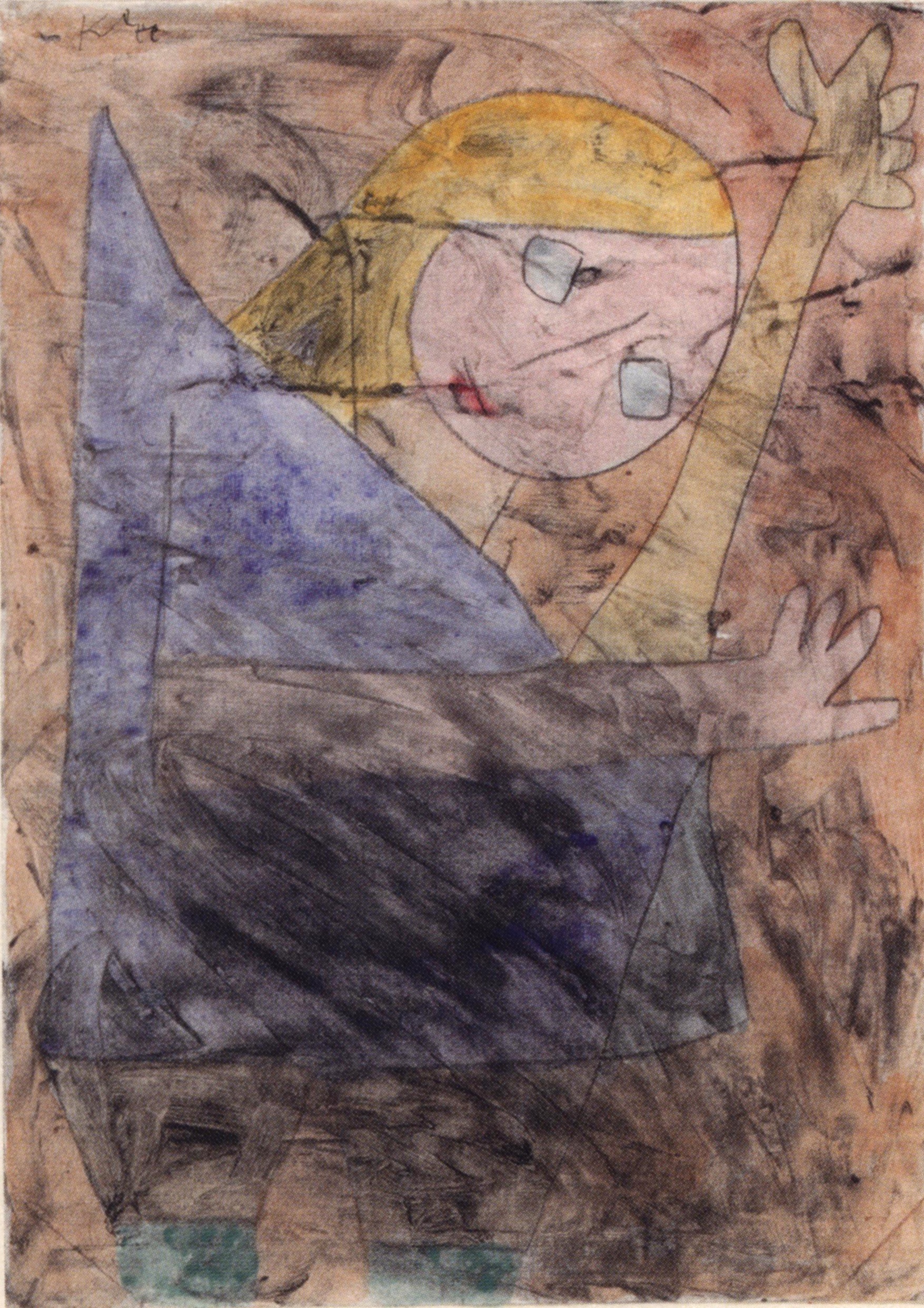
Angel, Still Groping is a painting by Paul Klee from 1939, the year before he died: a childlike angel with a round pink face, blond hair, blue-grey eyes and a small red mouth tilts down to the right, while an outstretched arm divides the sheet into a light upper half and a dark lower half. The original is a small watercolour on paper, just 29.4 x 20.8 cm, held by the Zentrum Paul Klee in Bern. Our painter recreates it for you by hand on canvas, in oil or acrylic, in 8 upright sizes from 31 x 42 to 136 x 193 cm or made to measure. Before dispatch, we send you a photograph of your finished painting.
| Title: | Angel, Still Groping |
| Other titles: | Engel, noch tastend (German title) · Angelo ancora brancolante (Italian title) |
| Painter: | Paul Klee (1879–1940) |
| Year painted: | 1939 |
| Original size: | 29.4 cm x 20.8 cm (height x width) |
| Original technique: | Watercolour on paper |
| Painting style: | Modernism |
| Located at: | Zentrum Paul Klee, Bern, Switzerland |
| Our reproduction: | Hand-painted in oil or acrylic on canvas, 8 sizes or made to measure |
Angel, Still Groping – Paul Klee
What does Angel, Still Groping show?
A round, pale pink face floats in the upper part of the sheet. A yellow cap of blond hair covers the crown of the head and runs off to the left like a ribbon. The eyes are two blue-grey, almost square shapes, one set higher than the other, and between them sits a small red mouth. Because the head tilts down to the right, the angel seems to be peering carefully at the ground.
On the left rises a large violet-blue triangle, which you can read as a wing or as a body wrapped in a loose robe. Across the middle an arm reaches out to the right; English Wikipedia describes three fingers and a thumb pointing forward. A second, yellowish arm stretches up into the top right corner.
The lower half is dark, smudged with blue-black strokes, and near the bottom edge sit two small greenish patches. The brownish ochre ground is scratched with fine, nervous lines. At the top left Klee signed his name in small letters.
What do the angels of Klee’s last years mean?
In 1933, after the Nazis took power, Klee was dismissed as a professor in Germany and branded a “degenerate artist”. He settled in Switzerland, the country of his birth, and there he was diagnosed with an incurable disease.
Angels became one of the recurring subjects of those final years. In 1939 alone he painted 28 of them, and in 1940, the year of his death, four more. English Wikipedia stresses that Klee’s angels are drawn with a childish humour and are not transcendent mystical beings.
This one looks like a child too. With an arm held out in front of it, it is, as the title says, still groping, as if feeling for a path or for something to hold on to.
Why do people love this little angel?
It was made in hard years, yet the sheet stays gentle and almost playful. The wide eyes, the red mouth and the yellow hair give the angel a face that children and adults warm to quickly.
Klee was born in 1879 in Münchenbuchsee near Bern, the son of a German music teacher and a Swiss singer. He played the violin from childhood, and Rilke wrote that his drawings seemed like transcriptions of music.
The short Wikipedia article on this work, written in English, describes the blond hair, the blue eyes and the outstretched arm, and places the sheet in Klee’s late series of angels.
Where is the original, and how small is it?
The original belongs to the Zentrum Paul Klee in Bern, the city near which the artist was born. It is a watercolour on paper measuring only 29.4 x 20.8 cm (height x width), a little smaller than an A4 sheet.
In 1937 the Nazi “Degenerate art” exhibition included seventeen of his pictures, and 102 of his works were seized from public collections.
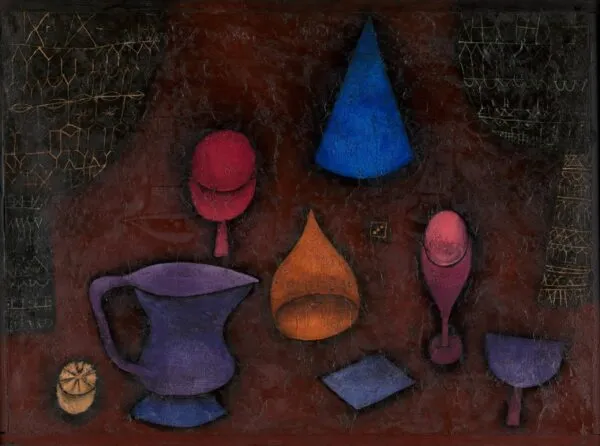
He left more than 9,000 works, many of them small sheets of paper, gauze or board. Some sit on surprising supports: Still Life of 1927, with its pots, fruit and Easter egg, is painted on a thick plaster panel.
Angel, Still Groping or another Klee?
As a canvas painting, this angel suits anyone who wants a quiet, friendly figure on the wall rather than a loud composition.
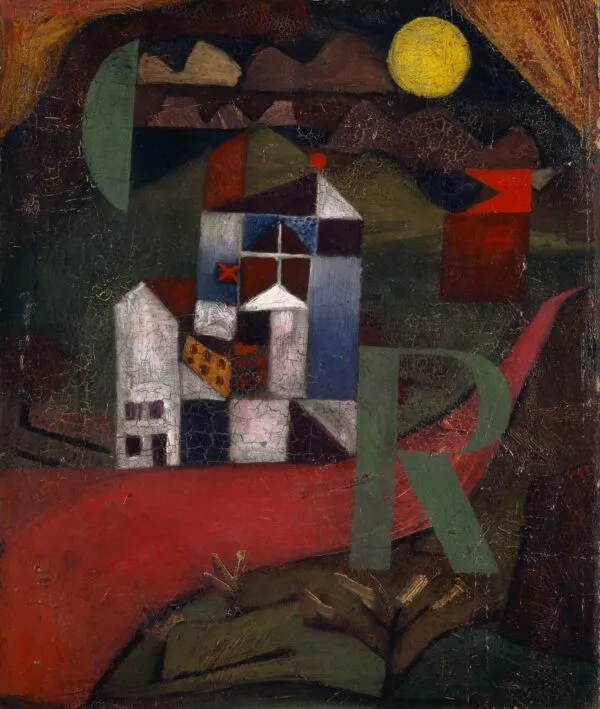
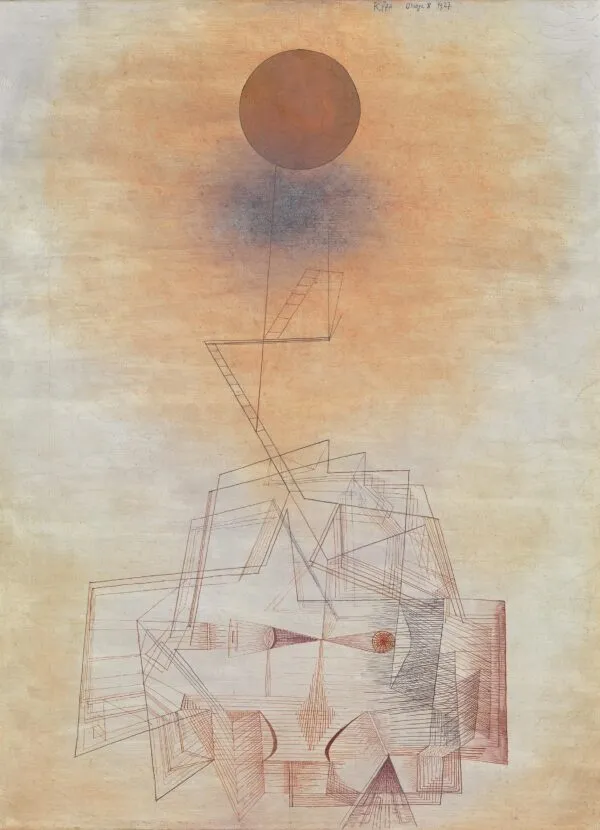
If you prefer geometry, look at Limits of Reason, with a red sphere above a tangle of fine lines. Variations (Progressive Motif) offers bands of tiny strokes under a musical title, and Rotating House shows a house that seems to spin around its own centre.
More angels, houses and colour grids wait on our Paul Klee page, which gathers the famous Paul Klee paintings we make to order.
How do we hand-paint this angel on canvas?
Klee’s original is a watercolour on a single sheet of paper. Ours is an oil painting reproduction on canvas: the painter works in oil or acrylic, in the size you choose, so the small sheet becomes a painting that hangs on your wall like any other. Choose oil and you get deep, soft tones.
He begins by drawing the outlines of the head, the triangle and both arms in thin lines, because the tilt of the face has to stay exactly as Klee set it. Then, in several thin layers, he lays in the brownish ground, the violet-blue triangle and the dark lower half, and only at the end adds the pink face, the yellow hair, the blue-grey eyes and the red mouth.
Which size fits which wall?
In short: 31 x 42 or 40 x 55 cm for the wall beside a bedside table, a shelf or a narrow strip next to a window, 45 x 65 and 60 x 81 cm above a bed or a desk, 77 x 107 and 85 x 125 cm above a sofa or a sideboard, and 110 x 152 or 136 x 193 cm for a tall empty wall, a hallway or a stairwell.
We paint this angel in 8 upright sizes (width x height): 31 x 42, 40 x 55, 45 x 65, 60 x 81, 77 x 107, 85 x 125, 110 x 152 and 136 x 193 cm. The original measures 20.8 x 29.4 cm (width x height), so even our smallest size is larger than Klee’s sheet, and the largest enlarges it more than six times. The little watercolour becomes a painting that can hold a whole wall.
As a painting for the living room it works best at 85 x 125 or 110 x 152 cm, where the contrast between the light top and the dark bottom really shows.
Can I order another size or a frame?
Of course. If your wall needs other proportions, we arrange the angel so that the head, both arms and the triangle stay whole, and adjust only the brownish ground at the edges; the figure stays as Klee drew it. Send us your own measurements and we will reply with a price and a delivery time.
The angel can travel to you rolled, stretched on a stretcher bar or already in its frame.Our workshop in Slovenia does the stretching and framing and protects each painting for the journey. Our 3D app lets you try out frame mouldings, and that is all it does; a view of the painting on your own wall is a separate service.
When will the angel arrive?
Work begins the day you confirm your order, and the angel is ready to leave us within 15 to 45 working days.Before we pack it, we show you a photograph of the finished painting, and if you want anything changed, we change it.
No customs duty applies inside Slovenia or anywhere else in the EU, and every order is protected by our returns policy.
A gentle angel is a lovely gift for the birth of a child, a new home or anyone who likes Klee. If you do not know their wall, give them a wall art voucher and let them choose the size themselves.
Frequently asked questions
Which museum holds the original?
The Zentrum Paul Klee in Bern, Switzerland, close to where Klee was born.
What can I see in it?
A childlike angel with yellow hair, blue-grey eyes and an outstretched arm, above a dark, smudged lower half.
Will I receive a print?
No. You receive a hand-painted copy, worked with brushes on canvas in oil or acrylic.
How small is Klee’s original?
Just 29.4 x 20.8 cm (height x width); our sizes go up to 136 x 193 cm.
Could you paint the angel in a size you do not list?
Yes. Tell us the width and height you need, and we will send you a price and a delivery time.
How long will I wait for my painting?
Between 15 and 45 working days, and you see a photograph of it before it leaves.
Is the angel a good choice for a bedroom or as a present?
Yes. The soft colours and the childlike face suit a bedroom, and as a present it fits a new baby or a housewarming.
Why is the angel groping?
The title says it is still feeling its way; Klee gave his late angels a childlike look, and this one reaches out like a child unsure of its step.
- Subject: a childlike angel with a round pink face, yellow hair, a violet-blue triangle and an outstretched arm.
- Original: watercolour on paper, 1939, 29.4 x 20.8 cm, Zentrum Paul Klee, Bern.
- Ours: a Paul Klee reproduction hand-painted on canvas in oil or acrylic, 8 upright sizes from 31 x 42 to 136 x 193 cm, or made to measure.
- Worth knowing: Klee painted 28 angels in 1939 and four more in 1940, the year of his death.