



Description
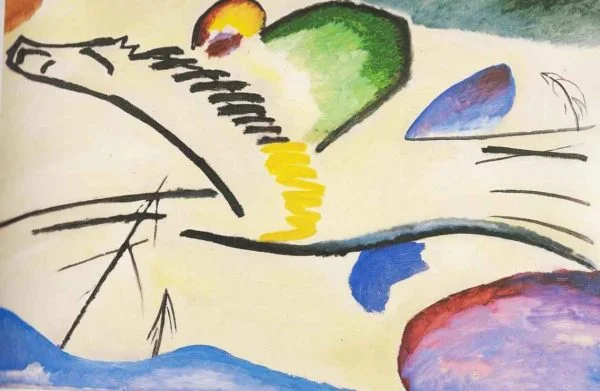
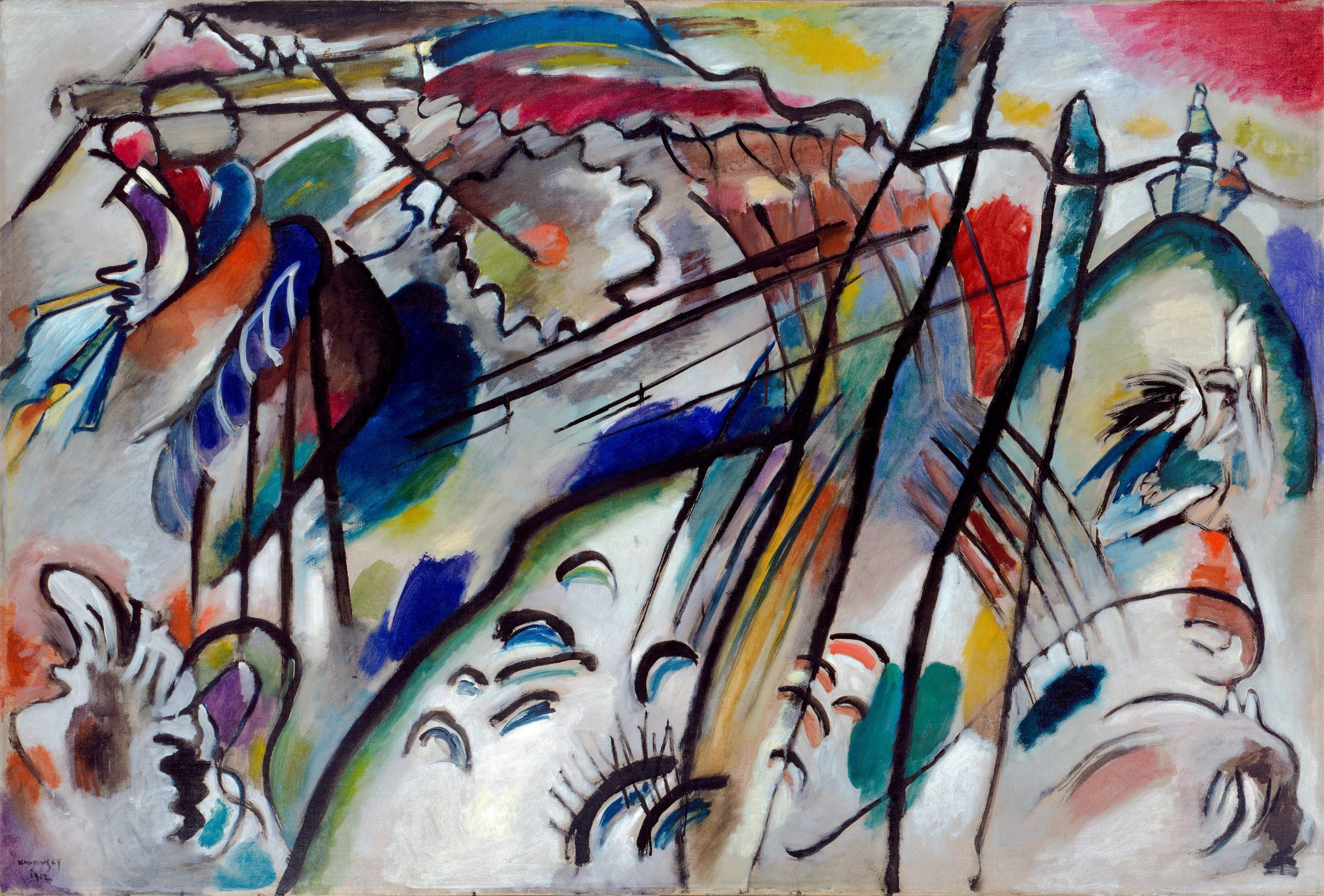
Improvisation 28 (second version) is a painting by Wassily Kandinsky from 1912: a wide canvas on a light ground, crossed by strong black lines, with blue, dark and wavy forms crowding on the left and a green arc with small towers rising on the right. The original is held by the Solomon R. Guggenheim Museum in New York. We make it as a hand-painted reproduction in oil on canvas, in eight sizes or made to measure, and before dispatch you receive a photograph of the finished work to approve.
| Title: | Improvisation 28 (second version) |
| Other titles: | Improvisation 28 (zweite Fassung) |
| Painter: | Wassily Kandinsky (1866–1944) |
| Year: | 1912 |
| Original size: | 162.5 cm x 112.6 cm |
| Original technique: | Oil on canvas |
| Style: | Expressionism (Der Blaue Reiter) |
| Location: | Solomon R. Guggenheim Museum, New York (inv. no. 37.239) |
| Our reproduction: | hand-painted oil on canvas, 8 sizes from 60 x 40 cm to 200 x 140 cm, made to measure on request |
Improvisation 28 (second version) – Wassily Kandinsky
What can be seen in the painting?
The ground is light, a greyish white, and thick black lines run across it, some straight and slanting, others winding. On the left a dense group of forms crowds together: a blue ladder-like form with white arcs, a dark brown mass and a deep blue patch, and higher up colourful, feather-like sweeps. At the upper left a black line breaks into a peak, and along the top edge run bands of blue, crimson and pink and a jagged black line. Through the middle a bundle of parallel black lines rises to the right. On the right a large green-blue arc spans, two small towers stand on it, and inside it a pale form gathers among black strokes. At the upper right is a pinkish red patch, with a violet one at the edge. Along the bottom small black arcs with blue shadows follow one another, and at the lower left are white, black-edged wavy forms. In the bottom left corner are the signature and the year.
Deluge on one side, salvation on the other?
That is how the museum reads it. According to its record, Kandinsky set catastrophe on one side of the canvas and the paradise of spiritual salvation on the other, by highly schematised means. On the left appear a boat and waves, signalling the great flood, a serpent and perhaps cannons; on the right an embracing couple, a shining sun and celebratory candles. As an abstract painting it shows nothing literally, but with the museum’s record in mind the white wavy forms at the lower left can be read as waves and the upright lines on the right as candles. According to the museum, Kandinsky’s Sketch for Composition II has the same division; the same museum holds it.
The rider and the Apocalypse
The museum places the painting in a wider context. For Kandinsky the horse-and-rider motif stood for his crusade against conventional aesthetic values and his dream of a more spiritual future through art. The rider appears in many woodcuts, temperas and oils, from its first appearance in his folk-inspired paintings made in his native Russia at the turn of the century to the abstracted landscapes he painted in Munich in the early 1910s, and on the covers of his book On the Spiritual in Art of 1911 and of the Blue Rider Almanac, which he co-edited with Franz Marc. In 1909, the year he completed Blue Mountain, he painted at least seven other canvases with riders; his style grew increasingly abstract and expressionistic, and his themes shifted from natural events to apocalyptic narratives. By 1910 many works drew on the Revelation of St John: the rider came to signify the Horsemen of the Apocalypse, who bring destruction on an epic scale, after which the world is redeemed.
What is an Improvisation?
In his book On the Spiritual in Art Kandinsky distinguished three kinds of his paintings: Impressions, Improvisations and Compositions. He described Improvisations as largely unconscious, spontaneous expressions of inner processes, that is, impressions of inner rather than outer nature. Improvisation 28 is such an expression, yet, as the museum’s record shows, it has a clear structure: danger on the left, rescue on the right.
How did the painting come about?
A study came before it. The same museum owns the Study for Improvisation 28 (Second Version) of 1912, watercolour, ink and graphite on paper, 39 x 56.1 cm. The painting itself is registered in the museum’s founding collection under inventory number 37.239.
How is our hand-painted version made?
The painter works from a high-resolution reference and builds the painting up in layers, with brush and oil paint. With this subject what matters is the black line: it has to be thick and rich yet mobile, as if drawn in one sweep, and the colour patches have to stay light and translucent so that the pale ground breathes through them. An oil painting reproduction keeps its colours for many years, because oil does not fade the way a print does. Since every reproduction is made individually, no two copies match down to the last detail; the subject, the proportions and the colours do.
Which size for which wall?
The original measures 162.5 x 112.6 cm; at our 162 x 111 cm size the width is 5 mm less and the height 16 mm less. As a painting for the living room it works best at 120 x 80 or 140 x 100 cm, where the black lines have room enough. The 60 x 40 and 70 x 50 cm sizes suit a desk or a hallway, 90 x 60 and 100 x 70 cm a bedroom, and 200 x 140 cm a very large wall. Because the work is wide, it looks good above a sofa or a chest of drawers.
Custom sizes, stretcher and frame
If none of the eight sizes fits your wall, we paint this Kandinsky reproduction to your measurements; that is our painting made to measure, and we tell you how the composition adapts to the new proportions. Every canvas is stretched on a wooden stretcher. A frame is optional and not included in the base price.
Delivery and guarantee
Because every painting on canvas is painted only after the order, in our studio in Slovenia, allow 15 to 45 days depending on the size you choose. We ship protected, insured and tracked, within the EU without customs. If anything is wrong on arrival, get in touch and we will put it right. All our works by Kandinsky are collected in the Wassily Kandinsky gallery, and the painter is introduced in our article about Wassily Kandinsky. Related works we paint include Improvisation 19 and All Saints I.
Frequently asked questions
Where is the original?
In the Solomon R. Guggenheim Museum in New York, where it belongs to the museum’s founding collection under inventory number 37.239. The museum’s record is on the Guggenheim website.
How big is the original?
It measures 162.5 x 112.6 cm. We give the width first; the museum puts the height first, 112.6 x 162.5 cm. At our 162 x 111 cm size the width is 5 mm less and the height 16 mm less.
When was the painting made?
In 1912. The signature Kandinsky and the year 1912 are in the bottom left corner.
What does the painting show?
According to the museum, catastrophe and salvation at once: on the left a boat, waves, a serpent and perhaps cannons, on the right an embracing couple, the sun and candles, all in black lines and patches of colour.
Is this a print?
No. It is a canvas painting, painted by hand in oil; the brushstrokes show in raking light and can be felt with the fingertips.
Which size should I choose?
For a living room 120 x 80 and 140 x 100 cm work best, for a desk or hallway 60 x 40 or 70 x 50 cm. Before deciding, tape a sheet of paper of the chosen size to the wall and leave it there for a day.
Can I have a size that is not on the list?
Yes. We also paint sizes outside the list and tell you how the forms will be arranged.
How is it delivered?
Insured and tracked, within the EU without customs. Before dispatch you receive a photograph of the finished painting to approve.
What is the Blue Rider Almanac?
According to the museum, a book Kandinsky co-edited with Franz Marc; its cover shows a rider, the motif with which Kandinsky expressed his hope for a more spiritual future.
Is the original for sale, and what is it worth?
It is not for sale and has no market price. It belongs to a public museum collection and stays there; what we offer is a hand-painted copy, not the original, and we never confuse the two.
Is the painting suitable as a gift?
Yes, especially for someone who loves strong lines and vivid colour. If you are unsure about the subject or the size, there is a gift voucher, and the choice stays with the person who receives it.
- Subject: black lines and patches of colour on a light ground; according to the museum, catastrophe on the left and salvation on the right
- Original: Solomon R. Guggenheim Museum, New York, inv. no. 37.239, 1912, 162.5 x 112.6 cm
- Our version: hand-painted oil on canvas, eight sizes from 60 x 40 to 200 x 140 cm, on a wooden stretcher, framed on request
- Worth knowing: according to the museum it shares its split between ruin and salvation with Sketch for Composition II