







































Description
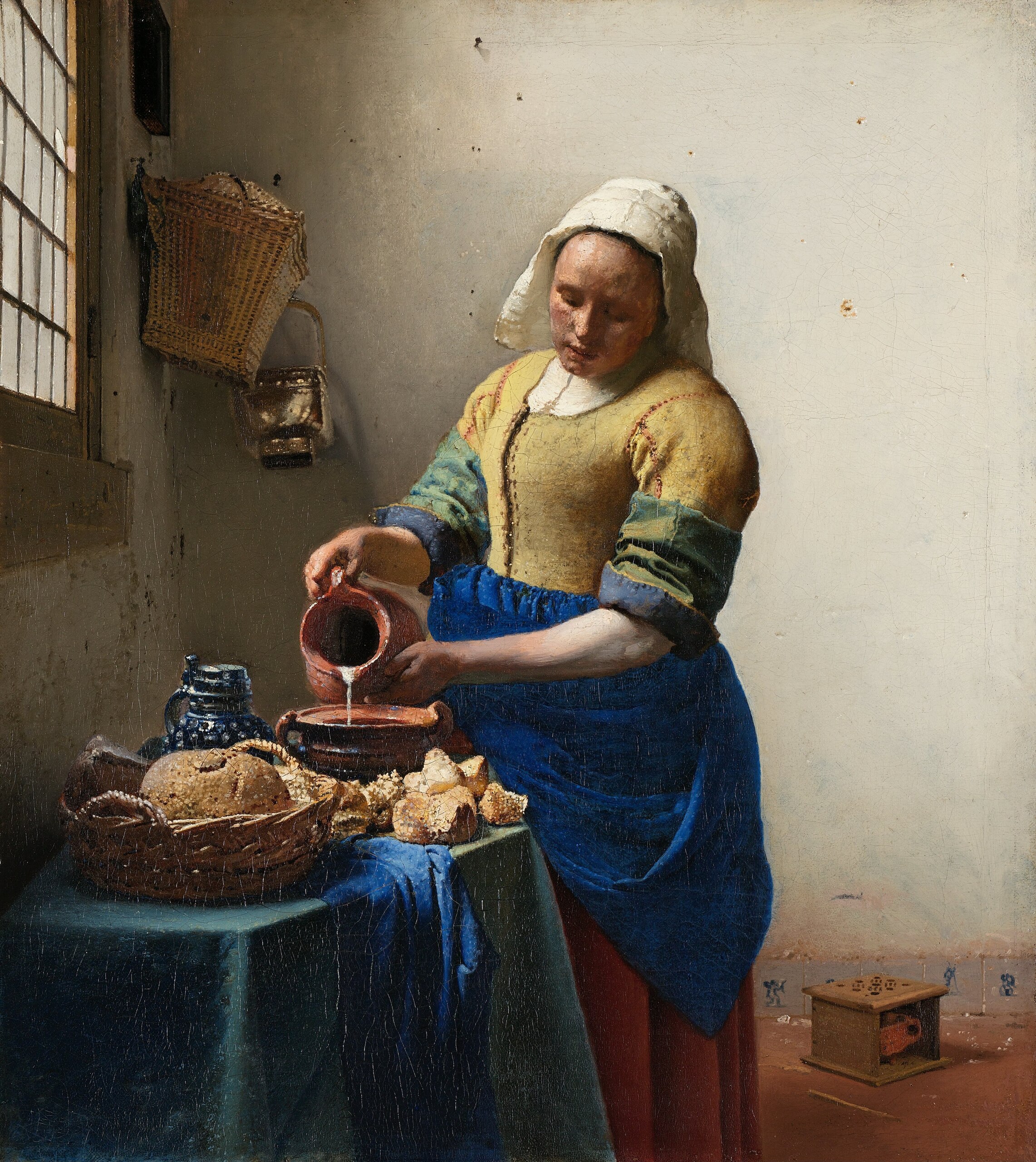
The Milkmaid is a painting by Johannes Vermeer from around 1660: a young kitchen maid in a white linen cap, a yellow bodice and a blue apron stands by a window and slowly pours a thin stream of milk from a red earthenware jug into a low bowl, while on the table before her lie a basket of bread, broken bread and a blue stoneware jug. The original, oil on canvas, is 45.5 cm high and 41 cm wide and belongs to the Rijksmuseum in Amsterdam. Our painter paints it for you in oil on canvas, in one of 8 portrait sizes between 43 x 47 and 163 x 180 cm or to your own measurement, and you receive a photograph of the finished painting before dispatch.
| Title: | The Milkmaid |
| Other titles: | Het melkmeisje · Die Dienstmagd mit dem Milchkrug |
| Painter: | Johannes Vermeer (1632–1675) |
| Year painted: | c. 1660 |
| Original size: | 45.5 cm x 41 cm (height x width) |
| Original technique: | Oil on canvas |
| Painting style: | Baroque, Dutch Golden Age |
| Located at: | Rijksmuseum, Amsterdam (inv. SK-A-2344) |
| Our reproduction: | Hand-painted oil on canvas, 8 sizes or made to measure |
The Milkmaid – Johannes Vermeer
What does The Milkmaid show?
Vermeer takes us into a plain kitchen. A sturdy young woman stands at a table, holds a red earthenware jug in both hands and carefully pours milk into a squat bowl. The stream is as thin as thread, and all her attention is on it.
She wears a white linen cap, a yellow bodice with green work sleeves pushed up to the elbows, and a blue apron tied over a red skirt. A blue-green cloth covers the table; on it stand a basket of bread, pieces of broken bread and a blue stoneware jug.
Light comes in through the window on the left and slides across the bare wall. A wicker basket and a brass bucket hang there, and low on the floor at the back you can make out a wooden foot warmer and a row of Delft tiles.
What does this quiet scene mean?
Despite the title, this woman did not milk cows. She was a kitchen maid, a maid-of-all-work in the household, and here she is doing one of the daily jobs of the kitchen.
What is unusual is how Vermeer presents her: with dignity and calm. In his day maids were often painted as figures of fun or objects of desire; he simply lets her be absorbed in her work.
Part of her face lies in shadow, so her expression stays open. You can read concentration in it, or quiet thought; the painter leaves the choice to the viewer.
Why is The Milkmaid so loved?
The Rijksmuseum counts it among its finest attractions. Nothing remarkable happens on a few dozen centimetres of canvas, there is only work, light and stillness, and yet it is hard to look away.
Johannes Vermeer (1632–1675) lived and painted in Delft. He is known for quiet interiors lit by daylight from the left and for small canvases; only a few dozen of his works are known today. The Milkmaid gathers all of that into a small space.
If you would like to read more about the work, the Wikipedia article (in English) has the details.
Where is the original kept?
The original is in Amsterdam, in the collection of the Rijksmuseum, under object number SK-A-2344. The canvas measures 45.5 cm in height and 41 cm in width, so it is small, like most of Vermeer’s works.
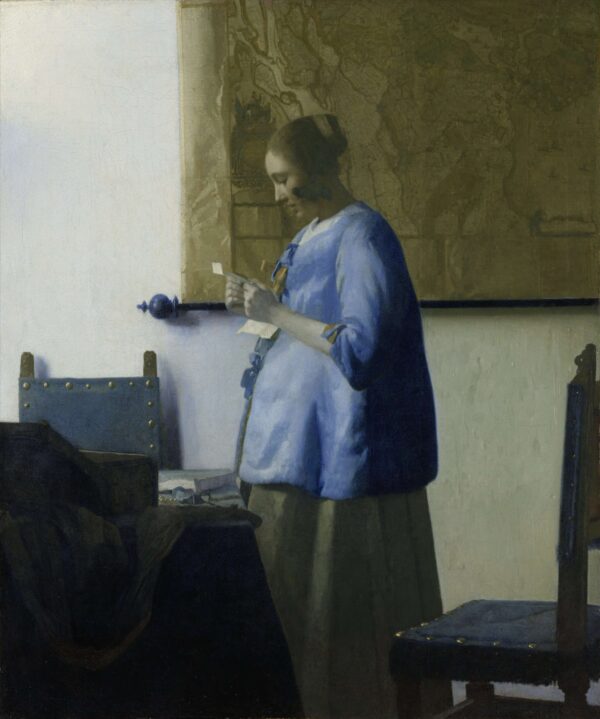
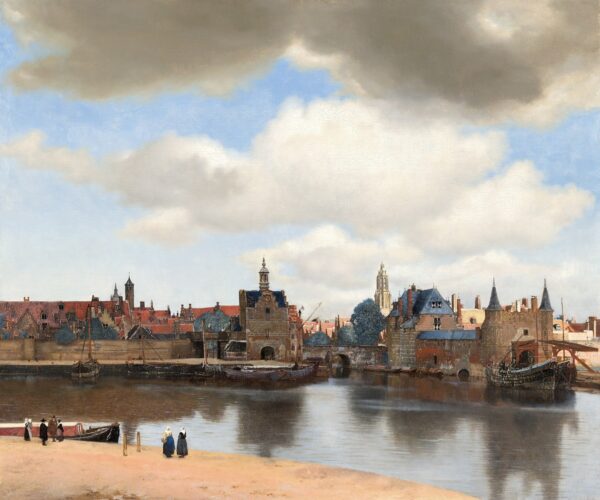
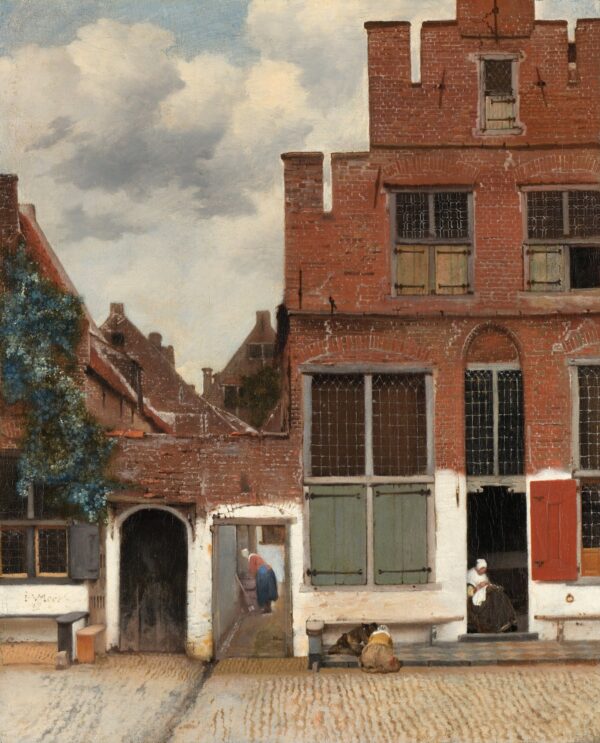
The same museum also holds Woman in Blue Reading a Letter and The Little Street, so on a visit to Amsterdam you can see all three in one day.
The Milkmaid or another Vermeer?
This one belongs in rooms where people cook, eat and talk: a kitchen, a dining room or the hallway next to them. The scene is calm and warm, so it sits comfortably in a bedroom too.
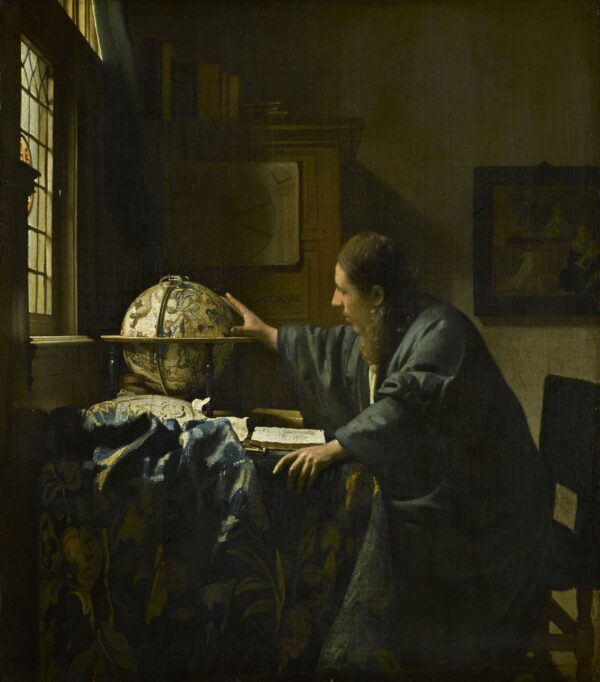
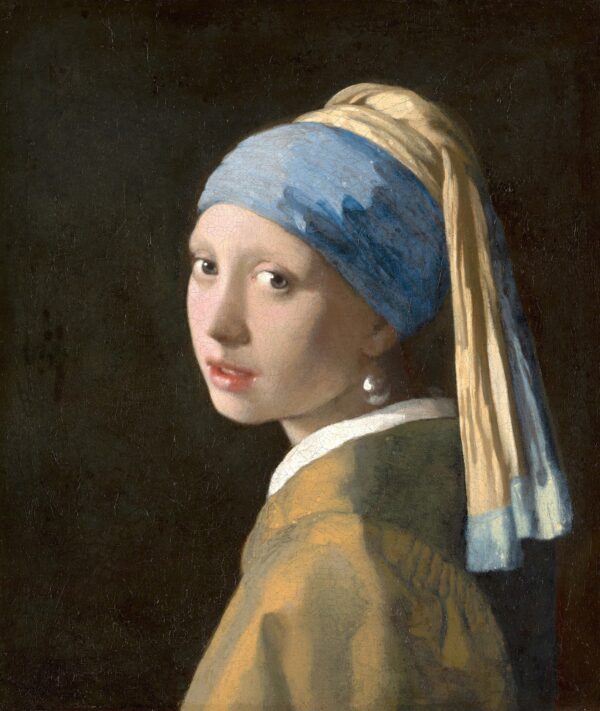
If you would rather have a single face turning towards you, choose Girl with a Pearl Earring. For a study or a library, the scholar by the window reaching for a celestial globe suits better: The Astronomer.
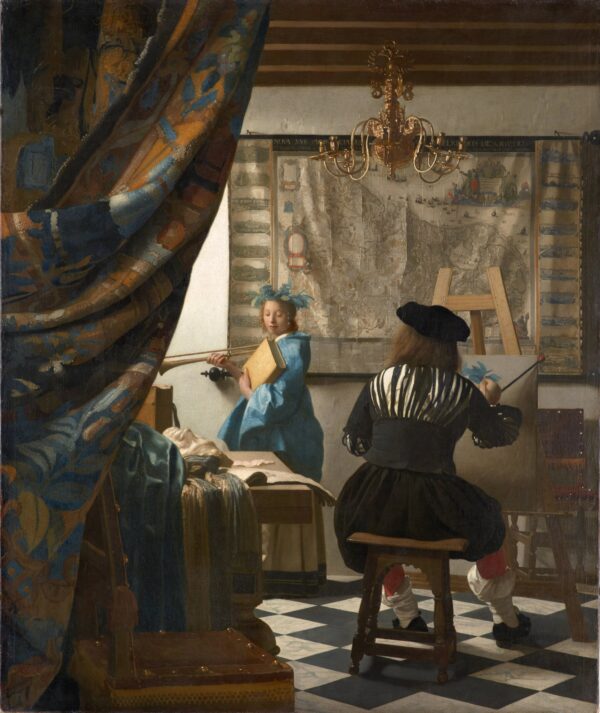
The Johannes Vermeer page gathers all the famous Vermeer paintings we paint to order.
How does our painter paint your Milkmaid?
We start each Milkmaid only once it is ordered, in oil on canvas, layer by layer. First the painter sets out light and dark: the lit wall by the window, the darker edge of the room and the figure standing between them.
Then he builds up the colours of the clothes, yellow, blue and red, and balances them so that they stay clear without turning loud. He lingers longest at the table: on the crust of the bread, the woven rim of the basket and the thin stream of milk, which has to flow rather than stand still.
A Vermeer reproduction made like this carries brush marks and a depth of colour that a print does not reach. An oil painting reproduction also changes with the light in the room, because the layers of paint take morning and evening light differently.
Which size for which wall?
In short: 43 x 47 or 50 x 55 cm for a kitchen or a narrow wall, 68 x 75 or 75 x 85 cm above a sideboard or in a dining room, 98 x 104 or 109 x 120 cm above a sofa, and 125 x 140 or 163 x 180 cm for a large wall.
There are 8 portrait sizes (width x height): 43 x 47, 50 x 55, 68 x 75, 75 x 85, 98 x 104, 109 x 120, 125 x 140 and 163 x 180 cm. The smallest, 43 x 47 cm, comes closest to the original: it is 2 cm wider and 1.5 cm taller.
So our smallest sizes are close to the original’s scale, while the larger ones turn the small scene into a wall piece. As a painting for the living room above a sofa, 98 x 104 or 109 x 120 cm works well; hang it so that the bowl of milk is roughly at eye level.
Can I choose another size or a frame?
Yes. The original is roughly 9 : 10 in proportion, almost square, so we can also paint it in a size that is not on the list without losing the basket or the jug at the edges. Give us the width and height you have in mind, and we will come back with a price and a delivery date.
We ship your Milkmaid rolled, stretched on a stretcher bar or framed. Our workshop in Slovenia does the stretching and framing, as it does for every canvas painting we send out. The frame is picked in our 3D application, a tool made for frame choice alone; a view of the painting on your own wall is a different service.
A narrow gold frame suits the warm yellows and reds, while plain dark wood goes with the quiet wall behind her.
When will the painting be with me?
We start painting as soon as your order arrives, and within 15 to 45 working days the painting is ready to ship. Before dispatch we send you a photograph of the finished work; if you would like anything different, we correct it.
It travels customs-free within Slovenia and to every other EU country, and our returns policy applies to every order.
The Milkmaid makes a lovely gift for someone who enjoys cooking or loves old Dutch art. If you would rather leave the size to them, give a wall art voucher.
Frequently asked questions
Where can I see the original?
In the Rijksmuseum in Amsterdam, where it has the object number SK-A-2344.
What is the woman pouring?
Milk, from a red earthenware jug into a low bowl on the table.
Was she really a milkmaid?
Not in the sense of someone who milked cows: she was a kitchen maid who did every kind of housework.
Is it a print?
No. Every Milkmaid we make is a hand-painted copy, done with a brush in oil paint on canvas.
How big is the original?
It is 45.5 cm high and 41 cm wide; our smallest size, 43 x 47 cm, is very close to it.
Which size suits a kitchen?
For a kitchen wall or the corner by a dining table, 50 x 55 or 68 x 75 cm works well.
Can I order it in my own size?
Yes. Give us the width and height, and we will send you a price and the time needed.
How long does it take?
From 15 to 45 working days; before dispatch you receive a photograph of the finished painting.
- Subject: a kitchen maid by a window pours milk from a red jug into a bowl, with bread, a basket and a blue jug on the table.
- Original: c. 1660, oil on canvas, 45.5 x 41 cm, Rijksmuseum, Amsterdam.
- Ours: painted by hand in oil on canvas, in 8 portrait sizes from 43 x 47 to 163 x 180 cm or made to measure.
- Worth knowing: Vermeer painted the maid with dignity, which was unusual for a servant in his time.