







































Description
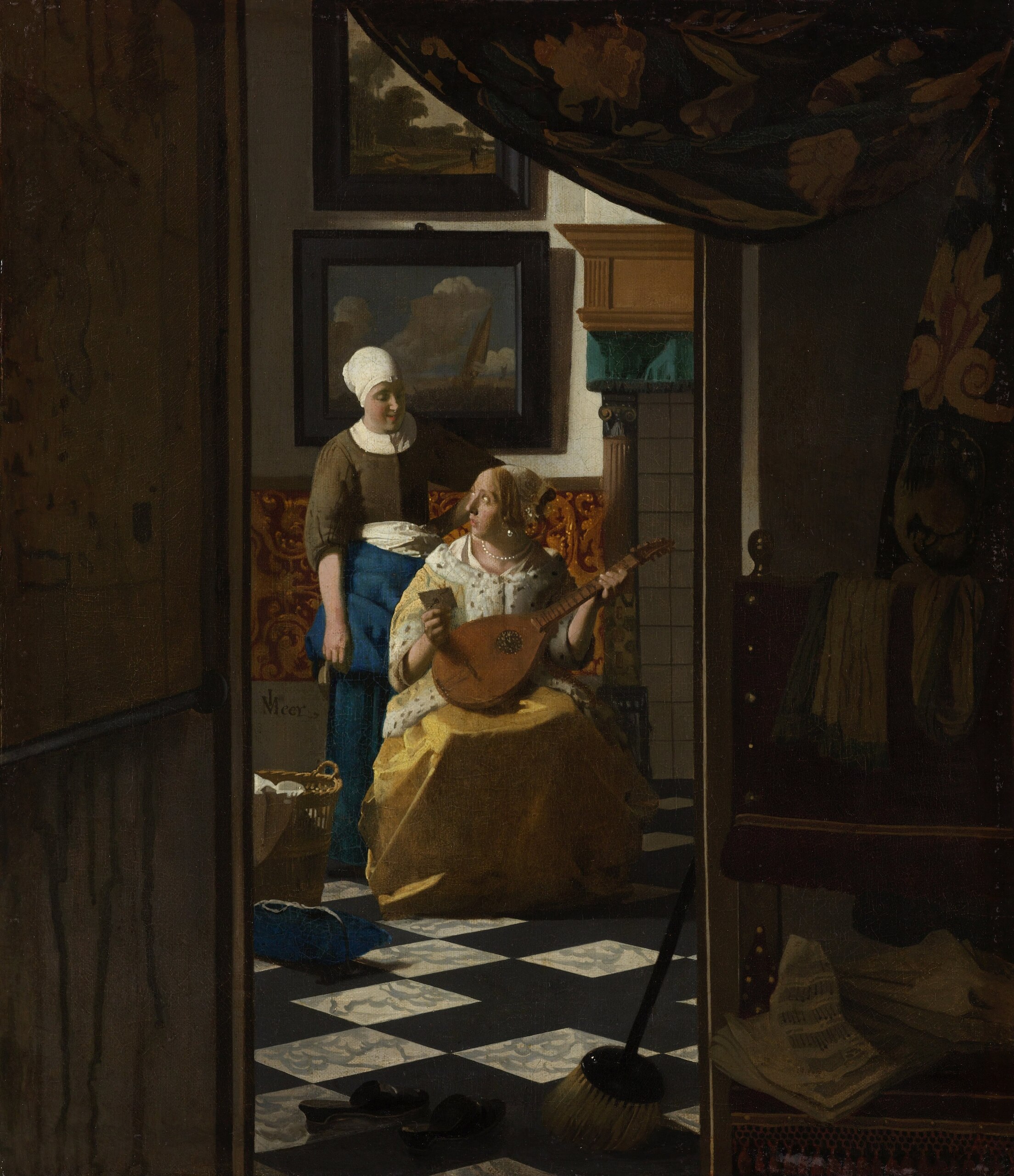
The Love Letter is a painting by Johannes Vermeer from about 1669–1670: through a dark doorway, past a curtain tied up to one side, we look into a bright room where a maid hands a letter to her mistress, who sits with a cittern in her lap and looks up at her. The original, oil on canvas, is 44 cm high and 38.5 cm wide and belongs to the Rijksmuseum in Amsterdam. Our painter paints it for you in oil on canvas in one of 8 portrait sizes from 45 x 50 to 172 x 200 cm, or to your own measurements, and before it leaves us you see it in a photograph.
| Title: | The Love Letter |
| Other titles: | De liefdesbrief · Der Liebesbrief |
| Painter: | Johannes Vermeer (1632–1675) |
| Year painted: | c. 1669–1670 |
| Original size: | 44 cm x 38.5 cm (height x width) |
| Original technique: | Oil on canvas |
| Painting style: | Baroque, Dutch Golden Age |
| Located at: | Rijksmuseum, Amsterdam (inv. SK-A-1595) |
| Our reproduction: | Hand-painted oil on canvas, 8 sizes or made to measure |
The Love Letter – Johannes Vermeer
What does The Love Letter show?
Vermeer places us in a dim front room. An open doorway lies ahead, a heavy curtain beside it is tied up out of the way, and through the opening we see into the bright room beyond.
There a lady in a golden-yellow dress sits with a cittern, a stringed instrument rather like a lute, resting in her lap. She looks up at the maid standing beside her, who has just handed her a letter. Vermeer catches the very moment the letter changes hands.
The floor is laid with black and white tiles that run in slanting rows into the depth of the room. On the threshold in the foreground a broom and a pair of slippers have been left behind, and on the wall behind the two women hang two paintings, one of the sea and one of a landscape.
What story does the scene tell?
The title tells us it is a love letter, yet the sender is nowhere in the painting and the words cannot be read. All we are shown is the handing over and the look the two women exchange.
The instrument in her lap suggests the lady was playing when the maid came in. The broom and slippers on the threshold also look as though someone set them down in a hurry because something more pressing turned up.
The curtain and the dark door frame keep us outside. We feel we have glimpsed, by chance, a private moment that was never meant for us, and that makes the scene both intimate and mysterious. What the letter says is for each viewer to imagine.
Why is this painting so well known?
Vermeer usually brings his figures close to us; here he pushes them far back. We stay in the shadow while the women are in the light, and that contrast between the two rooms gives the composition an unusual depth.
Johannes Vermeer (1632–1675) worked in Delft all his life and left only a few dozen canvases. Letters turn up more than once in his interiors, but here we follow the event through a doorway from the next room.
The English Wikipedia article tells the story of the painting in more detail.
Where is the original of The Love Letter?
The original belongs to the Rijksmuseum in Amsterdam, where its object number is SK-A-1595. The canvas is 44 cm high and 38.5 cm wide, so it rewards a close look.
The same museum also holds Vermeer’s view of the houses of Delft, The Little Street, so you can see both on a single visit.
The Love Letter or another Vermeer?
The Love Letter suits the quieter corners of a home: a hallway, a bedroom or the armchair where you like to read. Because it tells the story of a letter, it is also a good choice for a couple marking an anniversary.
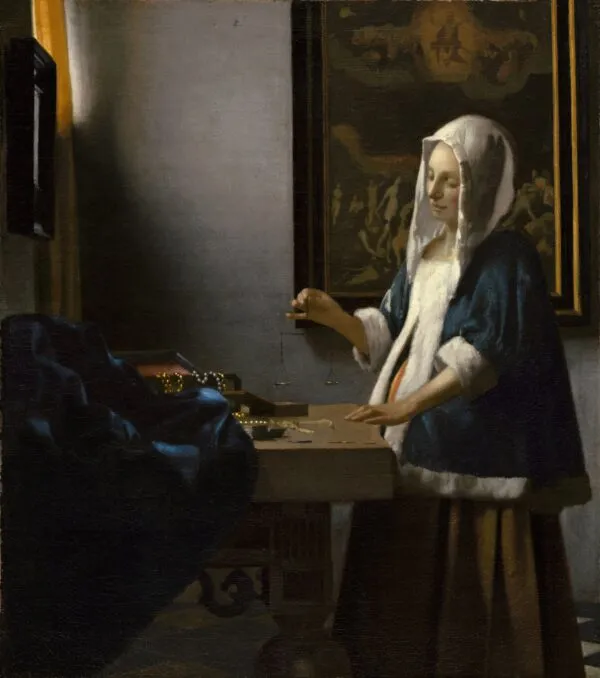
If the same theme appeals in a quieter key, choose Woman in Blue Reading a Letter, where the woman is alone with her letter. Window light and a careful task at a table come with Woman Holding a Balance, while a livelier early scene from 1656, again with a cittern, is The Procuress.
Every Vermeer reproduction we offer, among them the most famous Vermeer paintings and his views of Delft, is on the Johannes Vermeer page.
How does our painter paint your Love Letter?
Your Love Letter is begun only once you order it, in oil on canvas and layer by layer. First the painter lays in the dark frame of the front room and the bright opening of the door, because the whole painting lives on that contrast.
Next he draws the floor so that the black and white tiles recede correctly, and shapes the folds of the curtain. Only then come the women: the golden-yellow dress, the two faces turned towards each other, the hands with the letter and the strings of the cittern.
A hand-painted surface carries brush marks that a print lacks. An oil painting reproduction also catches the light in the room, so the golden dress looks different in the morning than in the evening.
Which size for which wall?
In short: 45 x 50 or 50 x 60 cm for a hallway or beside a bedside table, 64 x 76 or 80 x 96 cm above a chest of drawers or a desk, 90 x 107 or 120 x 140 cm above a sofa, and 135 x 160 or 172 x 200 cm for a large empty wall.
There are 8 portrait sizes (width x height): 45 x 50, 50 x 60, 64 x 76, 80 x 96, 90 x 107, 120 x 140, 135 x 160 and 172 x 200 cm. The smallest, 45 x 50 cm, is closest to the original: 6.5 cm wider and 6 cm taller.
Because the women are far back in the room, the scene looks delicate on a small canvas; in a larger size the tiles, the curtain and the faces read clearly from across the room. As a painting for the living room above a sofa, 90 x 107 or 120 x 140 cm works well.
Can I choose another size or a frame?
Yes. The original is in a 7 : 8 proportion, so we can paint it in a size that is not on the list without cutting off the curtain or the broom at the edges. Send us the width and height you need for your Love Letter, and we will reply with a price and a date.
We ship your Love Letter rolled, stretched on a stretcher bar or framed. Our workshop in Slovenia does the stretching and framing, as it does for each canvas painting we send. Frames are picked in our 3D application, a tool for choosing the frame only; a view of the painting on your own wall is a separate service.
A dark wooden frame echoes the dark door frame in the painting, while a slim gold moulding brings out the lady’s dress.
When will The Love Letter arrive?
We start painting as soon as your order comes in, and the painting is ready to ship within 15 to 45 working days. Before dispatch you receive a photograph of your finished Love Letter; if you would like something changed, we change it.
No customs are charged on the letter scene within Slovenia or to any other EU country, and our returns policy applies.
A painting about a letter is a fine gift for an anniversary or for someone who still likes to write letters by hand. When the size is better left to the person receiving it, choose a wall art voucher.
Frequently asked questions
Which museum has the original?
The Rijksmuseum in Amsterdam, under object number SK-A-1595.
Who are the two women?
A mistress with a cittern in her lap and the maid who has brought her the letter.
What does the letter say?
Nobody knows; the title only tells us it is a love letter, and the rest is up to you.
Is it a print?
No, every painting we make is a hand-painted copy in oil paint on canvas.
How big is the original?
It is 44 cm high and 38.5 cm wide; our smallest size is 45 x 50 cm.
Which size suits a bedroom?
Above a bed, 64 x 76 or 80 x 96 cm looks good; beside a bedside table, 45 x 50 cm.
Can I order a different size?
Yes, tell us the width and height and we will send you a price and a delivery time.
How long will I wait?
From 15 to 45 working days, and before dispatch you see your painting in a photograph.
- Subject: through a doorway we see a maid handing a letter to her mistress, who has a cittern in her lap; a black and white tiled floor, a broom and slippers on the threshold.
- Original: c. 1669–1670, oil on canvas, 44 x 38.5 cm, Rijksmuseum, Amsterdam.
- Ours: hand-painted in oil on canvas, in 8 portrait sizes from 45 x 50 to 172 x 200 cm or made to measure.
- Worth knowing: the tied-up curtain and the dark doorway make us feel we are glimpsing a private moment.