







































Description
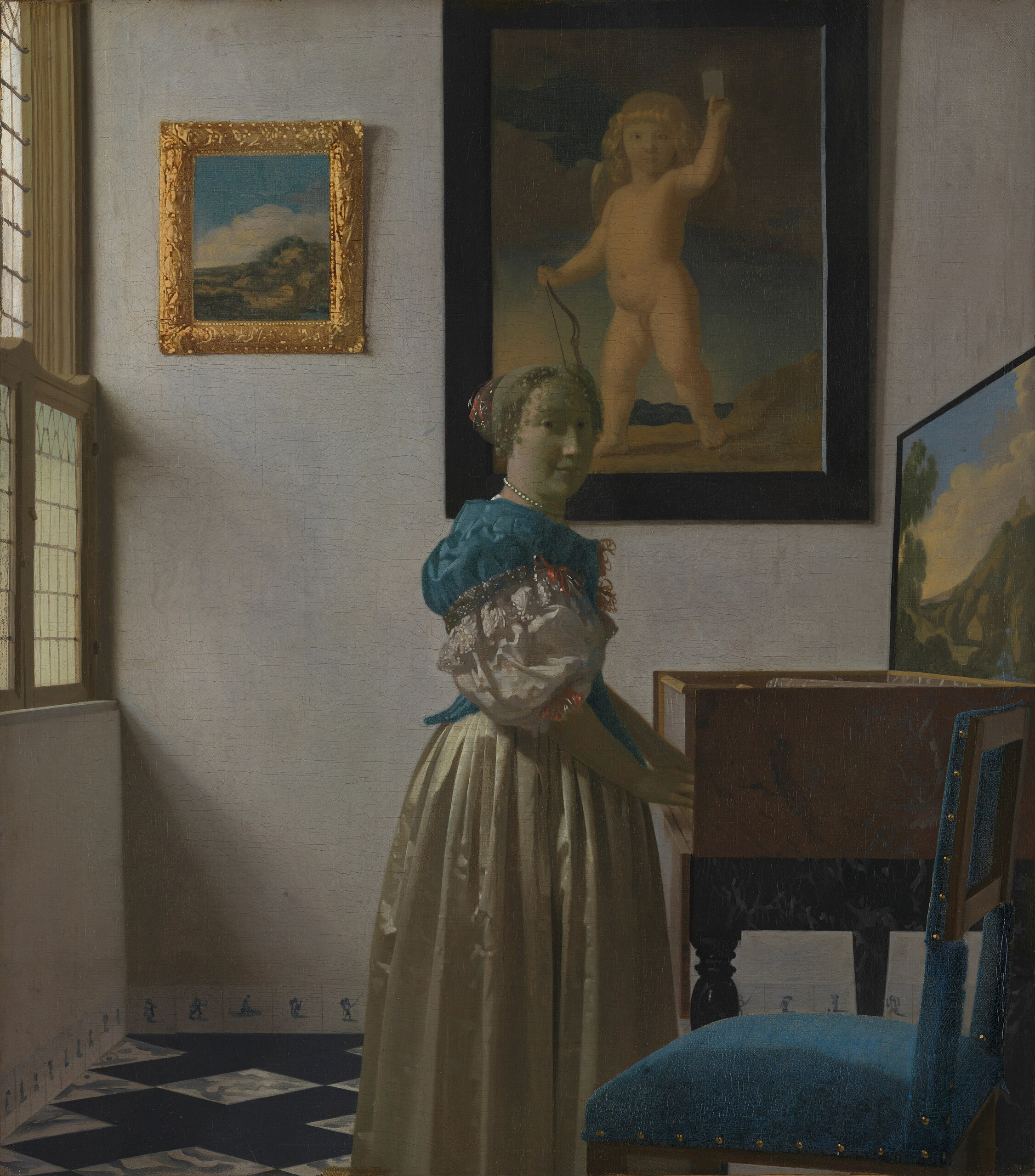
A Young Woman Standing at a Virginal is one of the late works of Johannes Vermeer, painted around 1670–1672: a richly dressed woman in blue and white satin stands at a virginal, playing, and looks straight back at us. The original, oil on canvas, is 51.7 cm high and 45.2 cm wide and belongs to the National Gallery in London. Our painter paints it to your order in oil on canvas, in one of 8 portrait sizes between 43 x 47 and 172 x 200 cm or in a size you name, and we send you a photograph of it before it leaves us.
| Title: | A Young Woman Standing at a Virginal |
| Other titles: | Lady Standing at a Virginal · Stehende Virginalspielerin |
| Painter: | Johannes Vermeer (1632–1675) |
| Year painted: | c. 1670–1672 |
| Original size: | 51.7 cm x 45.2 cm (height x width) |
| Original technique: | Oil on canvas |
| Painting style: | Baroque, Dutch Golden Age |
| Located at: | The National Gallery, London (acc. no. NG1383) |
| Our reproduction: | Hand-painted oil on canvas, 8 sizes or made to measure |
A Young Woman Standing at a Virginal – Johannes Vermeer
What do we see in A Young Woman Standing at a Virginal?
In the middle of a bright room a young woman stands at a virginal, a keyboard instrument related to the harpsichord. Her fingers rest on the keys, but she has turned her face towards us and regards us calmly.
Her gown of blue and white satin shines in the light that falls from the left, and its folds catch small glints, so that the fabric seems almost close enough to touch.
Of the two paintings on the wall behind her, the larger shows Cupid holding a card aloft; the smaller, on the left, is a landscape in a gilt frame.
A blue chair in the foreground holds the scene a little away from us. The floor is tiled, and a row of blue and white Delft tiles runs along the skirting, of a type that turns up in other Vermeer canvases as well.
What does the Cupid on the wall mean?
The paintings on the wall are not random decoration. According to the National Gallery, their authors are not certain; the landscape on the left may be by Jan Wijnants or by Allart van Everdingen.
The Cupid with the card is attributed to Caesar van Everdingen, Allart’s brother. The motif comes from a contemporary emblem.
What exactly it says is left open. It may stand for faithfulness to a single lover, or Cupid may simply answer the virginal, since music and love were traditionally linked in the painting of that age.
Why does this Young Woman at a Virginal hold a special place?
It is one of Vermeer’s last works. Scholars have dated it on grounds of style and from the costume the young woman wears, placing it around 1670–1672.
Its companion makes it more interesting still. The same London collection owns Vermeer’s Young Woman Seated at a Virginal, on a canvas of almost exactly the same size, and the two may form a pair. A recent study has shown that both canvases were cut from the same bolt of cloth, and the ground laid on them appears to be identical.
That same ground is shared by A Young Woman Seated at the Virginals, now in New York.
In 1977 David Hockney included the painting in one of his own oil paintings, Looking at Pictures on a Screen. Dating, pairing and the paintings on the wall are discussed further in the Wikipedia article (in English).
Where is the original kept?
The original belongs to the National Gallery in London, accession number NG1383. The canvas is 51.7 cm high and 45.2 cm wide, a usual, modest format for Vermeer.
In 2000 the art historian Ivan Gaskell published Vermeer’s Wager, a book structured around a detailed discussion of this very painting.
A Young Woman Standing at a Virginal or another Vermeer?
This canvas painting is at its best where music is played or listened to: beside the piano, in a music room or in a quiet reading corner.
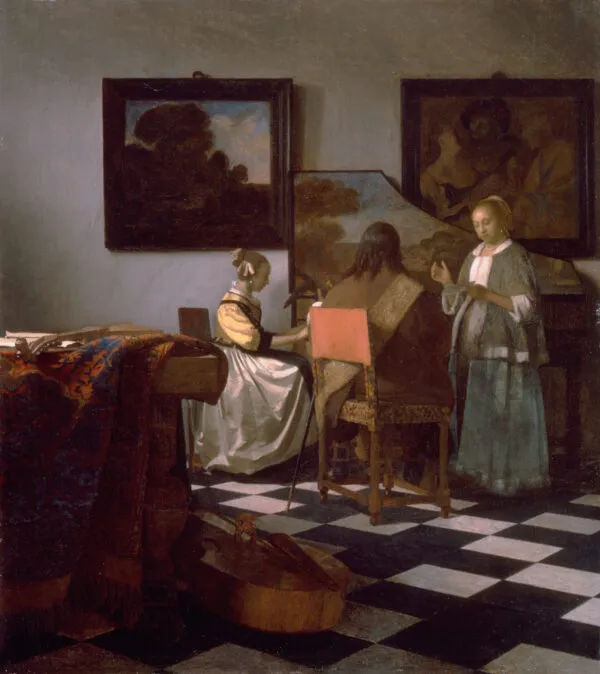
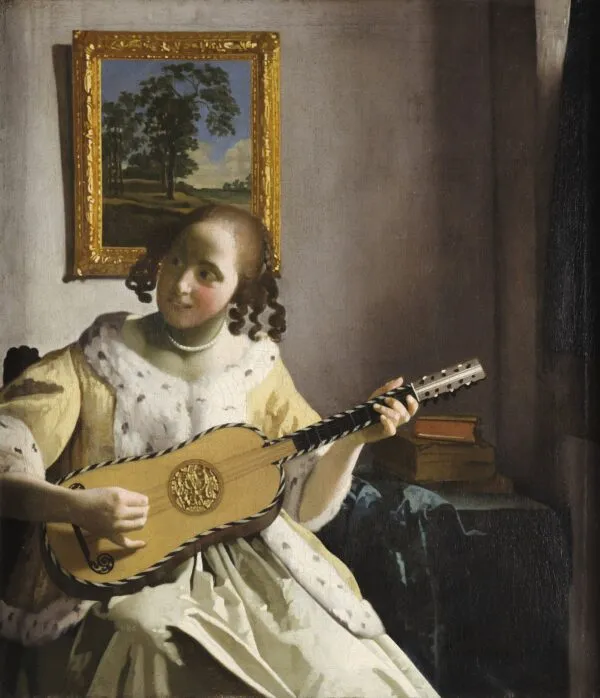
If music in Vermeer’s interiors draws you, look also at The Music Lesson, where music is again the main theme, or at Woman with a Lute, in which a young woman tunes her lute and gazes out of the window.
Our whole range of famous Vermeer paintings, from the streets of Delft to quiet rooms with women at their instruments, is gathered on the Johannes Vermeer page.
How does our painter paint your Young Woman at a Virginal?
Once the order is confirmed, the painter first lays in the basic areas: the pale wall, the darker floor and the outline of the woman at her instrument. Then he builds the painting up in oil, layer upon layer.
The satin takes the most time. The blue and white fabric has to be painted so that the light from the left kindles in it while the folds stay soft.
The small things come last: the gilt frame of the landscape, Cupid with his card, the tiles along the skirting and the blue chair in front. The result is a Vermeer reproduction with brush marks that no print has.
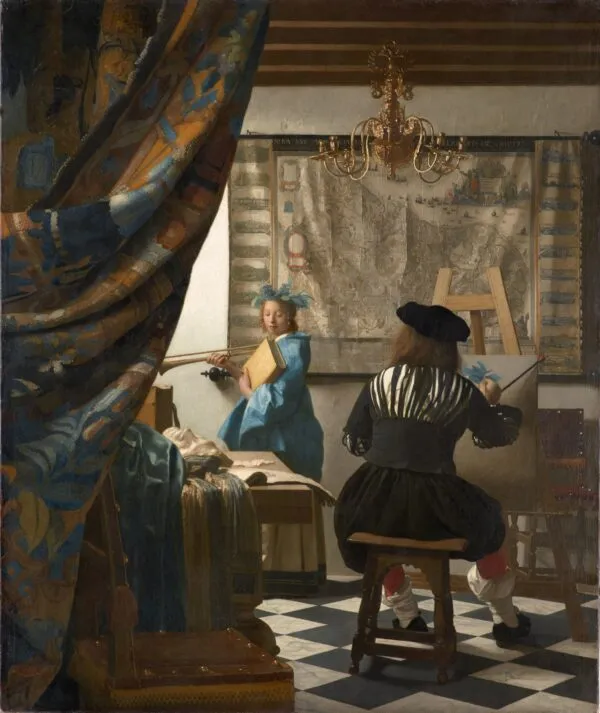
Like any oil painting reproduction, it responds to the light in your room: the blue is cool and clear by day and warms under an evening lamp. How Vermeer himself pictured a painter at work you can see in The Art of Painting.
Which size for which wall?
The short answer: 43 x 47 or 56 x 64 cm for a narrow wall or beside a piano, 64 x 76 or 72 x 85 cm above a chest of drawers or in a bedroom, 90 x 107 or 120 x 140 cm above a sofa, and 135 x 160 or 172 x 200 cm for a tall wall or a stairwell.
We paint A Young Woman Standing at a Virginal in 8 portrait sizes (width x height): 43 x 47, 56 x 64, 64 x 76, 72 x 85, 90 x 107, 120 x 140, 135 x 160 and 172 x 200 cm. The closest to the original is 43 x 47 cm, which is 2.2 cm narrower and 4.7 cm shorter.
As a painting for the living room above a sofa, 90 x 107 cm works well, hung with her face at about eye level.
Can I choose another size or a frame?
Of course. The sides of the original are roughly in a 7 : 8 ratio, so we carry it over easily to a size that is not on the list, without the chair or Cupid slipping off the edge. Send us the width and height through our page for paintings made to order, and we reply with a price and a delivery time.
We send the work rolled, stretched on a stretcher bar or ready framed. Stretching and framing are done by our workshop in Slovenia, where every painting is prepared before it sets off.
You choose the frame in our 3D application, which serves only that choice. Seeing the painting on your own wall is a separate service.
A warm gold frame echoes the gilt frame of the little painted landscape, while a dark or black frame brings out the cool blue of the satin.
When will my Young Woman at a Virginal arrive?
As soon as the order is confirmed we begin to paint; in 15 to 45 working days the painting is finished and ready to travel. Before dispatch you receive a photograph of the finished work, and if you would like anything changed, we change it.
Within Slovenia and the rest of the EU the parcel pays no customs duty, and every purchase is covered by our returns policy.
A Young Woman Standing at a Virginal makes a lovely gift for a pianist, a music teacher or anyone with a piano at home. If the recipient should pick the size, give them a wall art voucher.
Frequently asked questions
Where can I see the original painting?
At the National Gallery in London, where it is listed as NG1383.
Would it suit a bedroom or a music room?
Yes, a calm figure in blue and white suits a bedroom, a music room or a hallway.
Does the painting have a hidden meaning?
Perhaps: Cupid with the card may mean faithfulness to one lover, or simply stress the old bond between music and love.
Is it a print?
No. Every one we make is a hand-painted copy, worked with brush and oil colours on canvas.
How big is the original?
It is 51.7 cm high and 45.2 cm wide; our nearest size is 43 x 47 cm.
Does it have a companion piece?
Perhaps. The same gallery holds Vermeer’s seated woman at a virginal, on a canvas of almost the same size from the same bolt.
Can I have it in my own size?
Yes, we also paint it in a size you set, and tell you the price and timing in advance.
How long does it take to make?
From 15 to 45 working days, and before dispatch we send you a photograph of the finished painting.
- Subject: a richly dressed young woman in blue and white satin stands at a virginal and looks at us, with a painting of Cupid and a gilt-framed landscape behind her.
- Original: c. 1670–1672, oil on canvas, 51.7 x 45.2 cm, The National Gallery, London.
- Ours: oil on canvas, hand-painted to order, in 8 portrait sizes from 43 x 47 to 172 x 200 cm or a custom size.
- Worth knowing: its canvas comes from the same bolt as that of the seated woman at a virginal in the same gallery, so the two may be a pair.