







































Description
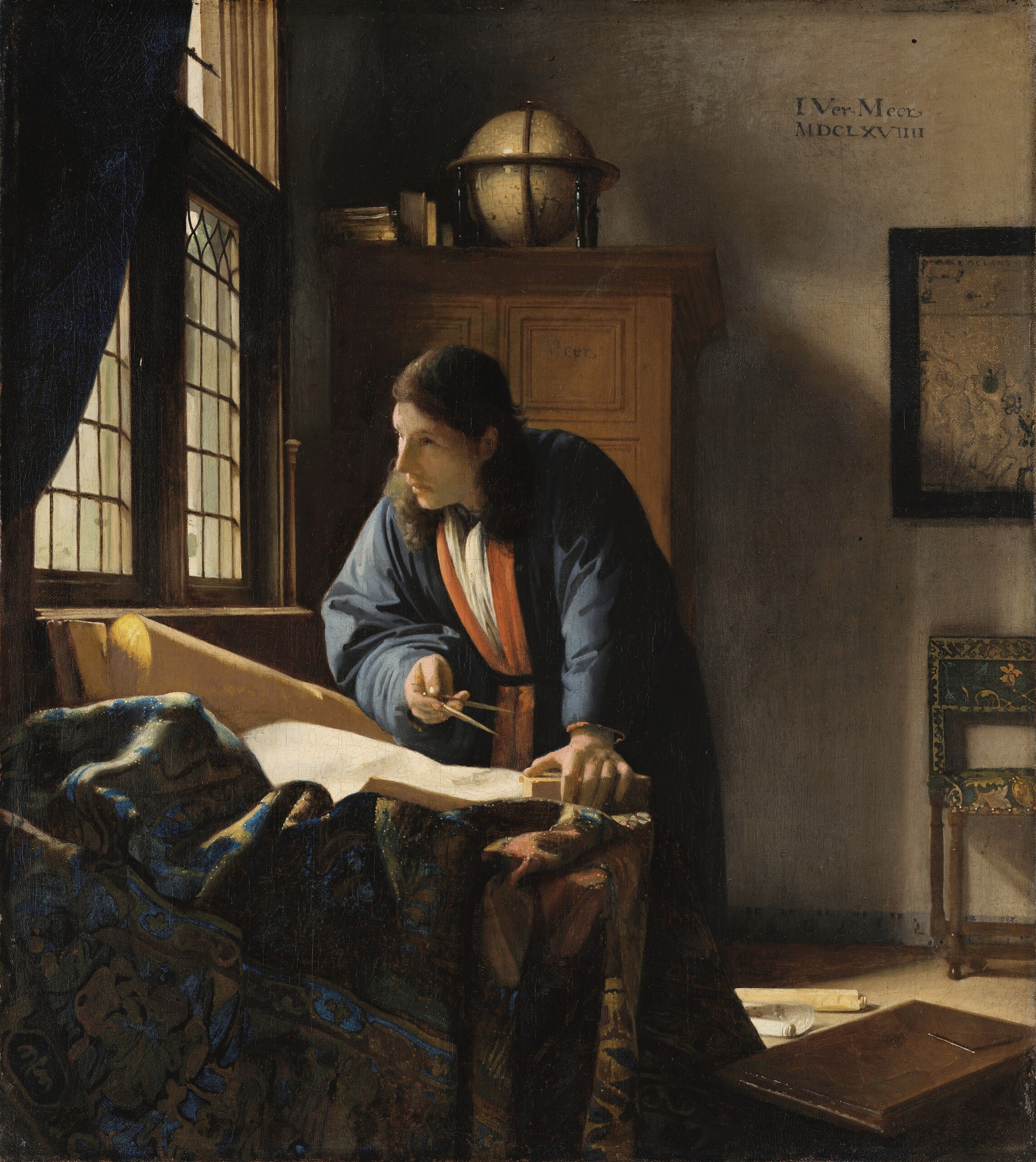
The Geographer is a painting by Johannes Vermeer from 1669: a long-haired scholar in a blue Japanese-style robe leans over a table spread with a map, holds a pair of dividers and looks up towards the window on the left, while a globe stands on the cupboard behind him. The original, oil on canvas, is 51.6 cm high and 45.4 cm wide and belongs to the Städel Museum in Frankfurt am Main. Our painter paints it to order in oil on canvas, in one of 8 portrait sizes from 43 x 47 to 172 x 200 cm or to your own measurement, and before dispatch we send you a photograph of the finished painting.
| Title: | The Geographer |
| Other titles: | De geograaf · Der Geograph |
| Painter: | Johannes Vermeer (1632–1675) |
| Year painted: | 1669 |
| Original size: | 51.6 cm x 45.4 cm (height x width) |
| Original technique: | Oil on canvas |
| Painting style: | Baroque, Dutch Golden Age |
| Located at: | Städel Museum, Frankfurt am Main (inv. 1149) |
| Our reproduction: | Hand-painted oil on canvas, 8 sizes or made to measure |
The Geographer – Johannes Vermeer
What does The Geographer show?
Vermeer lets us into a scholar’s room. A man with long hair stands behind a table and leans over it, holding a pair of dividers, the tool used to measure distances on a map. He has paused, and his gaze has drifted out of the window on the left.
He wears a long blue robe cut in the Japanese manner, falling to the floor in soft folds. A heavy patterned rug covers the table, and a map is spread across it, its edge curling up a little.
Behind him a globe stands on a cupboard, and another map hangs on the back wall. Everything here points to the world this man draws, measures and tries to understand.
Light from the left falls on his face, hands and paper, while the right side of the room stays in soft half-light, so the eye keeps returning to the face and the window.
What does the look towards the window mean?
Vermeer does not show him reading in peace but at the instant when thought runs ahead of the hand. The dividers stop above the paper and his eyes seek the light, as if he had just found an answer, or a new question.
Map, globe and dividers make his work plain: measuring coasts and distances and carrying them onto paper. The window links the map on the table with the real world outside.
The blue robe is not formal portrait dress, so the scene feels like a glimpse into a private room.
Vermeer signed and dated the canvas 1669 on the cupboard, something he rarely did, so we know exactly when it was painted.
Why is The Geographer so well known?
The Geographer has a twin. For The Astronomer, now in the Louvre in Paris, Vermeer painted the same model in the same robe and the same room. A 2017 study found that the canvases of both works were cut from one bolt of fabric.
Among the Vermeers we paint, women by a window are in the majority: the maid with her milk jug, the woman with the balance, the reader of a letter. The Geographer and The Astronomer are the exceptions that put a scholar at work at the centre.
Its pull lies in the tension between the stillness of the room and the lively movement of the man, who leans forward while looking away. For more on its history, the Wikipedia article (in English) has the details.
Where is the original of The Geographer?
The original is in Frankfurt am Main, in the collection of the Städel Museum, under inventory number 1149. The canvas is 51.6 cm high and 45.4 cm wide, so it is small, as nearly all of Vermeer’s works are.
The Städel acquired the painting in 1885, and it has been part of the Frankfurt collection ever since. You will find the link to the museum’s own entry on the work in the table at the top of this page.
In Frankfurt you can see in person how small the canvas is that holds such a wide world.
The Geographer or another Vermeer?
This one belongs in a study, a library or an office, wherever people read, draw or make plans. It also suits a hallway bookcase or the room of someone who loves to travel.
If you are looking for a quiet female figure by a window, take a look at Woman Holding a Balance. For a larger wall and a scene about painting itself there is The Art of Painting, and for a kitchen or dining room the warm kitchen scene of The Milkmaid.
The Geographer and the other famous Vermeer paintings we paint to order are gathered on the Johannes Vermeer page.
How does our painter paint your Geographer?
We begin once your order arrives and build the painting in oil on canvas, layer by layer. First the painter blocks in the big division: the bright window and the lit table on the left, the darker part of the room on the right.
Next he turns to the blue robe, which needs deep folds and must still look soft, and to the pattern of the rug on the table. The face gets the most time, because the raised gaze caught in the light holds the whole scene together. The dividers, the globe and the edge of the map come last, with a fine brush.
The result is a Vermeer reproduction with brush marks on its surface and a depth of colour that no print can match. An oil painting reproduction also lives with the light in your room: the blue robe looks cooler in the morning and warmer in the evening.
Which size for which wall?
In short: 43 x 47 or 47 x 56 cm above a desk or on a narrow wall, 64 x 76 or 72 x 85 cm above a chest of drawers or a bookcase, 97 x 106 or 120 x 140 cm above a sofa, and 135 x 160 or 172 x 200 cm for a tall wall.
There are 8 portrait sizes (width x height): 43 x 47, 47 x 56, 64 x 76, 72 x 85, 97 x 106, 120 x 140, 135 x 160 and 172 x 200 cm. The closest to the original is 47 x 56 cm, which is 1.6 cm wider and 4.4 cm taller.
The two small sizes keep the concentrated feel of the little original, while the larger ones make the scholar’s room the focal point of a wall. As a painting for the living room above a sofa, 97 x 106 cm works well; hang it so that his face is roughly at eye level.
Can I choose another size or a frame?
Of course. The original is roughly 7 : 8 in proportion, so we can also paint it in a size that is not on the list without losing the window or the globe at the edges. Send us the width and height you would like, and we will reply with a price and a delivery time.
We ship the Geographer rolled, stretched on a stretcher bar or framed. Our workshop in Slovenia does the stretching and framing, as it does for every canvas painting that leaves us. You pick the frame in our 3D application, which is meant for choosing the frame only; showing the painting on your own wall is a separate service.
A dark wooden frame suits the blue robe and the brown tones of the room, while a narrow gold moulding brings out the light from the window.
When will The Geographer arrive?
We start right after your order comes in, and within 15 to 45 working days the painting is ready to ship. Before it leaves we send you a photograph of the finished Geographer, and if you wish, we adjust something.
It travels without customs within Slovenia and to any other EU country, and our returns policy applies to the order.
The Geographer is a thoughtful gift for a teacher, a traveller, a lover of maps or someone who has just finished their studies. To leave the choice of size to them, give a wall art voucher instead.
Frequently asked questions
Where can the original be seen?
In the Städel Museum in Frankfurt am Main, under inventory number 1149.
What is the scholar holding?
A pair of dividers, used for measuring distances on maps.
How is it linked to The Astronomer?
Same model, same robe, same room; the two canvases come from the same bolt of fabric.
Is it a print?
No. Every Geographer we make is a hand-painted copy, done with a brush in oil paint on canvas.
How big is the original?
It is 51.6 cm high and 45.4 cm wide; our 47 x 56 cm size is the closest to it.
Does it suit an office?
Very well: a scholar at work fits naturally into a study, an office or a library.
Can I order it in my own size?
Yes, we also paint the Geographer in a size you set yourself; we send you the price and the time needed.
How long does it take to make?
From 15 to 45 working days, and before dispatch you receive a photograph of the finished Geographer.
- Subject: a long-haired scholar in a blue robe, dividers in hand, leans over a map and looks towards the window, with a globe on the cupboard behind him.
- Original: 1669, oil on canvas, 51.6 x 45.4 cm, Städel Museum, Frankfurt am Main.
- Ours: oil on canvas, painted by hand to order, in 8 portrait sizes from 43 x 47 to 172 x 200 cm or a size of your choice.
- Worth knowing: the same model, robe and room appear in Vermeer’s Astronomer in the Louvre in Paris.