







































Description
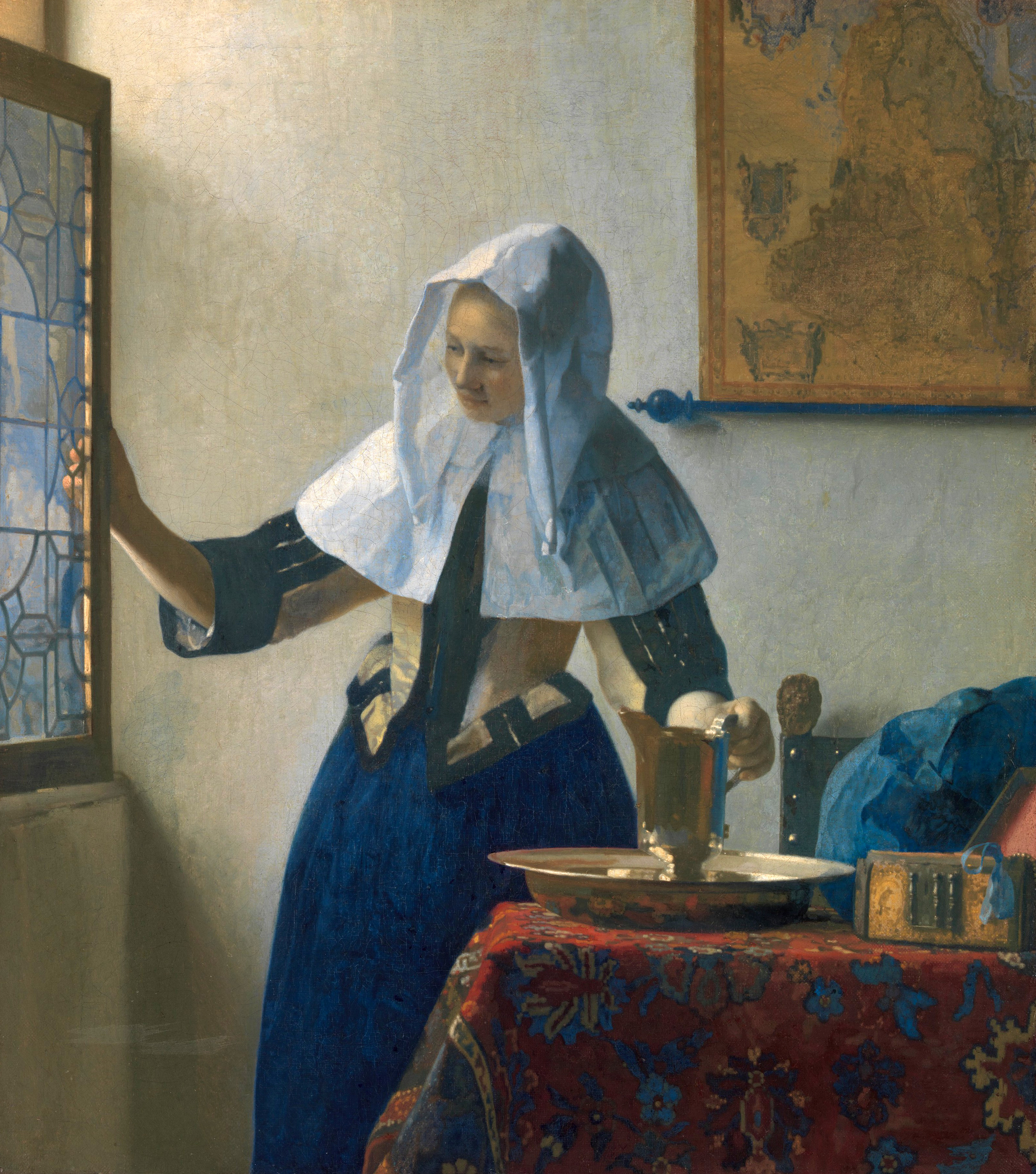
Young Woman with a Water Pitcher is a painting by Johannes Vermeer from about 1660–1662: a young woman in a white linen hood and collar, a blue skirt and a yellow bodice opens a leaded window with her right hand and, with her left, holds a silver-gilt water jug that stands in a basin on the table. The original, oil on canvas, is 45.7 cm high and 40.6 cm wide and belongs to the Metropolitan Museum of Art in New York. Our painter makes it for you to order in oil on canvas, in 8 portrait sizes between 43 x 47 and 172 x 200 cm or in a size you set yourself, and you receive a photograph of the finished painting before it is dispatched.
| Title: | Young Woman with a Water Pitcher |
| Other titles: | Vrouw met waterkan · Woman with a Water Jug |
| Painter: | Johannes Vermeer (1632–1675) |
| Year painted: | c. 1660–1662 |
| Original size: | 45.7 cm x 40.6 cm (height x width) |
| Original technique: | Oil on canvas |
| Painting style: | Baroque, Dutch Golden Age |
| Located at: | Metropolitan Museum of Art, New York (acc. no. 89.15.21) |
| Our reproduction: | Hand-painted oil on canvas, 8 sizes or made to measure |
Young Woman with a Water Pitcher – Johannes Vermeer
What does Young Woman with a Water Pitcher show?
A young woman stands at the centre, beside a table below a window. Her right hand pushes the casement open; her left rests on the handle of a water jug. Her eyes turn outside, towards something we cannot see.
A white linen hood covers her head and falls over her shoulders, and a broad white collar lies around her neck. She wears a blue skirt and a yellow bodice.
The silver-gilt jug stands in a larger basin. A carpet with a red pattern covers the table, and on it stands a jewellery box; a blue cloth lies on the chair behind the table. A map on the wall behind her closes off the space at the back.
Light enters through the small leaded panes and falls on the hood, the hand and the metal of the jug, while the back of the room stays a calm grey.
What does this quiet scene mean?
Vermeer tells no story here. No letter, no visitor, no instrument: just the woman, the window and the jug. He holds a moment between two movements and leaves what comes next unsaid.
The painting belongs to a closely related group made in the early to mid-1660s. In these works Vermeer does not lean on linear perspective or geometric order; the only means he uses to give emphasis is light.
That is why the scene feels so calm: no sharp lines, no dramatic shadows. What matters is lit, the face, the hand, the jug, and everything else withdraws into soft shade.
Why is this painting so admired?
Here you can see clearly that Vermeer understood light to be made of colours, and colours to act on one another. The blue cloth is reflected as a dark blue patch on the side of the metal jug, and the red carpet changes the gold hue on the underside of the basin.
Most painters smooth such reflections away; Vermeer kept them, which is why the jug looks real enough to touch.
The painting also holds a special place in the history of collecting: it was the first Vermeer to reach America. For more, including how it crossed the Atlantic, see the Wikipedia article (in English).
Where is the original today?
The original is on display at the Metropolitan Museum of Art in New York, accession number 89.15.21. The canvas is just 45.7 cm high and 40.6 cm wide.
In 1887 Henry Gurdon Marquand bought it from a Paris gallery for 800 dollars. When he brought it to the United States, it became the first Vermeer in America. Marquand later gave it to the museum together with other works from his collection.
The same collection also holds Vermeer’s Study of a Young Woman, so both belong to the same New York museum.
Young Woman with a Water Pitcher or another Vermeer?
It is happiest in a bright room: a bedroom, a bathroom with a window, an entrance hall or a kitchen where the day begins.
If you like the woman with the jug, look at The Milkmaid too, where a jug is again at the centre, only in a warmer mood. The male counterpart, a scholar at a window bent over a map, is The Geographer, and for a scene with a letter and a maid there is Lady Writing a Letter with her Maid.
The famous Vermeer paintings we paint to order, this one among them, are collected on the Johannes Vermeer page.
How does our painter make your copy?
We start when your order arrives and build the painting in oil on canvas, layer by layer, first setting out light and dark: the lit window and woman on the left, the table below, the wall and map behind.
Then come the hood and collar, whose white is really a run of greys, bluish and warm yellowish tones, followed by the skirt, the bodice and the red carpet.
The jug and basin are the hardest part. The painter has to let the blue cloth and the red carpet show in the metal, or the silver would read as a flat grey shape. The small window panes and the edge of the map come last.
The result is a Vermeer reproduction with visible brush marks, something no print has. An oil painting reproduction also takes in the light of your room, and the jug catches it a little differently at every hour of the day.
Which size for which wall?
In short: 43 x 47 or 50 x 55 cm above a bedside table or on a narrow wall, 68 x 75 or 75 x 85 cm above a chest of drawers, 97 x 106 or 120 x 140 cm above a sofa, and 140 x 150 or 172 x 200 cm for a large wall.
There are 8 portrait sizes (width x height): 43 x 47, 50 x 55, 68 x 75, 75 x 85, 97 x 106, 120 x 140, 140 x 150 and 172 x 200 cm. The closest to the original is 43 x 47 cm, which is 2.4 cm wider and 1.3 cm taller.
Small sizes keep the scene intimate; large ones make the bright window read like a second window in your wall. As a painting for the living room above a sofa, 97 x 106 cm is a good choice; hang it so that her face is roughly at eye level.
Can I have a different size and a frame?
Yes. At roughly 8 : 9, the composition carries over to sizes outside the list without losing the window or the basin. Tell us the width and height you have in mind, and we will come back with a price and a time frame.
It leaves us rolled, on a stretcher bar or framed. Our workshop in Slovenia handles the stretching and framing, preparing every canvas painting it sends out the same way. You choose the frame in our 3D application, which is for picking the frame only; seeing the painting on your own wall is a separate service.
The cool blues and whites look good in a light wooden frame or a slim silver moulding, while a narrow gold moulding picks up the gilded jug.
When will the painting arrive?
We get to work as soon as your order comes in, and within 15 to 45 working days the painting is ready to travel. You see a photograph of it before it ships, and we change anything you ask for.
Within Slovenia and to other EU countries it travels without customs duties, and our returns policy covers every order.
Young Woman with a Water Pitcher makes a lovely housewarming present or a gift for a couple setting up a new home. If they would rather pick the size, a wall art voucher leaves the choice to them.
Frequently asked questions
Where can I see the original?
At the Metropolitan Museum of Art in New York, accession number 89.15.21.
What is the woman holding?
In her left hand a silver-gilt jug standing in a basin; with her right she opens the window.
Is this a print?
No. Every Young Woman with a Water Pitcher we make is a hand-painted copy, done with a brush in oil paint on canvas.
How big is the original?
It is 45.7 cm high and 40.6 cm wide; our nearest size is 43 x 47 cm.
Do you paint it in other sizes?
Yes, in any size you specify; we send you the price and the time it takes.
How long will I wait?
Between 15 and 45 working days, and a photograph of the finished painting reaches you before it ships.
Is it suitable for a bedroom?
Very much so: the quiet window scene with its soft light suits a bedroom, a bathroom or a hallway.
Why does the painting matter to America?
It was the first Vermeer in the United States; Henry G. Marquand bought it in Paris in 1887 and brought it across the ocean.
- Subject: a young woman in a white hood opens the window with one hand and holds a gilded jug in a basin with the other; a red carpet on the table, a map on the wall.
- Original: c. 1660–1662, oil on canvas, 45.7 x 40.6 cm, Metropolitan Museum of Art, New York.
- Ours: painted by hand to order in oil on canvas, in 8 portrait sizes from 43 x 47 cm to 172 x 200 cm or in a size of your own.
- Worth knowing: it was the first painting by Vermeer to reach America.