







































Description
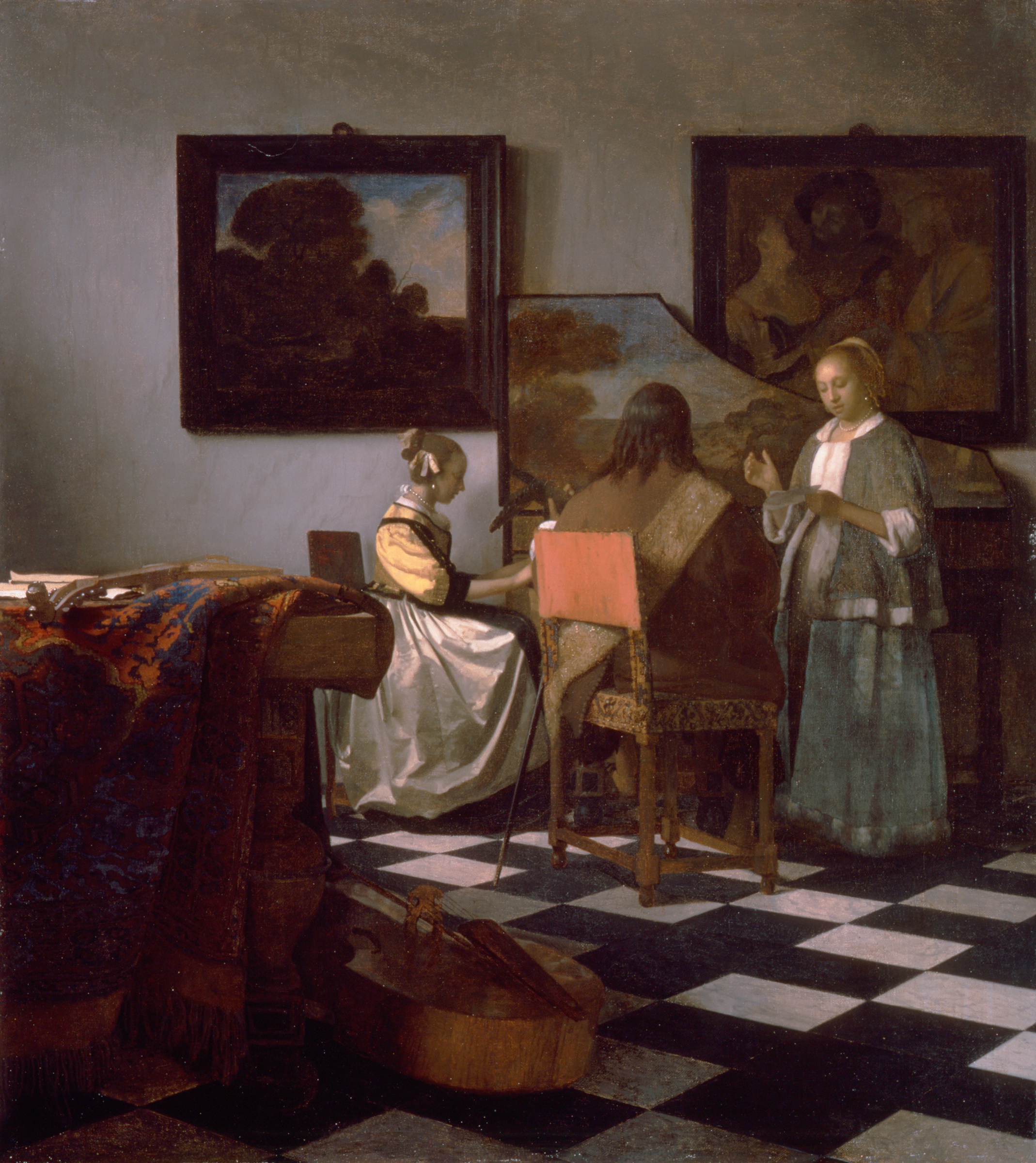
The Concert is a painting by Johannes Vermeer from around 1664: in a room with a black-and-white tiled floor a young woman plays the harpsichord, a man seen from behind sits with a lute, and a second woman stands holding a sheet of music and sings. The original, oil on canvas, 72.5 cm high and 64.7 cm wide, was in the Isabella Stewart Gardner Museum in Boston until it was stolen in 1990; it is still missing. Our painter paints it to order in oil on canvas, in one of 8 portrait sizes from 45 x 50 to 172 x 200 cm or to your own measurement, and before we ship it you receive a photograph of the finished painting.
| Title: | The Concert |
| Other titles: | Het concert · Das Konzert |
| Painter: | Johannes Vermeer (1632–1675) |
| Year painted: | c. 1664 |
| Original size: | 72.5 cm x 64.7 cm (height x width) |
| Original technique: | Oil on canvas |
| Painting style: | Baroque, Dutch Golden Age |
| Located at: | Missing since 1990 (stolen from the Isabella Stewart Gardner Museum, Boston) |
| Our reproduction: | Hand-painted oil on canvas, 8 sizes or made to measure |
The Concert – Johannes Vermeer
What does The Concert show?
We look into a spacious room whose floor is laid with black and white marble slabs. Deep inside it, three people make music together: a young woman sits at the harpsichord and plays, a man we see from behind holds a lute, and beside them a woman stands with a sheet of music in her hand, singing.
The raised lid of the harpsichord is decorated with an Arcadian landscape. Two paintings hang on the back wall, a table covered with a patterned rug stands in the foreground, and a viola da gamba lies on the floor.
Their clothes and the furnishings mark the musicians out as members of the upper middle class. The lute player wears a shoulder belt and a sword, and the marble floor, plain as its pattern is, was a costly luxury.
What does the scene of three musicians mean?
In Dutch painting of Vermeer’s day, music often hinted at love and seduction. In The Concert the mood is harder to pin down.
The painting on the right of the wall is The Procuress by Dirck van Baburen, from around 1622, which belonged to Vermeer’s mother-in-law, Maria Thins. Its boisterous, sensual scene might point to a reading about love, but it may just as well be there to contrast with the calm domestic music-making in the room. The same canvas turns up again in a later Vermeer of a lady seated at a virginal, probably painted some six years afterwards.
On the left hangs a wild pastoral landscape. It too joins the conversation: the peaceful scenes on the harpsichord lid stand against the restless landscape on the wall, and the three keep playing between those two worlds.
Why is The Concert so famous?
Part of its fame comes from the theft. On the night of 18 March 1990, thieves disguised as police officers took 13 works from the Boston museum, this Vermeer among them. It has not resurfaced since.
The robbery later found its way into several novels.
Johannes Vermeer (1632–1675) worked in Delft, painting mostly quiet interiors lit through a window on the left; only a few dozen of his works are known. Music returns elsewhere too: in The Music Lesson a young woman stands at a virginal, and there too a viola da gamba lies on the floor.
The English Wikipedia article tells the history of the canvas at greater length.
Where is the original of The Concert today?
Nobody knows. The painting was in the Isabella Stewart Gardner Museum in Boston until it was stolen in 1990, and it is still missing.
Isabella Stewart Gardner bought it at an auction in Paris in 1892. It is first recorded in writing only in 1780, although its style dates it to the mid-1660s.
The canvas is 72.5 cm high and 64.7 cm wide.
The Concert or another Vermeer?
This is a canvas painting for a home where music is played or listened to: next to the piano, in a music room or wherever the record collection lives.
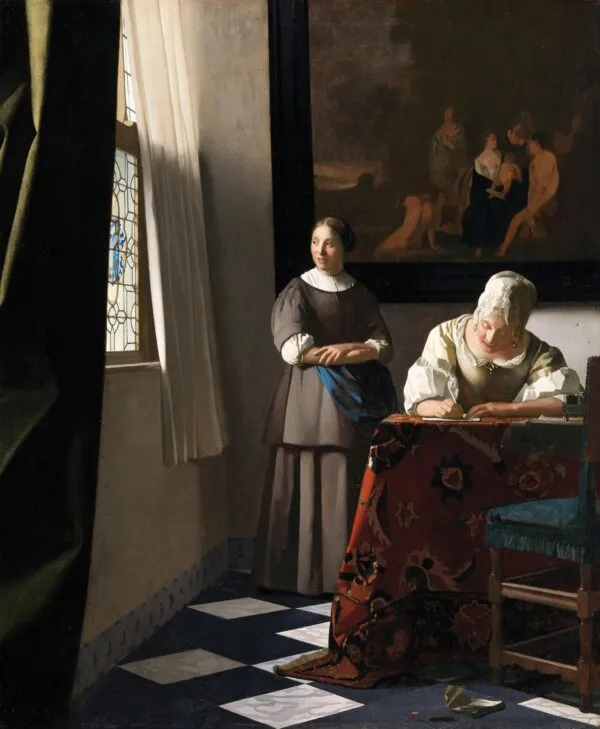
If the quiet story of two women draws you more, choose The Love Letter, where a maid hands a letter to her mistress, who has a cittern in her lap. For lovers of painting itself there is The Art of Painting, and if you prefer streets to rooms, The Little Street is the one.
You will find the other famous Vermeer paintings we make to order on the Johannes Vermeer page.
How does our painter paint your Concert?
We begin your Concert only after you order it, in oil on canvas and in several layers. First the painter lays out the space: the perspective of the black and white tiles, which draws the eye into depth, and the pale back wall with its two paintings.
Then he shapes the three figures and their instruments, the harpsichord, the lute and the viola da gamba on the floor. The details ask the most patience: the landscape on the lid, the pattern of the table rug and the two paintings on the wall, which must stay recognisable without drowning out the musicians.
The result is a Vermeer reproduction with brush marks and layers of paint that a print does not have. An oil painting reproduction also lives with the light in the room, because the layers catch daylight a little differently each time.
Which size for which wall?
In short: 45 x 50 or 51 x 60 cm for a narrow wall or a hallway, 68 x 75 or 85 x 95 cm above a piano or a chest of drawers, 97 x 106 or 120 x 140 cm above a sofa, and 140 x 150 or 172 x 200 cm for a large wall.
There are 8 portrait sizes (width x height): 45 x 50, 51 x 60, 68 x 75, 85 x 95, 97 x 106, 120 x 140, 140 x 150 and 172 x 200 cm. The closest to the original is 68 x 75 cm, which is 3.3 cm wider and 2.5 cm taller.
Because the musicians sit deep in the room, the scene gains in the larger sizes: from 97 x 106 cm upwards the harpsichord lid and the paintings on the wall read clearly even from the far end of the room. As a painting for the living room above a sofa, 97 x 106 or 120 x 140 cm suits well.
Can I have another size or a frame?
Of course. The original’s proportions are close to 9 : 10, so we can paint The Concert in a size outside the list without losing the viola da gamba or the edge of the table. Send us the width and height you need, and we will reply with a price and a delivery date.
The Concert leaves us rolled, stretched on a stretcher bar or ready framed. Stretching and framing are done by our workshop in Slovenia, which prepares every painting we send out in the same way. You choose the frame in our 3D application, which is for frame choice only; seeing the painting on your own wall is a separate service.
A dark wooden frame suits the room’s deep tones, and a warmer gold edge lifts the light on the back wall.
When will my Concert arrive?
We start as soon as your order comes in; within 15 to 45 working days the painting is ready to ship. Before it leaves, we send you a photograph of the finished Concert, and if you want a correction, we make it.
Within Slovenia and to the rest of the EU there are no customs, and our returns policy applies.
The Concert makes a fine gift for a musician, a music teacher or a couple who like to play together. If you would rather let them pick the size, give a wall art voucher.
Frequently asked questions
Has the original ever been found?
No. It was stolen from the Isabella Stewart Gardner Museum in Boston in 1990 and is still missing.
Which instruments can I see?
A harpsichord with a young woman at it, a lute in the man’s hands and a viola da gamba on the floor; the third figure sings.
Is this a print?
No. Every Concert we send out is a hand-painted copy, made with a brush in oil paint on canvas.
How big was the original?
It is 72.5 cm high and 64.7 cm wide; our 68 x 75 cm size is 3.3 cm wider and 2.5 cm taller.
Which size works above a piano?
Above an upright or a grand piano, 68 x 75 or 85 x 95 cm works best, depending on the width of the instrument.
Can you paint The Concert in a size that is not listed?
Yes. Tell us the width and height, and we will send an offer with price and delivery time.
How long will I wait for my painting?
From 15 to 45 working days; a photograph of your finished Concert reaches you before dispatch.
What hangs on the wall behind the musicians?
On the right Baburen’s Procuress, once owned by Vermeer’s mother-in-law; on the left a wild pastoral landscape.
- Subject: three musicians in a room with a black-and-white floor: a woman at the harpsichord, a man with a lute and a singer with sheet music.
- Original: c. 1664, oil on canvas, 72.5 x 64.7 cm, stolen from the Isabella Stewart Gardner Museum in 1990 and still missing.
- Ours: painted in oil on canvas by our painter, 8 portrait sizes from 45 x 50 to 172 x 200 cm or a size of your choice.
- Worth knowing: the back wall shows Baburen’s Procuress, which belonged to Vermeer’s mother-in-law, Maria Thins.