







































Description
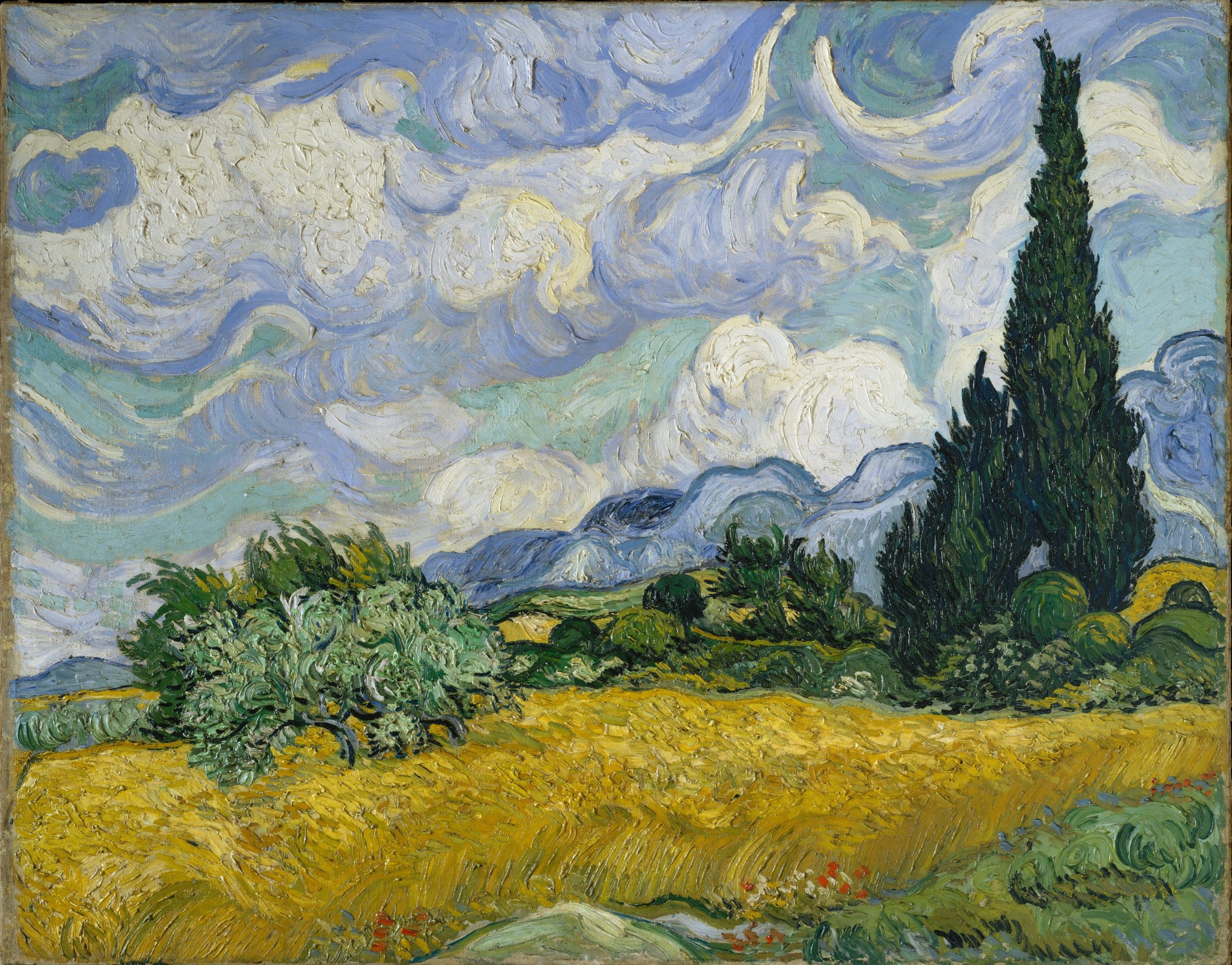
A Wheat Field with Cypresses is the summer landscape Vincent van Gogh painted at Saint-Rémy-de-Provence in 1889: a field of ripe yellow wheat, a tall dark cypress on the right, olive-green bushes, blue-violet hills and a sky full of swirling white clouds. The original measures 73.2 x 93.4 cm and belongs to The Metropolitan Museum of Art in New York. We paint it by hand in oil on canvas, in 17 sizes from 50 x 40 to 205 x 164 cm or to your own measurements, and send you a photograph of the finished painting to approve before dispatch.
| Title: | A Wheat Field with Cypresses |
| Other titles: | Wheat Field with Cypresses · A Wheatfield, with Cypresses · Champ de blé avec cyprès |
| Painter: | Vincent van Gogh (1853–1890) |
| Year painted: | Late June or early July 1889, Saint-Rémy-de-Provence |
| Original size: | 73.2 cm x 93.4 cm |
| Original technique: | Oil on canvas |
| Painting style: | Post-Impressionism |
| Located at: | The Metropolitan Museum of Art, New York (accession no. 1993.132) |
| Our reproduction: | Hand-painted oil on canvas, 17 sizes or made to measure |
A Wheat Field with Cypresses – Vincent van Gogh
What does A Wheat Field with Cypresses show?
The painting shows a wheat field in Provence on a hot, windy summer day. Across the foreground lies the ripe wheat in thick yellow and gold strokes that bend in the wind, with a few red dots of poppies and a strip of green grass at the bottom. On the left, in the middle of the field, stands a group of light olive-green bushes.
On the right rise the cypresses, tall and almost black-green, their flame-like shape painted in short curving strokes. Behind the field run lower trees and bushes, then a line of blue-violet hills. Above them the sky takes up nearly half of the canvas: turquoise and pale blue, filled with white and lilac clouds that curl and twist like waves. Nothing in it stands still.
Why did Van Gogh paint cypresses at Saint-Rémy?
In May 1889 Van Gogh entered the asylum of Saint-Paul-de-Mausole near Saint-Rémy-de-Provence as a voluntary patient. According to Wikipedia, the view was inspired by his window, which looked towards the Alpilles. He painted the first version in the fields outside, most likely in front of the subject, in late June or early July 1889.
The cypresses held him. On 25 June 1889 he wrote to his brother Theo, in the words the National Gallery quotes, that the cypress is the dark patch in a sun-drenched landscape. On 2 July he described the result to Theo as a canvas of cypresses with some ears of wheat, some poppies, a blue sky like a piece of Scotch plaid. He also wrote that he had painted the wheat very thickly, to give the extreme heat.
What does the painting mean?
The National Gallery in London explains that for Van Gogh the cycle of wheat, from sowing to harvest, carried a meaning of life and death. In its reading, the wind moves through everything in the painting – the wheat, the trees, the clouds and even the distant mountains – and the swirling brushwork carries the life of the landscape.
The painting is built on contrast: warm yellow wheat against dark green cypresses, heavy upright trees against a light, restless sky. The Wikipedia article on the painting describes the cypress as rising like a green obelisk over the golden field.
Where does the original hang?
The original belongs to The Metropolitan Museum of Art in New York. The museum lists it as Wheat Field with Cypresses, 1889, oil on canvas, 73.2 x 93.4 cm, under accession number 1993.132, with the credit line Purchase, The Annenberg Foundation Gift, 1993. Wikipedia gives it the number F717 in the catalogue of Van Gogh’s work.
According to Wikipedia, Van Gogh sent it to Theo in Paris in September 1889, Theo’s widow sold it in 1900, and in 1993 the museum bought it for 57 million dollars, with funds from Walter Annenberg.
A Wheat Field with Cypresses in New York or in London – which one is which?
Van Gogh painted this composition three times. The first version, painted outdoors in late June or early July 1889, is the one in New York, and it is the one we paint. In September 1889, while he was confined to his room after a relapse, he painted a second version in the studio, 72.1 x 90.9 cm, now in the National Gallery in London. A third, smaller version, 51.5 x 65 cm, is in a private collection.
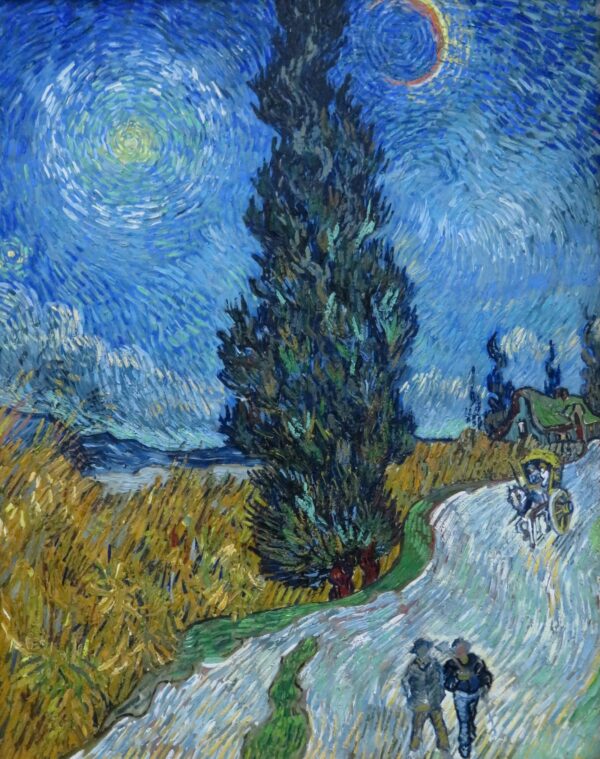
Cypresses, painted at Saint-Rémy in 1889, puts the trees in the centre of an upright canvas. The Starry Night, from June 1889, sets a tall cypress in front of the night sky over the village. Olive Trees with the Alpilles in the Background, also from 1889, shows the same mountains behind an olive grove, and Road with Cypress and Star was painted at Saint-Rémy in 1890. Choose this painting for daylight, The Starry Night for the night.
How is our hand-painted A Wheat Field with Cypresses made?
The painter first sets out the hills, the cypresses and the edge of the field, then paints the sky with its curling clouds, the bushes and the trees, and last the wheat in long, bending strokes. Our oil painting reproduction is painted by hand in oil on canvas with real impasto: the paint goes on thickly, so the brushstrokes stand up from the canvas as they do on the original and catch the light. A print shows only a flat surface; on our painting the strokes are real.
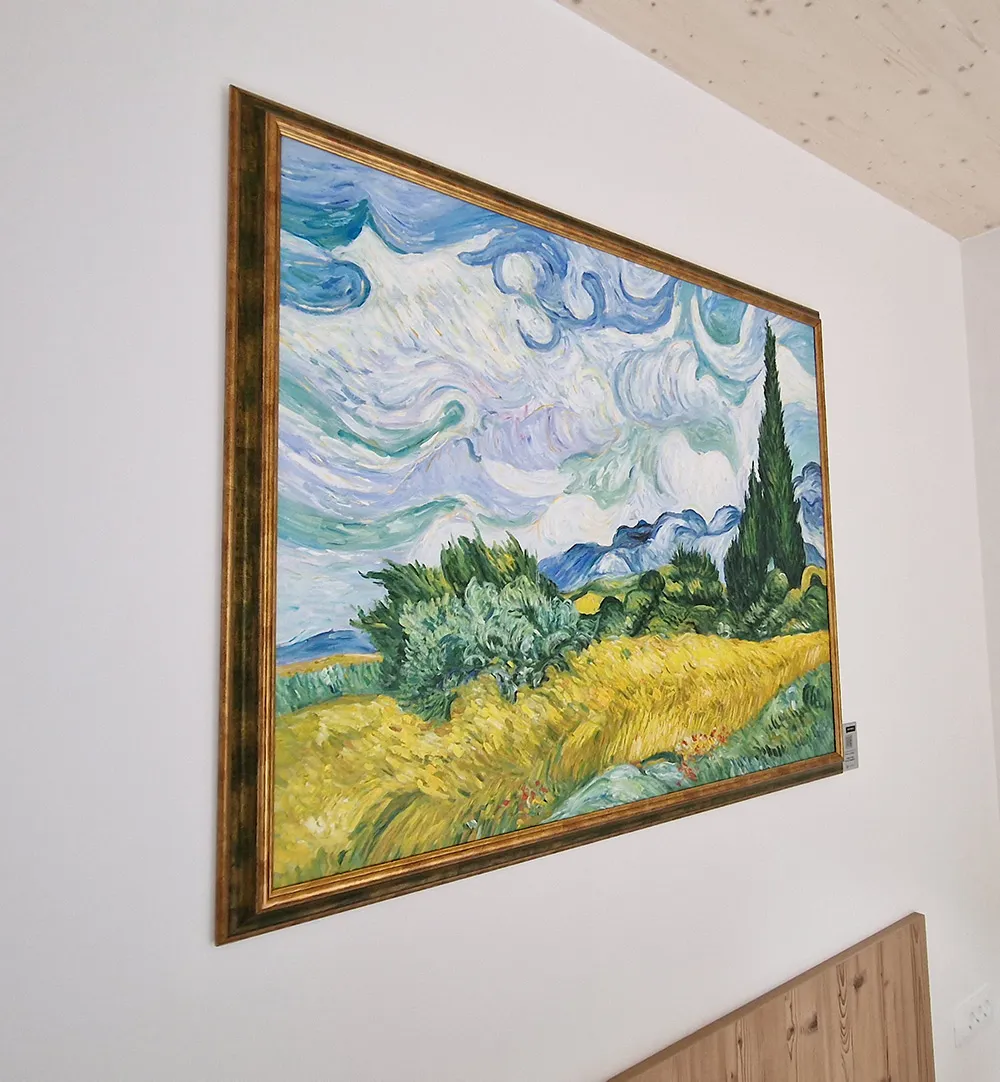
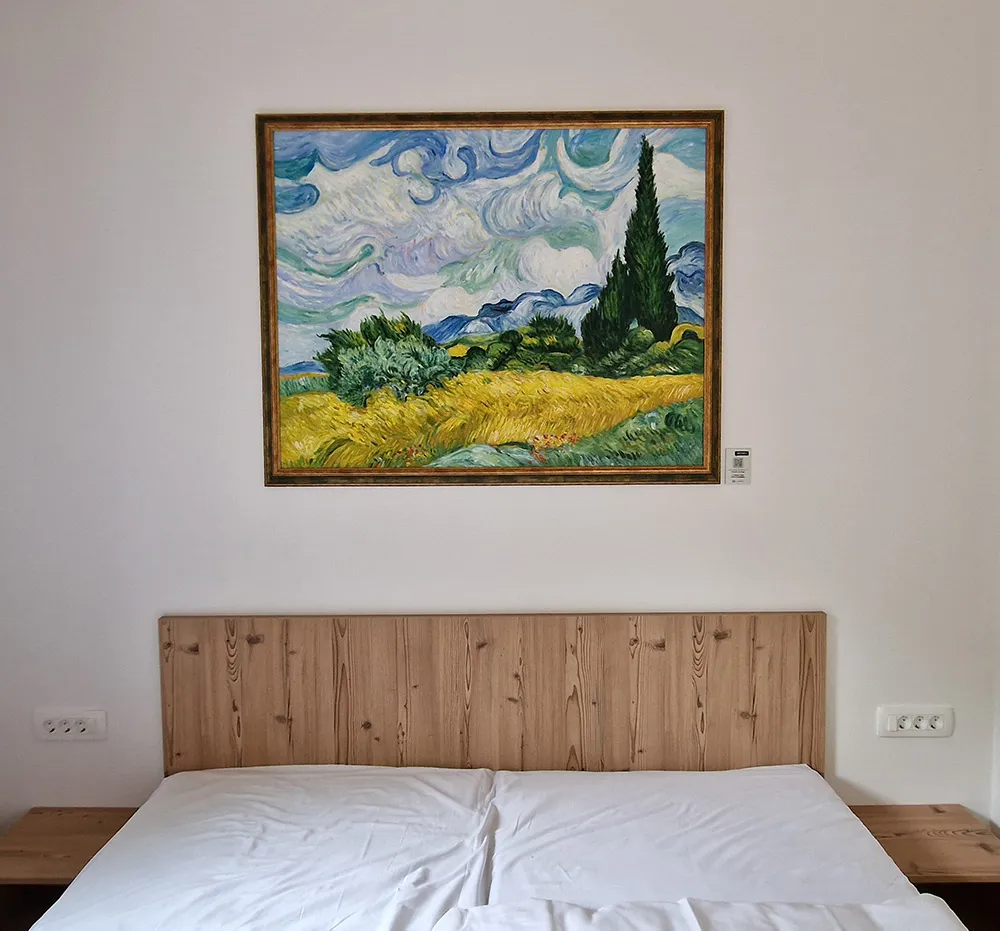
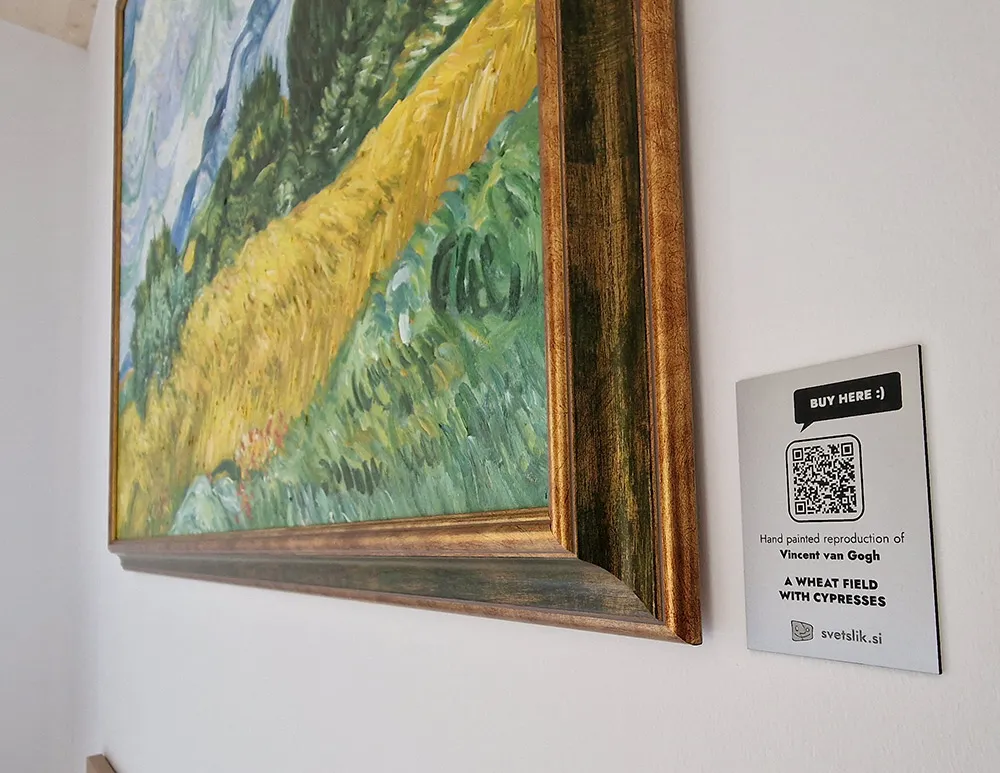
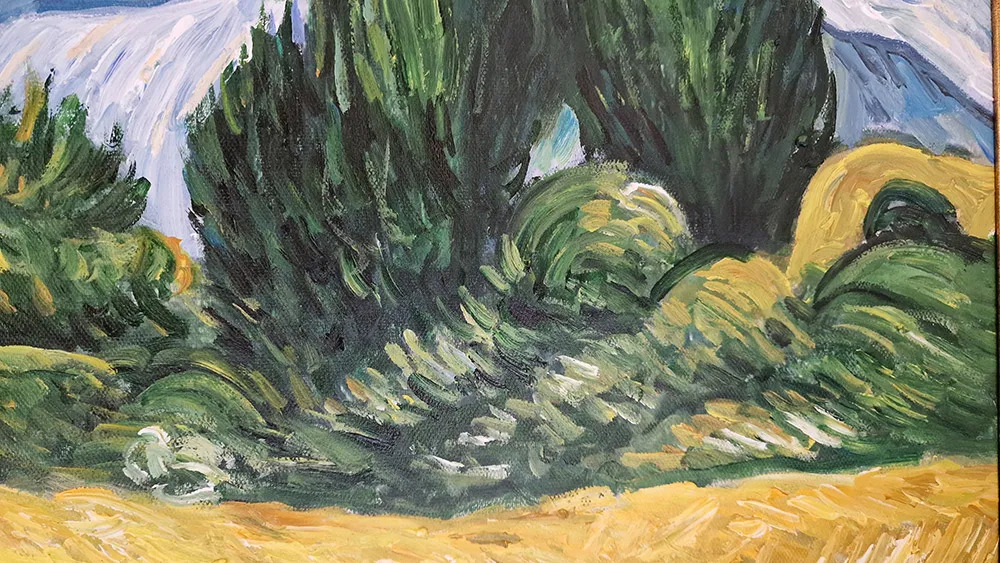
In the first photograph you see the painting shown in a room setting: our finished painting in an antique gold frame on a white wall, seen from the side. The second photograph is another room: the same painting hangs above a bed with a light wooden headboard. The third photograph is a close side view of the lower right corner, where the thick strokes of the wheat and the grass rise against the frame. The fourth photograph is a close-up of the cypresses and the bushes at their foot, painted in heavy, curving strokes.
Every painting is a hand-painted copy made for your order, so no two are quite the same.
Which size of A Wheat Field with Cypresses for which wall?
Short answer: 70 x 55 or 80 x 65 cm above a chest of drawers or a desk, 110 x 90 or 120 x 100 cm above a bed or a sofa, and 160 x 125 cm or larger for a big empty wall. The landscape format suits a living room, a bedroom or a hallway.
There are 17 sizes: 50 x 40, 60 x 50, 70 x 55, 75 x 60, 80 x 65, 91 x 72, 100 x 80, 110 x 90, 120 x 100, 130 x 105, 140 x 110, 145 x 119, 160 x 125, 170 x 134, 180 x 144, 190 x 156 and 205 x 164 cm (width x height). The original is 93.4 cm wide and 73.2 cm high; our 91 x 72 cm size is the closest to it, so the painting on your wall is almost exactly as large as the one in New York. A painting for the living room should take up about two thirds of the width of the furniture below it. With its yellow wheat and blue sky, it sits well on a white, cream or light grey wall, and on a pale blue or green one that picks up the sky and the trees.
Hang it with the centre of the canvas about 150 cm above the floor, and leave 20 to 30 cm between the furniture and the lower edge.
What if I need a custom size or a frame?
If none of the 17 sizes fits your wall, we paint it to measure. Keep the proportions close to the original, otherwise the cypresses and the clouds get squeezed or stretched. Send us the width and height you want and we will quote a price and a lead time. Every painting we make is stretched over a wooden stretcher and ready to hang.
For the moulding, use our 3D application: it shows each of our frame profiles on this subject – the application is for choosing the frame only. Seeing the painting on your own wall is our separate room placement service. An antique gold frame, as in the first and second photographs, picks up the gold of the wheat; a white or light wooden frame keeps the sky fresh.
How does delivery work, and what is the guarantee?
Every painting is made to order in our studio in Slovenia, so allow 15 to 45 days depending on the size you choose. We ship it stretched and protected, framed if you chose a frame, across the EU with no customs. Before dispatch you receive a photograph of the finished work to approve, and we correct anything that is not right. Our returns policy applies to every order.
You will find more famous Van Gogh paintings among all our Vincent van Gogh paintings, and there is more about the painter in our article on Vincent van Gogh. If you are giving it as a present and are not sure of the size, a wall art voucher lets the recipient choose.
Frequently asked questions
Where is the original of A Wheat Field with Cypresses today?
In The Metropolitan Museum of Art in New York. The museum lists it as Wheat Field with Cypresses, 1889, oil on canvas, 73.2 x 93.4 cm, accession number 1993.132, bought in 1993 with a gift of The Annenberg Foundation. A later version painted by Van Gogh in September 1889 is in the National Gallery in London, and a smaller one is in a private collection.
How many versions of A Wheat Field with Cypresses did Van Gogh paint?
Three. The first, painted outdoors in late June or early July 1889, is in The Metropolitan Museum of Art in New York. In September 1889 he painted a studio version of almost the same size, now in the National Gallery in London, and a smaller one, 51.5 x 65 cm, in a private collection.
When and where did Van Gogh paint A Wheat Field with Cypresses?
In the summer of 1889 at Saint-Rémy-de-Provence, in the south of France, where he was a voluntary patient at the asylum of Saint-Paul-de-Mausole. The New York version dates from late June or early July 1889 and was most likely painted outdoors, in front of the fields near the asylum, with the Alpilles in the distance.
What do the wheat and the cypresses mean in A Wheat Field with Cypresses?
In the National Gallery’s reading, the wheat stands for the cycle of life. The National Gallery in London explains that for Van Gogh the growth of wheat from sowing to harvest carried a meaning of life and death. The cypress was, in his own words to Theo, the dark patch in a sun-drenched landscape, and the painting lives from that contrast of dark trees against bright gold.
What did Van Gogh write about A Wheat Field with Cypresses?
He described it to his brother Theo on 2 July 1889 as a canvas of cypresses with some ears of wheat, some poppies, a blue sky like a piece of Scotch plaid. He added that the wheat was painted very thickly, to give the extreme heat. He compared the thick paint of the cypresses to the work of the painter Monticelli.
How big is the original A Wheat Field with Cypresses?
The New York original is 73.2 cm high and 93.4 cm wide, a landscape format that hangs well above a sofa, a sideboard or a bed. Our 91 x 72 cm size is practically the same, and there are smaller and larger sizes from 50 x 40 to 205 x 164 cm, or made to measure.
Which version of A Wheat Field with Cypresses do you paint?
We paint the first version, the one in The Metropolitan Museum of Art in New York, with its heavily worked, thick paint, the hooked white cloud at the top right and the olive-green bushes on the left. The London version from September 1889 has the same composition but is slightly more stylised and more thinly painted, according to the National Gallery.
Does your A Wheat Field with Cypresses have the raised brushstrokes of the original?
Yes. We paint our copy in impasto: the paint goes on thickly, so the brushstrokes stand up from the canvas as on Van Gogh’s original. You see it best in the curling clouds, in the cypresses and in the bending wheat, as in the third and fourth photographs, where the relief catches the light from the side.
Is A Wheat Field with Cypresses a good gift?
It is a bright, summery gift that suits many homes: a living room or a bedroom, a house in the country, or someone who has travelled in Provence or loves landscapes full of light and wind. As a canvas painting with warm gold and cool blue, it fits both light and darker walls, and a voucher lets the recipient choose the size.
- Subject: a field of ripe wheat at Saint-Rémy with tall dark cypresses, olive-green bushes, blue-violet hills and a sky of swirling clouds.
- Original: late June or early July 1889, Saint-Rémy-de-Provence, 73.2 x 93.4 cm, The Metropolitan Museum of Art, New York.
- Ours: a Van Gogh reproduction painted by hand in oil on canvas, in 17 sizes from 50 x 40 to 205 x 164 cm or made to measure.
- Worth knowing: each painting is made to order in 15 to 45 days, and our 3D application lets you compare frames on this subject.